

What do you think?
Fundamentals of Physics, Volume 1
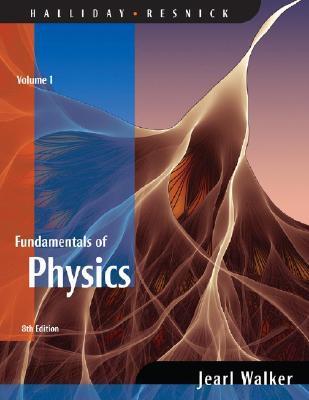
The front cover is an image by Eric J. Heller depicting electron flow over a microscopically bumpy surface. The paths of the 100,000 electrons begin at the upper right but branch and fold back on one another in a surprising pattern as they spread toward the lower left. Electron flow is the subject of several chapters in this book and is especially important in the discussion of electric sparks. Some sparks. Some sparks are amusing, such as those generated when someone chomps down on a wintergreen LifeSaver-the brief blue glow that illuminates the mouth can be seen in a dark room (Chapter 21.) Other sparks are quite dangerous, such as those in electrostatic discharges that can accidental cause airborne dust to explode (Chapter 25). Take Your Seat-The Show's About To Begin! This 8th edition of Fundamentals of Physics includes hundreds of items about curious effects in the everyday world, written in the spirit of Jearl Walker's The Flying Circus of Physics. The original edition of The Flying Circus of Physics-in print for over 30 years in 10 languages-is a cult classic among physics students, physics instructors, and the general public. Electronic links to the new 2nd Edition of The Flying Circus of Physics are available in the electronic version of 8th edition of Fundamentals of Physics that is part of WileyPLUS, one of the online homework systems available with this book. WileyPLUS also includes electronic versions of all the end-of-chapter problems in Fundamentals of Physics and the interactive tutorials (several hundred) and hints (several thousand) written by author Jearl Walker.
616 pages, Hardcover
First published January 2, 2007
About the author
David Halliday
1,003 books49 followersDavid Halliday (March 3, 1916 – April 2, 2010) was an American physicist known for his physics textbooks, Physics and Fundamentals of Physics, which he wrote with Robert Resnick. Both textbooks have been in continuous use since 1960 and are available in more than 47 languages.
His Physics has been used widely and is considered to have revolutionized physics education by many. Now in its tenth edition in a two-volume set revised by Jearl Walker, and under the title Fundamentals of Physics, it is still highly regarded. It is noted for its clear standardized diagrams, very thorough but highly readable pedagogy, outlook into modern physics, and challenging, thought provoking problems. In 2002 the American Physical Society named the work the most outstanding introductory physics text of the 20th century.
(Source: Wikipedia)
His Physics has been used widely and is considered to have revolutionized physics education by many. Now in its tenth edition in a two-volume set revised by Jearl Walker, and under the title Fundamentals of Physics, it is still highly regarded. It is noted for its clear standardized diagrams, very thorough but highly readable pedagogy, outlook into modern physics, and challenging, thought provoking problems. In 2002 the American Physical Society named the work the most outstanding introductory physics text of the 20th century.
(Source: Wikipedia)
Ratings & Reviews
Friends & Following
Create a free account to discover what your friends think of this book!
Community Reviews
Displaying 1 - 5 of 5 reviews

April 26, 2017
The large number of exercises and examples help improve one's problem solving skills...a lot.
Read
February 3, 2013It's a complete book :D

September 7, 2026
The ultimate standard for classical mechanics
If you are starting an Engineering, Physics, or STEM degree, Halliday, Resnick, and Walker's Fundamentals of Physics (Volume 1: Mechanics) is pretty much the definitive benchmark.
What makes this book stand out isn't just the rigorous breakdown of concepts like kinematics, Newton's laws, energy, and rotational motion, but the clarity of its explanations. The mathematical derivations are logical and structured, making calculus-based physics approachable without dumbing down the material.
Pros:
Sample Problems: Walkthroughs are clear, showing step-by-step problem-solving strategies rather than just plugging in numbers.
Visuals & Diagrams: Free-body diagrams and illustrations are clean and directly aid conceptual understanding.
End-of-Chapter Exercises: Excellent variety, ranging from straightforward practice questions to challenging conceptual problems that really force you to think.
It requires active reading and working through the problems with pen and paper, but as a foundational text for mechanics, it is unmatched. Essential reading for any STEM student.
----------------------------------------------------------
O padrão definitivo para mecânica clássica
Para quem está iniciando uma graduação em Engenharia, Física ou áreas de exatas, o Fundamentos de Física - Volume 1: Mecânica (Halliday, Resnick e Walker) é praticamente a referência bibliográfica definitiva.
O grande diferencial do livro não é apenas o rigor na apresentação dos conteúdos — como cinemática, leis de Newton, conservação de energia e dinâmica rotacional —, mas sim a clareza didática. As demonstrações matemáticas utilizando cálculo são estruturadas de forma muito lógica, tornando a física universitária acessível sem perder o nível de exigência.
Pontos Fortes:
Problemas Exemplo: As resoluções passo a passo ensinam estratégias de pensamento crítico e solução de problemas, não apenas a aplicação direta de fórmulas.
Diagramas: As ilustrações e diagramas de corpo livre são extremamente limpos e ajudam a visualizar a física por trás da matemática.
Exercícios: Excelente variedade ao final de cada capítulo, desde questões diretas de fixação até desafios conceituais mais complexos.
If you are starting an Engineering, Physics, or STEM degree, Halliday, Resnick, and Walker's Fundamentals of Physics (Volume 1: Mechanics) is pretty much the definitive benchmark.
What makes this book stand out isn't just the rigorous breakdown of concepts like kinematics, Newton's laws, energy, and rotational motion, but the clarity of its explanations. The mathematical derivations are logical and structured, making calculus-based physics approachable without dumbing down the material.
Pros:
Sample Problems: Walkthroughs are clear, showing step-by-step problem-solving strategies rather than just plugging in numbers.
Visuals & Diagrams: Free-body diagrams and illustrations are clean and directly aid conceptual understanding.
End-of-Chapter Exercises: Excellent variety, ranging from straightforward practice questions to challenging conceptual problems that really force you to think.
It requires active reading and working through the problems with pen and paper, but as a foundational text for mechanics, it is unmatched. Essential reading for any STEM student.
----------------------------------------------------------
O padrão definitivo para mecânica clássica
Para quem está iniciando uma graduação em Engenharia, Física ou áreas de exatas, o Fundamentos de Física - Volume 1: Mecânica (Halliday, Resnick e Walker) é praticamente a referência bibliográfica definitiva.
O grande diferencial do livro não é apenas o rigor na apresentação dos conteúdos — como cinemática, leis de Newton, conservação de energia e dinâmica rotacional —, mas sim a clareza didática. As demonstrações matemáticas utilizando cálculo são estruturadas de forma muito lógica, tornando a física universitária acessível sem perder o nível de exigência.
Pontos Fortes:
Problemas Exemplo: As resoluções passo a passo ensinam estratégias de pensamento crítico e solução de problemas, não apenas a aplicação direta de fórmulas.
Diagramas: As ilustrações e diagramas de corpo livre são extremamente limpos e ajudam a visualizar a física por trás da matemática.
Exercícios: Excelente variedade ao final de cada capítulo, desde questões diretas de fixação até desafios conceituais mais complexos.

Read
February 26, 2011no think
Read
June 15, 2011mmmm
Displaying 1 - 5 of 5 reviews