

What do you think?
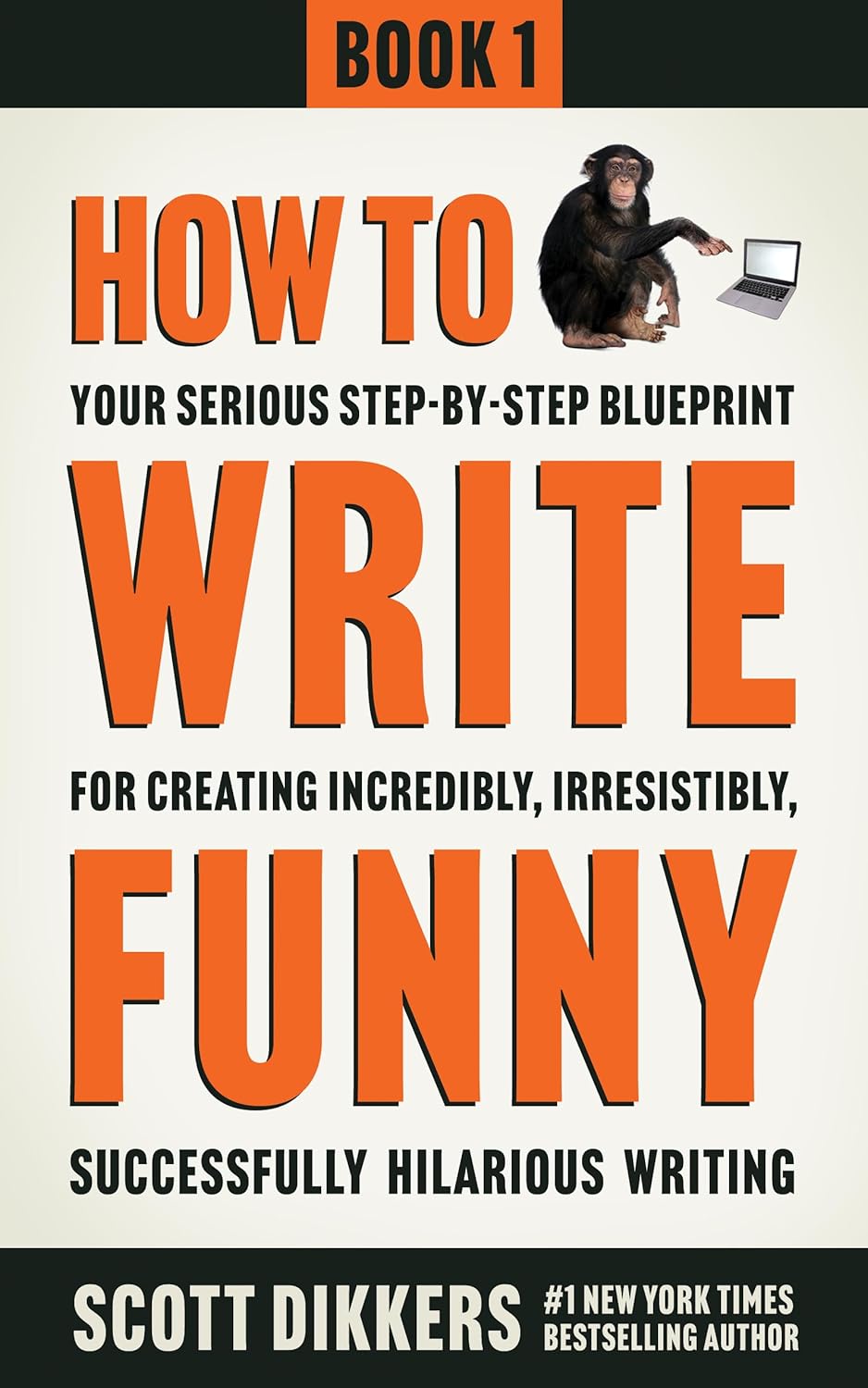
How to Write Funny: Your Serious, Step-By-Step Blueprint For Creating Incredibly, Irresistibly, Successfully Hilarious Writing
The Definitive Humor-Writing Handbook From A Top Comedy Pro
This easy-to-follow guide, written by one of the world's most successful humor writers, lays out a clear system for creating funny ideas that get big, milk-coming-out-of-your-nose laughs, reliably and repeatably. You'll learn...
• The 3 sure-fire ways to generate material
• The 11 different kinds of jokes and how to tell them
• The secret to permanently overcoming writer's block
• And many more tips, tricks, and techniques
Table of Contents
1 Introduction
Use the techniques in this book to reliably create top-notch humor writing (page 9)
2 Your Brain’s Comedy Engine
Access both hemispheres of your brain to eliminate writer’s block and tap an endless reserve of comedy ideas (page 19)
3 The Humor Writer’s Biggest Problem
Overcome this one devastating obstacle to reach the widest possible audience (page 27)
4 How To Get Laughs
Understand the different kinds of laughs, and how to generate the best one (page 37)
6 Subtext: The Secret Ingredient
Infuse your humor with this vital component to create writing that makes people laugh (page 51)
6 The 11 Funny Filters
Create any joke using the 11 fundamental building blocks of humor (page 61)
Funny Filter 1: Irony (page 62)
Funny Filter 2: Character (page 64)
Funny Filter 3: Shock (page 70)
Funny Filter 4: Hyperbole (page 74)
Funny Filter 5: Wordplay (page 77)
Funny Filter 6: Reference (page 81)
Funny Filter 7: Madcap (page 85)
Funny Filter 8: Parody (page 90)
Funny Filter 9: Analogy 9(page 4)
Funny Filter 10: Misplaced Focus (page 96)
Funny Filter 11: Metahumor (page 99)
7 Using The Funny Filters
Layer the building blocks to create increasingly hilarious jokes (page 105)
8 Process Overview
Master this simple system to become a prolific humor writer (page 127)
This easy-to-follow guide, written by one of the world's most successful humor writers, lays out a clear system for creating funny ideas that get big, milk-coming-out-of-your-nose laughs, reliably and repeatably. You'll learn...
• The 3 sure-fire ways to generate material
• The 11 different kinds of jokes and how to tell them
• The secret to permanently overcoming writer's block
• And many more tips, tricks, and techniques
Table of Contents
1 Introduction
Use the techniques in this book to reliably create top-notch humor writing (page 9)
2 Your Brain’s Comedy Engine
Access both hemispheres of your brain to eliminate writer’s block and tap an endless reserve of comedy ideas (page 19)
3 The Humor Writer’s Biggest Problem
Overcome this one devastating obstacle to reach the widest possible audience (page 27)
4 How To Get Laughs
Understand the different kinds of laughs, and how to generate the best one (page 37)
6 Subtext: The Secret Ingredient
Infuse your humor with this vital component to create writing that makes people laugh (page 51)
6 The 11 Funny Filters
Create any joke using the 11 fundamental building blocks of humor (page 61)
Funny Filter 1: Irony (page 62)
Funny Filter 2: Character (page 64)
Funny Filter 3: Shock (page 70)
Funny Filter 4: Hyperbole (page 74)
Funny Filter 5: Wordplay (page 77)
Funny Filter 6: Reference (page 81)
Funny Filter 7: Madcap (page 85)
Funny Filter 8: Parody (page 90)
Funny Filter 9: Analogy 9(page 4)
Funny Filter 10: Misplaced Focus (page 96)
Funny Filter 11: Metahumor (page 99)
7 Using The Funny Filters
Layer the building blocks to create increasingly hilarious jokes (page 105)
8 Process Overview
Master this simple system to become a prolific humor writer (page 127)
157 pages, Kindle Edition
First published April 18, 2014
About the author
Scott Dikkers
41 books89 followersScott Dikkers is the #1 New York Times bestselling author of “How to Write Funny.” He's also the founder of TheOnion.com and The AV Club.
Scott sends out a daily tip on Substack:
https://scottdikkers.substack.com/
Be sure to follow him on BookBub for insiders deals on his books!
https://www.bookbub.com/authors/scott...
Scott sends out a daily tip on Substack:
https://scottdikkers.substack.com/
Be sure to follow him on BookBub for insiders deals on his books!
https://www.bookbub.com/authors/scott...
Ratings & Reviews
Friends & Following
Create a free account to discover what your friends think of this book!
Community Reviews
Displaying 1 - 30 of 132 reviews

March 25, 2020
Everyone loves a good joke, but what are the elements that make a joke funny? You may have experienced how some times an unintentional monosyllable utterance is enough to make your friends break into fits of laughter. At other times a carefully crafted joke will fall flat. Annoyingly, there seems to be no formula that can consistently predict what people will find amusing.
If you are a comedy enthusiast, the author's credentials are enough to make you give this book a try. He is the founded the popular satirical news agency, The Onion New Network and served as its editor in chief. The books lays out a framework which anyone can use to make their content funny. Dikkers himself employs these techniques while creating content at work. He goes on to claim that he's never come across a joke that can't be explained by one of the categories in his framework. Apart from this, there's few other useful tips for the aspiring funny writer:
1) Write a lot, and drop your standards: A common mistake committed by most amateur writers at the start of their career is to hope that everything they write be automatically hilarious. This seldom happens, which is why most of them can't seem to get any writing done. When you are facing writer's block, a good way forward is to drop your standards. As soon as you learn to turn off their overly critical internal self critic, you shall begin to enjoy the process.
2) Always punch upwards: Use comedy to restore the balance of power. Jokes are usually funny when they are cracked at the expense of the rich and powerful folks whom everyone fears/hates. Jokes are usually not funny when they mock and ridicule those who are already weak and suffering.
3) Be consumer oriented: Sounds obvious, but not keeping the audience in mind while writing is an unforgivable mistake. Who are you really writing for? Can your work address a problem your target readers are dealing with? If you are only writing for yourself, why even bother publishing?
4) Note the subtext: The subtext is the essence of any funny communication, interestingly the part that is left unsaid. By itself, the subtext doesn't need to be humorous at all. It's a bland fact/opinion which is the foundation on which you build your joke. Unless your audience gets the subtext, they will not be amused.
Example: Consider the following joke: Your mama's so fat she lives in two cities at once. Subtext: Your mother is overweight. In Biswa's popular joke on extroverts v/s introverts, the subtext is that most festivals involve large number of people coming together to perform absurd rituals. In Abhishek Upmanyu's popular bit on Delhi v/s Mumbai people, the subtext is that aggressive behavior is considered normal in Delhi.
5) Pick a subtext and apply a funny filter to it: These are the tools which make when added to your subtext make it funny. The subtext is the actual meal, the funny filters are what make it palatable. The funny filters sort of made this book worth reading. If you set them aside most writing advice in this book is generic and already common knowledge.
If you are a comedy enthusiast, the author's credentials are enough to make you give this book a try. He is the founded the popular satirical news agency, The Onion New Network and served as its editor in chief. The books lays out a framework which anyone can use to make their content funny. Dikkers himself employs these techniques while creating content at work. He goes on to claim that he's never come across a joke that can't be explained by one of the categories in his framework. Apart from this, there's few other useful tips for the aspiring funny writer:
1) Write a lot, and drop your standards: A common mistake committed by most amateur writers at the start of their career is to hope that everything they write be automatically hilarious. This seldom happens, which is why most of them can't seem to get any writing done. When you are facing writer's block, a good way forward is to drop your standards. As soon as you learn to turn off their overly critical internal self critic, you shall begin to enjoy the process.
2) Always punch upwards: Use comedy to restore the balance of power. Jokes are usually funny when they are cracked at the expense of the rich and powerful folks whom everyone fears/hates. Jokes are usually not funny when they mock and ridicule those who are already weak and suffering.
3) Be consumer oriented: Sounds obvious, but not keeping the audience in mind while writing is an unforgivable mistake. Who are you really writing for? Can your work address a problem your target readers are dealing with? If you are only writing for yourself, why even bother publishing?
4) Note the subtext: The subtext is the essence of any funny communication, interestingly the part that is left unsaid. By itself, the subtext doesn't need to be humorous at all. It's a bland fact/opinion which is the foundation on which you build your joke. Unless your audience gets the subtext, they will not be amused.
Example: Consider the following joke: Your mama's so fat she lives in two cities at once. Subtext: Your mother is overweight. In Biswa's popular joke on extroverts v/s introverts, the subtext is that most festivals involve large number of people coming together to perform absurd rituals. In Abhishek Upmanyu's popular bit on Delhi v/s Mumbai people, the subtext is that aggressive behavior is considered normal in Delhi.
5) Pick a subtext and apply a funny filter to it: These are the tools which make when added to your subtext make it funny. The subtext is the actual meal, the funny filters are what make it palatable. The funny filters sort of made this book worth reading. If you set them aside most writing advice in this book is generic and already common knowledge.

November 7, 2019
So I don’t have aspirations to write funny, but I love goof writing advice and I saw a passage from this book and it piqued my interest. It was good. And you know what? all those white dudes who complain that they can’t be funny without making the same old
Stupid racist and sexist jokes should read this book.
Stupid racist and sexist jokes should read this book.
September 26, 2017
This book dispels 2 major assumptions about comedy writing - that it is a full time laugh riot and that you can only write good jokes when inspiration strikes. Writing comedy is a full-time job like any other, one that often requires coffee fuelled late-night sessions with your nuthead buddies, one where you occasionally want to tear your hair out and strangle your boss with it, and it is also one that requires skill and sustained effort to create something worthwhile.
The author does a brilliant job of dissecting the jokes to their core components and analyzing what makes for good, funny writing. If the process seems drab and boring, that's because it is. Why does he do it then? So that we understand what makes something funny. After understanding, we can use the principles in our writing to make it funny.
We learn about the core principle that makes the written word funny - subtext. We also learn 11 funny filters that can be applied to ideas to make them funnier. While this is laid out in a wonderfully structured manner that is so easy even Donald Trump could understand it, you will still have to make serious efforts to actually implement what is being discussed in the book.
You either use this book or lose it, just like your thousand page college textbooks that you open once and then sell to the junkman for drug money.
One of the best books on getting started with writing comedy, I highly recommend this to all aspiring comics. You will get a lowdown on how to reliably and consistently churn out high quality material.
The author does a brilliant job of dissecting the jokes to their core components and analyzing what makes for good, funny writing. If the process seems drab and boring, that's because it is. Why does he do it then? So that we understand what makes something funny. After understanding, we can use the principles in our writing to make it funny.
We learn about the core principle that makes the written word funny - subtext. We also learn 11 funny filters that can be applied to ideas to make them funnier. While this is laid out in a wonderfully structured manner that is so easy even Donald Trump could understand it, you will still have to make serious efforts to actually implement what is being discussed in the book.
You either use this book or lose it, just like your thousand page college textbooks that you open once and then sell to the junkman for drug money.
One of the best books on getting started with writing comedy, I highly recommend this to all aspiring comics. You will get a lowdown on how to reliably and consistently churn out high quality material.

August 20, 2018
This book was not funny, as it was not supposed to be. I think one of the greatest [potential] impacts of this book would be teaching the reader how to appreciate good comedy. The book shows how difficult it is to write funny and shows that a good writing requires a lot of hard work and practice.
I think the book could have leveraged many more examples throughout the text. In many parts, the concepts were mechanically presented as facts, without any examples on them. More inline samples could have greatly improved the impact. For another group of examples, the author just mentioned the names of people or some certain comedy works, without stating the instances. For me, as someone who does not know much about the literature in this area, these references were not much useful.
There were several typos and grammar mistakes in the text. The author emphasized the importance of proofreading on a few occasions; yet, ironically, these typos made their way to the same text.
I believe that this is a must-read book. Do not expect it to immediately make your writings funny. If it was the case, this review should have become funny already.
I think the book could have leveraged many more examples throughout the text. In many parts, the concepts were mechanically presented as facts, without any examples on them. More inline samples could have greatly improved the impact. For another group of examples, the author just mentioned the names of people or some certain comedy works, without stating the instances. For me, as someone who does not know much about the literature in this area, these references were not much useful.
There were several typos and grammar mistakes in the text. The author emphasized the importance of proofreading on a few occasions; yet, ironically, these typos made their way to the same text.
I believe that this is a must-read book. Do not expect it to immediately make your writings funny. If it was the case, this review should have become funny already.

March 18, 2024
It actually does provide what was promised in the title - a step-by-step guide on how to write funny. I didn't even plan to start a comedian career before reading the book, now I am not that sure.

September 17, 2021
Scott Dikkers (who founded the Onion) has written this book to help comedy writers. My instincts is always to be very critical of such books but in this case I have to say that I found the suggestions helpful. One example is to use extreme constrast when writing about a subject in order to emphasize the irony. I would recommend the book to anyone getting started in comedy writing.

August 27, 2016
If you want to work as a comedy writer, this will definitely help you. A lot of books on comedy writing are quite similar to each other, but I think this one stands out. It will help you write much better jokes, and it'll help you come up with ideas and realize that writer's block is not a real thing.
Maybe it's hard to get an actual sense of whether or not a book is good even with a review, because you don't know me and you don't know my work, but I can tell you that I recently got hired at the French equivalent of The Onion, and I know this book had something to do with it. Of course this book is very "Onion focused", but it'll definitely help you with your joke writing in general. And if you're not very familiar with The Onion, the book will fix that. There's also example one-liners from outside The Onion such as Louis CK jokes and twitter jokes.
Maybe it's hard to get an actual sense of whether or not a book is good even with a review, because you don't know me and you don't know my work, but I can tell you that I recently got hired at the French equivalent of The Onion, and I know this book had something to do with it. Of course this book is very "Onion focused", but it'll definitely help you with your joke writing in general. And if you're not very familiar with The Onion, the book will fix that. There's also example one-liners from outside The Onion such as Louis CK jokes and twitter jokes.

February 16, 2021
كتاب قرأته لابتعد قليلا عن المواضيع الشاقة كنوع من التحلية
كيف تكتب بطريقة ما هو مضحك ...الكتاب ليس مضحكا لكنه يتطرق لانواع الكوميديا ، كيف تقدم محتوى بمضمون جيد بطريقة فكاهية.. فلكل كاتب كوميدي ادوات و تقنيات ، ما عليه تجنبه ، و ما عليه ان يركز عليه ، وكيفية ايجاد الفكرة ، و نقدها ذاتيا ..انواع التقنيات الكوميدية ، و استعرضها مع عرض نماذج لعملاقة ال stand up comedy .. الكتاب قد يكون عن الكوميديا لكنه بنفس الوقت دليل جيد للتعرف على اساليب مفيدة بأي نوع من انواع الكتابة ..
الكاتب اسمه سكوت دكرز قد لا يكون الكتاب مترجما لكن للكاتب فيديوهات على يوتيوب ...
كيف تكتب بطريقة ما هو مضحك ...الكتاب ليس مضحكا لكنه يتطرق لانواع الكوميديا ، كيف تقدم محتوى بمضمون جيد بطريقة فكاهية.. فلكل كاتب كوميدي ادوات و تقنيات ، ما عليه تجنبه ، و ما عليه ان يركز عليه ، وكيفية ايجاد الفكرة ، و نقدها ذاتيا ..انواع التقنيات الكوميدية ، و استعرضها مع عرض نماذج لعملاقة ال stand up comedy .. الكتاب قد يكون عن الكوميديا لكنه بنفس الوقت دليل جيد للتعرف على اساليب مفيدة بأي نوع من انواع الكتابة ..
الكاتب اسمه سكوت دكرز قد لا يكون الكتاب مترجما لكن للكاتب فيديوهات على يوتيوب ...
February 24, 2020
Written by an expert with lots of interesting ideas
I am on a quest to get funnier since this book was written by such a successful comedy writer I knew I had to take a look. It's an easy and fast read with lots of hints, tips, and methods to extract more funny out of your material. I'm starting the next book in the series today.
I am on a quest to get funnier since this book was written by such a successful comedy writer I knew I had to take a look. It's an easy and fast read with lots of hints, tips, and methods to extract more funny out of your material. I'm starting the next book in the series today.

January 25, 2019
According to Scott Dikkers, the nature-versus-nurture argument means nothing to comedy writing. Because, according to him, being funny isn’t an innate skill—it can be learned. That’s the overriding theme of "How to Write Funny."
Dikkers is one of the co-founders of satirical news outlet The Onion. You might think his book would be uproariously funny, but it’s really not. In fact, he writes up front, "A lot of people who write books about how to write humor feel a pressure to make the book funny. I won't be making any overt attempts."
I found "How to Write Funny" highly informative, especially the sections on subtext and elements of humor. Dikkers disects numerous jokes and outlines the comedic strategy behind each. When he explains the inner-workings a simple one-liner, you really understand the complexity of good humor.
The runtime should appeal to today’s busy reader; At just 143 pages, I finished How to Write Funny in just three days (and I’m an admittedly slow reader). There’s no space wasted and no gratuitous ego-stroking—Dikkers presents the salient points, then ends the book.
Usually this is the part where I list my grievances with the book, but I really don’t have many. This is the closest thing: I now analyze all humor I encounter. For example, "Was that joke an example of hyperbole or madcap humor?"
"How to Write Funny" is an excellent inspection of comedy writing. Not fun beach reading, but the book certainly delivers on its title. Read it, learn, and make people laugh.
Dikkers is one of the co-founders of satirical news outlet The Onion. You might think his book would be uproariously funny, but it’s really not. In fact, he writes up front, "A lot of people who write books about how to write humor feel a pressure to make the book funny. I won't be making any overt attempts."
I found "How to Write Funny" highly informative, especially the sections on subtext and elements of humor. Dikkers disects numerous jokes and outlines the comedic strategy behind each. When he explains the inner-workings a simple one-liner, you really understand the complexity of good humor.
The runtime should appeal to today’s busy reader; At just 143 pages, I finished How to Write Funny in just three days (and I’m an admittedly slow reader). There’s no space wasted and no gratuitous ego-stroking—Dikkers presents the salient points, then ends the book.
Usually this is the part where I list my grievances with the book, but I really don’t have many. This is the closest thing: I now analyze all humor I encounter. For example, "Was that joke an example of hyperbole or madcap humor?"
"How to Write Funny" is an excellent inspection of comedy writing. Not fun beach reading, but the book certainly delivers on its title. Read it, learn, and make people laugh.

September 30, 2020
Good book for beginners: concise and informative. The constant patting on the back for the Onion was a bit unnecessary though.

July 15, 2018
Excellent Blueprint for Comedy Writing
It’s really difficult to find a book that maps out process. How to Write Funny knocks it out of the park in this respect. Dikkers deconstructs the comedy writing process on a metacognitive level, but with simple actionable steps for the comedy writer to follow. I feel like this text was exactly what I needed to help me level up my comedy writing. However, much of the insight contained within can be applied to my improv and stand up adventures as well! Excellent, entertaining, and easy read! I can’t wait to double back and get started on the action steps!
It’s really difficult to find a book that maps out process. How to Write Funny knocks it out of the park in this respect. Dikkers deconstructs the comedy writing process on a metacognitive level, but with simple actionable steps for the comedy writer to follow. I feel like this text was exactly what I needed to help me level up my comedy writing. However, much of the insight contained within can be applied to my improv and stand up adventures as well! Excellent, entertaining, and easy read! I can’t wait to double back and get started on the action steps!

October 6, 2017
This book a great resource for anyone who writes in some form. It lays out methods to create jokes. These methods are useful. They are not a step by step process — which are difficult to remember and hard to incorporate — but a way to think from particular perspectives. I especially found the funny filters to be particularly useful tool. Will definitely use this book as a reference material in the future.
September 30, 2018
Great read
This book has some fascinating insight to writing funny stuff, although I plan to use these tips to write jokes for stand up comedy rather than online content there’s so much to be learned from what is said here. I think it warrants multiple reads over the span of your career as you get more prolific in your craft, more the text might inspire and provide you ‘divine inspiration’
This book has some fascinating insight to writing funny stuff, although I plan to use these tips to write jokes for stand up comedy rather than online content there’s so much to be learned from what is said here. I think it warrants multiple reads over the span of your career as you get more prolific in your craft, more the text might inspire and provide you ‘divine inspiration’

Read
July 14, 2019I don't know what it says about me that I feel like I have to read "how to write humor" books over and over again, but I feel odd reviewing this book after only one read. My take-away: satire is the way to go. I do need to re-read to actually TRY the method taught. But it was a solid enough book that I will do so.

December 26, 2019
Taking on the risky project of splitting the comedy atom, Scott Dikkers breaks down some good advice on writing habits, what comedy is, and how to make jokes. His theory is sound (he breaks humour down into 11 types of "funny filter" to create a viewpoint on different types of jokes) and his exercises and advice are all solid.
December 26, 2019
Excellent. This is a very practical resource. Scott makes no apologies for creating a workman-like book without a crazy/funny commentary. He just gets down to business and delivers short, concise, extremely useful guidelines for creating modern 21st century comedy. Well worth a read.

January 12, 2020
Absolute Gold
I’ve read a lot of comedy writing books before but this one has been the most insightful. Scott provides you with the tools to start writing jokes right away. Highly recommend.
I’ve read a lot of comedy writing books before but this one has been the most insightful. Scott provides you with the tools to start writing jokes right away. Highly recommend.

May 15, 2020
Beyond teaching jokes
There’s a good sense to this book in that it accomplishes the task at hand. How to write funny. It continues beyond that by reasoning why these tools matter and how best to apply them.
There’s a good sense to this book in that it accomplishes the task at hand. How to write funny. It continues beyond that by reasoning why these tools matter and how best to apply them.
July 2, 2022
Excellent addition to your comedy toolkit! There's a damn good reason this one keeps coming up in the top 10 best books on learning comedy. Highly recommended for EVERYONE (not just writers and comedians)! Absolute game changer.

February 24, 2018
It took a while to get to the real information, but I really did learn a lot from this. Very informative in a clear, all business style.

December 16, 2018
A practical step-by-step guide that makes comedy writing very accessible. This is a very useful and instructional book for anyone who would like to get started, or wants to get better at the craft.
August 10, 2019
Great techniques
Solid advice for anyone interested in comedy, regardless of medium. It’s a quick and engaging read. Excited to read his next book!
Solid advice for anyone interested in comedy, regardless of medium. It’s a quick and engaging read. Excited to read his next book!
September 26, 2019
This book is PACKED with information as well as writing assignments. I will refer back to this book often and buy more in the series.
February 14, 2020
Do not expect an hilarious book, just a guide to make your writing much funnier.

March 31, 2020
Excellent. Clearly written (definitely adhering to the rule of making it accessible). Lucid conversation of 11 funny filters for writing comedy. Highly recommended.

May 27, 2020
Awesome book! I loved it and absolutely a must read to any aspiring comedian. It showcases all skills and analyses humor in a very theoretical way so it makes sense.

May 28, 2020
Surprisingly information dense and practical. Received this as a freebie giveaway. It's quite good.

June 4, 2020
Excellent guide, clear concise and helpful.

November 7, 2021
Segunda lectura. Siempre viene bien repasar los clásicos 😀
Displaying 1 - 30 of 132 reviews