Jump to ratings and reviews
Rate this book

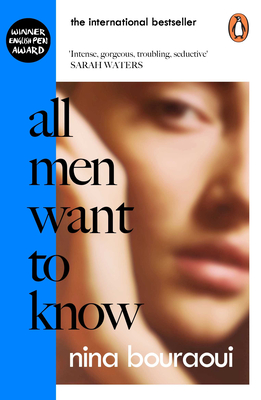
All Men Want to Know

Rate this book
All Men Want to Know traces Nina Bouraoui's blissful childhood in Algeria, a wild, sun-soaked paradise, with hazy summer afternoons spent swimming, diving, and driving across the desert. Her mother is French, her father Algerian; when racial tensions begin to surface in their neighbourhood, her mother suffers an unspeakable act of violence that forces the family to flee the country.

In Paris, eighteen-year-old Nina lives alone. It's the 1980s. Four nights a week she makes her way to The Kat, a legendary gay nightclub, where she watches women from the sidelines, afraid of her own desires, her sudden and intoxicating freedom. In her solitude, she starts to write - and finds herself writing about her mother.

All Men Want to Know is a haunting, lyrical international bestseller about mothers and daughters, about shame and sexuality, about existing between two cultures and belonging to neither. A phenomenon in France, this is a defining portrait of womanhood from one of Europe's greatest living writers.

175 pages, Paperback

First published August 22, 2018

82 people are currently reading
7617 people want to read

About the author

Nina Bouraoui

29 books190 followers
Nina Bouraoui (born on 31 July 1967) is a French writer born in Rennes, Ille-et-Vilaine, of an Algerian father and a French mother. She spent the first fourteen years of her life in Algiers, then Zürich and Abu Dhabi. She now lives in Paris.

Her novels are mostly written in the first person and, with the exception of Avant les hommes (Before the Men), have been said by the author to be works of "auto-fiction". This is even the case for Le Bal des Murènes (The ball of moray eels), which, like Avant les hommes, has a male narrator. Since writing her first novel in 1991, Bouraoui has affirmed the influence of Marguerite Duras in her work, although the life narratives and works many other artists are also to be found in her novels (and songs). This is particularly true of Mes Mauvaises Pensées (My Bad Thoughts) which bears the imprint of Hervé Guibert, Annie Ernaux, David Lynch, Eileen Gray, and Violette Leduc amongst others. Questions of identity, desire, memory, writing, childhood and celebrity culture are some of the major themes of her work.

Ratings & Reviews

What do you think?
Rate this book

Friends & Following

Create a free account to discover what your friends think of this book!

Community Reviews

5 stars
406 (19%)
4 stars
836 (40%)
3 stars
633 (30%)
2 stars
166 (8%)
1 star
25 (1%)
Displaying 1 - 30 of 298 reviews
Profile Image for Orsodimondo.
2,451 reviews2,425 followers
November 2, 2023
DIVENIRE RICORDARE


Quando arriva a Parigi con la sua famiglia ha 14 anni. È il 17 luglio del 1981. In Algeria sta per iniziare il decennio nero, ed è per questo che i suoi decidono di venire via.
Nina, o chiunque si nasconda dietro questo io narrante, che a me ricorda sia Marguerite Duras che Annie Ernaux, dotato di una scrittura semplice ed elaborata al contempo, che abbonda di frasi brevi e virgole, parole intrecciate a immagini, poetica che contrasta con la violenza dei temi affrontati (crescere, morire, ricordare, divenire, l’omosessualità, il sangue misto, l’integralismo, l’integrazione, il meticciato…), Nina, o chi per lei, dà fuoco al passato: non risponde alle lettere degli amici algerini, sa che non li rivedrà più - strappa le foto dell’ultima gita scolastica alle rovine di Tipasa, dell’ultima estate al Club des Pins, al Moretti, ad Alger Plage.
Il dolore non deve rallentarla.


Il racconto avanza a capitoli molto brevi tutti con un titolo che si ripete, ‘ricordare’, ‘divenire’, ‘sapere’: i primi generalmente dedicati ai suoi primi quattordici anni di vita trascorsi in Algeria, i secondi ai suoi diciotto anni, la conquista dell’indipendenza - vive da sola a Parigi, i genitori sono trasferiti negli Emirati - l’omosessualità; gli altri coinvolgono i nonni, sia quelli paterni algerini che quelli materni francesi, ricostruiscono le loro storie e di conseguenza quelle dei suoi genitori, la storia della famiglia prima della sua nascita. La nascita di Nina, o chiunque si nasconda dietro questo io narrante.
E poi, alla fine del viaggio, al termine di questo breve memoir che stilla bellezza, i capitoli prendono un altro titolo: Essere.


Questa e le due foto che precedono sono di Robert Mapplethorpe.

Non vado a cercarmi la sofferenza. Non mi piace soffrire. Non voglio soffrire, ma la sofferenza mi sveglia. Mi apre il cuore. Mi fa tremare le mani. Mi fa scrivere… tengo ormai un diario nella speranza che venga trovato, per non dovermi più spiegare – che la scrittura parli al posto mio e mi liberi.


Tamanrasset nel sud dell’Algeria dove si trova l’eremo di padre Charles de Foucauld ora tenuto dalla Piccole Sorelle del Sacro Cuore.
Profile Image for luce (cry bebè's back from hiatus).
1,555 reviews5,808 followers
June 5, 2022
In the past week or so I’ve picked up three books I’d previously DNFed in the hopes that I would like them better now...turns out instead that I shouldn’t have given them a second chance and that instead, I should have just trusted my gut-instinct. Lesson learned.

All Men Want to Know is an incredibly affected and stylised memoir that doesn’t ring particularly true to life. The author and narrator of All Men Want to Know is very much into navel-gazing and has a penchant for making edgy comments. The few ‘characters’ who are given lines of dialogue do not sound like particularly believable individuals, rather they sounded like the narrator masquerading as different people. They use the same type of metaphorical and flashy language, and similarly to her have a propensity for making fake-deep statements about human nature, society, queerness etc.
The narrative is divided into sections called Remembering, Becoming, and Knowing. These last one or two pages and present us with what amounts to an underdeveloped and fragmented snapshot of the author’s life. This technique is sadly all the rage and if you enjoyed Pik-Shuen Fung’s Ghost Forest you might actually be able to appreciate All Men Want to Know in a way that I was unable to. In the Remembering segments, Bouraoui writes about her childhood, specifically about growing up in Algeria to an Algerian father and a French mother. In Becoming and Knowing Bouraoui is living in Paris in the 80s and going to lesbian bars and clubs, unsure whether she actually wants to find someone or not. I should have found these sections somewhat relatable as they are seemingly intent on exploring her internalised homophobia but the way she articulates her anxieties, fears, and desires struck me as laboured and showy.
Nothing about her childhood or her time in Paris is rendered clearly to us. The studied language takes the centre-stage. Which would have been bearable if say her prose was anything like Ocean Vuong or Caleb Azumah Nelson. But her style just isn’t as lyrical and readable as theirs These impressionistic snapshots of her life left no lasting impressions on me as they failed to capture the scenes they were supposedly meant to capture. They begin randomly and end abruptly so that I was left wondering what function they served in the overall narrative. I also found the way the author writes about things such as sexual abuse and suicide to be tasteless and sensationalistic. She seemed more intent on using a certain type of language than on showing any sensitivity towards these topics. Much of the imagery included in this novel was clichéd (we have the classic scene featuring ‘blood’ on ‘sheets’). There was nothing subversive or thought-provoking about this memoir. I found myself disliking Bouraoui and I was vexed in particular by her endless self-dramatizing. Her queer friends all blur together, they are given barely any lines and serve the role of filler. We don’t really gain any insight into Bouraoui’s family dynamics nor are her mother or father particularly fleshed out. Bouraoui also has the habit of speaking on behalf of other characters, so that she will write about the thoughts and feelings someone else is allegedly experiencing as if these are true (rather than her speculations). Although this book is desperately trying to be sensual and deep, it is neither of these things. I found it boring, unconvincing, and sensationalistic. The best thing about this book is the cover. A truly banal excuse of a book.


find me on: ❀ blogthestorygraphletterboxd tumblrko-fi
Profile Image for m..
355 reviews51 followers
June 26, 2021
hmm i'm left with the feeling that i should have liked this more than i really did. the family drama, the gorgeous prose, the exploration of sexuality, and the unfamiliar setting all lured me in but i just didn't warm to it. the fragmented nature of the narration always left me wanting more in a way that felt neither intentional nor enjoyable. maybe it was the fault of the translation? i don't know.
Profile Image for Charlott.
294 reviews73 followers
June 14, 2021
Written in short vignettes, this is is an autofictional novel about a young woman who tells us about her experiences as a young lesbian in 1980s Paris and her upbringing in Algeria in the wake of independence. The fragmented style beautifully mirrors her fragmented identities and the ways she tries to make sense of all the things which made her and influenced her: her queerness, her sister, her white French grandparents not accepting her Algerian father and the choices her mother made, the feelings of loss and not belonging. There are layers of trauma in her family she starts to lay open. And then there are the relationships she developes with other women in the queer bar she starts frequenting.

In theory, I should have loved this book. But there was something which just did not click completely. For books with such a style I am always hoping to really love the writing on a sentence level. I want to read paragraphs and reread them because they are so stunning and layered and surprising. This did not happen here. Also there are so many themes touched upon but often not deeply developed. So in the end, while I did enjoy reading All Men Want to Know it kept me wanting more.
Profile Image for Nicole Murphy.
205 reviews1,645 followers
September 21, 2024
I had hopes this would be great but sadly found it very dull. There wasn’t enough of each of the different times and elements of her life to feel any sort of emotion toward them. I also didn’t gel with the format.
Profile Image for Gaby.
180 reviews6 followers
January 19, 2024
4.5 ⭐️ (I think it might be even better if you read this in maybe one sitting). Took so many pics to save all these quotes. So those will be my review :)

“It will be years before I can rid myself of the fantasy that words can protect, mend what is broken, make everything better.”

“My Algerian grandmother doesn't speak French, I don't speak Arabic, our only link is her tenderness, her hands in mine, in my hair, on my shoulders, her kisses on my forehead, her smiles; but this gentleness is beyond me, I don't know what it means, I don't know if it's an expression of love or a way of apologizing for being so unlike us, for not wanting to be like us.
We are so very different.”

“I walk home later, I've shed my fear. I walk quickly, fleeing from what I've just been doing, dancing cheek to cheek, skin to skin, the kiss.
I'm at one with the sky, the wind, the clouds scudding across the moon. Paris moves through me, carrying me, helping me:
I'm ashamed, ashamed of who I am”

“We need danger to show us how attached to life we are. She learned more about herself in those few seconds than she had in many years: she's stronger than she realized, and even though she loves us, her daughters, more than anything else in the world, she has no attachments, she accepts whatever fate has in store for her, and if she'd had to die during that flight, so be it, that was what was written and there's nothing anyone could have done; and better still, she felt a kind of relief, a pleasure almost, in staring her own death in the face, in being the heroine of her own life, being fully present in the experience she was having.”

“I dive off the rocks to impress her, climb the highest peaks, reach for the sky to fill her with beauty and poetry. I want to heal her wounds, soothe her anguish, avenge her of her enemies; I promise to cherish and protect her for the rest of my life - I'll betray her, of course - and I sing La mal-adie d'amour for her because it's about us.”

“I don't know who she is, but I don't need to know, because I know who I am, I love who I am with her. I want to go with her, I'm not afraid any more, and that makes me nervous too. I've changed, I want to know everything, understand everything, try everything, I've got nothing to lose - I want to have it all, take it all.”

“Everything falls away, the sounds of the city stirring, the lilac hues of the dawn sky, the wind beneath the roof, the weight of the unknown. I am the same but I've changed, I've let go, I'm floating free on this waking dream, desired and desiring - I have no past, no future, no witness, here in her hands I could cease to be, and yet I am reborn.”
Profile Image for Gabril.
1,035 reviews250 followers
February 24, 2022
“Non ho perduto la giovinezza, da lei provengo ed è lei ad annunciarmi.”

Lirico e suggestivo, questo è un racconto per frammenti. I brevi capitoli si alternano e si intitolano Ricordare, Sapere, Divenire…e infine Essere.
La storia è quella di una ragazza dalla doppia origine e dalla doppia patria: padre algerino, madre francese. Anche la sua identità è borderline: è una donna che ama le donne. Ma per accettarsi, per sopportare la solitudine di sentirsi diversa dagli altri, dovrà attraversare le tempeste dell’adolescenza senza soccombere, esporsi al fuoco della giovinezza senza bruciare.

A diciotto anni Nina torna in Francia, a Parigi, dove si svolge il suo divenire, cioè l’ansiosa ricerca della propria identità, di un gruppo di appartenenza, una collocazione sociale e, last but not least, dell’amore. Sono gli anni Ottanta.
Di giorno studentessa universitaria, di notte frequentatrice di locali equivoci e di ragazze estreme, la sua vita vibra di intenso desiderio verso l’essenza e la verità. Che sarà tutta da scoprire e da accogliere, perché la paura e la vergogna adesso sono più forti di tutto.
Perciò la narratrice si sente un essere ambiguo e indefinito: “una sorta di ologramma che scompare alla stessa velocità con cui è apparso”.

E intanto la sua infanzia algerina ritorna a ondate nella sua memoria, come la testimonianza di una felicità e una compattezza definitivamente perdute.

“Solo la scrittura è innocente. La pratico con grande libertà; senza orari, senza obblighi, sopraggiunge in modo brusco, secco, invasivo, e scompare non appena ritrovo la notte.”
Sarà la scrittura, dunque, il ponte tra gli opposti e incomprensibili aspetti dell’essere, sarà il tentativo di dare forma al caos che è l’aspirazione irrinunciabile a cui ogni essere umano tende.

”Non smetteremo di cercare di sapere, noi, gli uomini e le donne, uguali e differenti, lanciati nel turbine della città e degli atomi invisibili magnetici.”
Profile Image for Rachel.
242 reviews191 followers
June 7, 2021

this month’s choice for my translated fiction book club came courtesy of bouraoui’s work of “auto-fiction” documenting snippets of her life as a half-french, half-algerian queer woman dividing her time between the two countries. it’s been a long time since I’ve read any French / Algerian literature - the one and only experience being with Albert Camus and the less I say about him the better. however bouraoui’s short, sharp prose coupled with that sense of existential european ennui make for a killer combination.

auto-fiction as a genre is quite a complex concept, immediately providing the reader with a notion of distrust and unreliability towards the narrator. can we truly trust bouraoui’s experiences and voice? will the truth be presented honestly or will our perspectives be skewed with biased and tainted memories. wholeheartedly, these thoughts never crossed my mind as I became engrossed with bouraoui’s laissez-faire writing style that is distinctly Very Very French.

with no linear timeline, each “chapter” flits between different memories and encounters throughout the authors life; becoming, knowing and remembering. her experiences as a queer woman in France, exploring the club scene and her relationships with other women during a time when homosexuality was still a contentious issue in society provided an enlightening insight into what the generation before our own experienced, that many continue to today. her memories of Algeria and the racist tensions between her two families echo the experiences of other mixed-race writers who lived through those heightened political tensions.

despite bouraoui’s short sentences and didactic, journalistic style, her work and writing invite us into an underground lifestyle that you can tell she is still getting to grips with now. I’m very excited to discuss with my book club and would highly encourage you to add this to your pride month reading list
Profile Image for Gabriela.
53 reviews66 followers
June 6, 2021
This was my first foray into auto-fiction, one that I found beautifully written & utterly captivating. Bouraoui is masterful in her prose & an author I feel like I should read more of. I particularly loved the short chapters & dual narrative, painting a picture of her younger years in her birth country Algeria & her life now in Paris - at points I felt as if I was there. Bouraoui’s examination of her identify as a gay women was incredibly insightful & yet again I felt as if I have learnt a fair bit. All this being said, I will mention that I did find this one to be lacking something - not sure if it’s just the way I perceived it yet it felt as if it was skimming the surface of her story with no real depth. I still feel like so many will enjoy this one, so please don’t be put off!
Profile Image for emma.
333 reviews297 followers
August 6, 2025
"I write the spaces and the silences, the unseen and unheard. I write the paths not taken, the forgotten roads. I hold fast to Others, those whose past flows into mine, like rivers spilling into the sea. I give voice to ghosts to stop them from haunting me. I write because of my mother, who clasped her books to her breast like children."

i am not the person i was one book ago. phenomenal in every sense of the word.
Profile Image for philosophie.
696 reviews
July 9, 2020
I want to know who I am, what I am made of, what I can hope for; I trace the thread of my past back as far as it will take me, making my way through the mysteries that haunt me, hoping to unravel them.
Profile Image for Sebastian Lönnlöv.
Author 6 books70 followers
Read
June 10, 2019
Läsvärt för Bouraoui-fantasten, men inte en av höjdpunkterna i hennes produktion.
Profile Image for Sarah.
73 reviews402 followers
April 16, 2023
4.5 :)) this was so nice and 'refreshing'
Profile Image for Kelly_Hunsaker_reads ....
2,259 reviews69 followers
September 27, 2020
All Men Want to Know is told in a dual narrative: part of it takes place in 1980s Paris telling the characters' present story as a gay woman, and the other part is told through her memories of her childhood in Algiers, Algeria. This book is biographical fiction, and the character's story is nearly identical to the author's own.

The part of the story set in Algeria explores the idea of national identity (both character and author have a French mother and an Algerian father), and I found this theme to be very interesting. As a white American I have never struggled with similar issues, but have always been fascinated in how culture would be passed down to children like this character. Our narrator speaks French and struggles to communicate with her paternal grandmother who speaks only Arabic. The maternal grandparents are judgmental and disapproving of the marriage and their life in Algeria, which they consider a third world country. This girl is never at home. She is never accepted. She is not seen as French by the French or as Algerian by the Algerians. This part of the story made me reflect upon the stories I have read and heard about children born in Vietnam, as a result of relationships between their mothers and American military men. Ostracized and alone.

The best part of the book for me was the beautiful prose describing the colorful, warm, sunny landscape of Algeria. In 2015 I was lucky enough to visit their neighbor, Morocco, and fell in love with everything about the place. This book presented Algeria as a similarly vibrant place. But of course there is also a dark, violent part of life, which tangibly affects our narrator's mother and results in their exit from the country

The part of the story which takes place in Paris when the character is an adult examines her identity as a gay woman. It was the 1980s and so she lived in hiding. She visited a gay bar, but couldn't pay for anything with a credit card or check. She couldn't give her phone number. She couldn't allow any trace of her gay life to leak. It is a powerful story to read in today's world. However, I didn't feel this part of the story was written as beautifully as that set in Algeria.

Still, the fact that both narratives are discussions on the theme of identity -- national (macro) and personal (micro) -- was smart and interesting.
Profile Image for Rosamund Taylor.
Author 2 books201 followers
September 23, 2021
Bouraoui, like other French novelists I've read, shapes her novel very differently from an English-language novel. Her concern is with place, atmosphere, and the passage of time, and this novel explores the same things over and over from different angles in order to build up a particular atmosphere. Bouraoui is writing of her childhood in Algiers in the 1970s, and of her discovery of the lesbian underground in Paris in the 1980s. These two time periods are intercut, the sections building around one another to create an atmosphere of unease and a sense of societal tension. Reading this, I tried to immerse myself in Bouraoui's language, and to realise that she wasn't trying to develop a plot thread, or even explore characters in any depth. At times, I found very moving ideas in this book, particularly around childhood and the dislocation of being 'other' as a child, but I was also frustrated by Bouraoui's refusal to draw out any of her characters, or to create any emotional development or catharsis. I wanted to be moved by this book, but, ultimately, I was only frustrated by it.
Profile Image for Madeline Van Eetvelde.
126 reviews
November 8, 2022
Nog ééntje dat, als het aan mij lag, uit veel meer pagina’s mocht bestaan!!!!
De gevoelens die gepaard gaan met de dualiteit van immigratie en LGBTQi worden heel mooi omgezet in woorden.
Profile Image for peace ☆.
111 reviews3 followers
February 13, 2023
i really enjoyed this but i think its partly because im biased towards short chapters.
its written nicely but it could be more, even then though it doesnt mean its a bad book. also really relate to her feelings of growing up as though she were a boy and that was why she liked women, how she had such bad internalised homophobia and that she was her fathers son :)
Profile Image for tris.
69 reviews5 followers
July 28, 2021
finally a five star rating!!!! please please read this book. such a beautiful account of coming of age as a queer woman, this one touched me in that way good literature should do but so rarely does.
Profile Image for Elizabeth.
186 reviews27 followers
June 28, 2020
Book 28 of 2020 - All Men Want to Know

Thank-you to NetGalley and the publisher for providing this book in exchange for an honest review.

The narrative of All Men Want to Know fluctuates between 1980s Paris and the narrator's childhood in Algiers, Algeria, which became independent from France in 1962.

It’s categorized as fiction, but the details of our narrator are identical to the author. I would say it’s contemporary auto-fiction.

I think the overall theme is identity issues: The narrator was born to a French mother and an Algerian father, and there are competing claims on her national identity. Her maternal grandparents live in Rennes and do not approve of their daughter's marriage or her (and consequently their granddaughters) living in Algiers, which they consider the third world. The narrator's native tongue is French, and she struggles to communicate with her Algerian grandmother who speaks only Arabic. To be French-Algerian after Algeria's Independence is not to inhabit two worlds, it is to exist in an unfamiliar, liminal space, neither here nor there. There are several really gorgeous descriptions of sunny Algiers, a mosaic of colour and tranquility, but underneath the glittering landscape is a dark undercurrent. This predominantly manifests as violence towards women: the narrator's mother returns home one day, her clothes torn and her face dirty, and tells her daughters not to ask what happened to her, while years later the narrator's local pharmacist is brutally murdered by her own son for not remarrying after leaving his cheating father, living what he deems is an "unhonest" life. This violence underscores the other facet of our narrator's identity, her sexuality.

In the present, she is a regular at a lesbian club in Paris, the Katmandou or "The Kat". She pays for everything in cash, no credit card or cheque book, she never checks her coat in case of a police raid, and she never gives out her number to other girls or accepts a ride home: she leaves no trace of herself and allows for no opportunity to be discovered in her normal life. The fear of consequences for being different is instilled in her.

The narrative flows very well, I read it in one sitting. The unprecedented English heat was perfect for reading about sun-baked Algeria. The prose is romantic but direct, which I like but it also fluctuates too seamlessly between Paris, Rennes, and Algiers, between the present and the past (including her mother's childhood in WWII-torn France), you have to keep an eye on who, where, when. (There’s a chance this is the proof copy I got, but also could be technique.)

Bouraoui never really settles anywhere, either. The ebb and flow between dark and light, between two worlds, washes up a lot of emotional debris that dissolves quickly in to the sand and never really gets explored. There is a constant sense that we are building up to something that never materializes.

It was nice, but I don’t think I’ll be thinking about it for long.
Profile Image for Aster.
196 reviews21 followers
February 3, 2025
there's so much about this that i loved. the style, the memories of algeria, the 80s paris lesbian scene, the amazingly quotable passages on feeling alien in your sexuality and always being in search of what defines a home when the one from your youth was ripped out from under you, but most of all the narrator's mother. really, this was a big love letter to her.

it leaves me with a lot to think about, but i was missing a sense of direction as to where all of this was going. a road towards self acceptance, maybe, but i just really wanted to know how her mother was doing.

update after reread: still want to know how her mother is doing. but damn some of these passages hit hard.
Profile Image for Lena.
640 reviews
March 15, 2019
"Finnas till
Jag skriver spannen och tystnaderna, det som inte
syns, det som inte hörs. Jag skriver vägarna som man
undviker och dem som har glömts bort. Jag omfamnar
De andra, dem vars historia fortplantar sig in i min,
likt sötvattensströmmen som mynnar ut i havet. Jag
får vålnaderna att tala för att de ska sluta förfölja mig.
Jag skriver eftersom mamma höll sina böcker mot bröstet
som om de hade varit barn."
Profile Image for Ula .
223 reviews10 followers
Read
August 10, 2025
this book is a collection of short thoughts and memories rather than actual chapters, which, while making it easy to read, causes the feeling of it being incomplete– it doesn't help that it's not even 200 pages long

there's no point in judging someone's experiences, and i'm not going to, i just wish the book was organised better so i could tell you it was worth reading

the pharmacist's story was powerful tho i'll give her that
Profile Image for Lizzy.
280 reviews15 followers
May 29, 2025
This was told in very short, vignette-style chapters (which I usually enjoy) and the writing was very skilled and lyrical, but I didn't find it all that interesting for some reason. As mentioned before, I usually love short chapters, but it didn't really work for me here. It caused the book to feel quite disjointed, and I wasn't able to fully immerse myself in either storyline.
Profile Image for Ghazal & other poems.
160 reviews
February 10, 2024
I’m sure this would have been a 4/5 star read for me if I had read it in the original language.

I feel like the authors often spends days to find the perfect words that would convey their intention, but then we just translate the text and change them entirely. That’s why I felt like at times the author’s message was a bit unclear or too generic if that makes sense. But at least it was a very easy read :)
Profile Image for Hannah  Poppe.
25 reviews48 followers
January 9, 2022
This book came to me at just the right time
I don't think I had anything to do with it
it just found its way to me and then devoured me
It showed me all the colours of melancholy
brought me a strange love for something far away
something foreign
to long for
to ache for

I loved it

Thank you Nina
Truly
Displaying 1 - 30 of 298 reviews

Can't find what you're looking for?

Get help and learn more about the design.