

What do you think?

The Sympathy of Things: Ruskin and the Ecology of Design
'If there is one thing we can learn from John Ruskin, it is that each age must find its own way to beauty' writes Lars Spuybroek in The Sympathy of Things , his ground-breaking work which proposes a radical new aesthetics for the digital era.
Spuybroek argues that we must 'undo' the twentieth century and learn to understand the aesthetic insights of the nineteenth-century art critic John Ruskin, from which he distils pointers for the contemporary age. Linking philosophy, design, and the digital, with art history, architecture, and craft, Spuybroek explores the romantic notion of 'sympathy', a core concept in Ruskin's aesthetics, re-evaluating it as the driving force of the twenty-first century aesthetic experience. For Ruskin, beauty always comprises variation, imperfection and fragility, three concepts that wholly disappeared from our mindsets during the twentieth century, but which Spuybroek argues to be central to contemporary aesthetics and design.
Revised throughout, and a new foreword by philosopher Brian Massumi, this is a new edition of a seminal work which has drawn praise from fields as diverse as digital architecture and speculative realism, and will continue to be influential as it wrests Ruskin's ideas out of the Victorian era and reconstructs them for the modern age.
Spuybroek argues that we must 'undo' the twentieth century and learn to understand the aesthetic insights of the nineteenth-century art critic John Ruskin, from which he distils pointers for the contemporary age. Linking philosophy, design, and the digital, with art history, architecture, and craft, Spuybroek explores the romantic notion of 'sympathy', a core concept in Ruskin's aesthetics, re-evaluating it as the driving force of the twenty-first century aesthetic experience. For Ruskin, beauty always comprises variation, imperfection and fragility, three concepts that wholly disappeared from our mindsets during the twentieth century, but which Spuybroek argues to be central to contemporary aesthetics and design.
Revised throughout, and a new foreword by philosopher Brian Massumi, this is a new edition of a seminal work which has drawn praise from fields as diverse as digital architecture and speculative realism, and will continue to be influential as it wrests Ruskin's ideas out of the Victorian era and reconstructs them for the modern age.
352 pages, Paperback
First published February 29, 2012
Ratings & Reviews
Friends & Following
Create a free account to discover what your friends think of this book!
Community Reviews
Displaying 1 - 2 of 2 reviews

July 27, 2019
"The main issue in design is the choice between cruelty and tenderness; there is no other. And if we want to begin to conceive what I would call an ecology of design, there remains only one option, and that is the one of tenderness, or sympathy: a fundamental reaching out of things to things."
This sprawling man-eater of a book is a brave and imaginative attempt to re-enchant our world. The ultimate aim of this manoeuvre is to rediscover a more viable way of inhabiting this Anthropocenic planet. In a companion volume to this book, Spuybroek and his co-authors characterize our time as one of "pure exhaustion". There is ugliness and boredom aplenty, and we are steeped in a permanent sense of crisis. But our societies show very little vitality to deal with these tendencies: "Everything seems to have been deflated, emptied out - politics, art, economy, theory; there seems to be no exception." One major sign of the times is the fact that environmentalism has so utterly failed in its political mission.
In 'The Sympathy of Things' Spuybroek seeks answers to our predicament, not in politics and economy, or in science, but in aesthetics. The root of our problems is a fundamental lack of ... beauty. The reasoning, perhaps, turns out a little more plausible when we remind ourselves that Spuybroek has been trained and practised as an architect, a creator of physical environments for dwelling. Yet, this book goes way beyond the discipline of architecture. It proposes an aesthetic ontology that encompasses all the things that furnish our lives.
Spuybroek's guide in this undertaking is the Victorian polymath John Ruskin. In his concept of vital beauty, Ruskin looked for a new aesthetic experience, one that replaced a cerebral decoding of a language of forms, with a sympathetic 'living with vital forms'. For Ruskin encounters between things are deeply aesthetic: things are not merely seen but felt and experienced. The experience of beauty is one of relationality, of bonding and friendship, of reciprocity. The question, therefore, is: "Will we be able to weave a web of sympathy between ourselves with the help of things?"
Sympathy is that immediate seeing-feeling-thinking relationship between things, understood as coalescences of ever-changing matter. This has little to do with the sentiment of empathy. Sympathy has nothing subjective or virtual about it. "Sympathy is as much a feeling as a form of thinking, meaning it specifically acknowledges a mental, but not psychological, and a bodily, though not sensual, reciprocity between us and things. It concerns both the resonance of two things and the synchronization of two activities, but it is certainly not a relationship of taste." Sympathy is a surplus of action, absolute generosity, always exceeding us.
John Ruskin was a stern critic of the mercantile and utilitarian spirit of his day. Vital beauty is also a moral concept. It emphatically goes beyond the purely transactional logic of a rational economy. Pure exchange does not entail beauty. And for things to be able to shape one another reciprocally, they need to be made in a certain way. The making needs to make space for relationality. 'The Sympathy of Things' is largely devoted to this question of making.
"Things only need to expose their making, making them vulnerable and fragile. Not unlike the caterpillar, they (abstractly) sacrifice themselves before being encountered. In the end, this is what relationality is founded upon: things are giving and generous. Ruskin's whole economy is one of sacrifice, whether that of the gratuitous ornament, whose details the stone carver spends hour after hour getting right, or the selfless extraneous labor, in which the physician spends hours of overtime caring for his patients. Things only start to network when they have exceeded their use value, turning them in to acts of pure care."
We have become thoroughly alienated from this kind of economy. Our world today is populated with objects (the Heideggerian Gegenstand, or 'what stands against') rather than things. They are designed badly, produced under the wrong conditions and hence obstruct sympathy rather than open towards it. Furthermore, relationships between things are no longer felt but have been replaced with mediation. They immanent existence is not enough. They are there a sign, to point towards something else. Finally, the aesthetics of beauty has been replaced by the aesthetics of the sublime.
Then Spuybroek puts forward an important question: "Can we, by acknowledging technology as the main source of the contemporary sublime, turn the tide?" The answer is affirmative: "I am convinced that this is the only way to retrieve a world of things, i.e., a world of beauty, which I equate with a world of feelings: to move not away from technology, but through it. Questions raised by art and artisanship should be appropriated by technology - not a technology of purposiveness, instrumentality, and mediation, however, but one of variation and flourishing". Spuybroek is convinced that digital technology offers a new realm for experimenting with vital beauty.
Spuybroek develops these ideas in wildly ramifying chapters devoted to Ruskin's concept of the Gothic, the role of ornament, and the character of the picturesque. The gothic is the art of configurational variation. There is a unique, co-evolutionary relationship between part and whole, figure and configuration in the Gothic. The smallest element entity is capable of deforming the set of outcomes on the highest level. Hence, in Gothic architecture, the form of the final product is not fully pregiven in a completed plan. There is accident, but accident that leads to substance. The Gothic is more than a style. It is an ontology unto itself. Or, better still, it is style as ontology. Ruskin's generative theory of ornamentation transforms structure into texture. The picturesque is developed as a notion that mediates between the opposing poles of beauty and the sublime.
The scope and depth of the discussion are astounding. Spuybroek's erudition seems to know no bounds. Readers need to be prepared to work through the ideas of thinkers as different as Peter Sloterdijk, William James, Henri Bergson, Charles Babbage, Bruno Latour, Charles Darwin, Gilles Deleuze, Wilhelm Worringer, Theodor Lips and many others. There is no way to do justice to this richness in a short review. The book is, perhaps, a reflection of the configurational logic that it puts forward, with ideas meshed into a dynamic web traversed by conceptual ribs of which the notion of relational sympathy is just one of the most prominent ones.
Why would we bother to work through the many layers and configurations of Spuybroek's unfashionable and esoteric manifesto? I would say: chiefly to rekindle our capacity for wonderment, not only in our relationship with the 'outside world' but also in our relations with our fellow humans. There is a fascinating passage in which the tenets of Gothic ontology are transposed to social life: "... every approach to another starts with a feeling-into, followed by a living-with. One’s relational act has to contribute to one’s own well-being, though it does require one to adapt and vary one’s actions. (...) The intent of beauty implies an act of composition, not an intent toward a specific finalized form for the group. Nobody lives-with the group qua group; we live, and things live, among things, and our actions and feelings are always local. (...) Perhaps there is no whole, and if there is, I am not sure I can see it. Anyone who marvels at the beauty of thousands of starlings (there can be more than 50,000) flying over a field marvels not at some sort of “emergent order” but purely at the gracefully coordinated effort. We, as beholders, simply take part in the act of construction."
At one point, Spuybroek refers to Alan Turing's seminal 1952 paper 'The Chemical Basis of Morphogenesis' in which the author hypothesizes a reaction-diffusion mechanism to explain the emergence of natural patterns such as stripes on zebras. For Spuybroek, this model of cell differentiation underlines the pertinence of a Gothic conception of 'changeful' patterning. Now consider the report by a group of scientists who empirically validated Turing's morphogenesis model. They worked with arrays of tiny water droplets floating in oil: "We could look at the behavior of each of these individual droplets, which we can think of as biological cells, producing chemicals which diffuse through the oil and eventually reach the neighboring cell, creating the kind of interaction that Turing had in his model," said one of the investigators. "When you look in the microscope at these drops flickering and flashing light and changing shape, they really look like something living. And it's quite stunning. And then to have these drops, which are all identical chemicals, and then to exhibit very different kinds of behavior, so, behaving like a potent cell, that, depending on its environment will change from one fate to another, to see that happen, not in a living system but a purely synthetic system, was kind of an experience that I think Dr Frankenstein had when he took lightning and took inanimate flesh and vitalized it."
Spuybroek: "I long for the day when we can see objects forming, like pools of mud, flowers on a wall, or clouds in the sky, as pure products in a context of pure productivity, without any intermediaries. There will be no desires, no opinions, no critics, no designers, just pure flourishing."
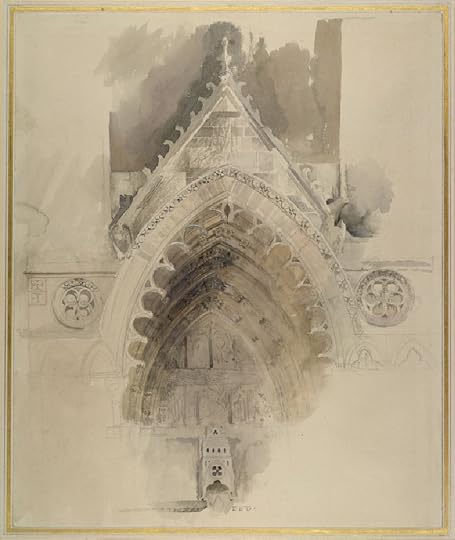
John Ruskin, Amiens Cathedral. Northern arch of west entrance, sketched in 1856
This sprawling man-eater of a book is a brave and imaginative attempt to re-enchant our world. The ultimate aim of this manoeuvre is to rediscover a more viable way of inhabiting this Anthropocenic planet. In a companion volume to this book, Spuybroek and his co-authors characterize our time as one of "pure exhaustion". There is ugliness and boredom aplenty, and we are steeped in a permanent sense of crisis. But our societies show very little vitality to deal with these tendencies: "Everything seems to have been deflated, emptied out - politics, art, economy, theory; there seems to be no exception." One major sign of the times is the fact that environmentalism has so utterly failed in its political mission.
In 'The Sympathy of Things' Spuybroek seeks answers to our predicament, not in politics and economy, or in science, but in aesthetics. The root of our problems is a fundamental lack of ... beauty. The reasoning, perhaps, turns out a little more plausible when we remind ourselves that Spuybroek has been trained and practised as an architect, a creator of physical environments for dwelling. Yet, this book goes way beyond the discipline of architecture. It proposes an aesthetic ontology that encompasses all the things that furnish our lives.
Spuybroek's guide in this undertaking is the Victorian polymath John Ruskin. In his concept of vital beauty, Ruskin looked for a new aesthetic experience, one that replaced a cerebral decoding of a language of forms, with a sympathetic 'living with vital forms'. For Ruskin encounters between things are deeply aesthetic: things are not merely seen but felt and experienced. The experience of beauty is one of relationality, of bonding and friendship, of reciprocity. The question, therefore, is: "Will we be able to weave a web of sympathy between ourselves with the help of things?"
Sympathy is that immediate seeing-feeling-thinking relationship between things, understood as coalescences of ever-changing matter. This has little to do with the sentiment of empathy. Sympathy has nothing subjective or virtual about it. "Sympathy is as much a feeling as a form of thinking, meaning it specifically acknowledges a mental, but not psychological, and a bodily, though not sensual, reciprocity between us and things. It concerns both the resonance of two things and the synchronization of two activities, but it is certainly not a relationship of taste." Sympathy is a surplus of action, absolute generosity, always exceeding us.
John Ruskin was a stern critic of the mercantile and utilitarian spirit of his day. Vital beauty is also a moral concept. It emphatically goes beyond the purely transactional logic of a rational economy. Pure exchange does not entail beauty. And for things to be able to shape one another reciprocally, they need to be made in a certain way. The making needs to make space for relationality. 'The Sympathy of Things' is largely devoted to this question of making.
"Things only need to expose their making, making them vulnerable and fragile. Not unlike the caterpillar, they (abstractly) sacrifice themselves before being encountered. In the end, this is what relationality is founded upon: things are giving and generous. Ruskin's whole economy is one of sacrifice, whether that of the gratuitous ornament, whose details the stone carver spends hour after hour getting right, or the selfless extraneous labor, in which the physician spends hours of overtime caring for his patients. Things only start to network when they have exceeded their use value, turning them in to acts of pure care."
We have become thoroughly alienated from this kind of economy. Our world today is populated with objects (the Heideggerian Gegenstand, or 'what stands against') rather than things. They are designed badly, produced under the wrong conditions and hence obstruct sympathy rather than open towards it. Furthermore, relationships between things are no longer felt but have been replaced with mediation. They immanent existence is not enough. They are there a sign, to point towards something else. Finally, the aesthetics of beauty has been replaced by the aesthetics of the sublime.
Then Spuybroek puts forward an important question: "Can we, by acknowledging technology as the main source of the contemporary sublime, turn the tide?" The answer is affirmative: "I am convinced that this is the only way to retrieve a world of things, i.e., a world of beauty, which I equate with a world of feelings: to move not away from technology, but through it. Questions raised by art and artisanship should be appropriated by technology - not a technology of purposiveness, instrumentality, and mediation, however, but one of variation and flourishing". Spuybroek is convinced that digital technology offers a new realm for experimenting with vital beauty.
Spuybroek develops these ideas in wildly ramifying chapters devoted to Ruskin's concept of the Gothic, the role of ornament, and the character of the picturesque. The gothic is the art of configurational variation. There is a unique, co-evolutionary relationship between part and whole, figure and configuration in the Gothic. The smallest element entity is capable of deforming the set of outcomes on the highest level. Hence, in Gothic architecture, the form of the final product is not fully pregiven in a completed plan. There is accident, but accident that leads to substance. The Gothic is more than a style. It is an ontology unto itself. Or, better still, it is style as ontology. Ruskin's generative theory of ornamentation transforms structure into texture. The picturesque is developed as a notion that mediates between the opposing poles of beauty and the sublime.
The scope and depth of the discussion are astounding. Spuybroek's erudition seems to know no bounds. Readers need to be prepared to work through the ideas of thinkers as different as Peter Sloterdijk, William James, Henri Bergson, Charles Babbage, Bruno Latour, Charles Darwin, Gilles Deleuze, Wilhelm Worringer, Theodor Lips and many others. There is no way to do justice to this richness in a short review. The book is, perhaps, a reflection of the configurational logic that it puts forward, with ideas meshed into a dynamic web traversed by conceptual ribs of which the notion of relational sympathy is just one of the most prominent ones.
Why would we bother to work through the many layers and configurations of Spuybroek's unfashionable and esoteric manifesto? I would say: chiefly to rekindle our capacity for wonderment, not only in our relationship with the 'outside world' but also in our relations with our fellow humans. There is a fascinating passage in which the tenets of Gothic ontology are transposed to social life: "... every approach to another starts with a feeling-into, followed by a living-with. One’s relational act has to contribute to one’s own well-being, though it does require one to adapt and vary one’s actions. (...) The intent of beauty implies an act of composition, not an intent toward a specific finalized form for the group. Nobody lives-with the group qua group; we live, and things live, among things, and our actions and feelings are always local. (...) Perhaps there is no whole, and if there is, I am not sure I can see it. Anyone who marvels at the beauty of thousands of starlings (there can be more than 50,000) flying over a field marvels not at some sort of “emergent order” but purely at the gracefully coordinated effort. We, as beholders, simply take part in the act of construction."
At one point, Spuybroek refers to Alan Turing's seminal 1952 paper 'The Chemical Basis of Morphogenesis' in which the author hypothesizes a reaction-diffusion mechanism to explain the emergence of natural patterns such as stripes on zebras. For Spuybroek, this model of cell differentiation underlines the pertinence of a Gothic conception of 'changeful' patterning. Now consider the report by a group of scientists who empirically validated Turing's morphogenesis model. They worked with arrays of tiny water droplets floating in oil: "We could look at the behavior of each of these individual droplets, which we can think of as biological cells, producing chemicals which diffuse through the oil and eventually reach the neighboring cell, creating the kind of interaction that Turing had in his model," said one of the investigators. "When you look in the microscope at these drops flickering and flashing light and changing shape, they really look like something living. And it's quite stunning. And then to have these drops, which are all identical chemicals, and then to exhibit very different kinds of behavior, so, behaving like a potent cell, that, depending on its environment will change from one fate to another, to see that happen, not in a living system but a purely synthetic system, was kind of an experience that I think Dr Frankenstein had when he took lightning and took inanimate flesh and vitalized it."
Spuybroek: "I long for the day when we can see objects forming, like pools of mud, flowers on a wall, or clouds in the sky, as pure products in a context of pure productivity, without any intermediaries. There will be no desires, no opinions, no critics, no designers, just pure flourishing."
John Ruskin, Amiens Cathedral. Northern arch of west entrance, sketched in 1856

Want to Read
March 20, 2016"A figure is a formal organization of variable points, not a fixed form. The organization is fixed, but not the form. […] This is not almost exactly but exactly how the digital is defined today. Fairly simple behavior by individual members resulting in complex and irreducible collective behavior is a form of computation, which finds its most fundamental form in the digital, though not necessarily electronically. We often understand 'digital' as meaning 'electronically computed,' but the speed of those electrons is actually irrelevant to the notion of computing which refers solely to the method of calculation, a stepwise procedure of iterative adjustments based on the minimization of difference" (Spuybroek, pg. #22).
Displaying 1 - 2 of 2 reviews