

What do you think?
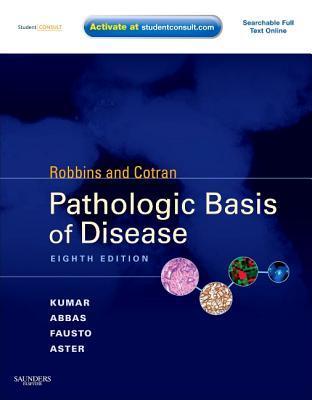
Robbins and Cotran Pathologic Basis of Disease [with Student Consult Online Access]
One of the best-selling medical textbooks of all time, Robbins and Cotran Pathologic Basis of Disease is the one book that nearly all medical students purchase, and is also widely used by physicians worldwide. A "who's who" of pathology experts delivers the most dependable, current, and complete coverage of today's essential pathology knowledge. At the same time, masterful editing and a practical organization make mastering every concept remarkably easy. Online access via Student Consult includes self-assessment and review questions, interactive case studies, downloadable images, videos, and a virtual microscope that lets you view slides at different magnifications. The result remains the ideal source for an optimal understanding of pathology. Offers the most authoritative and comprehensive, yet readable coverage available in any pathology textbook, making it ideal for USMLE or specialty board preparation as well as for course work. Includes access to the complete contents online via Student Consult, along with self-assessment and review questions, over 100 interactive clinical case studies, videos, and a virtual microscope that lets users view slides at different magnifications.
Delivers a state-of-the-art understanding of the pathologic basis of disease through completely updated coverage, including the latest cellular and molecular biology.
Demonstrates every concept visually with over 1,600 full-color photomicrographs and conceptual diagrams - many revised for even better quality.
Facilitates learning with an outstanding full-color, highly user-friendly design.
Delivers a state-of-the-art understanding of the pathologic basis of disease through completely updated coverage, including the latest cellular and molecular biology.
Demonstrates every concept visually with over 1,600 full-color photomicrographs and conceptual diagrams - many revised for even better quality.
Facilitates learning with an outstanding full-color, highly user-friendly design.
1464 pages, Hardcover
First published January 1, 1974
About the author
Vinay Kumar
25 books12 followersLibrarian Note: There is more than one author in the Goodreads database with this name.
Vinay Kumar is a pathologist and educator who was Lowell T. Coggeshall Distinguished Service Professor of Pathology at the University of Chicago, where he chaired the Department of Pathology from 2000 to 2016. He studied medicine at Glancy Medical College, graduating with honors and receiving Pfizer Award and a gold medal. He completed a PhD in experimental pathology and residencies in anatomic pathology and hematology at the All India Institute of Medical Sciences, New Delhi, where he received Khanolkar Prize for research. Kumar has been a senior editor of Robbins and Cotran Pathologic Basis of Disease and was a co-editor of the Annual Review of Pathology: Mechanisms of Disease. He became a Fellow of the American Association for the Advancement of Science in 2003. His honors include the Robbins Distinguished Educator Award, a National Board of Examinations Lifetime Achievement Award, and the Gold-Headed Cane Award.
Vinay Kumar is a pathologist and educator who was Lowell T. Coggeshall Distinguished Service Professor of Pathology at the University of Chicago, where he chaired the Department of Pathology from 2000 to 2016. He studied medicine at Glancy Medical College, graduating with honors and receiving Pfizer Award and a gold medal. He completed a PhD in experimental pathology and residencies in anatomic pathology and hematology at the All India Institute of Medical Sciences, New Delhi, where he received Khanolkar Prize for research. Kumar has been a senior editor of Robbins and Cotran Pathologic Basis of Disease and was a co-editor of the Annual Review of Pathology: Mechanisms of Disease. He became a Fellow of the American Association for the Advancement of Science in 2003. His honors include the Robbins Distinguished Educator Award, a National Board of Examinations Lifetime Achievement Award, and the Gold-Headed Cane Award.
Ratings & Reviews
Friends & Following
Create a free account to discover what your friends think of this book!
Community Reviews
Displaying 1 - 30 of 81 reviews

January 3, 2015
This is my most favorite Med school book!
This comprehensive volume is a gorgeous medical Textbook (yes,text books can be gorgeous too!I used this word for this book and it's not a typo just to be clear!)
Robbin's is that book which would take you to the next level in 2nd year of med school!In Indian system 1st year of med school is awful and for over 95% students,the biggest worry is how to survive the 1st year,ragging,English language,most dreaded vivas etc!But once you scramp through the 1st year,you enter clinics!Welcome to the big leagues now!
Here comes the big guy!Robbin's is that book!Robbins is so well written,comprehensive yet a very easy read!Pathology is a very important subject and if you do well in it,Internal Medicine becomes much easier!If you study well with Robbin's,you really get used to a new realm!This book prepares you for the next level,which is Harrison's Internal Medicine!
Robbin's has two main parts:General pathology and systemic!General part of the book is absolutely absolutely essential!!DO NOT AVOID those chapters,esp 1st seven chapters of the Big Robbin's book as they are very important and must read chapters for exams!For life too!
I was addicted to this book and ended up reading it 7 times in my 2nd year!It was my default-go to book and it helped me immensely!
It is a very beautiful book,full in color and charts,amazing images,flow charts!It is wayy better than that other book your lazy guide/senior is telling you about!I can swear on it!
I heart Robbins (Father Robbins-the biggest of 3 ) book!A must read treasure for any medical student :-)
5 stars
This comprehensive volume is a gorgeous medical Textbook (yes,text books can be gorgeous too!I used this word for this book and it's not a typo just to be clear!)
Robbin's is that book which would take you to the next level in 2nd year of med school!In Indian system 1st year of med school is awful and for over 95% students,the biggest worry is how to survive the 1st year,ragging,English language,most dreaded vivas etc!But once you scramp through the 1st year,you enter clinics!Welcome to the big leagues now!
Here comes the big guy!Robbin's is that book!Robbins is so well written,comprehensive yet a very easy read!Pathology is a very important subject and if you do well in it,Internal Medicine becomes much easier!If you study well with Robbin's,you really get used to a new realm!This book prepares you for the next level,which is Harrison's Internal Medicine!
Robbin's has two main parts:General pathology and systemic!General part of the book is absolutely absolutely essential!!DO NOT AVOID those chapters,esp 1st seven chapters of the Big Robbin's book as they are very important and must read chapters for exams!For life too!
I was addicted to this book and ended up reading it 7 times in my 2nd year!It was my default-go to book and it helped me immensely!
It is a very beautiful book,full in color and charts,amazing images,flow charts!It is wayy better than that other book your lazy guide/senior is telling you about!I can swear on it!
I heart Robbins (Father Robbins-the biggest of 3 ) book!A must read treasure for any medical student :-)
5 stars

April 17, 2011
there is just one problem with this book. IT'S TOO HEAVY. my shoulder muscles got hypertrophied from carrying it around in my satchel to class. as a result my body is no longer symmetrical because i usually let the left shoulder alone to suffer. (<--- kidding)
otherwise it's the coolest pathology book ever. it helped me a lot. :DD
otherwise it's the coolest pathology book ever. it helped me a lot. :DD
August 29, 2018
A review of the 9th edition, 2015, edited by Kumar, Abbas, Aster.
Warning, spoilers ahead: it's a textbook about the pathologic basis of human disease! *gasp*
Many years have passed since the conception of this magnum opus of Dr. Stanley Robbins', yet so constant was this textbook in it's primary content that the last time someone (Dr Robbins himself, actually) added a chapter was in 1967 - Genetic Diseases, or rather, more accurately known as 'that chapter most doctors skip'. So sturdy are the facts dispensed by this work of genius, that in a typical argument amongst medicos, the first person who quotes Robbins will be awarded with a defeated silence from the rest.
I read Robbins as a student, hated it; I read Robbins as an intern; tolerated it. Still reading Robbins now, as a practicing clinician; my exams depend on it. I must admit, for a textbook that engulfs the lives of many a medical professional like terminal cancer, it also operates as a guardian angel where basic pathology is concerned. I guess this textbook has....'grown' on me. (Ba dum tss)
As I plough on it's labyrinthine chapters, the voice of Robbins in my head is that of an old British professor, ever austere in the delivery of it's endless lectures, with (to the delight of it's readers or 'students') occasional punctures of appalling wit and sarcasm. An example - note a rather snarky take on mankind's failure of attaining immortality as an opening to a chapter on cell death, and that 'individuals age because their cells age'. Duh? (page 66, chapter 2)
Such was the influence of Robbins in my life, that I now use sunscreen religiously upon discovering the pathogenesis behind skin malignancies, and sent a significant number of stubborn cockroaches to their deaths.. although the latter is more of an appreciation to the physical robustness of this tome (translate that as - even if you don't read Robbins, it's good to have a full edition handy - it passes as a reliable weapon!)
Remember this before you flip that preface: This book will break you or make you, kids. Embrace the darkness of Robbins, and you will see the light at the end of the tunnel (i.e your exams).
Favourite quote:
'It appears that almost everything one does to earn a livelihood or for pleasure is fattening, immoral, illegal, or, even worse, carcinogenic!' (page 278, Chapter 7)
*And to think, my first book review on any platform whatsoever, is that of a textbook I have a love-hate relationship with. Oh well.
Warning, spoilers ahead: it's a textbook about the pathologic basis of human disease! *gasp*
Many years have passed since the conception of this magnum opus of Dr. Stanley Robbins', yet so constant was this textbook in it's primary content that the last time someone (Dr Robbins himself, actually) added a chapter was in 1967 - Genetic Diseases, or rather, more accurately known as 'that chapter most doctors skip'. So sturdy are the facts dispensed by this work of genius, that in a typical argument amongst medicos, the first person who quotes Robbins will be awarded with a defeated silence from the rest.
I read Robbins as a student, hated it; I read Robbins as an intern; tolerated it. Still reading Robbins now, as a practicing clinician; my exams depend on it. I must admit, for a textbook that engulfs the lives of many a medical professional like terminal cancer, it also operates as a guardian angel where basic pathology is concerned. I guess this textbook has....'grown' on me. (Ba dum tss)
As I plough on it's labyrinthine chapters, the voice of Robbins in my head is that of an old British professor, ever austere in the delivery of it's endless lectures, with (to the delight of it's readers or 'students') occasional punctures of appalling wit and sarcasm. An example - note a rather snarky take on mankind's failure of attaining immortality as an opening to a chapter on cell death, and that 'individuals age because their cells age'. Duh? (page 66, chapter 2)
Such was the influence of Robbins in my life, that I now use sunscreen religiously upon discovering the pathogenesis behind skin malignancies, and sent a significant number of stubborn cockroaches to their deaths.. although the latter is more of an appreciation to the physical robustness of this tome (translate that as - even if you don't read Robbins, it's good to have a full edition handy - it passes as a reliable weapon!)
Remember this before you flip that preface: This book will break you or make you, kids. Embrace the darkness of Robbins, and you will see the light at the end of the tunnel (i.e your exams).
Favourite quote:
'It appears that almost everything one does to earn a livelihood or for pleasure is fattening, immoral, illegal, or, even worse, carcinogenic!' (page 278, Chapter 7)
*And to think, my first book review on any platform whatsoever, is that of a textbook I have a love-hate relationship with. Oh well.
April 17, 2008
Best pathology resource EVER.
May 19, 2008
Currently saving my life.
June 25, 2008
The bible of pathology.
November 1, 2011
A classic read, real page turner.

January 28, 2011
Finally, a science text to rival the unbridled, carnal sexiness of my infectious disease epidemiology text (Infectious Disease Epidemiology: Theory And Practice).
Read
February 1, 2008you'd think this was some dry, informative, educational text on pathology but it's laced with quips, tongue in cheek comments on the immune system, cellular interactions via cytokines, obesity, even cancer. i highly recommend this text.
Read
August 22, 2007i love how i have perverted this website for leisure reading with the book that with its very existence denies me any time for leisure reading.
Currently Reading
October 13, 2009Forget medical school -if you can memorize every page of this bloody thriller, you'll be the envy of every physician.
October 7, 2014
An American book on the mechanism of disease. Good for the enthusiastic student that ever yearns to know more than his classmates.

March 22, 2024
The last few months have been spent working towards one singular and unifying goal - to read this textbook from cover to cover. Embarking on such a quest meant that my self-identify became defined and solidified between its crusty hardback pages. I took it on buses, trains, and then (perhaps a little egotistically) on a plane journey to South East Asia and back. Maybe because of this the end has crept up on me and it's unasatisfying. All that being said, and after all I (we) went through, I hold a fantastically tender affection twards Robbins, and Cotran, and whoever-the-hell-else decided to contribute to this beast.
As a faraway colleague, Hattie, pointed out when she read it a year ago (also for her Part 1 exam, and also "not for fun:): "Swathes of this are unbelievably dry, and it will suddenly reward you for traversing the desert with an absolute gem of a sentence."
Here are some of my (additional) favourites:
“Tattooing is a form of localised, exogenous pigmentation of the skin. The pigments inoculated are phagocytoses by dermal macrophages, in which they reside for the remainder of the life of the embellished ✨”
"When hygiene fails, diarrhoeal disease becomes rampant"
On acne: “androgens were first implicated [in the development of acne] in times past when it was noted that young castrated males generally did not develop the condition (a questionable tradeoff).”
At the other end lie patients with pure chronic bronchitis, ingloriously referred to as “blue bloaters”
“It is not necessary to detail Mendel’s law here, since every student in biology, and possibly every garden pea, has learned about them at an early age”
“The prevalence of endemic African Kaposi's Sarcoma is inversely related to the wearing of shoes” (this one included just because this one blew my mind in the late witching hallucinatory evening hours)
As a faraway colleague, Hattie, pointed out when she read it a year ago (also for her Part 1 exam, and also "not for fun:): "Swathes of this are unbelievably dry, and it will suddenly reward you for traversing the desert with an absolute gem of a sentence."
Here are some of my (additional) favourites:
“Tattooing is a form of localised, exogenous pigmentation of the skin. The pigments inoculated are phagocytoses by dermal macrophages, in which they reside for the remainder of the life of the embellished ✨”
"When hygiene fails, diarrhoeal disease becomes rampant"
On acne: “androgens were first implicated [in the development of acne] in times past when it was noted that young castrated males generally did not develop the condition (a questionable tradeoff).”
At the other end lie patients with pure chronic bronchitis, ingloriously referred to as “blue bloaters”
“It is not necessary to detail Mendel’s law here, since every student in biology, and possibly every garden pea, has learned about them at an early age”
“The prevalence of endemic African Kaposi's Sarcoma is inversely related to the wearing of shoes” (this one included just because this one blew my mind in the late witching hallucinatory evening hours)

October 24, 2017
Best Pathology resource out there .. highly recommended !!

December 15, 2024
I’m on chapter 9 and they haven’t even kissed yet. And the plot. WHERE WAS THE PLOT. Would never recommend. Can’t wait for the next one.
September 8, 2025
Habían chistecitos... No necesito más nada para darle 5 estrellas a este libro, aparte, el formato del libro lo hace súper fácil de leer y entender.

June 15, 2023
The Textbook to school all textbooks. More and more giving upon each read, joyful to revisit after integration with other subjects (both theoretical and human). Very sad I can't get my batchmates to latch off of shortcuts and onto this beauty.
Definitely a book I'll look back fondly on and refer to when I'm a doctor.
Definitely a book I'll look back fondly on and refer to when I'm a doctor.

April 20, 2023
This text is thicc. Thicc. The page count does not even do it justice. Each section is denser than Diamond with all the information it tries to fit in. In actuality, it is probably more thorough than one will require for examination or clinical purposes, but that is the intent. As a complete source of information it definitely gets the job done. I hope in future editions they do an effort to highlight the more important details from the endless pages. Perhaps the bold setting could be used more readily?
January 19, 2013
Well written book. I have not finished it but I don't think I would. Everytime I got to a chapter I had the impression that the chapter would never end. Overall great read but just too much info good Reference definitely not a review
October 12, 2007
name a disease--there's anywhere from 2-50 pages on it in this book. Sometimes I read it just for fun. Mostly, though, I read because I have homework.
May 22, 2008
the one textbook in medical school that i think i will keep for the rest of my life.

December 6, 2008
Gak cuma buat pre tes Patologi Anatomi, tapi juga bisa buat bantal. Hahaha.. Saya suka buku ini. Bahasa Inggrisnya enak dibaca.

June 16, 2012
Good illustrations! Bought for pharmacy school as a reference, even though it wasn't used for any actual class.

Read
August 26, 2012This is my life now.
February 18, 2013
I have not finished reading this book and will never ever stop referring to this book!

August 31, 2013
Bible of pathology/pathophysiology, discover the real fun of medicine, and being a doctor

December 17, 2020
One of the only textbooks I read literally cover-to-cover in medical school!

October 19, 2013
Amazing piece of literature to study Pathology but it is too time consuming.

March 14, 2023
Can now actually claim to have read this cover to cover (not for fun, I have an exam coming up).
Swathes of this are unbelievably dry, and it will suddenly reward you for traversing the desert with an absolute gem of a sentence (either that or I just started hallucinating).
I've listed my favourites here to save you the trouble of reading this 1000+ page monster. Although perhaps they lose their charm when you haven't had to work for them.
What is a human but an ingenious machine designed to turn, with infinite artfulness, the red wine of Shiraz into urine?
Regardless of cause, the enlargement of the lymphoid tissue invites the tender mercies of the ENT surgeon.
The term adrenal incidentaloma is a half-facetious moniker that has crept into the medical lexicon
The rarity of clinically significant lesions (virtually only tumors) justifies brevity in the consideration of the pineal gland... Whether to characterize these germ cell neoplasms as pinealomas is debated, but most “pinealophiles” favor restricting the term pinealoma to neoplasms arising from the pineocytes.
The mouth is not merely a gateway for delicacies
Although the human integument may appear drab com- pared with the skin and pelage of other members of the animal kingdom, it is extraordinarily vibrant with regard to the diversity of functions that it carries out.
Another cell type found in skin that remains cloaked in mystery is the Merkel cell.
Cretinism refers to hypothyroidism that develops in infancy or early childhood. The term cretin was de- rived from the French chrétien, meaning “Christian” or “Christlike,” and was applied to these unfortunates because they were considered to be so mentally retarded as to be incapable of sinning.
Swathes of this are unbelievably dry, and it will suddenly reward you for traversing the desert with an absolute gem of a sentence (either that or I just started hallucinating).
I've listed my favourites here to save you the trouble of reading this 1000+ page monster. Although perhaps they lose their charm when you haven't had to work for them.
What is a human but an ingenious machine designed to turn, with infinite artfulness, the red wine of Shiraz into urine?
Regardless of cause, the enlargement of the lymphoid tissue invites the tender mercies of the ENT surgeon.
The term adrenal incidentaloma is a half-facetious moniker that has crept into the medical lexicon
The rarity of clinically significant lesions (virtually only tumors) justifies brevity in the consideration of the pineal gland... Whether to characterize these germ cell neoplasms as pinealomas is debated, but most “pinealophiles” favor restricting the term pinealoma to neoplasms arising from the pineocytes.
The mouth is not merely a gateway for delicacies
Although the human integument may appear drab com- pared with the skin and pelage of other members of the animal kingdom, it is extraordinarily vibrant with regard to the diversity of functions that it carries out.
Another cell type found in skin that remains cloaked in mystery is the Merkel cell.
Cretinism refers to hypothyroidism that develops in infancy or early childhood. The term cretin was de- rived from the French chrétien, meaning “Christian” or “Christlike,” and was applied to these unfortunates because they were considered to be so mentally retarded as to be incapable of sinning.
June 20, 2026
Direi che dopo un mese ad annotarlo e a rischiare la scoliosi per portarlo in giro può contare come lettura... grazie per avermi salvato da ana pat 🙏🏻
Si apprezzano la sintassi, curiosi aneddoti storico-culturali, occasionale sarcasmo, la poeticità e la fantasia nei paragoni assurdi per descrivere cellule strane.
"Quindi, che cosa distingue gli esseri umani dai vermi? Una risposta definitiva ancora non c'è."
Epidemiologia del cancro: "Sembra che quasi tutto ciò che facciamo per guadagnarci da vivere o per divertirci sia immorale, illegale, faccia ingrassare o, ancora peggio, sia cancerogeno! Il solo modo sicuro di evitare il cancro è quello di non nascere, vivere significa correre il rischio."
Dieta e malattie sistemiche: "L'umile aglio è stato considerato in grado di proteggere contro la patologia cardiaca -oltre che contro demoni, lupi mannari, vampiri e, purtroppo, baci- sebbene la ricerca debba ancora provare questo effetto in maniera equivocabile. Tra questi, l'effetto sui baci è il più consolidato."
Si apprezzano la sintassi, curiosi aneddoti storico-culturali, occasionale sarcasmo, la poeticità e la fantasia nei paragoni assurdi per descrivere cellule strane.
"Quindi, che cosa distingue gli esseri umani dai vermi? Una risposta definitiva ancora non c'è."
Epidemiologia del cancro: "Sembra che quasi tutto ciò che facciamo per guadagnarci da vivere o per divertirci sia immorale, illegale, faccia ingrassare o, ancora peggio, sia cancerogeno! Il solo modo sicuro di evitare il cancro è quello di non nascere, vivere significa correre il rischio."
Dieta e malattie sistemiche: "L'umile aglio è stato considerato in grado di proteggere contro la patologia cardiaca -oltre che contro demoni, lupi mannari, vampiri e, purtroppo, baci- sebbene la ricerca debba ancora provare questo effetto in maniera equivocabile. Tra questi, l'effetto sui baci è il più consolidato."
Displaying 1 - 30 of 81 reviews