

What do you think?

Functional approach to precalculus
Functional approach to precalculus
569 pages, Hardcover
First published January 1, 1974
Ratings & Reviews
Friends & Following
Create a free account to discover what your friends think of this book!
Community Reviews
Displaying 1 - 2 of 2 reviews

February 4, 2016
This text came out the year I was born as a textbook for a community college in a county adjacent to the one I teach at 45 years later. This was a fully digested of the New Mathematics or New Math brief, dramatic change in the way mathematics was taught in American grade schools during the 1960s. While the phrase is often used now to describe this change as a short-lived pedagogical fad which quickly became highly discredited, the set of teaching practices introduced in the U.S. shortly after the Sputnik crisis in order to boost science education and mathematical skill in the population, introduced topics seen here including modular arithmetic, algebraic inequalities, and abstract algebra. These topics have been greatly de-emphasized or eliminated in US elementary schools and high schools curricula since then while built upon outside of the US. Consequently, a typical US math student is a good academic year behind foreign students who also tend to school for longer during the year. The rules of sets would later prove to be very valuable with the onset of databases and other formations of data that were emerging in society. I find it is the area my incoming students are weakest at when I meet them in their final semester before calculus where the readers of this text were grappling with the idea of a set algebraically closed under an operation. This is something we cannot approach at the level of a first-year college student, any longer. This allows such concepts as the circle as a set of equidistant points from a center as well as proofs and theorems – all notions current students are allergic to. I see the readers of this text could handle mathematical induction, now an optional and often foregone topic, as well as periodic function, basic trigonometry to inverses of the sine and cosine as well as vectors and polar coordinates. Now, these topics, a good engineering foundation, have their own semester.
As this book was falling apart, I disassembled it into two piles: on the left material still taught at my CC at that level and thus of use to me as classroom capsule, and on the right the hefty stack of material now behind the reach of my students:
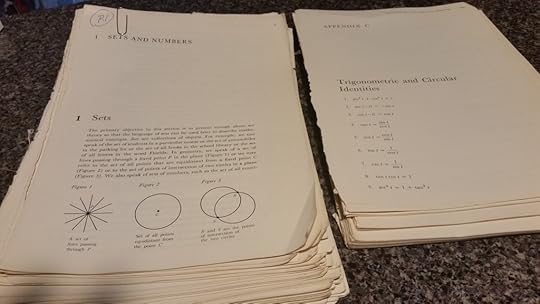
As this book was falling apart, I disassembled it into two piles: on the left material still taught at my CC at that level and thus of use to me as classroom capsule, and on the right the hefty stack of material now behind the reach of my students:

January 24, 2016
My primary interest in this book was the chapter on functions, for which I needed a strong foundation. Ended up going through the entire text; perhaps this is the best written of all the ones I've used.
Displaying 1 - 2 of 2 reviews