

What do you think?
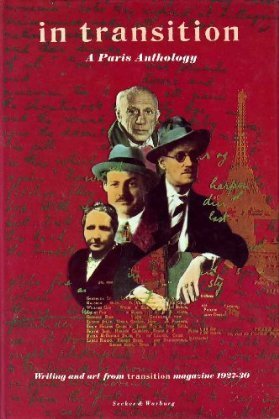
In Transition: A Paris Anthology: Writing And Art From Transition Magazine 1927-30
A selection of the some of the best writing to appear in 'Transition', one of the most important literary magazines of the 1920s in Paris. For its time, ‘Transition’ was a mouthpiece of high modernism unmatched by any other journal in Europe; featured here are most of the great avant-garde writers of that era, such as Gide, Joyce, Jung, Kafka, Miro, Rilke, Picasso and Gertrude Stein.
Hardcover
First published May 21, 1990
About the author
Samuel Beckett
959 books6,808 followersNovels of Samuel Barclay Beckett, Irish writer, include
Murphy
in 1938 and
Malone Dies
in 1951; a wider audience know his absurdist plays, such as
Waiting for Godot
in 1952 and
Krapp's Last Tape
in 1959, and he won the Nobel Prize of 1969 for literature.
Samuel Barclay Beckett, an avant-garde theater director and poet, lived in France for most of his adult life. He used English and French. His work offers a bleak, tragicomic outlook on human nature, often coupled with black gallows humor.
People regard most influence of Samuel Barclay Beckett of the 20th century. James Augustine Aloysius Joyce strongly influenced him, whom people consider as one modernist. People sometimes consider him as an inspiration to many later first postmodernists. He is one of the key in what Martin Esslin called the "theater of the absurd". His later career worked with increasing minimalism.
People awarded Samuel Barclay Beckett "for his writing, which—in new forms for the novel and drama—in the destitution of modern man acquires its elevation".
In 1984, people elected Samuel Barclay Bennett as Saoi of Aosdána.
Samuel Barclay Beckett, an avant-garde theater director and poet, lived in France for most of his adult life. He used English and French. His work offers a bleak, tragicomic outlook on human nature, often coupled with black gallows humor.
People regard most influence of Samuel Barclay Beckett of the 20th century. James Augustine Aloysius Joyce strongly influenced him, whom people consider as one modernist. People sometimes consider him as an inspiration to many later first postmodernists. He is one of the key in what Martin Esslin called the "theater of the absurd". His later career worked with increasing minimalism.
People awarded Samuel Barclay Beckett "for his writing, which—in new forms for the novel and drama—in the destitution of modern man acquires its elevation".
In 1984, people elected Samuel Barclay Bennett as Saoi of Aosdána.
Ratings & Reviews
Friends & Following
Create a free account to discover what your friends think of this book!
Community Reviews
No one has reviewed this book yet.