

What do you think?

Official Negligence : How Rodney King and the Riots Changed Los Angeles and the LAPD
In the Spring of 1992 five days of rioting laid waste to South Central Los Angeles, took scores of lives, cost the city more than $900 million in property damages and captured the attention of horrified people worldwide. Lou Cannon, veteran journalist, combines extensive research with interviews from hundreds of survivors, offering the only definitive story behind what happened and why.Official Negligence takes a hard look at the circumstances leading up to the riots. Cannon reveals how the videotape of the brutal beating of Rodney King had been sensationally edited by a local TV station, how political leaders required LAPD officers to carry metal batons despite evidence linking them to the rising toll of serious injury in the community, and how poorly prepared the city was for the violence that erupted.
698 pages, Hardcover
First published January 1, 1998
About the author
Lou Cannon
17 books8 followersLouis Simeon Cannon was an American journalist, non-fiction author, and biographer, best known for his books about Ronald Reagan. He was state bureau chief for the San Jose Mercury News in the late 1960s and later senior White House correspondent of the Washington Post during the Ronald Reagan administration.
Ratings & Reviews
Friends & Following
Create a free account to discover what your friends think of this book!
Community Reviews
Displaying 1 - 15 of 15 reviews

September 26, 2018

My takeaway from this book is that there are not good or bad human characters in any story. There are no guilty or innocent parties. The problem is the system. Humans can be good and human on a one-to-one basis, but when they get together, or form part of a bigger system, then the problems begin.
The issue with this problem is remarkably summarized in the title: "Official Negligence" The problem was not with the white abusive policemen, or the black wrongdoers... it was with the system and the society they belong to. Evidence of this is the exaggerated overreaction to the results of the trials: riots that ended in 51 deaths and hundreds of millions of dollars in damages.
It also brought good things: the LAPD would be more prepared for issues like this, and acts of violence like those riots would forever be a thing of the past.

The first picture of this post is a young Rodney King, trying to do whatever he could to stop the carnage. This violent phenomenon surpased him and everyone else. His extremely worried gaze and his demeanor show the weight of the circumstances. It is a pitty that he is one of those beings that would never be out of trouble. To this days he is still a victim of his own inability to cope with complex personal issues.
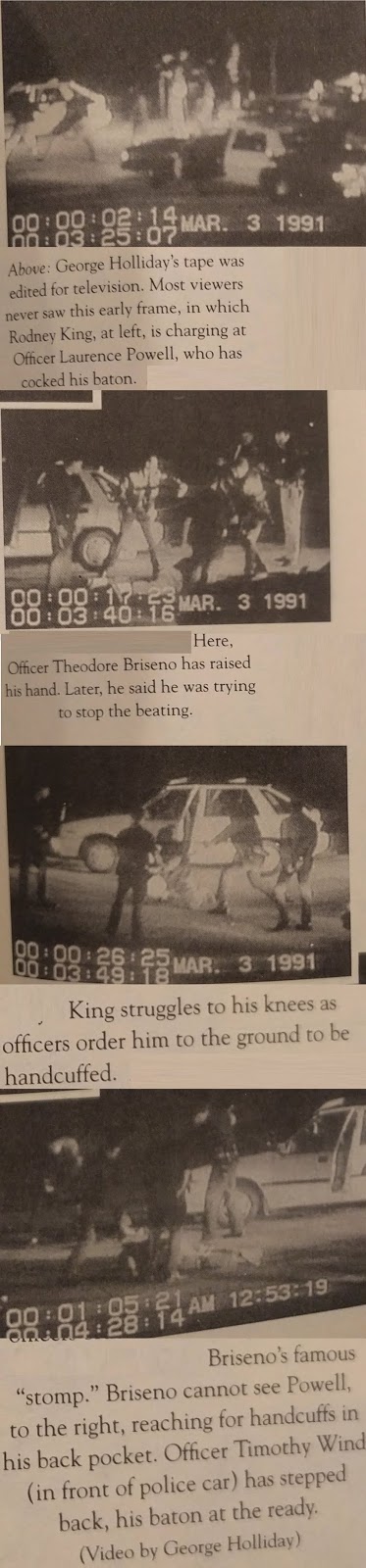
The second image are the cover and jacket of the book I read. Some footage of the beating illustrates one small aspect of what this very complete work covers.
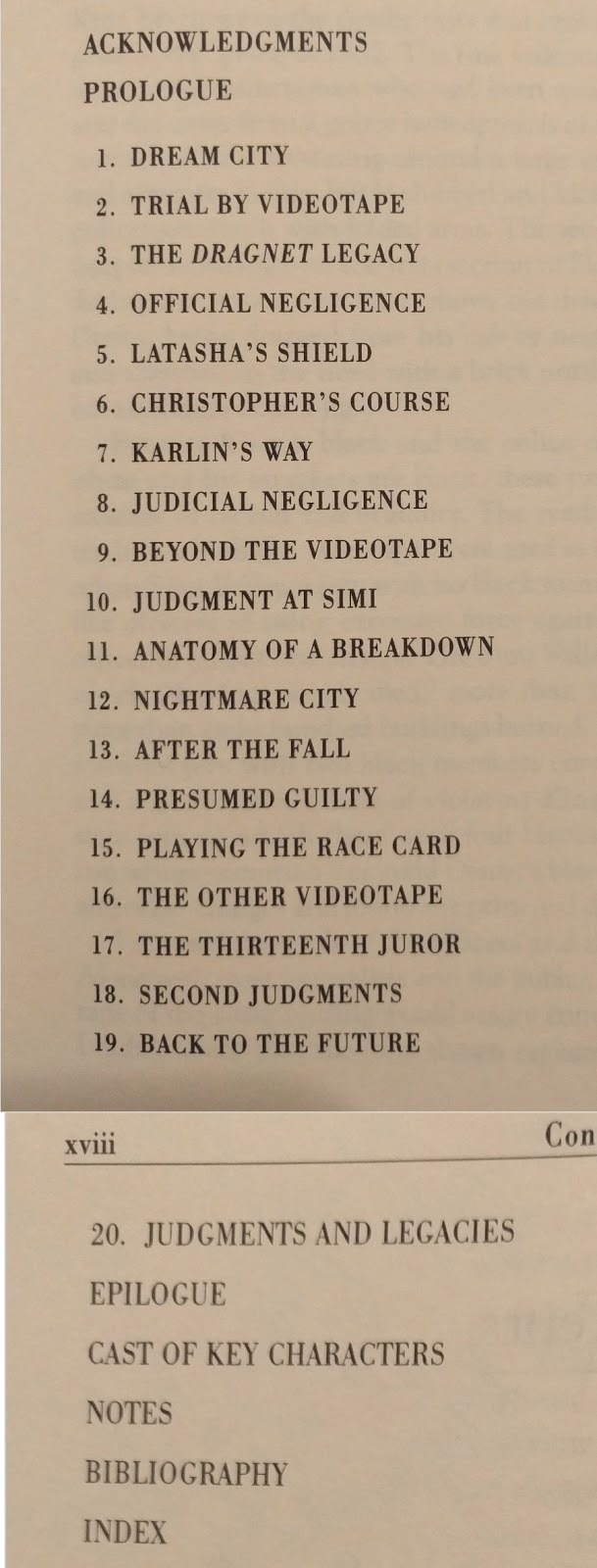
Below this lines, the dedicatory and acknowledgements, which I love the way the author wrote them. In this first page the reader can enjoy a fresh style and anticipate the seriousness and thoroughness yet to come.
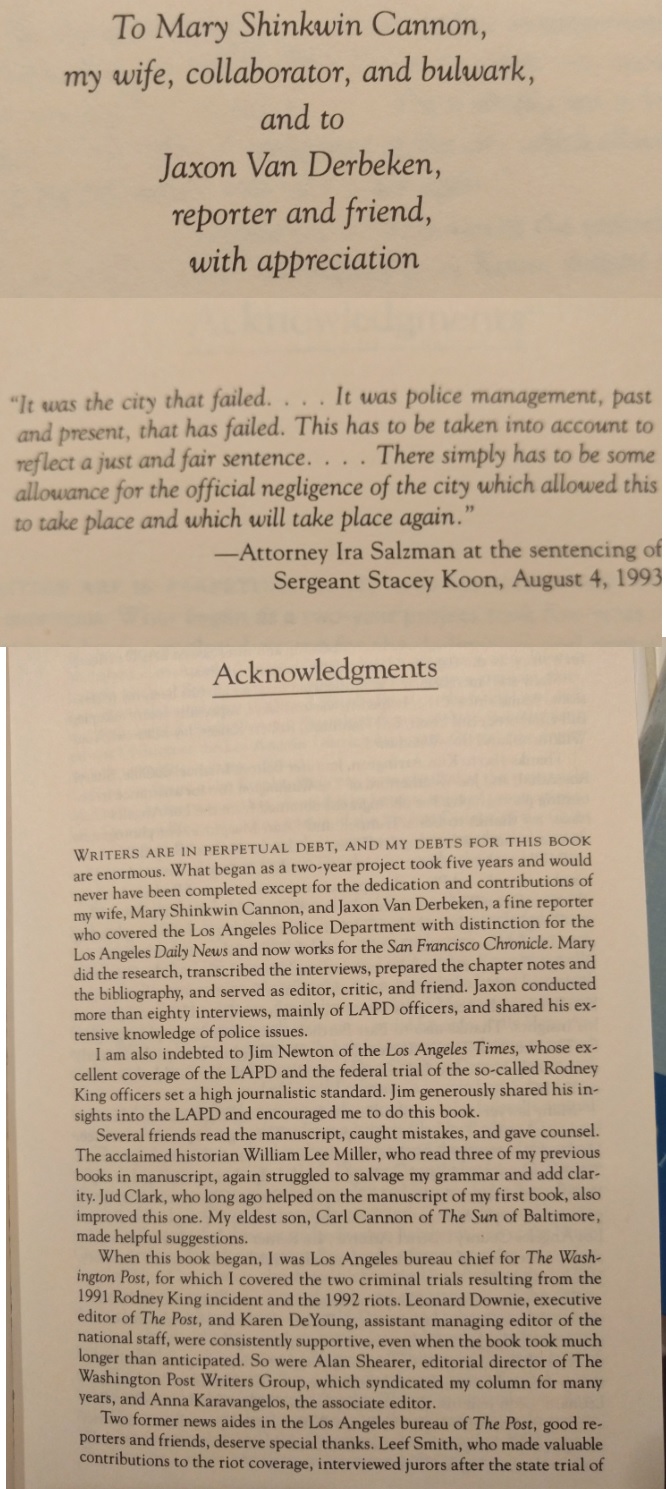
This is the table of contents of this dense book. It is a long read, but believe me, it is worth every minute invested.
The prologue (depicted below) is another example of the superb writing of this journalist. It catches your attention and makes you not wanting to put down the book until the very end.

Here is a taste of the first words of the book: describing southern California as a paradisiac place where everyone wants to live.

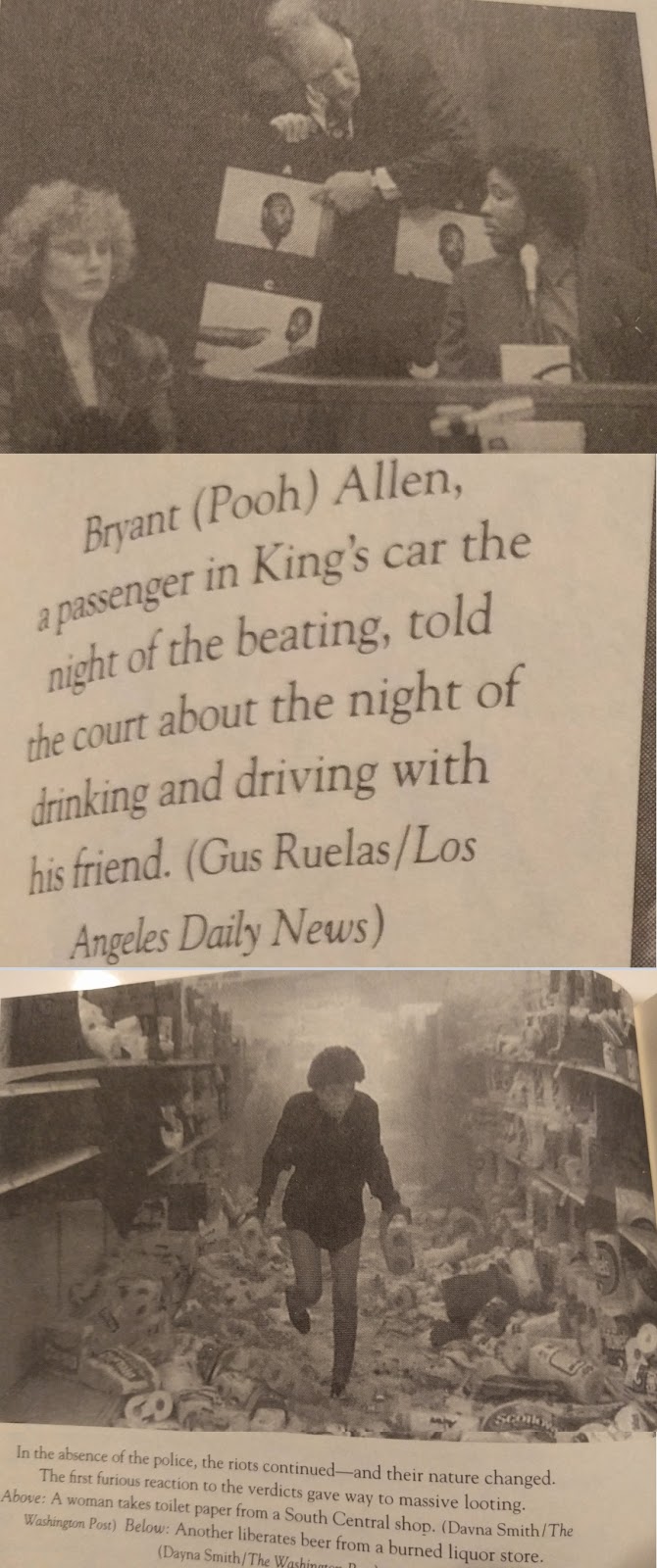
The following images are some of the pictures in the book.

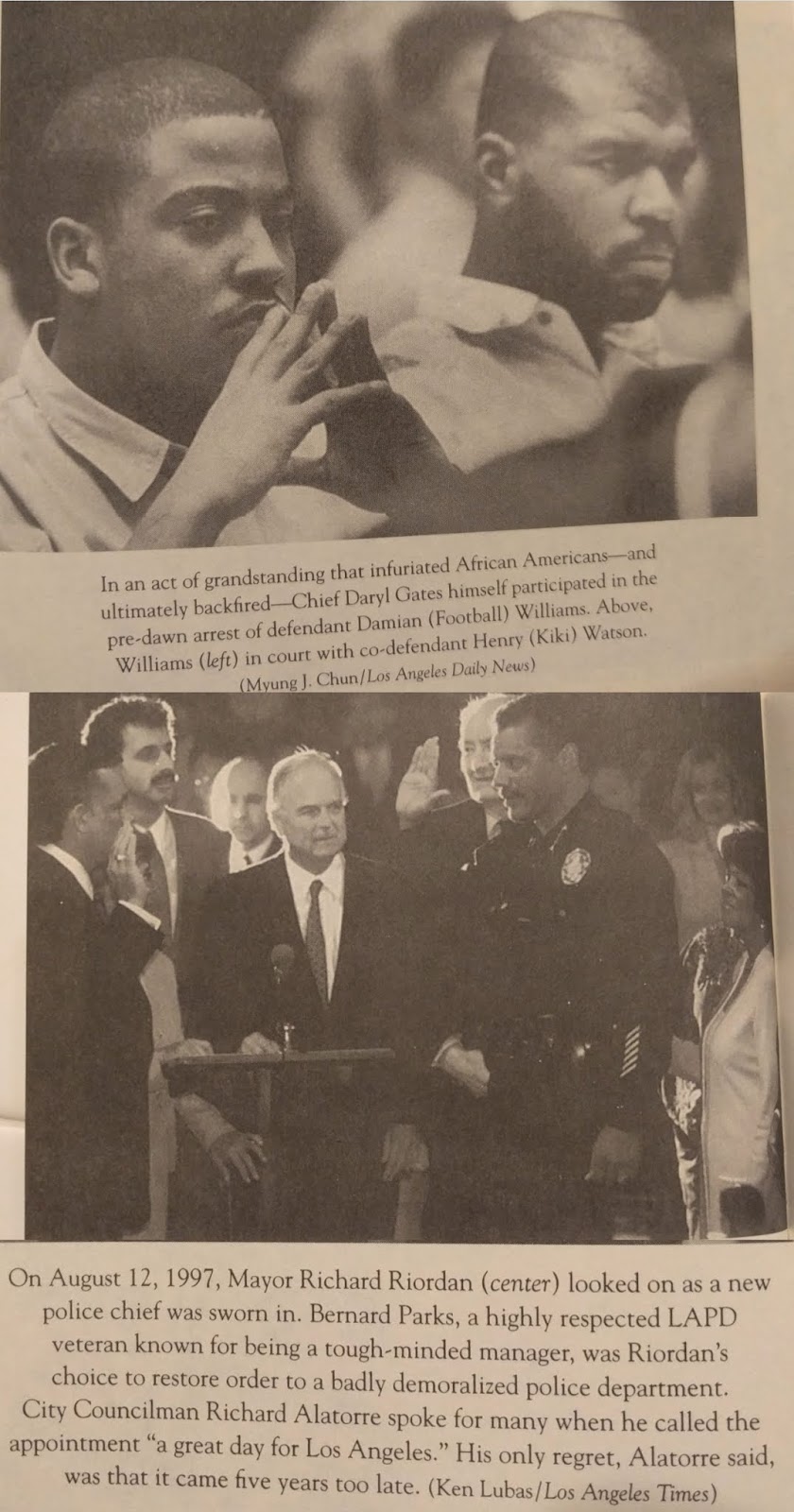
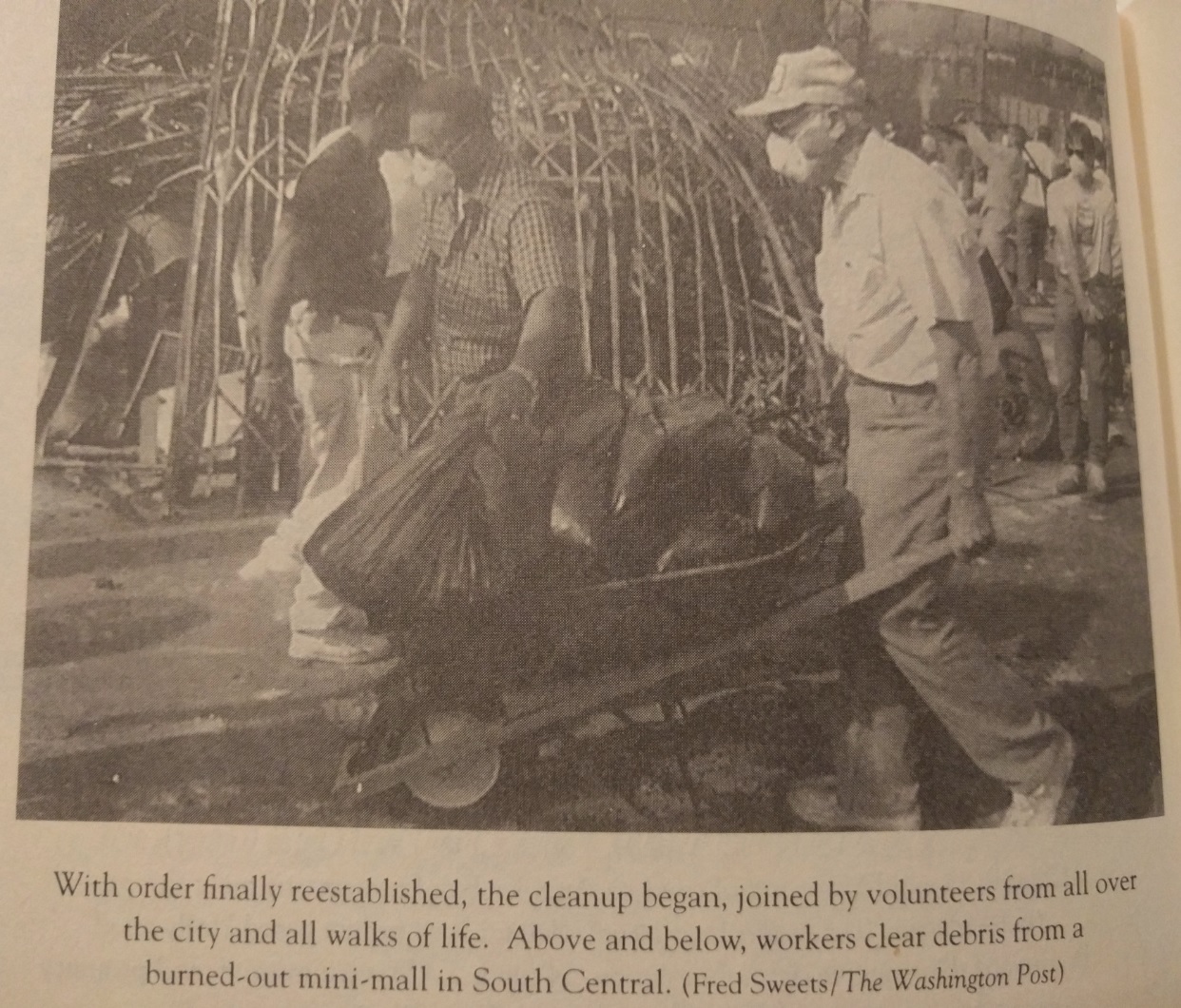
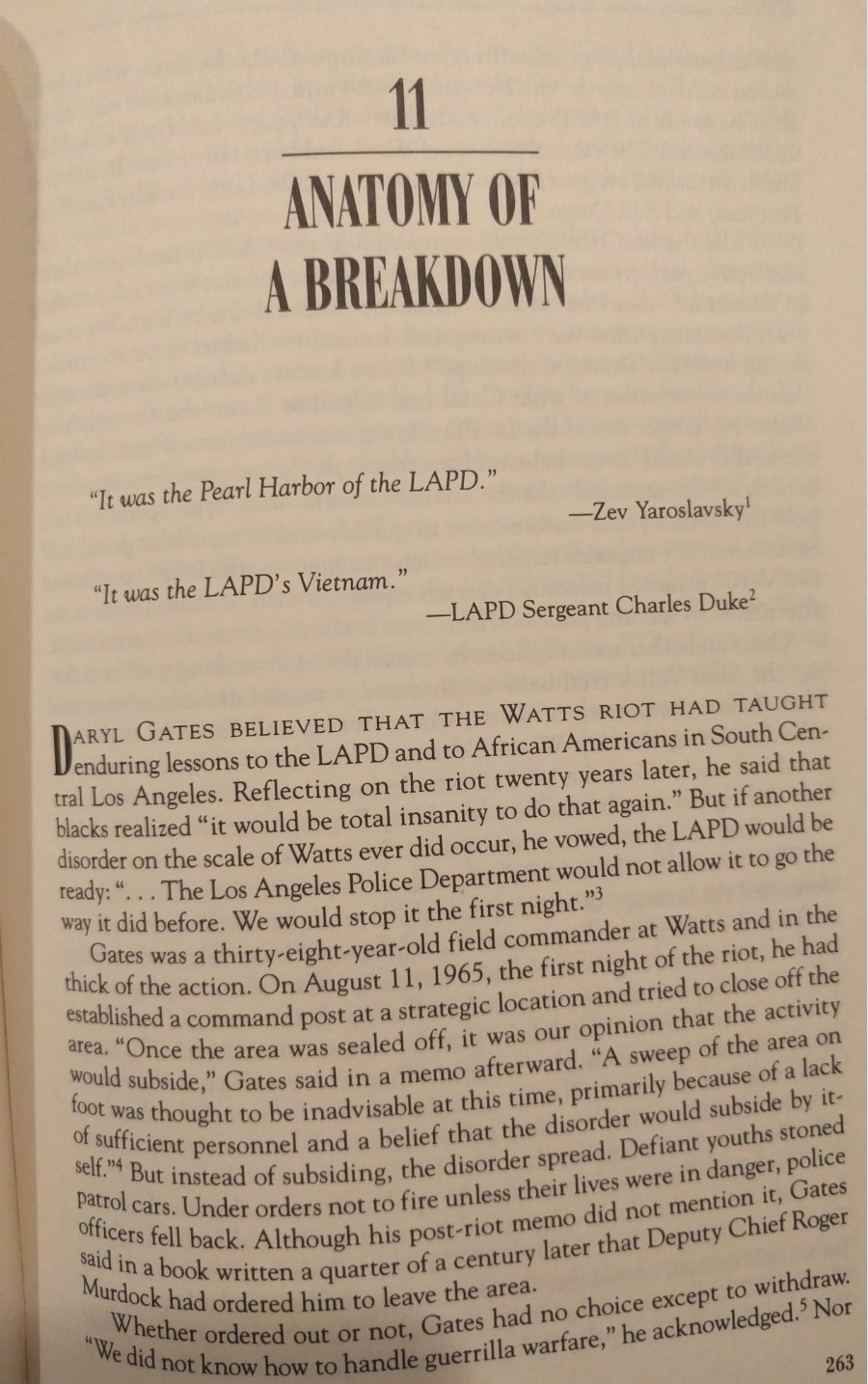
A few excerpts from the text. Tell me if it is not the best teaser ever tried.
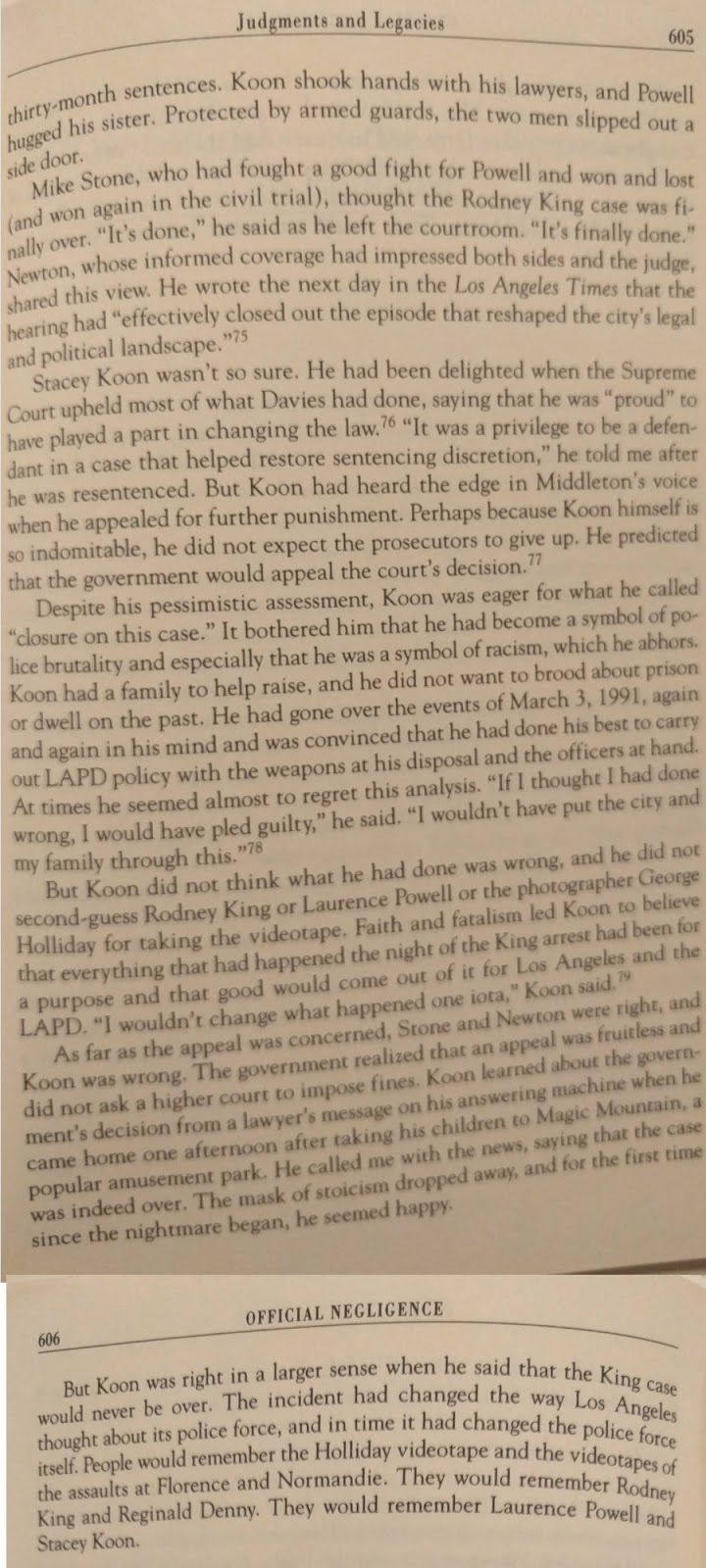
Finally, I could not help but reproduce the epilogue, which gives you perfect closure, following the entire tone of the writing. A masterpiece of research and journalism.
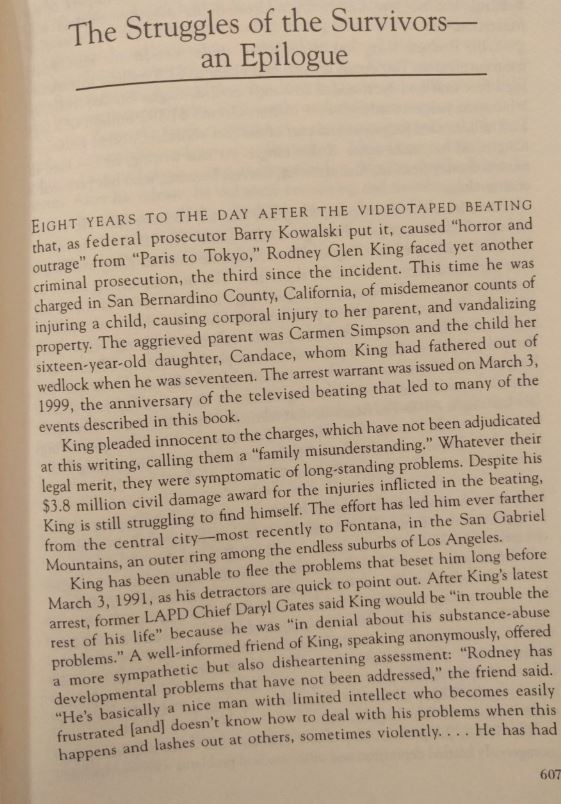
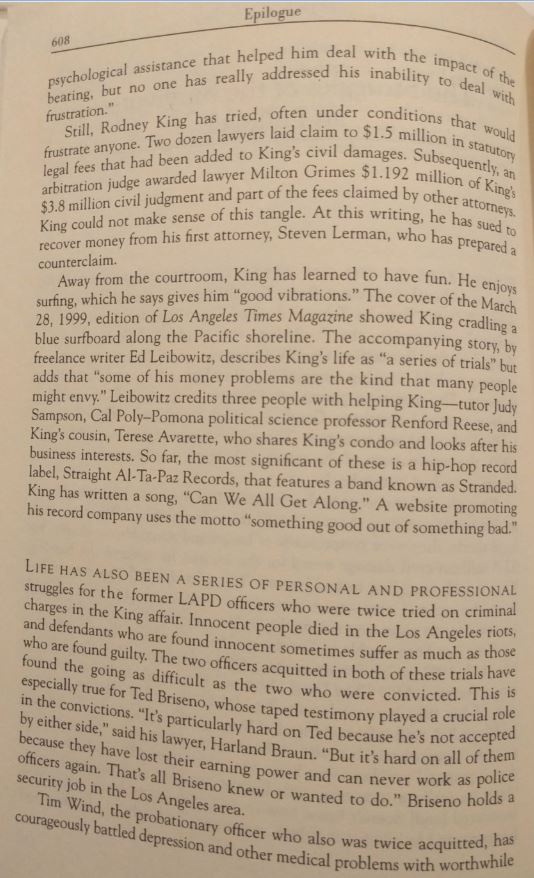

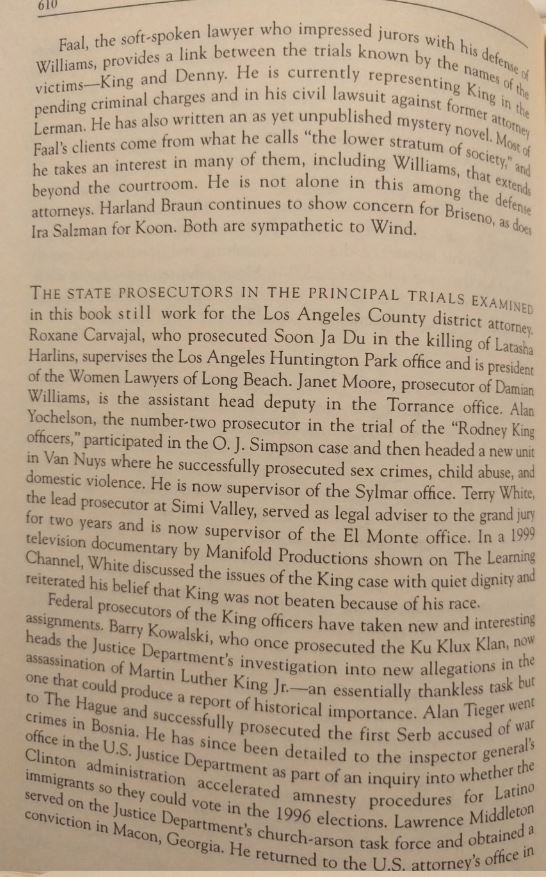
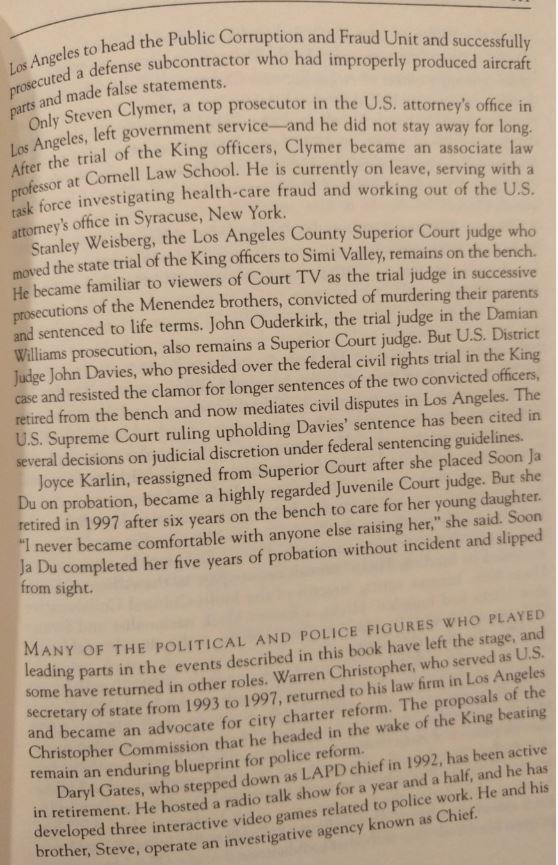
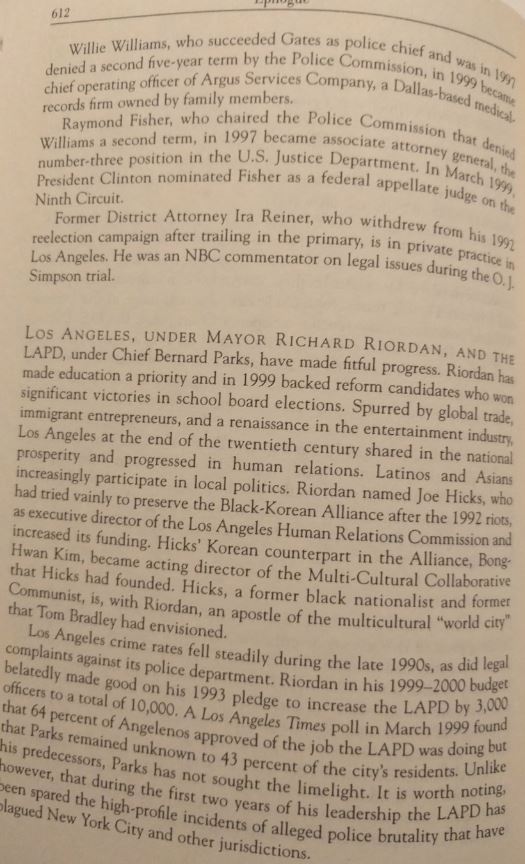
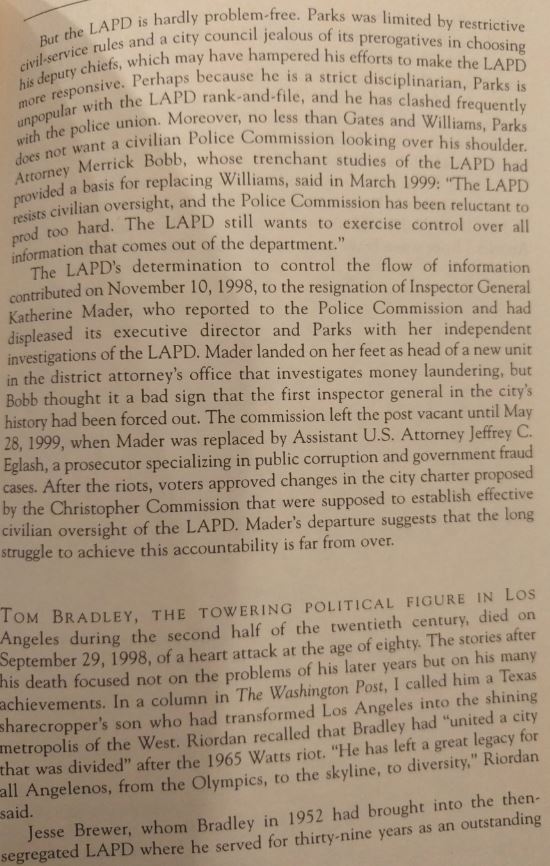
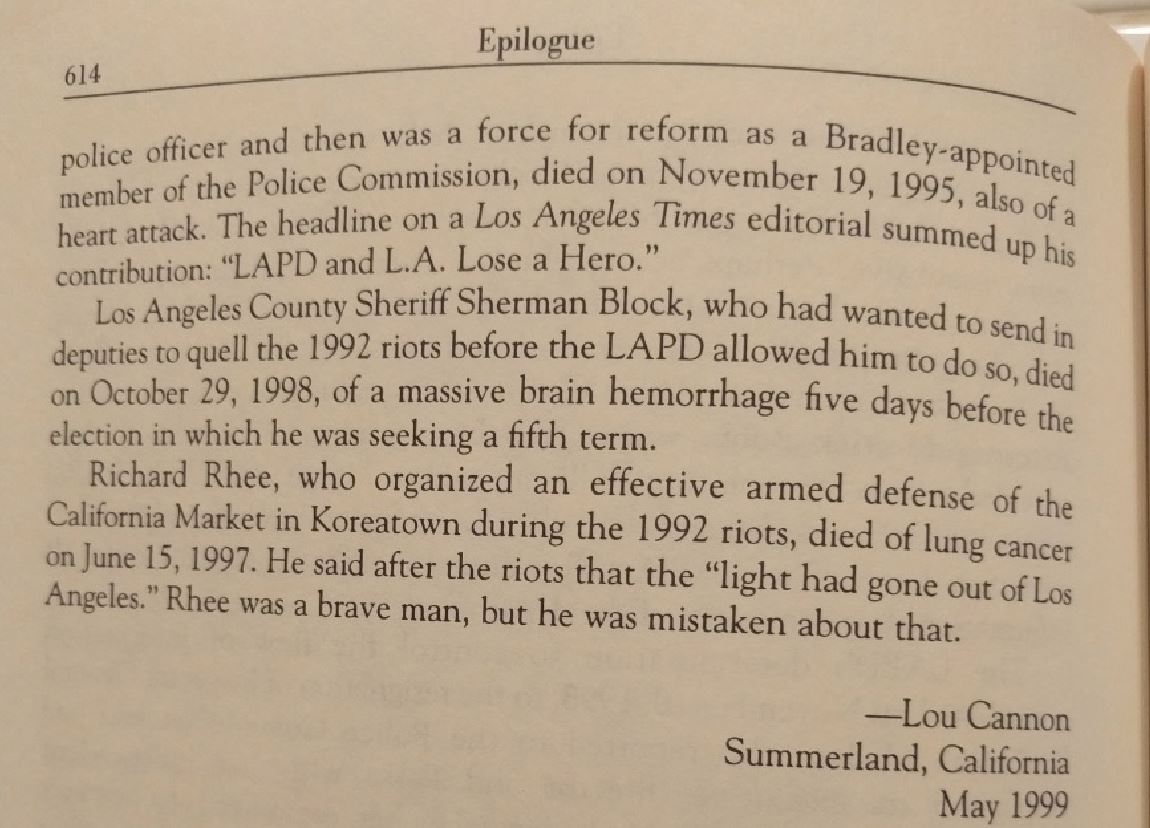
And after finally, the list of characters of this story. It is always good to read a story with a map, and this list is a perfect tool for orientation.
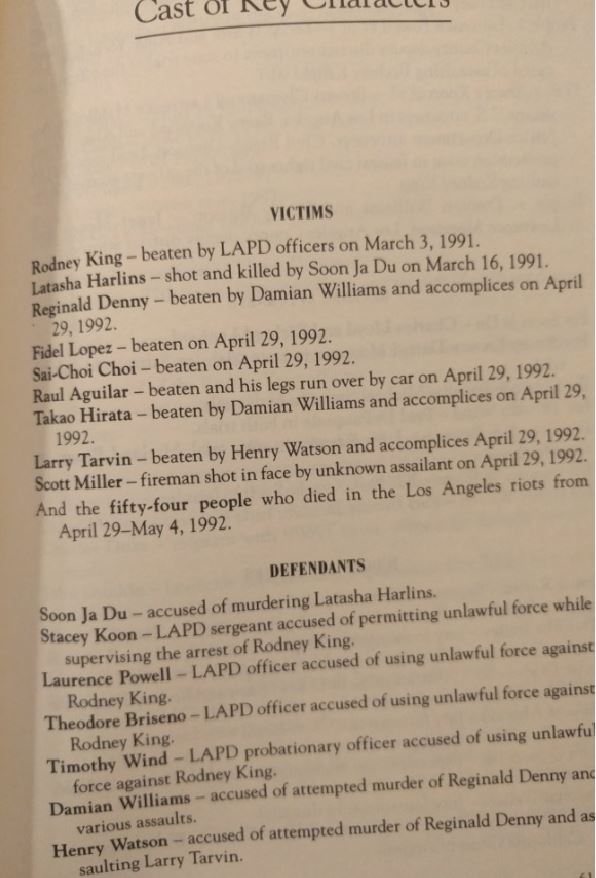


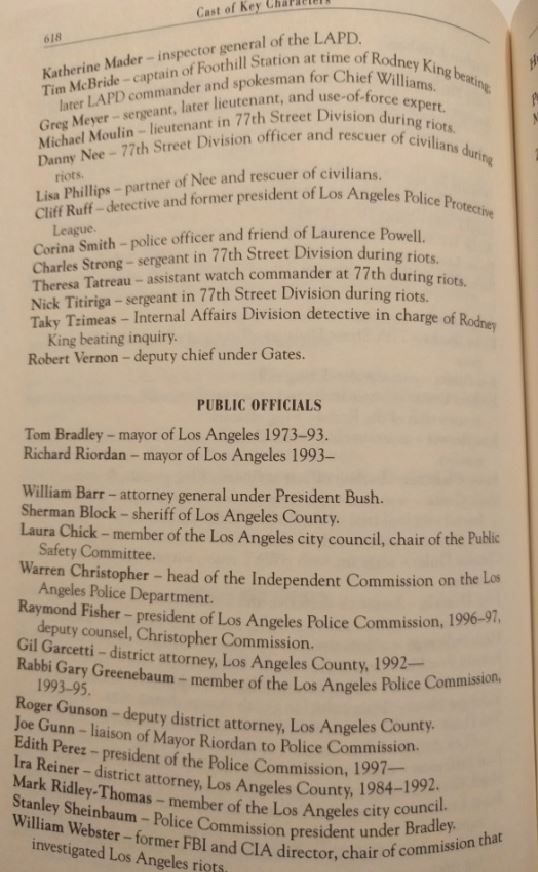

In conclusion, I liked this book a lot. The happenings that it depicts are difficult to read sometimes, and other times are sad; but one thing is real: Cannon really wanted to find the truth behind what happened, and he succeeds at providing a very good portrait of what happened before, during and after that obscure moment in the city.
I also have a blog! Link here:
http://lunairereadings.blogspot.com/2018/09/official-negligence-lou-cannon.html

July 18, 2009
Considering the national obsession with this 5-minute incident of alleged police brutality and the riots that followed the acquittal of the officers involved in it, there is surprisingly little serious writing about it. Lou Cannon's Official Negligence fills the void more than adequately, by making the effort to dig beneath the mountains of bullshit put forth by not only the usual political suspects on both sides of the fence, but by the media as well, and try to get at the truth. What Cannon, a writer for the Washington Post, discovered in his research is that the video that was drilled into the collective consciousness of the American public was a distortion, due to its missing some key footage; and that what went on on the night of March 3, 1991 was more a display of gross incompetence than racist brutality. Essential reading for anyone who is seeking to understand this particular historical event, or the political climate of the 90's in general.

Read
November 27, 2022Veteran California journalist Lou Cannon methodically and exhaustively reports the background and context of the Rodney King incident and subsequent trial of four Los Angeles police officers for brutality in an objective way. Cannon provides a historical landscape for race relations in L.A., a brief and interesting history of the LAPD, (an army unto itself) and how the chiefs since William Parker in the '50s and '60s shaped the modern police department. He reveals the shortcomings in training, staffing and empathy, but stays objective and refuses to demonize the police completely. He profiles many of the main characters of the era, including Chief Daryl Gates, Tom Bradley the longtime mayor, the four officers and many other main characters in the drama. 30 years later, the same basic problems of policing in the United States remain.
June 25, 2024
A NOTED JOURNALIST AND BIOGRAPHER LOOKS AT THESE EVENTS
Louis Cannon (born 1933) is an American journalist, non-fiction author, and biographer. He wrote in the Prologue to this 1997 book, “I covered the trials of the officers and the riots for The Washington Post… I at first assumed that the videotape of the King beating would assure conviction of the police defendants. I didn’t know that the tape shown repeatedly n television was a partial edited record. While the videotape is brutal in any version, the larger record is vital to any understanding of why the Simi Valley jurors acted as they did. In time I learned that the mythology of the King case concealed a complex story of official negligence in which local governments and the police department were implicated.
“For example, the political leaders of Los Angeles had insisted on equipping LAPD officers with bone-breaking metal batons even though they knew that use of these crude weapons produced a mounting toll of serious injuries. Meanwhile, the police department failed to train some officers---including the officer who delivered most of the blows to Rodney King---in the basic techniques of … taking a resistant suspect into custody without hurting him… The officers whom Joseph Wambaugh had celebrated as ‘new centurions’ proved to be knights in rusty armor, poorly equipped and badly led. It was widely believed in South Central that the LAPD did not want to protect the city’s poor, minority neighborhoods. The shocking reality was that the LAPD was unable to provide such protection… By understanding the causes of the Kin case and the riots, we may improve our chances of avoiding another descent into the chaos that gripped Los Angeles during five terrifying spring days in 192. That is the purpose of this book.”
He notes that “the tape that shaped the opinion of the world had been edited by KTLA from eighty-one seconds to sixty-eight seconds. This eliminated a blurry ten-second segment just preceding it that showed King’s charge at Powell. The charge … showed King’s resistance to being taken into custody… the missing three seconds would return to haunt the prosecution when the police officers accused … were tried.” (Pg. 23)
He states, “The belief [of Laurence Powell] that he had been engaged in a potential death struggle with someone on PCP would overshadow all of Powell’s memories of the incident… Powell and [Stacey] Koon never conceded that King was hit in the head and maintained that his head injuries were the result of falls to the ground… The truth is that Powell remembered so little except his fear that he could not have reconstructed the beating without the videotape.” (Pg. 32-33)
He records, “Over the next two years, King gave several conflicting accounts of the beating. His story changed nearly every time he told it… and at times he denied that he had been wither drinking or speeding. He told a federal grand jury that … he ran in Powell’s direction with his hands up so that officers could see he had no gun and would not shoot him. This statement has the ring of truth. King had seen Melanie Singer’s gun… The validity of King’s fear… is underscored … on the audio track… when a male voice can clearly be heard shouting… ‘You’re gonna get shot, you’re gonna get shot.’” (Pg. 44)
He continues, “The most pertinent criticism of Powell and the training that put him into an ineffective and brutal confrontation with King was made by Sergeant Duke... Duke believed that Powell was … no match for King in size or strength and unprepared by his training to take him into custody. ‘First of all, Powell should never have been out in the field… Because after … they found out that he was defective in his [baton] tactics and needed training, why put him back out in the field?’ … The LAPD tried unsuccessfully to muzzle Duke…” (Pg. 106-107)
He notes that after Korean store owner Soon Ja Du fatally shot 15-year old Latasha Harlins and received a light sentence, “Racial violence would terrify white people five months later when Reginald Denny was dragged from his truck and savagely beaten for no reason except his skin color. But there was no similar white outrage when the killing of Latasha Harlins went unpunished. Nonetheless, the Du sentence was an early warning of the firestorm that would engulf Los Angeles, claiming people of all races as victim and taking a heavy toll of Korean shops and markets.” (Pg. 171)
He acknowledges, “Among all the dubious actions by public officials during the disturbances none is as troubling as Gates’ astounding decision to leave his post. This action probably would have led to a court-martial if the LAPD were a true military organization… the Webster Commission called Gates; action ‘mystifying.’ As the commission saw it, Gates’ absence ‘compounded all of the department’s command and control problems.’ The report added: ‘Chief Gates himself cannot justify his decision to take a leisurely car ride to a Brentwood political event at this critical time.’” (Pg. 300)
He recounts, “Abandonment by the police was not the only surprise for Korean shopkeepers, who had expected to be overrun by blacks streaming north and west from South Central. But Richard Rhee was astonished to find that a majority of the looters repulsed by his guards---70 percent by his estimate---were Latino… Because a police presence was lacking, however, the riots that began as an expression of black rage became a massive looting sprees… On the first day, they were mostly a race riot pitting blacks against everyone else. They became a ‘minority riot’ on the second and third days, as the police breakdown created tempting targets of looting opportunity, especially in South Central.” (Pg. 337)
He explains, “the withdrawal of troops marked the end of one ordeal and the beginning of another. The riots had wrecked the infrastructure of the city’s poorest neighborhoods. In a sprawling with where public transportation is at best inadequate, hard lives became especially har for those without an automobile. Many neighborhoods no longer had any grocery stores, and most of the mini-malls where the poor had done their shopping had disappeared. Gone… were drugstores, clothing stores, and discount variety stores. Gone, too, were jobs, at least 30,000 of them, in neighborhoods where they had been scarce to begin with.” (Pg. 347-348)
In federal prosecutor Steven Clymer’s opening statement, “was the disclosure that Powell and Wind had not taken King directly from Pacifica Hospital, where he was first treated for his injuries, to Los Angeles County—USC Medical Center. Instead, disobeying Koon’s orders, they have driven to Foothill Staton, where Powell had officers ‘go out and look at Rodney King in the car.’ The officers then covered up their side trip by putting down the wrong times on their logs… The apparent treatment of King as a trophy was a bombshell that gave reporters a lead for their first-day story.” (Pg. 412)
LAPD sergeant Mark Conta testified that “[Powell] has violated policy… Rodney King is on the ground now… He’s not displaying any behavior of being combative or aggressive.” He continued, “Wind had been out of policy because he delivered baton blows and ‘brutal kicks’ while King was on the ground… ‘Sergeant Koon has an opportunity to take control of the situation… He should tell those officers to put their batons away… and handcuff and cord cuff Rodney King.’” But Cannon adds, “The tactic had failed. King had thrown the officers off his back, climbed to his feet even after being hit with two volleys of the electric stun gun that Koon had fired into him, and charged at Powell.” (Pg. 418)
He summarizes the aftermath, “The officers continue to leave their batons behind… The punishments given the officers in the King case sent a far louder message than any memo form the deputy chief… they were aware that officers who used their batons were now more likely to be required to justify their conduct than before the King case… Small wonder that few officers bothered to drive down the alleys where the gangsters were. In the post-King LAPD, such aggressiveness was not worth the risk… the Taser… also fell into disuse… No sergeant wanted to use a Taser and become another Stacey Koon.” (Pg. 547)
He acknowledges, “The LAPD’s subsequent handling of [the disability pension application of detective Mark] Fuhrman was remiss. Either Fuhrman was an avowed racist with violent impulses or he was willing to tell outrageous lies to obtain a public pension to which he was not entitled… According to Ira Reiner, who was then the city attorney, ‘The department should have initiated proceedings to remove Fuhrman without granting him a pension.’ Instead, the LAPD assigned Fuhrman a desk job …Eight months later he was given back his gun and returned to the streets as a patrol officer.” (Pg. 553)
This is perhaps the most detailed book about the trial and the riots; it will be of great interest those studying these events.
Louis Cannon (born 1933) is an American journalist, non-fiction author, and biographer. He wrote in the Prologue to this 1997 book, “I covered the trials of the officers and the riots for The Washington Post… I at first assumed that the videotape of the King beating would assure conviction of the police defendants. I didn’t know that the tape shown repeatedly n television was a partial edited record. While the videotape is brutal in any version, the larger record is vital to any understanding of why the Simi Valley jurors acted as they did. In time I learned that the mythology of the King case concealed a complex story of official negligence in which local governments and the police department were implicated.
“For example, the political leaders of Los Angeles had insisted on equipping LAPD officers with bone-breaking metal batons even though they knew that use of these crude weapons produced a mounting toll of serious injuries. Meanwhile, the police department failed to train some officers---including the officer who delivered most of the blows to Rodney King---in the basic techniques of … taking a resistant suspect into custody without hurting him… The officers whom Joseph Wambaugh had celebrated as ‘new centurions’ proved to be knights in rusty armor, poorly equipped and badly led. It was widely believed in South Central that the LAPD did not want to protect the city’s poor, minority neighborhoods. The shocking reality was that the LAPD was unable to provide such protection… By understanding the causes of the Kin case and the riots, we may improve our chances of avoiding another descent into the chaos that gripped Los Angeles during five terrifying spring days in 192. That is the purpose of this book.”
He notes that “the tape that shaped the opinion of the world had been edited by KTLA from eighty-one seconds to sixty-eight seconds. This eliminated a blurry ten-second segment just preceding it that showed King’s charge at Powell. The charge … showed King’s resistance to being taken into custody… the missing three seconds would return to haunt the prosecution when the police officers accused … were tried.” (Pg. 23)
He states, “The belief [of Laurence Powell] that he had been engaged in a potential death struggle with someone on PCP would overshadow all of Powell’s memories of the incident… Powell and [Stacey] Koon never conceded that King was hit in the head and maintained that his head injuries were the result of falls to the ground… The truth is that Powell remembered so little except his fear that he could not have reconstructed the beating without the videotape.” (Pg. 32-33)
He records, “Over the next two years, King gave several conflicting accounts of the beating. His story changed nearly every time he told it… and at times he denied that he had been wither drinking or speeding. He told a federal grand jury that … he ran in Powell’s direction with his hands up so that officers could see he had no gun and would not shoot him. This statement has the ring of truth. King had seen Melanie Singer’s gun… The validity of King’s fear… is underscored … on the audio track… when a male voice can clearly be heard shouting… ‘You’re gonna get shot, you’re gonna get shot.’” (Pg. 44)
He continues, “The most pertinent criticism of Powell and the training that put him into an ineffective and brutal confrontation with King was made by Sergeant Duke... Duke believed that Powell was … no match for King in size or strength and unprepared by his training to take him into custody. ‘First of all, Powell should never have been out in the field… Because after … they found out that he was defective in his [baton] tactics and needed training, why put him back out in the field?’ … The LAPD tried unsuccessfully to muzzle Duke…” (Pg. 106-107)
He notes that after Korean store owner Soon Ja Du fatally shot 15-year old Latasha Harlins and received a light sentence, “Racial violence would terrify white people five months later when Reginald Denny was dragged from his truck and savagely beaten for no reason except his skin color. But there was no similar white outrage when the killing of Latasha Harlins went unpunished. Nonetheless, the Du sentence was an early warning of the firestorm that would engulf Los Angeles, claiming people of all races as victim and taking a heavy toll of Korean shops and markets.” (Pg. 171)
He acknowledges, “Among all the dubious actions by public officials during the disturbances none is as troubling as Gates’ astounding decision to leave his post. This action probably would have led to a court-martial if the LAPD were a true military organization… the Webster Commission called Gates; action ‘mystifying.’ As the commission saw it, Gates’ absence ‘compounded all of the department’s command and control problems.’ The report added: ‘Chief Gates himself cannot justify his decision to take a leisurely car ride to a Brentwood political event at this critical time.’” (Pg. 300)
He recounts, “Abandonment by the police was not the only surprise for Korean shopkeepers, who had expected to be overrun by blacks streaming north and west from South Central. But Richard Rhee was astonished to find that a majority of the looters repulsed by his guards---70 percent by his estimate---were Latino… Because a police presence was lacking, however, the riots that began as an expression of black rage became a massive looting sprees… On the first day, they were mostly a race riot pitting blacks against everyone else. They became a ‘minority riot’ on the second and third days, as the police breakdown created tempting targets of looting opportunity, especially in South Central.” (Pg. 337)
He explains, “the withdrawal of troops marked the end of one ordeal and the beginning of another. The riots had wrecked the infrastructure of the city’s poorest neighborhoods. In a sprawling with where public transportation is at best inadequate, hard lives became especially har for those without an automobile. Many neighborhoods no longer had any grocery stores, and most of the mini-malls where the poor had done their shopping had disappeared. Gone… were drugstores, clothing stores, and discount variety stores. Gone, too, were jobs, at least 30,000 of them, in neighborhoods where they had been scarce to begin with.” (Pg. 347-348)
In federal prosecutor Steven Clymer’s opening statement, “was the disclosure that Powell and Wind had not taken King directly from Pacifica Hospital, where he was first treated for his injuries, to Los Angeles County—USC Medical Center. Instead, disobeying Koon’s orders, they have driven to Foothill Staton, where Powell had officers ‘go out and look at Rodney King in the car.’ The officers then covered up their side trip by putting down the wrong times on their logs… The apparent treatment of King as a trophy was a bombshell that gave reporters a lead for their first-day story.” (Pg. 412)
LAPD sergeant Mark Conta testified that “[Powell] has violated policy… Rodney King is on the ground now… He’s not displaying any behavior of being combative or aggressive.” He continued, “Wind had been out of policy because he delivered baton blows and ‘brutal kicks’ while King was on the ground… ‘Sergeant Koon has an opportunity to take control of the situation… He should tell those officers to put their batons away… and handcuff and cord cuff Rodney King.’” But Cannon adds, “The tactic had failed. King had thrown the officers off his back, climbed to his feet even after being hit with two volleys of the electric stun gun that Koon had fired into him, and charged at Powell.” (Pg. 418)
He summarizes the aftermath, “The officers continue to leave their batons behind… The punishments given the officers in the King case sent a far louder message than any memo form the deputy chief… they were aware that officers who used their batons were now more likely to be required to justify their conduct than before the King case… Small wonder that few officers bothered to drive down the alleys where the gangsters were. In the post-King LAPD, such aggressiveness was not worth the risk… the Taser… also fell into disuse… No sergeant wanted to use a Taser and become another Stacey Koon.” (Pg. 547)
He acknowledges, “The LAPD’s subsequent handling of [the disability pension application of detective Mark] Fuhrman was remiss. Either Fuhrman was an avowed racist with violent impulses or he was willing to tell outrageous lies to obtain a public pension to which he was not entitled… According to Ira Reiner, who was then the city attorney, ‘The department should have initiated proceedings to remove Fuhrman without granting him a pension.’ Instead, the LAPD assigned Fuhrman a desk job …Eight months later he was given back his gun and returned to the streets as a patrol officer.” (Pg. 553)
This is perhaps the most detailed book about the trial and the riots; it will be of great interest those studying these events.
September 1, 2020
This is a truly even-handed account of the beating, the trials, and the aftermath. Some might read Cannon as conservative, and that might even be fair; I would call him an extremely diligent reporter who has many if not all of the facts at his command and who is completely fair even if he does have a blind spot or two. Highly recommended if you want to understand an event that is at the foundation of the current Black Lives Matter movement.
August 11, 2025
The most thorough and unbiased account of a highly controversial event in our nation's history. It gives a excellent brief history of the LAPD and Los Angeles as a whole and actually delves into the backgrounds of all the people involved in the incident and how they came together on one fateful night. There is so much that has been left out of mainstream historiography of the Rodney King beating and the resulting trial and riots and this book fleshes it all out.
June 15, 2020
An engrossing account of a misunderstood event that changed a generation.
January 20, 2021
Well written. It allocates blame in a thoughtful and clear way. It does a good job of contextualizing the riots within the history of L.A. and the LAPD.

August 27, 2022
i feel like i learned a lot but this was a borderline-reference book that took me forever to get through and wasn't super correct in today's climate

May 22, 2024
Mr. Cannon produces a concise work, which consideres multiple facts and perspectives, before coming to its logical conclusions.

January 17, 2022
This is an epic account of the LA police, the beating of Rodney King and the murder of Latasha Harlins, and the riots/uprising and their aftermath. And in its scope it becomes a story of Los Angeles itself. Like a Russian epic, there is such a vast cast of characters, so many names, that I wished for a Russian style list of characters - it was only when I'd finished the book that I found such a cast of characters was provided at the end. D'oh!
I don't generally research the background of an author before I read a book. In reading this, I detected an ideological slant from the author that was confirmed by observing his other works - such as biographies of Ronald Reagan - that confined a conservative bent. This is in contrast to my own political beliefs, and especially in what I have learned through university studies and my career, in the most successful ways of working with disadvantaged communities. Nonetheless, I found the author to be fair handed, for the most part, in dealing with difficult and sensitive subjects.
The four star rating reflects the intense research which has gone into writing this, if not definitive, then at least exhaustive (and at times exhausting) social history. I can't say it was a pleasure to read - given the subject matter, it could hardly be other than at times frustrating, depressing and aggravating - but I'm glad I read it; I feel better informed.
I don't generally research the background of an author before I read a book. In reading this, I detected an ideological slant from the author that was confirmed by observing his other works - such as biographies of Ronald Reagan - that confined a conservative bent. This is in contrast to my own political beliefs, and especially in what I have learned through university studies and my career, in the most successful ways of working with disadvantaged communities. Nonetheless, I found the author to be fair handed, for the most part, in dealing with difficult and sensitive subjects.
The four star rating reflects the intense research which has gone into writing this, if not definitive, then at least exhaustive (and at times exhausting) social history. I can't say it was a pleasure to read - given the subject matter, it could hardly be other than at times frustrating, depressing and aggravating - but I'm glad I read it; I feel better informed.

June 21, 2020
In 2020, and probably into 2021, the legal systems in Minneapolis and Atlanta will be confronted with police officers charged with the murders of George Floyd and Rayshard Brooks. On March 3, 1991, a 26-year-old African American man, Rodney King, was severely beaten and arrested by officers from the Los Angeles Police Department (LAPD) -an arrest/beating caught, in part, on videotape. Thirteen days later a 14-year-old African American girl, Latasha Harlins, was murdered by a Korean store owner in South Los Angeles - a murder caught, by the store's security camera, on videotape. The videotape evidence in both cases seemed indisputable -beyond any possible doubt. However, in court, the tapes became an ambiguous record open to different interpretations. The four LAPD officers charged in the King case were all found not guilty. A second trial on federal charges led to the conviction of two of the four. The Korean shop owner was found guilty of murder, but at her sentencing, the judge let her go free - not one day in prison. Can you say rage? Uprising? Noted journalist and biographer Lou Cannon's "Official Negligence" (published in 1997) primarily details and analyzes the Rodney King case and the subsequent "riots." UCLA Professor of History Brenda Stevenson brilliantly examines the Latasha Harlins case in "The Contested Murder of Latasha Harlins: Justice, Gender, and the Origins of the LA Riots" published in 2013. It is possible that the King and Harlins cases and their subsequent events might be able to cast some insight on what is to come in Minneapolis and Atlanta. A template, if you will. The anatomy of the King and Harlins trials may prove instructive. Both Cannon and Stevenson offer roadmaps of what to watch for from prosecutors, defense teams, witnesses, the police, judges, juries, politicians, and the media. Two books that are well worth your time and effort. Absolutely 5 stars for Stevenson's book.
August 26, 2015
I loved this book. Cannon does an outstanding job juggling lots of storylines and turning a mountain of detailed reporting into something readable and thought-provoking.

December 30, 2015
Finally finished! Very long and dense with info, but an excellent narrative around Rodney King, the riots, and other incidents that got way less press but are just as important.

November 15, 2018
I think about this book nearly everyday.
Displaying 1 - 15 of 15 reviews