Winner — IACP 2019 Reference & Technical Cookbook Award
From apples and oranges to pawpaws and persimmons
"Sara Bir’s voice is quirky, informed, and fresh. The Fruit Forager’s Companion will push any soul who is interested in foraging into the curious world of fruits. . . . You want someone with passion and appetite to lead you on a foraging quest, and Sara has plenty of both."—Deborah Madison, author of Vegetable Literacy and In My Kitchen
Half of the fruit that grows in yards and public spaces is never picked or eaten. Citrus trees are burdened with misshapen lemons, berries grow in tangled thickets on the roadside, and the crooked rows of abandoned orchards fill with fallen apples. At the same time, people yearn for an emotional connection that’s lacking in bland grocery store bananas and tasteless melons.
The Fruit Forager’s Companion is a how-to guide with nearly 100 recipes devoted to the secret, sweet bounty just outside our front doors and ripe for the taking, from familiar apples and oranges to lesser-known pawpaws and mayhaws. Sara Bir—a seasoned chef, gardener, and forager—primes readers on foraging basics, demonstrates gathering and preservation techniques, and presents a suite of recipes including habanero crabapple jelly, lime pickle, pawpaw lemon curd, and fermented cranberry relish.
Bir encourages readers to reconnect with nature and believes once the foraging mindset takes control, a new culinary world hiding in plain sight will reveal itself. Written in a witty and welcoming style, The Fruit Forager’s Companion is a must-have for seekers of both flavor and fun.
Sara Bir is a chef, culinary educator, and author of three cookbooks, The Pocket Pawpaw Cookbook, Tasting Ohio and The Fruit Forager's Companion. The latter won a 2019 IACP Cookbook Award. Her writing has been featured in Best Food Writing, Saveur, Lucky Peach, Full Grown People, Edible Ohio Valley, Ohio Magazine, and many other publications.
This gorgeous culinary nature guide should find a place on the shelves or Kindles of anyone who enjoys cooking fruit. The author tells us how she walks and forages, mentally mapping out the locations of likely harvests and returning later to take advantage. Whether garden apple trees that are under-utilised, or wild berries (like the eponymous huckleberry of Huckleberry Finn) or pick your own raspberries, the fruit picker has the choice crop and it's free or cheap.
Look forward to the luscious recipes in the book, like buckwheat huckleberry buckle, with colourful photos of preserves and pies to accompany the illustrations; and photos of the growing fruits in situ. After all, you need to be sure what you are picking. A few toxic relatives - like nightshade - are shown so you can tell them apart. And we get a warning to watch out for thorns and poison oak.
The book is set in North America, where folks are lucky enough to have grapes growing wild, paw paws and lemons fruiting in random parks and bogs with cranberries and blueberries. Then there are odder natives like mahonias and mayhaws. If you have not explored your neighbourhood, maybe it's time you did. The history and notable uses of the trees and shrubs - gooseberries or elder, say - are listed, so you can get to know the plant. I found every page a delight, with informative but accessible language and enough detail for the botanist. The photos are an inspiration, whether to plant some shrubs in your garden or to cook and store the crops.
Some useful tools for picking - minimal - and cooking are listed at the start. Some useful resources are placed at the end, such as websites, books and a Youtube vlogger who eats the weeds. The whole is a delight.
I downloaded an e-ARC from Net Galley, which means I now have to go and buy my own copy. This is an unbiased review.
Disclaimer: I received an advance reading copy from NetGalley in exchange for a review.
I've recently gotten interested in foraging but didn't know where to start (well, and had to wait for winter to end). Having moved to a new state within the last year, I'm not that familiar with the plants available to me. This book helps give an overall picture of what's available in the continental US. (If you're in Hawai'i, I'm afraid this probably won't be of much use to you. She doesn't go out of her way to include Alaska, either, but as a born-and-raised Alaskan whose grandma took her out berrypicking every year, I know a lot of the berries she includes in "northern US" and other similar descriptions do, indeed, grow in Alaska.)
The book also has appealing, well-written recipes to help inspire you if you're not sure what to do with some of your foraged treasure. Most of them could be used with store-bought fruit, too.
Helpfully, the author includes warnings for some (mostly wild) plants that aren't safe to eat, especially some that look similar to other safe-to-eat plants. I can see this being especially useful for beginners like me and transplants to a new area who aren't as familiar with the local plants.
What it's missing: a chart summarizing all the edibles strewn throughout the book. At the beginning of each section on a particular fruit, there's information about where it's found in broad terms, such as northeastern US. It would be really handy if there were an overall chart summarizing this so it was available all in one place. It would be fantastically helpful if there were also estimates of when each particular fruit is ready to harvest. I know specifics aren't possible because of the size of the country we're dealing with, but general statements like "mid-summer" or "late autumn" would be helpful for planning foraging outings.
Overall, this is a really good intro to foraging and an excellent cookbook for foraged fruits. I hope to put it to use in Colorado when plants start fruiting.
When I received a digital ARC of Sara Bir's The Fruit Forager’s Companion, the only thing I didn't like was the fact that it was deleted after the review period and I didn't get to keep a copy.
I absolutely loved this book and plan to purchase a copy of my own.
As most of our blog readers know, our family forages a LOT. We put up about 300-400 pounds of wild foods a year. Much of that is fruits -- apples, pears, gooseberries, wild plums, bush cherries and of course elderberries (most readers also know that I've written a book about foraging and using elderberries and we forage at least 20 gallons of elderberries each year). I am constantly looking for new ways to use our fruits, especially as I'm not big on just making sugar-laden jellies or pies with everything. I'm also always looking to expand the fruits we forage. This book fits the bill on both.
The book provides general information on foraging, lots of color photos for ID purposes, info on each fruit, and a few recipes for each.
Not only are these fruits covered in detail, but the book also highlights poisonous look-alikes to avoid.
Many of these fruits aren't in our area (zone 4 Minnesota) but enough of them are to make this book invaluable. (For readers in our area, I also highly recommend the books Wild Berries & Fruits Field Guide of Minnesota, Wisconsin & Michigan (Wild Berries & Fruits Identification Guides) and Cooking Wild Berries Fruits of MN, WI, MI (Foraging Cookbooks) by Teresa Marrone).
Recipes include Meyer lemon kimchi, habanero crabapple jelly, pawpaw lemon curd, and fermented cranberry relish.
The author also includes recipes for foods to complement the fruits, such as kolachi (jelly filled cookies) and granola.
At 400 pages, this is a book that will be put to good use by foragers of any skill level.
Sara Bir is a treasure. This book is both informational and witty in its writing. Reading it made me feel like parts of it are written in my own snarky voice.
I appreciate the work the author put into not only highlighting muscadines and scuppernongs, but also explaining the connotations of each's name. That is a rarity in books as many barely feature them and most that do use the name muscadine exclusively. It shows some real work was put into learning about them.
The safety information here is relatively sparse, but valuable when it pops up. In particular, the gingko and prickly pear harvesting tips are helpful if one is unfamiliar with them. I also like that the author explains to not just go HAM on wild fruits because some of them will (if eaten enough) give you gastro-intestinal distress. It's quality information. Also, cheers on the pokeweed information because I swear its the forager FAQ everywhere I look --and Bir explains the contentious issue around its edibility. (And for those who aren't going to read the book: let me assure you that if you're not up to reading safety info about pokeweed, you are also not up to safely cooking and eating the parts that could edible.)
Some of my favorite parts: * . . . there were unlimited crab apples for the taking. Why, then, are people not beating each other down to get to these things? Because they are a pain in the ass. * A default trope of foraged fruits is making some obscure, painfully bitter knob of a berry into jelly. (Later she attempts to do this with kousa dogwood berries, THE bitter knob of a berry without success because they are THE WORST. A++) * All wild grapes are edible, but not all of them are tasty . . . One hot and wet year, some finally ripened to a lovely purple shade. They still tasted like shit. * Generally, we can't pick out exactly how or when we die. I don't want to die tomorrow, but I could. . . * Papayas are not pawpaws, and paw paws are not papayas. . . the pawpaws the carefree bear Baloo sang about in Disney's adaptation of The Jungle Book are papayas not Asimina triloba. * The whole persimmon section where she indicates they are the American fruit stepchild and includes a [insert fruit] bread recipes to show that off --comedy gold
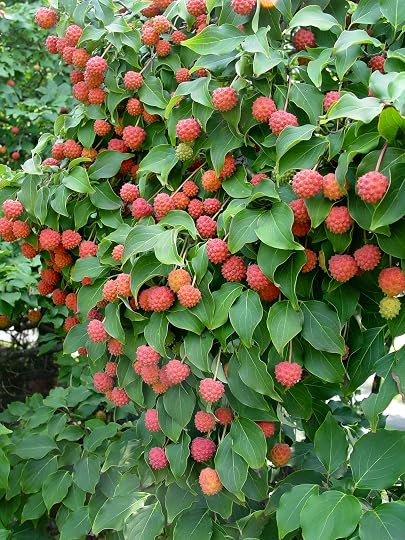
Here's that offending dogwood berry if you're feeling spunky. It's fall and they are out right now --I saw a bush/tree last week:
Now all I have to do is go in search of these treats! Sadly, I live in an urban area and there really is little to forage in terms of fruit. Growing up I used to forage sugar pears at abandoned homesteads, blackberries, strawberries, and even apples, It's difficult to find these yummy treats now, but I do keep an eye out for them! But If you happen upon some of these delicious fruits in your foraging, this recipe has lots of great recipes for using them! And the photos of the dishes make me wish I had free fruit to create them with, but farmers market and neighbors fruit trees may have to suffice..
the idea of this book is superb and fleeting. tho I'm learning just a bit, i'm not a fan of the voice and the hodgepodge recipes aren't groundbreaking. i don't appreciate the sentiment that food isn't medicine, cause it is, or the organization, with random berries and fruits interspersed among the ones with treatises that should be odes but fall short and are often laced with a weird sarcasm. also not sure how i feel about the inclusion of poisonous berries, what is to say someone won't miss the simple warning when skimming through.
An informative and super fun guide to all things foraged fruit. Written by a true forager and fruit lover, it has great info as well as countless tasty recipes. Lovely to look at as well.
Well-written and inspiring guide to finding and using foraged fruits. Could use a bit more on the identifying-the-right-plant front, but gives resources for finding that information.