

What do you think?
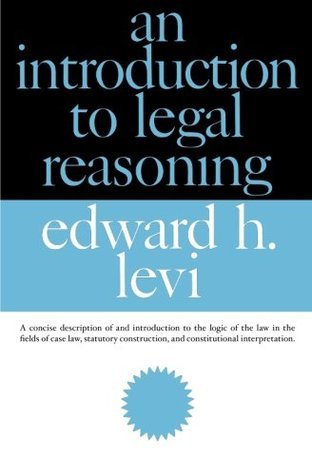
An Introduction to Legal Reasoning
This volume will be of interest and value to students of logic, ethics, and political philosophy, as well as to members of the legal profession and to everyone concerned with problems of government and jurisprudence. By citing a large number of cases, the author makes his presentation of the processes of judicial interpretation particularly lucid.
120 pages, Paperback
First published February 15, 1962
Ratings & Reviews
Friends & Following
Create a free account to discover what your friends think of this book!
Community Reviews
Displaying 1 - 22 of 22 reviews

July 1, 2010
I love this book. The book reminds me of my first days in law school, because this is one of the first texts we used for required reading. However, the book harkens nostalgia for me, but it remains a strong and articulate text for understanding legal reasoning. This work exemplifies the way in which legal scholars, lawyers, judges, and citizens must review cases, digest cases, and reason in ways that make the rule of law the foundation on which our republic is built.

December 3, 2021
It was what it was.
Legal reasoning is a three-step process:
1. Similarity between cases
2. Rule of law in the first case announced
3. Rule of law from the first case is made applicable to the second case
Judges determine the similarity/differences.
Reasoning by example indicates the hold that the process of law has over people, as people have participated in the law-making and are therefore bound by something they helped to create.
"It is only folklore which holds that a statute if clearly written can be completely unambiguous and applied as intended to a specific case" (pg 6)
Constitutions give courts greater freedom to interpret than with regards to the application of statutes or case law, as the constitution sets up "conflicting ideals of the community in certain ambiguous categories" (pg 7) which allows the court to be inconsistent
Cardozo said something to the effect of "the word starts out to free thought and ends by enslaving it" (pg 8)
Words of a statute aren't dicta, and therefore the intent of the legislature is important when interpreting. The actual words of the statute are not the entire picture, and other clues as to intent can be gained from reports, conduct, revisions, etc.
Case-law interpretations can be reworked through the use of broad or narrow interpretations.
Book gives examples regarding the legal reasoning process in regards to inherently dangerous items & third party liability and interstate commerce regulating morality.
Page 104:
"This is the only kind of system which will work when people do not agree completely. The loyalty of the community is directed toward the institution in which it participates."
Legal reasoning is a three-step process:
1. Similarity between cases
2. Rule of law in the first case announced
3. Rule of law from the first case is made applicable to the second case
Judges determine the similarity/differences.
Reasoning by example indicates the hold that the process of law has over people, as people have participated in the law-making and are therefore bound by something they helped to create.
"It is only folklore which holds that a statute if clearly written can be completely unambiguous and applied as intended to a specific case" (pg 6)
Constitutions give courts greater freedom to interpret than with regards to the application of statutes or case law, as the constitution sets up "conflicting ideals of the community in certain ambiguous categories" (pg 7) which allows the court to be inconsistent
Cardozo said something to the effect of "the word starts out to free thought and ends by enslaving it" (pg 8)
Words of a statute aren't dicta, and therefore the intent of the legislature is important when interpreting. The actual words of the statute are not the entire picture, and other clues as to intent can be gained from reports, conduct, revisions, etc.
Case-law interpretations can be reworked through the use of broad or narrow interpretations.
Book gives examples regarding the legal reasoning process in regards to inherently dangerous items & third party liability and interstate commerce regulating morality.
Page 104:
"This is the only kind of system which will work when people do not agree completely. The loyalty of the community is directed toward the institution in which it participates."
Currently Reading
June 23, 2009This is a very difficult book to read. It requires complete concentration.

December 28, 2024
As it is an old book, the language was a bit odd, and very hard to understand at some time, but it was readable.
It was interesting to see how the rules of the American legal system first formed, it's actually very peculiar how analogies worked and how the judges thought back then, especially that we already have established rules that regulate all the matters they had issues governing, some judgments were a bit silly IMO but it was an informative read.
It was interesting to see how the rules of the American legal system first formed, it's actually very peculiar how analogies worked and how the judges thought back then, especially that we already have established rules that regulate all the matters they had issues governing, some judgments were a bit silly IMO but it was an informative read.

June 14, 2007
Flat textbook writing at its most mind-numbing. Don't be fooled by those who say you "must" read it before law school. If you're starting law school in the fall and want a head start, get John Delaney's Learning Legal Reasoning.

January 18, 2013
I'd probably appreciate it more if I completely understood it. A good overview of how a body of law expands and changes in constitutional, case law, and statutory contexts. I intend to re-read it soon.
January 27, 2023
Levi’s book is best read by those who have finished one or more years in law school or who have studied legislation and its interpretation by courts; that will provide good background for what Levi describes as “legal reasoning.” Levi’s focus is the interpretation of the Commerce Clause in the Constitution, and he shows how the application of the Commerce Clause to overrule state laws that burdened interstate commerce and support federal laws that both burdened and supported commerce generally (both interstate and intrastate) were interpreted and judged by the Supreme Court.
Levi does an excellent job showing the “legal reasoning”, which is not necessarily “logical reasoning” per se, but is much more a reasoning by example of how the present facts of the current case are like or unlike prior cases, or whether the principles of the Commerce Clause are somehow applicable in the present case even if the current case is unlike earlier cases.
It is unnerving to see the fluidity in the Court’s interpretations over the years, and troubling to see how modern practices of commerce have caused the Court to lose sight of how the Commerce Clause would have been originally interpreted at the time of the drafting of the Constitution, although those arguing for a “living Constitution” (whatever that might mean precisely) will not find this aspect troubling.
This book is an important work explaining how courts reason.
Levi does an excellent job showing the “legal reasoning”, which is not necessarily “logical reasoning” per se, but is much more a reasoning by example of how the present facts of the current case are like or unlike prior cases, or whether the principles of the Commerce Clause are somehow applicable in the present case even if the current case is unlike earlier cases.
It is unnerving to see the fluidity in the Court’s interpretations over the years, and troubling to see how modern practices of commerce have caused the Court to lose sight of how the Commerce Clause would have been originally interpreted at the time of the drafting of the Constitution, although those arguing for a “living Constitution” (whatever that might mean precisely) will not find this aspect troubling.
This book is an important work explaining how courts reason.

Read
January 28, 2021Read for AAS/GOV Asian American Jurisprudence, Spring 2021.

January 18, 2022
This was so dense. Each freaking paragraph could have been argued for days. Amazing work. Never want to read again.
November 25, 2022
Edward Levi would’ve loved Taylor Swift’s 2020 Album Folklore♥️
June 16, 2023
Dry, as you'd expect, but short enough to power through any dull spots and still interesting if you're interested in getting a foundation of how legal reasoning works.

September 23, 2023
Realized it was published in 1949 halfway through, so that’s cool. Basically saying that the justice system ensures that no one is ever 100% satisfied so way to go us

December 11, 2024
Great book!
Read for Stotzky's Elements course.
Read for Stotzky's Elements course.
Read
February 11, 2025My head hurts

January 14, 2026
tldr: you can accomplish anything through reason by example.

February 19, 2011
Levi really simplifies the "science of legal reasoning" in a nice easy to remember mantra of "reasoning by example".
He tracks the development of case law, statutory interpretation, and constitutional law through this theory and provides a nice foundation for attacking legal problems.
A must read for any student of law.
He tracks the development of case law, statutory interpretation, and constitutional law through this theory and provides a nice foundation for attacking legal problems.
A must read for any student of law.

January 27, 2008
Short, excellent book on law.
April 29, 2008
concise & interesting. showed me how today's arguments for constitutional originalism fall flat even to a book first written 50+ years ago.
June 14, 2013
Can you out think the thinker?

March 14, 2022
Enlightening. Quite dense with quotations from cases, not suited for a casual reader.
April 24, 2008
Discusses the way lawyers reason. A good book for any lawyer.
August 24, 2012
good intro to read before law school.
Displaying 1 - 22 of 22 reviews