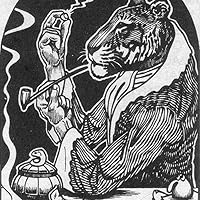
Library of Congress Card Catalog 57:11167 The passing of three centuries has not dimmed Molière's genius nor changed the perennial vices at which he hurled his shafts of comedy. The follies & frailties humankind still feel the impact of his urbane wit & his meaningful laughter. The eight plays in this volume, complete & unabridged, are among Molière's best comedies. They give full evidence of his undisputed rank as the foremost dramatist in all French literature & concededly one of the world's greatest since Shakespeare. These plays have all been newly translated for this edition by Morris Bishop of Cornell University with skillful fidelity that will establish these translations as the definitive ones of our time. Introduction The Precious Damsels Tartuffe The Misanthrope The School for Wives The Physician in Spite of Himself The Would-Be Gentleman
French literary figures, including Molière and Jean de la Fontaine, gathered at Auteuil, a favorite place.
People know and consider Molière, stage of Jean-Baptiste Poquelin, also an actor of the greatest masters in western literature. People best know l'Ecole des femmes (The School for Wives), l'Avare ou l'École du mensonge (The Miser), and le Malade imaginaire (The Imaginary Invalid) among dramas of Molière.
From a prosperous family, Molière studied at the Jesuit Clermont college (now lycée Louis-le-Grand) and well suited to begin a life in the theater. While 13 years as an itinerant actor helped to polish his abilities, he also began to combine the more refined elements with ccommedia dell'arte.
Through the patronage of the brother of Louis XIV and a few aristocrats, Molière procured a command performance before the king at the Louvre. Molière performed a classic of [authore:Pierre Corneille] and le Docteur amoureux (The Doctor in Love), a farce of his own; people granted him the use of Salle du Petit-Bourbon, a spacious room, appointed for theater at the Louvre. Later, people granted the use of the Palais-Royal to Molière. In both locations, he found success among the Parisians with les Précieuses ridicules (The Affected Ladies), l'École des maris</i> (<i>The School for Husbands</i>), and <i>[book:l'École des femmes (The School for Wives). This royal favor brought a pension and the title "Troupe du Roi" (the troupe of the king). Molière continued as the official author of court entertainments.
Molière received the adulation of the court and Parisians, but from moralists and the Church, his satires attracted criticisms. From the Church, his attack on religious hypocrisy roundly received condemnations, while people banned performance of Don Juan. From the stage, hard work of Molière in so many theatrical capacities began to take its toll on his health and forced him to take a break before 1667.
From pulmonary tuberculosis, Molière suffered. In 1673 during his final production of le Malade imaginaire (The Imaginary Invalid), a coughing fit and a haemorrhage seized him as Argan, the hypochondriac. He finished the performance but collapsed again quickly and died a few hours later. In time in Paris, Molière completely reformed.
The Physician Inspite of Himself had me cracking up! The others were decently funny and I appreciated the historical intros. This has motivated me to read some Shakespeare.
as the introduction notes its pretty incredible how modern these plays feel. without too much effort you could cast edwige fenech and george hilton and have a series of 70s sex comedies. also interesting to see how meta a couple of the plays get
I remember first being interested in Moliere's plays, many of which I have read before in other translations, as a college student who read drama for fun, a habit I still have [1]. In reading these plays, each of which has an individual introduction by the book's translator, as well as a larger introduction for whole collection, I was reminded that Moliere, though he may be less familiar than Shakespeare, is well known because he still speaks to contemporary humanity. In fact, his plays have a lot to say to us, sometimes in ways that are very awkward and personal, often because he speaks about himself as an artist and a man, and in so doing says a lot about other people who are complicated men and artists like himself. After all, it is largely artists who would be most interested in reading plays that are hundreds of years old and have to be translated from their native French. The fact that we read Moliere's plays, and the fact that his plays are still performed with regularity suggest that something is deeply worthwhile in these books, a point that Bishop makes several times, pointing out that many of the plays that are most popular to our contemporary age are not those works which resonated best with his original audience.
The contents of this book are very straightforward. There are eight plays by Moliere, of varying length, that take up almost exactly 400 pages including the introductions provided by the translator. The eight plays are as follows, with translated titles as well: The Precious Damsels, The School For Wives, The Critique Of The School For Wives, The Versailles Impromptu, Tartuffe, The Misantrhope, The Physician In Spite Of Himself, and The Would-Be Gentleman. These plays range from very familiar (Tartuffe, The Misantrhope) to very unfamiliar (The Critique Of The School For Wives, The Versailles Impromptu). They show a range between farcical comedy, like The Physician In Spite Of Himself, to works of deep and brooding sensibilities. Moliere's plays may be light in the performance, but in the reading there are a lot of heavier elements to them, and I agree with the translator that Moliere intended it to be so, that the social commentary and ambiguity and irony of his writing is not accidental, but that even if he played for laughs as an actor, he wrote material that was deeper than meets the eye, which is why it is still read today, and debated for its meaning and significance.
Overall, one can sense that Moliere has a lot to say and chose, perhaps quite sensibly, to mostly give deep thoughts and meaning in honey rather than with bile and vinegar as is the case for some writers. Even so, these plays run a wide gamut in terms of their approach--the Critique Of The School Of Wives seems almost like a Shaw or an Ibsen play with its heavy symbolism and almost grim realism and its topicality to the philosophy and politics at the time. Tartuffe is a play about a dangerously sensual man whose religious beliefs, if not hypocritical, are certainly no match for his native pride and greed, and whose behavior tended to lead people to mock certain aspects of Christianity. The Misanthrope, by contrast, provides a false dilemma between a man who is honest and quite rudely unpleasant and a society that is hypocritically friendly in person while biting behind someone's back, and where the drama involves a flirtatious young woman tormenting honest men, something I find a bit painful to read even in the best of times. Yet Moliere's plays are like that--he writes about the problems he had with doctors who could not help him feel better, about his own insecurities as a bourgeois gentleman flattering the sensibilities of noble and even royal elites in order to make a living, as a man who married a much younger woman to widespread scandal and found it to be an unhappy state, and included witty inside jokes about other rival playwrights that were not always taken in stride by those he teased and poked. All too many writers, then and now, find such material hits perhaps a bit too close to home for comfort, but we do not read great literature for comfort, after all.
One of my favorite things about Moliere is that his whole aim was to entertain! He wasn't worried about becoming a classic poet, or being remembered for ages, or anything "lofty" like that...he just wanted to please the crowd. His plays are very enjoyable, full of wit and humor, along with great insights into human nature. I really enjoyed reading these, and if I ever got a chance to see a Moliere play performed, I'd love it!
Moliere exposes a personality quirk in a realistic character, we might call the quirk an obsessive compulsive behavior, by setting up a comical situation in which the character leads him/herself to a funny downfall.