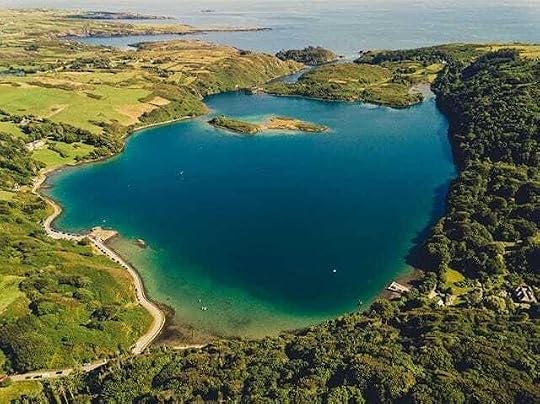
This is the funny and touching story of a menagerie of eccentric and talented ecologists who, mainly as a hobby, spent forty summers at Lough Ine, a stunning marine lough in a corner of Ireland. It is a humorous and moving account of ecologists who collaborated for forty years until their friendship came to a tragic end. The book brings together all the rich flavours of Ireland, the wonders of natural history and the magic of being a marine biologist just for the fun of it.
Trevor Norton was an Emeritus Professor at the University of Liverpool, having retired from the Chair of Marine Biology. He has published widely on ecological topics. He was also an Honorary Fellow at the Centre for Manx Studies on the Isle of Man where he lived. (1940 - February 2021)
Having read the fifth and last book written by Trevor Norton, I'm so sad to say there won't be another, because the author passed away in February 2021. I will deeply miss his fascinating stories and exquisite writing, his enthusiasm toward his field of study and nature in general, and above all, his unrivaled sense of humor.
Reflections On A Summer Sea is an amalgam book, an ode to picturesque Ireland, a remembrance of his starting career and a couple of the pioneers in this field (John Ebling and Jack Kitching), whose work and implication lead to Lough Hyne (Ine) to be declared the first marine nature reserve in Europe in 1981.*
Lough Ine was also the place where he met his wife, Win, whose beautiful drawings adorn the pages of this book and all the others'.
It was a book to relish and I have taken my time with it, more so because I won't have another. But at least I have all and I can reread them whenever I chose to. He is and will remain one of my favorite writers of all time.
A few lovely quotes to remember:
"In 1759 Arthur Guinness had come into a small inheritance. I would have gone out and got drunk, but Arthur took a 900-year lease on a brewery and got the whole of Ireland drunk. The brewery paid a quarter of all the excise revenue levied in Ireland. It sold best in Africa, where Guinness was considered an aphrodisiac. Not so in Ireland apparently for, according to a local journalist, an Irishman is the only man in the world who would climb over a dozen naked women to get to a bottle of stout."
"My fellow passengers energetically crossed themselves at every church and cemetery we passed. 'It is just our way of keeping fit,' said the man sitting next to me, with a wry smile. This was the most strict Catholic country in Europe. A bishop had denounced the mention of 'nighties' on television and demanded that dangerous pursuits such as late-night dancing should be banned. Ten thousand books were banned for being too explicit - 350 in 1964 alone. In response to sexual queries, a magazine agony aunt replied that the answer to the reader's problem would be given by her confessor and, in any case, outside marriage it was unnecessary to know the details. London was swinging, Cork was dangling in the darkness."
"The road seemed never-ending but at last it dropped down. I rounded a bend and suddenly, as if a curtain had been withdrawn, there was the steep wooded shoulder of a hill and the beautiful lough, alive in the sunlight. An island with a ruined castle floated in its centre. The trees came down to the water's edge and on the still surface Cezanne had painted them upside down. I knew at once that this was a magical place with fairies, holy wells and crocks of gold."
"I was edging towards the brink of panic and was breathing heavily. Above me trembling medusae of air rose, expanding towards the surface, and I became aware that there was more beauty in the rippling rainbows of liberated bubbles than was incarcerated in all the art galleries in the world. A touch of the 'rapture of the deep' imbues great importance to slight things. Even so, long after the rapture had receded, the magical image remained."
"And the lough remains... in all its moods, as magical and mysterious as ever, still awaiting discovery, for it holds far more secrets than we uncovered. And, as the ancient Celts knew... the sea is the beginning and end of all things."
The recollections of a group of marine biologists working at Lough Ine in Ireland. Although this book was published in 2001, the episodes described go back 40 years, so the equipment used, funding and organisation of this exploratory early work in Natural History seem unbelievably basic and haphazard to a modern reader. The relationships between the scientists are also sometimes rather fraught. It makes for an entertaining and informative read.
A memoir of a group of marine biologists who spent 40 summers exploring the waters of Lough Ine in south west Ireland "where rain comes to retire" and where Guinness-loving locals drink tea "with an air of quiet resignation". I found the account of these early days of marine biology fascinating - it seemed to be a cross between a student party and a boy scout camp with added seaweed and limpets. Some of the equipment used in the early experiments sounds positively Heath Robinson, and while they obviously worked hard, the camps sounded like great fun too Norton has a sense of humour and a sharp turn of phrase, though I do wonder what his colleagues would have thought of some of his descriptions, e.g. "Having almost certainly lacked a chin for much of his life, he was now developing two."
Sadly, the book seems to lose its way a little in the second part. Norton was obviously very distressed by the breakdown in friendship between two of his senior colleagues, but the account of the slow decline of both their friendship and the Lough Ine project is far too drawn out. The book could easily have been at least 30 pages shorter - and would have been all the better for it.
A charming book full of great and often very funny quotes about Ireland, marine biologists, academia and life. I have to say, though, that, even though I knew it was autobiographical, I had no idea that the book was non-fiction for a long time while reading; mainly because of the narrator - why would you say all these things about real people with their real names and everything? A lot of the time it does register as simply cynical observational humour about life for added colour. But the tone also often comes off as patronising and negative, he is laughing at not with all these characters. And not only the main ones, some of the background people seem even less deserving of being constantly mocked. The downward spiralling structure of the book does not help either.
Nevertheless, I can completely see what the author tried to achieve and I think, for the most part, he succeeded. The book gives a very romantically framed insight into so many things and is overall a great read.
Review published in the New Zealand Herald, 21 September 2002
Reflections on a Summer Sea Trevor Norton (Arrow Books, $26.95)
Reviewed by Philippa Jamieson
If you're looking for an entertaining, intelligent, satisfying read, try this wonderfully evocative memoir. Reflections on a Summer Sea is the story of a group of English scientists who spent almost fifty summers carrying out research at a unique marine lake in Ireland. The author reminisces about the personalities, the experiments, local eccentrics, and life in rural Cork in the sixties. In 1925 a laboratory was set up on the shores of Lough Ine (rhymes with wine), a saltwater lake joined to the sea by a narrow channel. In the late thirties research on the lake's ecosystem intensified, with scientists, students and divers working on projects every summer. Trevor Norton arrived as a student in 1964 and later became a senior member of the research team. Over the years Lough Ine became the world's most intensively studied patch of seawater, and in 1981 was made a marine nature reserve, the first to be designated in Europe. Norton conveys the wonder of the natural world in a way accessible to the layperson, with an eye for detail, and enthusiasm for his subjects (including seaweeds, sponges, starfish and urchins). Studies were carried out on a shoestring, but surprisingly accurate measurements were produced with rudimentary equipment and a bit of ingenuity. Much more than a natural history, Reflections weaves together local legends, snippets of songs, a dash of politics, and delightful descriptions of everyday life: the shopkeepers of Skibbereen, the pubs, donkeys and carts. Many an amusing anecdote had me laughing out loud. The book is enhanced by charming black and white line drawings by Win Norton, the author's wife, who also took part in the research. A strong sense of teamwork and camaraderie developed over the years and then waned. Jack Kitching and John Ebling were the two key scientists involved, and while their complementary personalities enabled a good partnership for many years, it deteriorated towards the end. I felt uncomfortable reading some of the personal correspondence between them, but part of Norton's even-handed treatment is to reproduce their words verbatim. The inclusion of a timeline would have been useful to keep track of events. As times changed, money exerted a greater influence over the conditions of research, and frequent pressure to secure funding took its toll. 'Excellent research at the lough continues,' Norton writes, 'but there is no place in modern ecology for the leisurely and pleasant world he [Kitching] built, and science is the poorer for it.' Warm, funny and nostalgic, Reflections on a Summer Sea comments on the changes we have made in our relationships with other human beings and with the natural world.