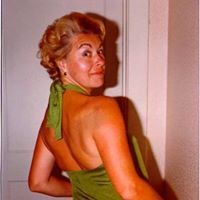
The story of a beautiful teenage debutante from New Orleans who was heartbreakingly diagnosed with leprosy, and entered the famous Carville hospital in Louisiana in the 1920s. Many of the patients changed their names to protect their families from the stigma attached to leprosy. Although she struggled most of her life with leprosy, now known as Hansen's disease, her secret could not be revealed. Neighbors of her family never knew what happened to her.
About 20 years after she was diagnosed, Martin wrote her autobiography, Miracle at Carville, and it became a minor classic.
Betty Martin (pseudonym of Edwina Parra) is an American writer (1909-2002). She was born into a family prominent in New Orleans society. In December 1927, when she was nineteen, she was diagnosed with Hansen's Disease; in order to protect her family from the stigma associated with this illness, when she entered the leprosarium of Carville in January 1928 she chose to take the name Betty Parker. She changed her pseudonym in Betty Martin when she married another Carville patient who had taken the name of Harry Martin. She wrote the story of her life in her two books. She and her husband returned permanently to Carville in 1989, as free care continued to be provided for former patients.
While growing up, I heard quite a bit about leprosy, and I found it fascinatingly fearful. This book should have found its way into my hands when I was in my teens ... but maybe I can appreciate it more now. There's a lot of history in this memoir. For example, I didn't know that people in the continental U.S. caught leprosy, nor did I know that there was a leprosarium in Louisiana (one of the states where leprosy was endemic).
Here 19 yo Betty describes what it was like to be diagnosed with such a feared disease in the late 1920s. Attitudes toward the disease, life as a "leper" in a leprosarium (which was fairly new at the time), the various treatments (most of which were passing fads) she experienced, ... all are explained in these pages. If I ever make it to Carville, I would definitely make time to visit the site (which is now a museum).
Betty Martin (a pseudonym assumed to prevent disgrace to her family) was a happy teenager in 1929 when she was diagnosed with leprosy. Her appalled family sent her to a special leprosy hospital in Carville, Louisiana, and her engagement ended abruptly. The horror of her family at Betty's situation and their willingness to abandon her and to lie to neighbors about where she had gone was shocking to me as a 7th or 8th grader when I found this book. Despite being fairly familiar with the Bible, I did not fully understand that lepers were still considered 'unclean' and the families did not want to be associated with the disease.
I remember being amazed that Betty eventually fell in love with a fellow patient, and if I recall correctly, her family was very disapproving of her efforts to find a little happiness after years of lonely misery and humiliation while incarcerated. At some point she volunteered for innovative treatment and was one of the first people cured using modern medicine. She and her beau escaped from Carville and ultimately were married.
This sad memoir was a bestseller in the 50s and was a staple of many Catholic school libraries (which is where I found it).
I first read this book many, many years ago when I was a teenager. It made a huge impression on me. I have often thought about Betty Martin and her life at Carville since that time. I was recently able to get my hands on a copy of the book which is now out of print, and I am so glad that I did and that I re-read it. A wonderful, poignant, and educational book, it has stood the test of time.
Interesting topic. I read this after Molokai. It was interesting to compare the "colonies" in Hawaii and Louisiana. There is a lot of history and knowledge imparted too.
When I was a teenager, Reader's Digest Selection magazines circulated in my house and also those big books that contained the condensed version of the best-selling books of the moment. I've read tons of books in this condensed form and then spent years looking for the unabridged versions. One book I had loved so much was the condensed version of Miracle at Carville. In recent days I discovered that this book is in the Internet Archive and I therefore had the opportunity to read the complete version. It is the autobiographical story of a nineteen-year-old American girl who in her late twenties discovered she had Hansen's disease (then called leprosy) and was therefore forced to completely change her life to go to a leper colony, Carville, for treatment. In those years, not only there was no real cure for this disease, but the sick were forced to hide. The author changed her name once she entered the leper colony and resumed her real name only when she left. The book tells the story of this disease and the evolution of treatments and the debate about it in the last century and how Betty and the other patients fought for a better understanding of the disease and for a better life for the patients of Carville.
This tale enhanced my recent visit to the National Hansen's Disease Museum on the grounds of the former US Marine Hospital in Carville, Louisiana. Betty's words about her life there gave more meaning to the artifacts on display in the museum. She may not be the most erudite of writers but she certainly conveyed her feelings and experiences well. Most interesting to me was there seemed to be no lines drawn at Carville, among the residents, in regards to race, religion, or socio-economic backgrounds.
An optimistic autobiography of individual endurance during the historical time period of the 1920's to late 1940's where American culture still looked upon leprosy (Hansen's disease) as those in the Bible 2000 years do and how, after WWII the American Government was influenced by those at Carville to engage health departments to educate medical communities and citizens of the scientific facts and change how those afflicted with the disease are treated.
This is a novel about leprosy or Hansen's disease, and the devastation it caused both to the sufferers and to their families. There is a lot of history in this book . I did not know that people in the U.S . could have leprosy and that there was a leper colony in Carville LA .in the 1920s. the disease was regarded with horror, in much the same way that AIDS was a few years ago.
so it seems that not a lot of people have read this book?? which i found crazy. it means so much to me.
i got it at a book giveaway at a homeschool convention many many years back and opened my eyes to what people with leprosy go through in more modern context (though it is certainly dated). poignantly written and a longtime favorite.
I read this book in 6th grade recommended by a favorite teacher. it made a lasting impression on me and 50 years later I still remember it vividly and recommend it often. I have just learned there is another book out about Carville. I hope it is as good a read as Miracle at Carville.
Because it impacted my life, read this when I was in my early teens and it was maybe the first book that made me realize the prejudices in the world regarding how we accept people and should be more accepting.
I have relatives who lived and worked at Carville and were deeply affected by Hansens Disease. It was fascinating to learn how different Betty's experience was in the 1940s and 1950s compared to my relatives' experiences in later years.
My sister tracked down a very rare copy of this book, so we could reread it as adults, both of us having read it in high school on the recommendation of our social studies teacher, Mrs. Bernstein. This was a rare glimpse into the life of a woman who spent 20 years inside a Louisiana leper colony. Betty Martin was a 19-year-old debutante in New Orleans, engaged to a handsome medical student and on the brink of her adult life when, in 1929, she was diagnosed with leprosy and sent to a Louisiana leper colony in Carville. This is the story of her 20 years inside Carville, like a small village unto itself, but surrounded by barbed wire. There, she not only lived to witness a cure, but became an advocate for change. Inside of Carville, patients and staff knew the truth -- that Hansen's Disease was only feebly communicable. Martin was one of the patients who helped make a difference in the way the disease is viewed today. She and her fellow patients – along with some champions on the outside – worked tirelessly to end the stigma associated with diagnosis ... to educate the public ... to educate physicians in early diagnosis ... and to improve conditions for patients, who back then weren't even allowed to vote. This was a fascinating story about the courage and faith to keep hoping in the face of the most grim circumstances. If you can get your hands on a copy, it will strengthen your resolve to live your life as a more empathetic and compassionate person.
I read this book many years ago and the title has stuck with me..if you know me, that is a rarity and I remember it being a very good book. I should reread to justify this rating.
A beautiful true story of life in Carville, LA. This book inspired me to visit Carville and learn more about it. It's a little difficult to get your hands on a copy though.
I thought this book was beautiful and humbling, reading about this woman's struggles with physical illness, social stigmas, and her trust in God nonetheless! She was 19 when she entered Carville with Hansen's disease, she changed her name so that no one would know and shun her and her family, she thought she might be able to get out quickly but ended up being there for twenty years! For the fear of the slight chance of passing on the disease she gave up her dreams of motherhood and was unable to even enjoy being with her family whenever she was able to visit. Because of the disease she was not able to celebrate with her two sisters when they got married, she was not there when her younger brother died, and while she was isolated from them her father dies (--> I cried so much at that part!!). Her perseverance is amazing and God's grace shines through! Another part of the book that I found so interesting was reading about how all of the patients banded together and worked towards making the future brighter for the treatment of Hansen's disease and the patients rehabilitation. It was also fascinating to read about how despite the strong community between the patients and the increasingly better care and public interest/concern, the patients never stop yearning for freedom. For the chance to be on their own, on their own and without fear! I think my two favorite passages come from the end when the author finds out she was completely free from Hansen's disease (the patients had to pass 12 consecutive monthly tests) and her and her husband (who also had had the disease and passed all 12 tests two months before her) were free: "Only those who have been denied freedom can appreciate the sudden opening of a long-closed door." The final two paragraphs describing her and her husband leaving were also especially poignant after everything that she had experienced (and that I too felt, as the reader): "The joy, sorrow, and excitement I was experiencing finally forced their way out in tears. As we drove out of the iron gate of isolation "together" into the free, uncertain world we had dreamed about so long, I looked back wet-eyed at the buildings and trees ringed with barbed wire that had held so much of Harry" (her husband) "and me. Now the years of suffering and struggle seemed dwarfed by the mental and spiritual enrichment this difficult experience had brought into our lives. Harry, eyes ahead, turned the car down the river road. And with spring in the air and springtime in our hearts we drove on our unknown way, knowing the road ahead would be rocky and long before we reached at last the place of our own we had talked and planned and dreamed about through the twenty lost years that could never be lost, that would always be part of us. Knowing this, we firmly believed that if we continued to seek first the Kingdom of God and His justice that all necessary things would be given. All else, to the smallest flower and simplest pleasure found along the way, would be His special gifts."
This entire review has been hidden because of spoilers.