In 1704 a bankrupt English merchant sent home the colt he had bought from Bedouin tribesmen near the ruins of Palmyra. Thomas Darley hoped this horse might be the ticket to a new life back in Yorkshire. But he turned out to be far more than that, and although Mr. Darley's Arabian never ran a race, 95% of all thoroughbreds in the world today are descended from him. In this book, for the first time, award-winning racing writer Christopher McGrath traces this extraordinary bloodline through twenty-five generations to our greatest modern racehorse, Frankel.
The story of racing is about man's relationship with horses, and Mr. Darley's Arabian also celebrates the men and women who owned, trained and traded the stallions that extended the dynasty. The great Eclipse, for instance, was bred by the Duke who foiled Bonnie Prince Charlie's invasion (with militia gathered from Wakefield races) and went on to lead the Jockey Club. But he only became a success once bought and raced by a card-sharp and brothel-keeper - the racecourse has always brought high and low life together.
McGrath expertly guides us through three centuries of scandals, adventures and fortunes won and lost: our sporting life offers a fascinating view into our history. With a canvas that extends from the diamond mines of South Africa to the trenches of the Great War, and a cast ranging from Smithfield meat salesmen to the inspiration for Mr Toad, and from legendary jockeys to not one, but two disreputable Princes of Wales (and a very unamused Queen Victoria), Mr. Darley's Arabian shows us the many faces of the sport of kings.
Not for everyone: an odd mixture of English politics and British/Irish/Canadian horse breeding & racing. One need not be a horesracing fan to enjoy, but there are no straight lines anywhere. Indeed, I would have appreciated a pictorial description of the lineage of some of the champions, the sort of thing seen in flyleafs of books on British royalty.
The book's premise begins with the first Arabian horse to come to England since the Roman empire. English horsemen had been trying to import such stock for years; the Bedoins, fully aware of the value of swift horses who needed watering only every two to three days, made such sales illegal. Back-door attempts had been made for decades, but first succeeded only in 1704 in the form of an Arabian stallion bought by a Mr. Darley. (The tribes refused to sell any mare, considering them more precious.) Something of a wastrel, and bankrupt, Darley didn't even survive Syria long enough for the voyage home: he fell from the eponymous horse and died from the wounds.
Mr Darley's horse did somewhat better -- raced; won; and sent to stud, albeit with only one excellent (male) offspring. According to the book, even though two other Arabians were brought to Britain somewhat later, every thoroughbred comes from a line through this "Bleeding Childers"--a terrible race horse, but tremendous stud.
The rest of this 370-page book consists of about 20 percent lineage (or sale) of horses; 60 percent the rise and fall of English/Irish/Canadian trainers; and 20 percent anecdotes. There's nothing wrong with the 80 percent: it all just flows together--though I couldn't name more than one or two breeders, trainers, jockeys or horses.
The anecdotes were terrific, at least for anyone with a passing knowledge of 18th-early 20th Century British politics and aristocracy. The growth of horse racing from a local dalliance on a Tory or Whig's estate to a public and (with invention of the railroad) national sport mirrored the maturation of Britain.
"Whitewall [racecourse] was never the same once Colonel Anson [a confidant of horse owner and occasional Prime Minister Lord Derby] was posted to India as commander-in-chief. Mind you, nor was India. Anson's immaculate manners caused him to avoid the unpardonable solecism of opening a telegram while hosting ladies to dinner at Simla in 1857. As a result, he dismissed all talk of a Sepoy mutiny until finally remembering the envelope he had pushed under his plate. It was a last message scrambled by the Delhi telegraph clerks before they fled the first wave of arson and butchery in the Colonial compound."
I need to look up "Thomas Ward"--if this book is accurate, a 15 year-old stableboy became, through a series of improbable events, Prime Minister to the Duke of Lucca in the mid-19th Century.
Many of the anecdotes concern the British Royals. Victoria loathed horse racing--she saw only gambling, prostitutes, pickpockets: and she wasn't far wrong. Her increasingly aging son, the future King Edward but then nicknamed "Bertie", loved horse racing and kept his own stables. The man, after all, needed something to do waiting for mummy to die, other than running around with other "Marlborough House" swells and loose women. (Lord Charles Beresford once turned down Bertie's dinner summons with a telegram: "Can't possibly. Lie follows by post.") The 1894 Derby win by Bertie's horse,"Ladas II", did much to cement racing as Britian's "Sport of Kings". Bertie's son, George V, became the first (and only) reigning monarch to run a Derby winner.
There's more like that; should you enjoy such gossip, it's a fun read. Not much for U.S. readers, though; the American Triple Crown comes into the frame only when one of the already-described horses is running. Except this: one of those who cabled congratulations to Bertie for winning the Derby was Chauncey Depew--an American politician who once defined a pessimist as "a man who thinks all women are bad, and an optimist as one who hopes they are".
This entire review has been hidden because of spoilers.
It starts off flying from the gate but then starts stumbling at Chapter Two and began floundering ever since. It is terrible prose that does not explain anything very well. It's written for a British audience so there are a lot of in-jokes or side-swipes at characters from English history, but I have a feeling the average Brit wouldn't be able to follow this mess, let alone an American that lived in the UK like me.
I did try to finish this. Oh, how I tried. I was about page 155 when I realized that for the last three pages I did not know if the names on the page referred to horses or humans.
And that's the main flaw of the book. It focuses on the HUMANS that impacted thoroughbred racing and NOT the horses. If you've read The Kentucky Thoroughbred by Kent Hollingsworth (and my sympathies if you have) then you know the kind of book I mean.
Even the pages of illustrations were human-centric and not horse centric. Only four or five of the horses mentioned in the text were pictured. Owners, trainers, jockeys and even owners' mistrisses are featured, instead.
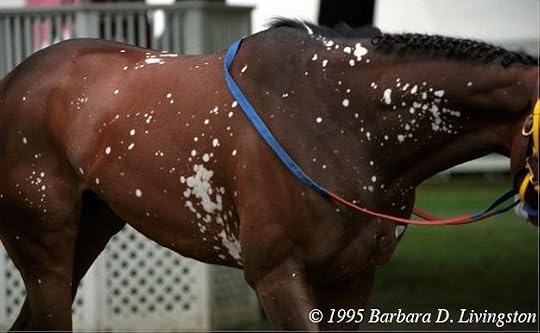
I don't even think the author likes horses as much as he likes history. For example, he mentions that Birdcatcher was chestnut "with grey flecks." He had spots, so much so that horses with similar spots are called Birdcatcher spots today. He mentions Birdcatcher tail, but not Birdcatcher spots. Here's a modern thoroughbred with Birdcatcher spots:
I'd call that a bit more than "flecks" -- wouldn't you?
I was expecting this book to show more of the lines and descendants of the Darnley Arabian. Instead it tells more of the scandals and gossip surrounding the leading characters over the years in the Turf. Set mostly in England and not being that knowledgeable of English history I got lost among some of the names and who exactly was who. One or two descendants of the Darley Arabian are mentioned during the years of change and designated as ‘the’ odesignated descendant to pass along the bloodline. I would have preferred more of the history. Of the horses and less of the people, which is why I gave it only 3 stars. If you like the history of the people involved and a general history of the sport, you might rank it higher. It was interesting, just not what I expected or wanted.
I’m sorry to say I DNF this book halfway through. I’ve been picking it up and putting it down again for the last year. I grew up with horses and have a Thoroughbred of my own, and I was excited by the idea of a history of the breed. Especially if that history included a few salacious and incredible stories! Unfortunately I think this book suffered by being overly inclusive. I had to quit (and I really don’t often quit) when I realized I could not keep track of the various characters in each sprawling chapter, and that frankly I didn’t care to keep track. The horses featured less than I hoped. The author is a good writer and the premise is exciting but some better organization or curation could have helped.
I liked it, with reservations. I don't believe anyone not into thoroughbreds would enjoy this book. It's just WAY too in depth about the 300 years of TB history.
My first 3 horses were TB. The second mare, then the foal I bred her to get were from the Northern Dancer an Princequillo lines. Even with that interest, I got bogged down. Normally it takes me one or two days to finish a book, this one took me two WEEKS. Unheard of.
Entertaining history of the thoroughbred horse. “All throughbreds are descended from one of just three stallions, imported to England around three hundred years ago: the Godolphin Arabian, The Byerley Turk and the Darley Arabian. Over the last century or so...the first two of these patriarchs have been more or less eradicated from the ‘top line’ of racehorse pedigrees...The Darley Arabian has achieved a virtual monopoly.” As well as equine history, this study serves as a social history of the higher strata of (mainly) English society and its self infatuation.
Two stories among many colorful and amusing characters stand out: trainer Henry Cecil, a traditional man, who, according to Mr. McGrath, deplored the confusion between innovation and progress, trained horses mainly through charm, did not even own a pair of binoculars and felt stop watches were for men far cleverer than himself. (Did I mention that Mr. McGarth is a wonderful writer?) Anyway, Mr. Cecil made a comeback training Frankel (unbeaten in a fourteen race career, thank you very much) while he himself was dying from lymphoma. The other story is of the quite successful Luchino Visconti who (yeah, him) as a young man gave up the track for film direction.
You needn't be a fan of horse racing to read this book, but it helps. Chris McGrath is a racing journalist and he's penned an interesting history of the sport and a line of remarkable horses, focusing on the UK but also examining the sport's spread to the United States and other countries around the world. Even if you have only a cursory interest in horses, the cast of characters--from monarchs to mountebanks--involved in the history and their follies and foibles offer intriguing diversion and make the book worthy of a reader's time. McGrath reveals that all thoroughbreds descend from just three stallions imported to England some 300 years ago and the Darley Arabian has the distinction of having provided a majority of the champions in the last century. The story of this line began when a bankrupt merchant shipped a colt purchased from a Bedouin tribesman home in 1704. Thomas Darley did not live to join his Arabian in England and the horse never ran a race. Yet 95 percent of today's thoroughbreds descend from this animal. That in itself makes for fascinating history. He traces the sport from its beginning in the 16th century to the present. Horse lovers may be offended by some accounts of the brutality exhibited by trainers in the early days. This is compensated for in at least one case where a horse took its revenge for mistreatment. McGrath has done an astounding amount of research and the tales of the horses, their owners, trainers and jockeys and the evolution of the sport add spice to the narrative. There are some chapters where his enthusiasm for his subject overwhelms and he deluges the reader with a host of names, making it difficult to keep the people and horses straight. A glossary of terms, bibliography and a good selection of photos help sort things out.
Mr Darley's Arabian is a scholarly, breathless romp through three hundred years of the thoroughbred racehorse in the western world. The author, bloodstock expert and prize winning journalist, Chris McGrath clearly has a passion for his subject, and the racy high and lowlife characters that romp through the pages of this book , from scoundrels, rakes and plutocrats, to nobility and royalty, are often overwhelming in their sheer numbers!
Whilst I admired the writing and commitment of the author, I was somewhat confused and exhausted at times by the many diversions and side stories, and by McGrath's sometimes figurative style and rather meandering and proliferating story thread. However, I'm sure that this is more my own failing, and when I catch my breath, I will remember the rollicking journey, the enthusiasm and grasp of history demonstrated by the very talented Chris McGrath.
I received this book in a Goodreads giveaway. As a huge horse racing fan, I was excited to read the book, and had high hopes for it. The twenty-five horses profiled are all British racers, but I was familiar with most of their names at least, if not their careers. I must say I wished the author had stuck with the stories of the racehorses, and not delved deeply into British politics and history so much. As an American, I found those parts kind of baffling, and they got boring. Much more enjoyable were the accounts of 18th and 19th century horse training and care, we have come a long way. And when the horse profiles entered the 20th century, everything got more interesting and lively.
This book was great! The name Pot8os will never ever make me not happy to be alive. One minor quibble though, since the book deals primarily with the history of English flat racing, the author assumes a certain amount of knowledge of English politics and political scandals. These parts were hard to follow because, as an American, I'm still trying to figure out WTF the electoral college is and why Puerto Rico holds a presidential primary. I don't have the emotional energy to learn about prime minister shenanigans of the 18th century.... at least at this time, get back to me in a few years.
Meh! I like to read something well outside of my interests every now and then. This caught my eye because of the assertion that almost all thoroughbred horses today are from the line of an Arabian shipped to England years ago. I might have enjoyed this more if I was into horse racing, but the only times I watch a race is when there is a possible Triple Crown is competing in the Belmont Stakes.
As it was, I found the book boring and hence slow to read. It seemed more a long list of names than a real history. For the most part there was minimal information given about most of the hundred of people (grooms, trainers, jockeys, owners, and yes, even horses) mentioned. There was a decent amount of information about some of the more contemporary figures, but very little about about the many characters and horses in play more than 50 years ago. I would also have appreciated a lot more about the social and political context surrounding events.
McGrath included some short passages entitled "A Day at the Races" in which he reprinted accounts of the atmosphere at racing venues on race days. I enjoyed these.
McGrath notes that the racetrack is a place where people from all walks of life rub elbows. That may well be so, but unless one is a very rich owner or a member of the elite trainer/jockey community, most people can only be involved through betting.
A thoroughly enjoyable and an informative journey. I liked most of the anecdotes and it made a nice mix of studying and having fun. from the trailblazing pioneers of the old days to the royal involvement and Queen Victoria’s disdain, to the lives and times of those heroic yet sometimes tragic figures, be it a jockey champion or a genius trainer, to all those breeders and owners who unwittingly took part in shaping up the stuff of legends that stood the test of time, to all the eccentric men and women of the turf, to the real superstars of the industry. There is so much to be learned about the horses and i only felt that it should have been more about them than the people. Nevertheless for me it just could not be boring. such a rich history and i love the fact that all of this at some point, came so close to never happening.
A superbly written history of the thoroughbred. Christopher McGrath chronicles the evolution of today's precocious racehorse in an entrancing and informative way that even someone who started out knowing nothing about the subject has to enjoy.
Obviously horses are key; all the way through Northern Dancer and Sadlers Wells to Frankel, but it is the characters involved, from Lord Egremont to Bob Sievier, that make this book so readable.
As they say: From royalty to horse thieves, all men are equally guileful on the turf.
I liked the bits about the horses. I was less interested in the owners and ancillary people that were involved. The US does great at publicizing the Triple Crown, but they never give credit to the British who invented the concept Would that both countries raced older horses as the British did when they started the sport. Racing 2 and 3 year old horses is too hard on their as yet not completely grown bodies.
You could think of this as a bloodstock laundry list with as many begats as the bible, but in the end a story is woven that enables changes in history, politics and equine understanding to shine through and reveal their impact on the racing world today.
missed opportunity - what a great story/stories but the telling was like sitting in a stuffy manor house were somebody is dropping names rather than telling stories - I so wanted to read the stories and yet it remained oddly muddled and I feel drained now. That said it still gave me the thrill of the horses racing past... for the serious race horse lover still a must read
I am not a horse racing fan but really enjoyed this book. A great social history covering several hundred years, against the backdrop of the race course.
McGrath packs in a huge amount, including some absolutely cracking stories, with none better than Pot8os.