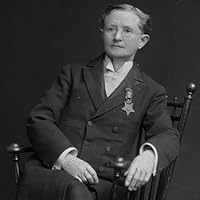
The Preface begins: "The author of the present essay, S. M. Dubnow, occupies a well-nigh dominating position in Russian-Jewish literature as an historian and an acute critic. His investigations into the history of the Polish-Russian Jews, especially his achievements in the history of Chassidism, have been of fundamental importance in these departments. What raises Mr. Dubnow far above the status of the professional historian, and awakens the reader's lively interest in him, is not so much the matter of his books, as the manner of presentation. It is rare to meet with an historian in whom scientific objectivity and thoroughness are so harmoniously combined with an ardent temperament and plastic ability. Mr. Dubnow's scientific activity, first and last, is a striking refutation of the widespread opinion that identifies attractiveness of form in the work of a scholar with superficiality of content."
Simon Meyerovich Dubnow (Шимон Меерович Дубнов) was a Jewish-born Russian historian, writer and activist. He is the father-in-law of Henryk Ehrlich, a famous Bundist leader.
I suspect that this was a pretty good history book for the time it was published (1903) and it remains good, but there is a lot more recent scholarship on the subject of Jewish history. Also, this book tends to be a little too much cheerleading for Jewish endurance and does not give much credit to outside forces that worked in our favor (I am thinking of Saint Augustine and his cajoling of Saint Ambrose into saving the Jews) and just plain luck.
FYI, I am an Orthodox Jew and love Judaism and my people, but that doesn't blind me to our faults.
This book certainly shows its age, starting off with a break down of 'civilised' and 'uncivilised' nations which was nearly enough for me to finish with it. However, pushing through, it actually provides a (perhaps overly) neat history of the Jewish people. Working from the position of there being something special about Jewish survivalism, Dubnow breaks down periods of Jewish history from Biblical times up to the nineteenth century in a clear way. He also explains the tangled spread of the Jewish people across Europe and the world, and how this relates to the development of various movements within Judaism, in a way that gave me greater clarity on this than I had before.
The author has a clear agenda, but he makes some compelling arguments, as well as having a strong skill in delivering complexity in an understandable way. The book ends on an optimistic note about the position of the Jewish people in Western Europe, relegating anti-Semitism to an odd affliction affecting Eastern Europe, and only touching the dregs of the West. This position of course reads with a sense of pathos now, with the benefit of hindsight. Overall, this book was a quick and useful read.
Interesting topic on how a religion can develop with no country or contiguous community and yet still grow with a clearly identified central identity. However, writing and structure were PAINFUL and made this short essay feel like it was thousands of pages.