

What do you think?

Writing in the Dust: Reflections on 11th September and its Aftermath
Rowan Williams was close by when the terrorists struck New York and the World Trade Center fell. In this short meditation, he takes his personal experience of the horror as the starting point for some broader reflections on the feelings of powerlessness which prompted the attacks, and the appropriate Christian response to this rage—understanding where the rage comes from. There are no easy answers, but this little meditation aims to give hope that risk and reconciliation are a new way to avoid the relentless spiral downward to more and worse aggression.
96 pages, Paperback
First published December 31, 2001
About the author
Rowan Williams
272 books371 followersRowan Douglas Williams, Baron Williams of Oystermouth, is an Anglican bishop, poet, and theologian. He was Archbishop of Canterbury from December 2002-2012, and is now Master of Magdalene College, Cambridge and Chancellor of the University of South Wales.
Ratings & Reviews
Friends & Following
Create a free account to discover what your friends think of this book!
Community Reviews
Displaying 1 - 18 of 18 reviews

September 5, 2012
Williams was in New York City on 9/11, just a few blocks from the World Trade Center. When the planes hit and the air filled with dust and smoke, what could this man of the cloth do? The same as everyone else: quickly evacuate the building, ensure that everyone was safe, and then watch, listen, and pray. And in the months that followed he thought about what he’d seen that day, what his experience had taught him about violence, peacemaking, and the ways of God.
There is such profound wisdom in this diminutive tract (it’s not even 80 pages long) that I read it twice over. Writing well before military action against Iraq began, Williams cautions against responding in a simple spirit of retribution. We have the freedom to choose how we will react, he insists, and rather than allowing a natural vengefulness to take hold, we can look for ways of changing a culture of hatred and violence – of understanding Muslim rage and working toward peaceful solutions.
But prophets’ words are never welcome, and time has, of course, shown that Western policies of retaliation only make things worse. Still, this essay is not idealistic claptrap; it is essential reading for every citizen of a globalized society, with timely warnings about how we use language to create enemies. It is also, for those of a spiritual bent, a frank discussion of theodicy – the theological attempt to justify the ways of God to man. Can we justify God’s absence and inactivity – or is God, in fact, not the comprehensible, interventionist being we so often assume? Rather, Williams argues, “That God has made a world into which he doesn’t casually step in to solve problems is fairly central to a lot of Christian faith.”
Here are a few more of Williams’s inspirational words: “We could refuse to be victims, striking back without imagination. The hardest thing in the world is to know how to act so as to make the difference that can be made; to know how and why that differs from the act that only releases or expresses the basic impotence of resentment.”
I can’t recommend this essay highly enough; think of it as training in how to face head-on our fear and suspicion, but then transcend them.
(This formed part of my article on 9/11 literature at Bookkaholic.)
There is such profound wisdom in this diminutive tract (it’s not even 80 pages long) that I read it twice over. Writing well before military action against Iraq began, Williams cautions against responding in a simple spirit of retribution. We have the freedom to choose how we will react, he insists, and rather than allowing a natural vengefulness to take hold, we can look for ways of changing a culture of hatred and violence – of understanding Muslim rage and working toward peaceful solutions.
But prophets’ words are never welcome, and time has, of course, shown that Western policies of retaliation only make things worse. Still, this essay is not idealistic claptrap; it is essential reading for every citizen of a globalized society, with timely warnings about how we use language to create enemies. It is also, for those of a spiritual bent, a frank discussion of theodicy – the theological attempt to justify the ways of God to man. Can we justify God’s absence and inactivity – or is God, in fact, not the comprehensible, interventionist being we so often assume? Rather, Williams argues, “That God has made a world into which he doesn’t casually step in to solve problems is fairly central to a lot of Christian faith.”
Here are a few more of Williams’s inspirational words: “We could refuse to be victims, striking back without imagination. The hardest thing in the world is to know how to act so as to make the difference that can be made; to know how and why that differs from the act that only releases or expresses the basic impotence of resentment.”
I can’t recommend this essay highly enough; think of it as training in how to face head-on our fear and suspicion, but then transcend them.
(This formed part of my article on 9/11 literature at Bookkaholic.)

September 17, 2021
Reading Writing in the Dust twenty years after 9/11 is rather surreal, especially because it happened when I was six years old. My generation grew up in the world after 9/11, and (as Williams astutely points out) in the world of school shootings. Public, widespread violence has become part of our collective experience. Writing in the Dust was published less than six months after 9/11, and reading it twenty years later, in the complex weft of aftermath, is almost surreal.
Williams writes from up close. He was blocks away from the World Trade Center, and the image of dust was physical for him. Yet, he also writes from far away, as a citizen of the UK, without the experience of being from the country that was attacked. As with anything dealing with this topic, the grief of the tragedy still packs a gut punch; there was a day-care in the building where Williams was; how did the workers there muster the inhuman ability to comfort children as the world literally crumbled around them?
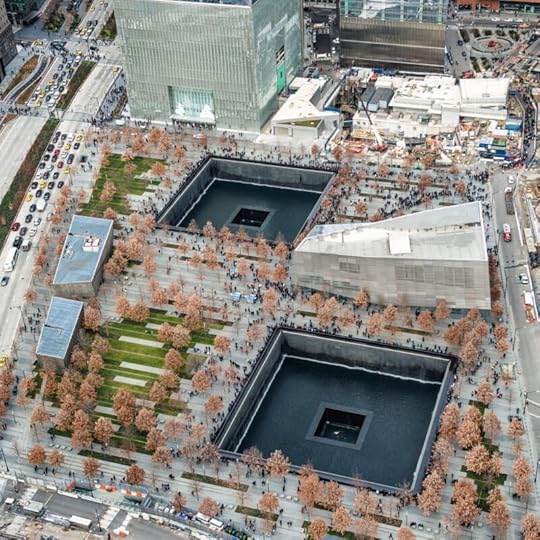
As a historian, I'm always fascinated by how society remembers (and forgets) pivotal moments. The 9/11 memorial in New York City has chosen to remember by leaving the gaping holes of the foundations of the towers:
While Williams's words about language, otherness, and neighborliness are still invigorating to read today, somehow Writing in the Dust just didn't do it for me like I hoped it would. Perhaps we're far enough away from the tragedy to make sense of it, as he was not, so I wanted a bit more. Perhaps I need a novel to process this (I found a copy of Extremely Loud and Incredibly Close for $1 on 9/11 this year--of course I bought it). However, Writing in the Dust is a good, brief read for those wanting a religious perspective on 9/11 and its immediate aftermath.
"What should strike us is Jesus's initial refusal to make the blind man's condition proof of anything--divine justice or injustice, human sin or innocence." (71)
"I want to say that it is only here, with the renunciation of all our various ways of making suffering a weapon or a tool of ideology, that we are going to learn how to grieve properly." (71-72)
"What use is faith to us if it is only a transcription into mythological jargon of the mechanisms of that inhuman grief that grasps its own suffering to itself as a ground of justification and encloses the suffering of others in interpretations to hold it at a safe distance?" (72)
Williams writes from up close. He was blocks away from the World Trade Center, and the image of dust was physical for him. Yet, he also writes from far away, as a citizen of the UK, without the experience of being from the country that was attacked. As with anything dealing with this topic, the grief of the tragedy still packs a gut punch; there was a day-care in the building where Williams was; how did the workers there muster the inhuman ability to comfort children as the world literally crumbled around them?
As a historian, I'm always fascinated by how society remembers (and forgets) pivotal moments. The 9/11 memorial in New York City has chosen to remember by leaving the gaping holes of the foundations of the towers:
While Williams's words about language, otherness, and neighborliness are still invigorating to read today, somehow Writing in the Dust just didn't do it for me like I hoped it would. Perhaps we're far enough away from the tragedy to make sense of it, as he was not, so I wanted a bit more. Perhaps I need a novel to process this (I found a copy of Extremely Loud and Incredibly Close for $1 on 9/11 this year--of course I bought it). However, Writing in the Dust is a good, brief read for those wanting a religious perspective on 9/11 and its immediate aftermath.
"What should strike us is Jesus's initial refusal to make the blind man's condition proof of anything--divine justice or injustice, human sin or innocence." (71)
"I want to say that it is only here, with the renunciation of all our various ways of making suffering a weapon or a tool of ideology, that we are going to learn how to grieve properly." (71-72)
"What use is faith to us if it is only a transcription into mythological jargon of the mechanisms of that inhuman grief that grasps its own suffering to itself as a ground of justification and encloses the suffering of others in interpretations to hold it at a safe distance?" (72)
November 15, 2012
I remember exactly where I was on September 11, 2001. But I did not know till just now that Rowan William, Archbishop of Canterbury, was practically at Ground Zero. Out of the trauma, he has created this book of personal meditations. I think his purpose was twofold: (1) to help himself cope and (2) to be a pastor to others, sometimes saying what we might not want to hear.
I do not find Rowan Williams easy to read. But a slow read of this book was fruitful for me. In the book, the Archbishop reflects on religious language (e.g., the dreadful, dense language of the terrorists that provides religious reasons for killing others) and language in the "breathing space" (e.g., the simple, uncomplicated cell phone messages of love to family from those about to die on 9/11). He discusses what might be an appropriate response to the brutality and carries the reader into a pastoral analysis of meaning and effect of turning the other cheek. He reflects on the loss or end of traditional concepts of war and worries about a response that is no more than an unthinking need for release. He mourns lost opportunities and warns about objectification of others in the Muslim world. He reminds us that, ultimately, destruction, anguish, and death are visited upon persons each of whom personally suffers. He teaches that symbols and ideology never suffer like that and that it is important not to take persons as symbols.
I think this is a book that took courage and is a witness to the integrity of one of the foremost religious leaders of the West.
I do not find Rowan Williams easy to read. But a slow read of this book was fruitful for me. In the book, the Archbishop reflects on religious language (e.g., the dreadful, dense language of the terrorists that provides religious reasons for killing others) and language in the "breathing space" (e.g., the simple, uncomplicated cell phone messages of love to family from those about to die on 9/11). He discusses what might be an appropriate response to the brutality and carries the reader into a pastoral analysis of meaning and effect of turning the other cheek. He reflects on the loss or end of traditional concepts of war and worries about a response that is no more than an unthinking need for release. He mourns lost opportunities and warns about objectification of others in the Muslim world. He reminds us that, ultimately, destruction, anguish, and death are visited upon persons each of whom personally suffers. He teaches that symbols and ideology never suffer like that and that it is important not to take persons as symbols.
I think this is a book that took courage and is a witness to the integrity of one of the foremost religious leaders of the West.
June 2, 2020
A concise and succinct but profound and carefully-thoughtful exploration of deep loss, pain and grief and the most appropriate way for Christians to respond to the questions of sufferers in the immediate, raw emotional aftermath of tragedy. He also specifically applies his response to the particular tragedy of 9/11 and tells us how he responded as one who was there on the day. Dr Williams is insightful but humble and meek in his wise approach. He does not try to explain away or justify suffering, but instead convincingly grapples and wrestles with the constant dynamic tension within which the real presence of the parasitic evil and an infinitely loving, immanent God both simultaneously exist. He seeks to expound upon the mystery and explore it from multiple angles and perspectives while also carefully refuting the arguments of the small but loud and vocal minority of militant atheists who publicly prey upon and exploit the suffering of Christians to try to demonstrate that God does not exist. It was so gripping that I read it in a one sitting.
August 29, 2020
This can be read in a day, but I have left it out on my desk. I have found myself flipping through the pages and rereading random passages. I plan to keep this book at an arms reach for quite a while.

October 9, 2008
Might be five stars -- I need to read it again. Essential reading for the re-arrangement of the furniture in one's head.
February 17, 2023
This book made me think deeply about human response to severe injustice .
The author advices that retaliation shouldn’t be a discharge of tension .
He advises “striking back without imagination “ is a poor response .
Some very brilliant course of thinking .
But sometimes the severity of injustice or crime does dictate the severity of the response .
In the case of 9/11 it was a extremely violent and gruesome attack , knocking a countries military base is a very severe offence and killing thousands of civilians in an unprovoked attack does qualify it as a gruesome attack .
Some form of action was necessary to curb the violence and protect their country .Iam not convinced of the course of action that was implemented , but it needed to be understood that a person will be held accountable for their actions and consequences will be there , because sadly that is the only thing ,stopping some humans from executing their convoluted desires .
The crime against Dalit women in India is a crime of gruesomeness at a similar level.
Dalit Women are raped , humiliated for days by groups of men and then murdered and burnt in villages in North India .The perpetrators also attack the victim families and silence them.
This is an issue which should have been addressed urgently and with a fitting punishment , which was not done .As a result this continues till date , more women raped for days , video taped and then murdered and burnt .More innocent death and shedding of blood because of not punishing the perpetrator .
I would say inaction is an offence and crime in itself .
The author advices that retaliation shouldn’t be a discharge of tension .
He advises “striking back without imagination “ is a poor response .
Some very brilliant course of thinking .
But sometimes the severity of injustice or crime does dictate the severity of the response .
In the case of 9/11 it was a extremely violent and gruesome attack , knocking a countries military base is a very severe offence and killing thousands of civilians in an unprovoked attack does qualify it as a gruesome attack .
Some form of action was necessary to curb the violence and protect their country .Iam not convinced of the course of action that was implemented , but it needed to be understood that a person will be held accountable for their actions and consequences will be there , because sadly that is the only thing ,stopping some humans from executing their convoluted desires .
The crime against Dalit women in India is a crime of gruesomeness at a similar level.
Dalit Women are raped , humiliated for days by groups of men and then murdered and burnt in villages in North India .The perpetrators also attack the victim families and silence them.
This is an issue which should have been addressed urgently and with a fitting punishment , which was not done .As a result this continues till date , more women raped for days , video taped and then murdered and burnt .More innocent death and shedding of blood because of not punishing the perpetrator .
I would say inaction is an offence and crime in itself .
November 2, 2020
This was a difficult book to read. It is difficult because Rowan Williams offers a different way of looking at the events of 9/11. It is a book that you need to study on many of the things he said. It isn't a book that one reads rapidly.
I would like to include the words that Stanley Hauerwas of Duke Divinity School that were on the back of the book. He said, "As Williams tells us, these words, written in the dust, are destined to be blown away. But even if that is true, they are words that give life." We must be like Jesus and the woman in adultery in the Gospel of John. When she is accused, Jesus didn't reply, but writes in the dust with his finger. He gives everyone a chance to see themselves differently. Amen!
I would like to include the words that Stanley Hauerwas of Duke Divinity School that were on the back of the book. He said, "As Williams tells us, these words, written in the dust, are destined to be blown away. But even if that is true, they are words that give life." We must be like Jesus and the woman in adultery in the Gospel of John. When she is accused, Jesus didn't reply, but writes in the dust with his finger. He gives everyone a chance to see themselves differently. Amen!

January 3, 2018
William’s book was a great help in reflecting and dealing with the aftermath of 9/11. A thoughtful, reflective, and pastoral read.

December 21, 2018
Much shorter than I expected.

January 2, 2021
This book contains my single favourite piece of theological writing that I've come across.
August 30, 2021
Very good and thoughtful and emotionally written.

September 13, 2021
Read (or reread?) in anticipation of the 9/11 anniversary. Turned out to be a prescient elegy for the futile wars in Iraq and, now, Afghanistan.
July 31, 2026
A wonderful, tiny essay, written in response to 9/11

April 29, 2012
I heard of this one a million years ago when Rowan Williams (the soon to retire Archbishop of Canterbury) was being interviewed about a year after 9/11. I can't recall many of the details now, but I remember being struck by how humble and thoughtful he was. I'd meant to pick this book up for ages, but finally a little while back I was ordering some books from Powells, remember it, and added it to my order. Read it yesterday (at 80 pages it's more of a long essay than a book).
I had expected it more to be a statement on how someone might reconcile their faith with something as horrific as the World Trade Centre attacks, but it's more his thoughts (from a Christian perspective) on how Western nations might respond to something like this. I suppose the tl;dr would be: compassion, thoughtfulness and pausing to think as a society before we respond with violence.
I had expected it more to be a statement on how someone might reconcile their faith with something as horrific as the World Trade Centre attacks, but it's more his thoughts (from a Christian perspective) on how Western nations might respond to something like this. I suppose the tl;dr would be: compassion, thoughtfulness and pausing to think as a society before we respond with violence.

September 22, 2024
Former Archbishop of Canterbury Rowan Williams was only a few blocks away from the World Trade Centre on September 11, 2001. In this short book of essays, he offers a unique perspective on the disaster: an eye witness who is not American, and one with a global spiritual perspective. The book is a snapshot of a moment suspended in time, outlining a wide spectrum of potential ways to respond to the horrific act. One wonders how different the world would be now if we had paused to reflect in the way that ++Rowan has here.
December 28, 2014
I don't exactly remember what I was expecting from this book; but I remember finishing it knowing that I got nothing I expected, and felt bad expecting it. Writing in the Dust is an honest attempt to sort out the tragedies of 9-11, in all of its confusion and messiness, from a leading religious figure. I suspect it would do us all good if more religious leaders wrote this type of book, and we read them

April 14, 2022
Read it in one sitting. Made me cry in the middle of a coffee shop.
Displaying 1 - 18 of 18 reviews