The Hollywood Chronicles of a Female Tech Founder is N.D. Zerman’s unfiltered memoir of building ScriptBook AI over seven years inside an industry that sells dreams and punishes disruption. Hollywood doesn’t fear technology—it fears exposure. Innovation is welcomed only when it protects existing power and buried the moment it exposes flawed judgement or fragile myths.
Shuttling between venture capital boardrooms and studio backlots, Zerman pulls back the curtain on two parallel ecosystems built on the same backstabbing disguised as networking, exclusion justified as instinct, and a ruthless hierarchy that rewards loyalty over truth.
In both Hollywood and venture capital, funding flows not to what works—but to who controls the narrative. For a woman founder, the margin for survival is conform, diminish, or disappear. This is not a startup success story. It is a firsthand account of what happens when a woman brings disruptive technology into a Hollywood sustained by delusion.
N.D. Zerman is the founder of ScriptBook io and DeepStory ai. Beyond her entrepreneurial endeavors, she has become a highly sought-after keynote speaker.
Zerman’s contributions have solidified her status as a thought leader in the intersection of AI and entertainment. Her insights and innovative approaches have been featured in numerous media outlets, including CNN, The Times, Vogue Magazine, CNBC, Variety, The Guardian, and many others.
She resides in Belgium, where she devotes her time to building mindful AI for the betterment of humanity.
A Startup, a Script, a Collapse: One Woman’s War Against Hollywood’s Beautiful Myths By Demetris Papadimitropoulos | March 6th, 2026
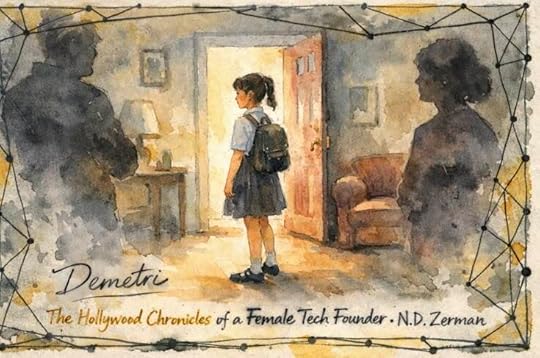
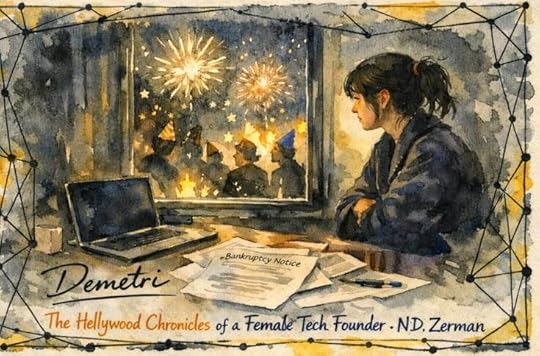
Watercolor Piece by Demetris Papadimitropoulos
There are books that arrive asking to be admired, and books that arrive asking to be believed. “The Hollywood Chronicles of a Female Tech Founder,” N.D. Zerman’s self-published memoir of building and losing ScriptBook AI, belongs emphatically to the second category. It does not glide in on polish. It storms in, singed, furious, sleep-deprived, occasionally overinsistent, carrying binders of old injuries under one arm and a machine-learning model under the other. It wants not your approval so much as your reckoning. Read it, it says. Look at what happened here. Look at what happens when a woman builds a tool designed to quantify a kingdom built on instinct, vanity, hierarchy and myth. Look at what the kingdom does in return.
That urgency is the book’s first strength and, at times, its undoing. Zerman writes as though the blood has not fully dried. Her memoir, composed in the aftermath of ScriptBook AI’s bankruptcy and only later brought into the world, still bears the pressure marks of a life recently crushed by investors, egos, co-founders, screenwriters, studio bureaucracy and European shame. The result is a narrative that can feel less like a polished business memoir than like a deposition given under oath after the building has already burned down. It is not always balanced. It is not always elegant. But it is alive in every limb.
And aliveness, in a book like this, counts for a great deal.
Zerman’s story begins with the kind of origin scene that risks sounding too neat if it were not rendered with such unembarrassed conviction. At 12, asked what she wants to be when she grows up, she writes that she wants to be “a legend.” The line might have curdled in lesser hands into motivational-poster nonsense. Here it becomes a key to the entire memoir. Legend, in this telling, is not celebrity. It is not even success, exactly. It is refusal – refusal to accept the scale of one’s assigned life, refusal to stay where one has been placed, refusal to let other people’s systems dictate the shape of one’s ambition.
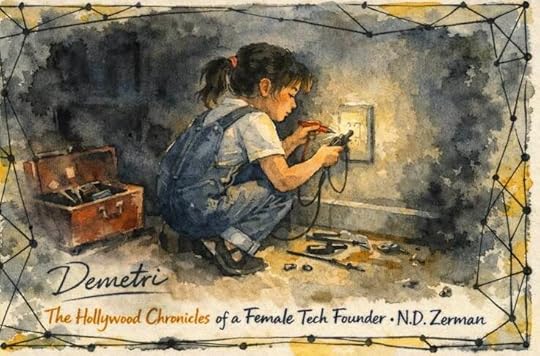
She is the daughter of Moroccan immigrants in Belgium, raised in a house short on money and rich in insistence. Instead of fantasy novels, she devours biographies of Newton, Tesla, Bruce Lee – men who changed the world by force of mind or body or both. She asks for a toolkit, not a dollhouse. She takes apart her bicycle to understand its mechanics. She nearly electrocutes the house trying to measure voltage. These childhood anecdotes have the burnished inevitability of founder mythmaking, and yet Zerman understands something crucial about memoir: if you are going to make use of origin stories, they had better reveal character rather than merely flatter it. These scenes do. They establish not only aptitude but temperament – curiosity with a violent edge, intellect fused to will.
The book’s first sustained wound comes in adolescence, when Zerman insists on attending a boys’ STEM school in Belgium and discovers, over six grinding years, what a society means when it says a girl may enter a room but does not belong there. She is mocked as female, Muslim, Moroccan, first-generation, wrong in every way the institution knows how to detect. The boys assault her physically. The teachers greet her presence not as promise but as administrative error. She survives through karate, becoming a black belt, a fighter, a girl willing to answer a shove with a punch. Here the memoir acquires its governing psychological pattern: every new arena becomes a more expensive version of the school hallway. The co-founders are the boys who pull her hair. The investors are the teachers who look at her and see trespass. Hollywood will prove simply to be a larger, better upholstered version of the same room.
But Zerman is too canny a memoirist to let early adversity serve as uncomplicated proof of later greatness. One of the most affecting notes in the book is her admission that the hostility of those school years did not merely harden her. It stole something from her. By the time she graduates, she has lost the uncomplicated love of technology that brought her there in the first place. The damage is not abstract. It is emotional, sensory, almost tactile. A hollow enters the heart. It will take years, grief, economics and one terrible Ben Affleck movie for her to find her way back.
Watercolor Piece by Demetris Papadimitropoulos
That movie is “Gigli,” the notorious flop that helps spark her graduate research into predictive modeling for film performance. The leap is so strange that it gives the book part of its charm. Zerman’s future company is born not from visionary certainty but from exasperated curiosity: How can an industry spend this much money, hire this many stars, generate this much noise and still fail so spectacularly? What if the problem is not bad luck but bad systems? What if the script, that old neglected thing beneath the celebrity and campaign and opening-weekend calculation, contains measurable signals no one is willing to see?
From that question comes ScriptBook AI, the company she will spend seven years building, defending, dragging, mismanaging, refining and finally burying. The idea is at once audacious and profoundly irritating to Hollywood. ScriptBook promises to analyze screenplays before production and forecast box office potential using data derived not merely from cast names and budgets and marketing chatter, but from the story itself – characterization, structure, emotional arcs, genre patterns, dialogue density, narrative strength. In Zerman’s formulation, this is not a gimmick. It is a corrective. The film business, she argues, has spent more than a century worshipping gut instinct, backroom prestige and inherited authority while hemorrhaging money on films no one actually wants to see.
It is here that the memoir acquires its most intoxicating counterfactual charge. What if she was right? What if the machine really could see what the moguls could not? What if “Adventures in the Screen Trade,” with its immortal shrug that “nobody knows anything,” met its algorithmic antagonist?
Zerman is at her strongest when she writes from within the practical absurdities of this premise. An accelerator program selects her startup, then insists she must have co-founders, a demand that soon reveals itself as a first tutorial in the gendered politics of supposed collaboration. Men arrive late to her idea and early to her equity. One tries to seize control. Another contributes almost nothing and extracts payment on his way out. The memoir’s co-founder material can feel a touch relentless, but that relentlessness is itself part of the point. There is no single betrayal, only a recurring structure in which a woman generates the work and men appear to negotiate ownership of it.
The fundraising chapters are among the book’s most gripping, in part because Zerman renders money not as triumph but as atmosphere – electric, humiliating, intoxicating, vaguely toxic. She secures what becomes a landmark seed round for a Belgian female founder, roughly $1.2 million, and is immediately transformed into a media symbol. A CNN appearance follows. So do speaking invitations, conference panels, magazine stories, the sudden and deeply American genre of applause reserved for women who become firsts. Zerman accepts the symbolic crown with mixed feelings. She knows she is being celebrated partly for what she has done and partly for the convenience of her representational value. She is the exceptional woman founder, the minority trailblazer, the headline. Yet already the terms beneath the celebration are rotting.
One of the book’s sharpest pleasures is its double portrait of Hollywood and venture capital as adjacent faith systems. Each claims to value disruption. Each is, in Zerman’s view, chiefly interested in preserving existing power. Each flatters itself as meritocratic while functioning through patronage, proximity and mythology. Hollywood wraps itself in art and glamour. Venture capital wraps itself in vision and risk. Both, she suggests, are narrative industries before they are anything else.
And then ScriptBook walks in carrying data.
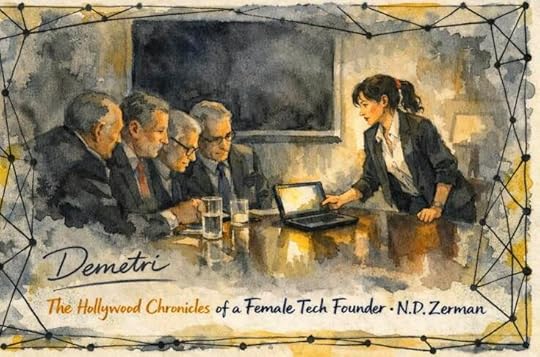
Watercolor Piece by Demetris Papadimitropoulos
The Hollywood sections are the book’s brightest and bitterest. Zerman loathes Los Angeles with the concentration of a woman condemned to keep returning there. New York, in her rendering, is rough, alive, metabolically honest. Los Angeles is lacquered falsehood – “plastic city” is the basic thesis – where even enthusiasm comes pre-whitened. She is not wrong often enough to make this portrait fresh, but she is vivid enough to make it feel earned. One can hear the specific abrasion of her hatred. It is not abstract anti-Hollywoodism. It is the fury of someone who sees too clearly what the place performs and what it withholds.
Yet the memoir is shrewd enough to register Hollywood’s seductions. Studio lots dazzle her. Fake New York streets under California sun make her dizzy. Hallways lined with plaques and legend photos exert real force. ScriptBook’s meetings with major studios – disguised under aliases like Yonis Pictures and Mercury Studios – pulse with the thrill of proximity to power. A room full of senior vice presidents leans over her tiny laptop to see the future. Executives ask the machine to run alternate casts through weak scripts, hoping star power might rescue mediocrity. ScriptBook says no. Story matters more. The room grows angry. One sees, in these scenes, why the technology was so destabilizing. It did not merely threaten to optimize development. It threatened to embarrass executives in front of their own self-image.
If the book has a single hinge, it is the ill-fated partnership with Franklin Leonard’s “The Black List,” the annual celebration of admired unproduced screenplays. Zerman imagines the collaboration as a democratizing coup. For a relatively low fee, struggling writers could receive AI-driven script analysis that might strengthen their work and help surface promising projects buried by an industry that often, she claims, has interns read no farther than Page 3. It is a noble idea, commercially smart, emotionally logical. It is also, as it turns out, an accelerant.
The backlash is swift, vicious and in the memoir’s telling profoundly revealing. Writers and commentators accuse the service of dehumanizing art, insulting creativity, mechanizing judgment. Leonard, who Zerman writes about with bruised respect, retreats under pressure. The partnership collapses. Here the memoir changes key. Before “The Black List,” Zerman still believes the people at the bottom of Hollywood’s food chain – emerging writers, unknown filmmakers, hustling outsiders – will recognize ScriptBook as an ally. Afterward, she understands that the romance of democratization is easier to chant than to operationalize. The very class she hopes to help joins the public stoning.
This is where the book becomes genuinely interesting and also least trustworthy in the cleanest sense. Zerman interprets the ferocity of the backlash as proof that ScriptBook threatened something real. She may be right. But the memoir is less interested in examining whether she and her company misread the emotional politics of creative labor than in demonstrating the hypocrisy of those who denounced them. It is strongest when it concedes complexity – as in the chapter “The Human Element,” where she acknowledges that AI cannot feel what a human feels and argues that ScriptBook was designed to assist, not replace, human judgment. It is weaker when every act of resistance is folded into the thesis that resistance itself proves the machine’s value.
Still, one need not swallow the entire case to appreciate its force. Zerman is persuasive on one crucial point: Hollywood already routinizes dehumanization, only less scientifically and more smugly. Scripts are skimmed, dumped, ignored, balanced under furniture. Assistants and interns serve as the first filter in systems that speak reverently of talent. The “human element,” as she depicts it, is often little more than arbitrary triage wrapped in taste. ScriptBook’s offense was not that it removed humanity, but that it made visible how little humanity was present in the process to begin with.
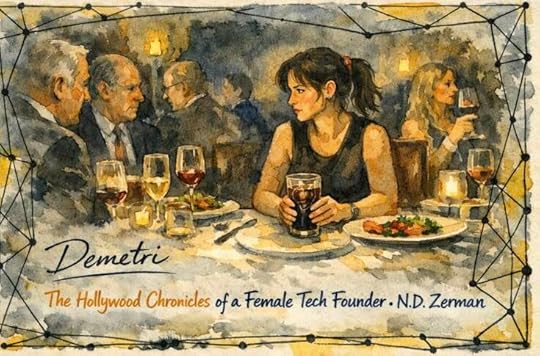
Watercolor Piece by Demetris Papadimitropoulos
The later chapters, darkened by investor neglect and pandemic timing, are the book’s most painful. Zerman’s board becomes effectively parasitic – unwilling to provide more money or meaningful guidance, unwilling to leave, still happy to retain upside. She keeps the company alive with personal savings, family money and bank debt, a choice she later judges harshly in hindsight. She takes on long, expensive proof-of-concept projects with major studios that do not pay enough soon enough. She underpays herself. She gives away too much labor in pursuit of future seven-figure deals. She is, in short, both right about many things and wrong about several fatal ones.
The memoir’s refusal to exempt its author from all blame is one reason it remains worth taking seriously. Zerman is not always self-critical in proportion to the grandeur of her claims, but she does understand, finally, that undercapitalization, trauma, perfectionism, unpaid proof-of-concepts and a catastrophically thin commercial runway all helped kill the company. COVID merely accelerated a collapse already incubating. Studios stalled. Streaming rearranged priorities. Former anti-tech executives defected to film-tech rivals. A much-needed European relief application was, in perhaps the book’s most grotesque bureaucratic detail, never properly submitted at all.
Then the company dies.
The final sections, which chronicle ScriptBook’s bankruptcy on Jan. 1, 2022, are both melodramatic and earned – a combination this book carries better than one might expect. Zerman treats the business like a body, a child, a civilization, a personal organ torn out in public. In Belgium, she notes, bankruptcy carries a cultural shame quite unlike the entrepreneurial shrug of the United States. There is no chic TED Talk waiting on the other side of failure, only silence, paperwork and the sensation of having become vaguely criminal. She hides at home in a robe. She stops speaking to the world. She begins to write.
That act of writing ends up saving the memoir from becoming merely a howl of grievance. In the closing pages and especially the author’s note, Zerman steps back far enough to articulate something larger than her own injury. ScriptBook, she argues, belonged to a pre-GPT wave of AI – research-heavy, predictive, domain-specific, built on structured data and long validation cycles. The newer flood of script-analysis tools, by contrast, often produces fluent language without comparable evidentiary rigor. It is a striking and timely distinction. In an era when everyone wants “AI” somewhere in the pitch deck, Zerman insists on the difference between language generation and actual insight. One hears, in that argument, not only self-defense but legitimate provocation.
That is also why this memoir feels so contemporary without having to strain for relevance. It arrives after the writers’ strike, after the normalization of AI panic, after streaming has rearranged the furniture of film culture, after every creative field has begun asking whether pattern recognition is aid or threat or both. “The Hollywood Chronicles of a Female Tech Founder” does not answer those questions cleanly. It is too invested, too bruised, too partial for that. But it stages them with unusual intimacy.
If I were to put a number on it, this lands at 80 out of 100: a flawed, fiercely readable, often exhilarating book whose originality and hard-earned specificity outweigh its rhetorical repetition and occasional self-exonerating drift. It is not “Bad Blood.” It is not “The Big Picture.” It is not “Uncanny Valley.” It is something messier – a startup autopsy written in the smoke, by the woman still coughing. And perhaps that is finally why it lingers. Zerman set out to build a machine that could tell Hollywood the truth about its stories. In the end, her most potent instrument turned out to be the old one: a human voice, angry enough to survive the collapse and skilled enough to turn it into narrative.
The Hollywood Chronicles of a Female Tech Founder by N. D. Zerman is a memoir of the author's seven-year journey as the young CEO of a startup, as well as a critique of Hollywood studios. Ms. Zeman is an entrepreneur and a keynote speaker.
The memoir is both raw and provocative with two parallel narratives. The first tells of the author's trials and tribulations leading a young Al company, ScriptBook Al from idea to fruition, the second is a criticism of the Hollywood studio system.
N. D. Zerman, a young, bright woman who is much tougher than, I believe, is giving herself credit for, won a competition in Belgium and got seed money to build her artificial intelligence company. She quickly finds herself dealing with the toxic swamps known as venture capital companies and the American studio system. The pressure on her must have been unbelievable.
The young lady learned something that, frankly, takes most of us a long time to learn: systems are interested, first and foremost, in feeding themselves. Whether it's the multi-billion-dollar Hollywood studios, or your local school programs. Her idea of using Al to predict whether a script would be successful (money wise) was not as well received as s hoped it would be.
The raw emotions and urgency of the book are both personal but can be destructive at times. While it's fascinating from the perspective of what it's like to deal with toxicity, it feels unpolished and unbalanced at times.
I think she took on a lot on herself, and many, if not most, of her criticism is relevant and justified. Today we all are feeling the effects of Al on our personal lives and jobs, we're in the midst of a technological revolution which we don't know what's on the other hand. Ms. Zeman was the forefront of that revolution, but she was unable to convince her target audience of her vision. She also didn't understand the Hollywood Studio system business model. They have many revenue streams, selling tickets is one of them but it's a short-term one. Other revenue streams, such as toys, long-term streaming values, and even creative account profiting from movies that perform badly (Mel Brooks knew about this in 1967 while write The Producers).
Another aspect that I found strange is her exasperation of online trolls and the talking points thrown at her during live events. Apparently, she, or her workers, spent much time reading posts on reddit or Twitter-but didn't have ready answers? To her credit, she does take responsibility for not being able to bring her vision to the masses.
Picking aside, The Hollywood Chronicles of a Female Tech Founder by N. D. Zerman is a fascinating look into the triumph, toxicity, intoxicating and sometimes humiliating aspects of running a business. As a cynical reader who loves the behind-the-scenes look at Innovation, I enjoyed this book very much.