In Luke Kennard's audacious new novel, a penniless and out-of-work actor picks up a job working for Dr Blend, a university professor who is conducting a psychological experiment. How will Dr Blend's students react to someone zipped into on oversized bag, sitting at the back of the lecture hall over a series of autumn term lectures? The role, eagerly accepted, soon has unexpected consequences. A professor of post-humanism develops research questions of her own, in particular can you love someone secreted away inside a black bag? Meanwhile, the actor's childhood friend and flatmate forms a vision for monetising this new situation...
A warped campus novel, an investigation into the crisis of masculinity and an off-kilter love story, Black Bag is a firework of a blazingly funny and profoundly humane.
This was just up my alley - bonkers, funny, but with an underlying sadness, and some insightful, but not heavy-handed, things to say about how we live now. What kept it from being a full 5 stars were some meandering scenes towards the end, and a bit too many meta congratulatory thoughts on its own cleverness.
At times, I caught whiffs of such disparate authors as A R Moxon, Mark Z. Danielewski, David NichollsTom Robbins and Kurt Vonnegut Jr. - while remaining utterly unique. It's certainly worthy of being on this year's Booker longlist - hoping it makes the shortlist, but doubt it can win.
Black Bag is a bizarre but compelling novel that follows an unnamed out of work actor who gets a job where he is required to sit in lectures from inside a black bag. Dr Blend, who employs the actor, insists he remain silent and not move; he must not speak to the students and preferably arrive and leave as black bag.
As the experiment continues the actor becomes more comfortable remaining as black bag outside of the classroom and the results of his non-interactions with others begins to bring about surprising results.
Perhaps to appreciate the weird nature of the book it should be noted that the original black bag experiment was first conducted by Charles Goetzinger in 1967 at Oregon State University.
In the original experiment it was the students reactions that were observed but Luke Kennard has flipped this on its head by being solely interested in the person inside the bag.
Black Bag is strange, surprising, funny in parts, most definitely not like anything I've read before and it makes me want to read more of his work.
Thankyou to Netgalley and Zando for the digital review copy.
"The world disappointed them, so they disappointed the world."
There’s no sugarcoating this, so I won’t even try. The cover for this is one of the weirdest I have ever seen. We all know my fondness of weird, that meant that this was a no brainer for me. Weird it was but also disappointing.
I wasn’t sure how the author would take a simple idea and turn it into a full fledged novel, but here we are and the outcome wasn’t as exciting as I had hoped. Now, parts of this were absolutely ridiculous and enjoyable. While others were dull and stretched out. Plus that conclusion bored me. I almost given up on this a few times but there was something about this that kept me going. It was a car wreck and you couldn’t help but look at it.
My favorite character was Justine. She was totally wild and I loved her. You never knew what was going to come out of her mouth, plus she was a straight up freak and didn’t care who knew. She was perfect. I swear, her character was the only standout one.
‘Black Bag’ was an interesting tale but about two hundred pages too long. There were a lot of unnecessary situations happening and it just wasn’t interesting. Everything that took place around campus had me intrigued, other than that I wasn’t impressed. It was worth the read once but definitely not an instant classic.
Male actor required for psychological enquiry. Non- speaking, but discretion and devotion to restrictive performance requirements obligatory. Duration 3– 4 months, start asap, pref immediate. No experience in discipline (Psychology) necessary. Short / slight stature preferred certainly no more than 5’8 but shorter if possible (Legs). Fee to be discussed. Contact Dr Paul Blend &c.
Luke Kennard's latest book is, in two different senses, a baggy novel. Our first person narrator introduces himself with:
If you met anyone as whiny, as disobliging and egocentric as the average narrator of a novel in real life you’d find them unbearable. You’d give them about five minutes before you excused yourself to get another drink, or moved to a different carriage, or asked to be transferred to an alternative department so you didn’t have to work with them any more. I’m not like that.
He is in fact an actor - although one lacking in much work other than corporate dinner murder-mystery gigs, leading him to apply for a series of unusual jobs including the advert above.
Dr Paul Blend proves to be a university lecturer in psychology and he wants our narrator to help him recreate the black bag experiment from 1967 when a student attended a term of lectures wearing a black bag that completely covered his body other than his bare feat, as the author explains in both an Observer article and the afterword:
The original black bag experiment was conducted by Charles Goetzinger in 1967 at Oregon State University in order to test Robert Zajonc’s mere-exposure effect. He observed that, over the course of the semester, ‘the students’ attitude changed from hostility toward the Black Bag to curiosity and finally to friendship’ (Goetzinger, quoted in Zajonc’s paper, ‘Attitudinal Effects of Mere Exposure’). In happening across this while researching a poem, I was immediately (which is to say obsessively and exclusively) concerned with Black Bag himself.
Although from my own research into the original sources (summarised here), I'm not convinced this was a deliberate experiment by Goetzinger, rather the idea was the student's who wore the black bag.
The inspiration was actually Yoko Ono and her then husband Anthony Cox and a performance they put on - here in London in 1966
The satirical columnist Art Hoppe from the San Francisco Chronicle in California wrote a column in early 1967 where he presented "the man of the Year Award to the individual who did the most during 1966 to make the world a better place to live" to Anthony Cox, who he credited with starting the Black Bag Movement which professes that "the world would be better off if everyone wore large, black, cloth bags."
And the student took his inspiration from that article which was syndicated in the US press including the The Oregon State Barometer on 5th Jan 1967, and who took to wearing a black bag to lectures, with Goetzinger's permission (and with only Goetzinger knowing his identity). The idea was more around eliminating prejudice and reducing sensory overload than testing Robert Zajonc’s ideas.
Later the reaction of the students to the black bag was picked up by Robert Zajonc as illustrating mere exposure, but it doesn't seem to have been the motivation.
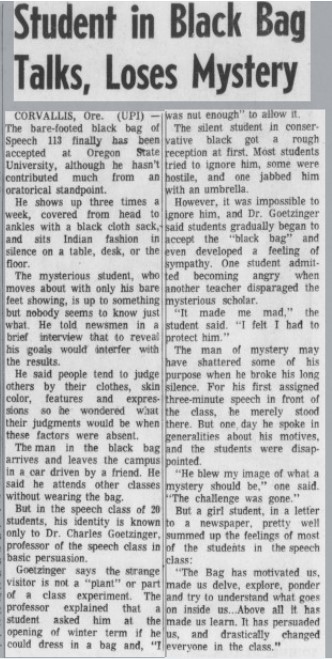
See below for a February 1967 article.
But (reluctantly) back to the novel.
Our narrator finds he is required to simply sit, or initially lie, in lectures, for a total of two hours a week, wearing his all encompassing bag, and interacting with the students as little as possible:
I am in black bag, and I'm lying on a desk at the back of the lecture theater. From the feel of it, I imagine it to be a desk with metal legs, painted a glossy gray, and the surface to be a pine-colored fake wood veneer. But why shouldn't I imagine the room to be far nicer than it may, in fact, be?
And while in the lectures while he listens to Dr Brand, he gradually drifts off, into what he terms 'maladaptive daydreaming', creating an elaborate fantasy of his life in an isolated Swedish town, initially prompted by Blend referring to the Örebro 10-to-18 Study into distance dependence of adolescent friendships).
Dr Blend shows us several slides of decorated bones, some encrusted with jewels, some converted into rudimentary weapons. He says something about Spinoza and ‘the sad passions’. Whenever our power to act is diminished. Fear, hate, envy, shame. He likens this to jouissance in Lacan. Birgitta has always wanted to visit her bedbound sister in the next town. I would like to make this possible but have no means of transport. I have been keeping savings from my salary at the sawmill, dull little silver coins decorated with stags, in a tin can in my locker to pay for her train fare. Mine too, so as to chaperone her. But when I leave work I notice that someone has stolen my can.
Our narrator starts to inhabit the role of black bag, rather than simply spending two hours performing it, and, inter alia, ends up getting sucked, via his best friend, into a crypto-scheme; has a sexual-relationship, while wearing his bag, with another lecturer; encounters a black-bags anonymous society; and has heated conversations with his parent's dogs while depicting them as mute statues.
And this is the problem with the novel - the second baggy element. It's 389 pages long and Kennard keeps throwing in more ideas. The novel covers / satirises, amongst other topics:
- the crisis in masculinity (although that doesn’t seem to have been particularly intended) - behavioural psychology and its adoption by the marketing industry to manipulate consumers - university campus architecture (and very disappointingly treats bricolage as a bad thing) - Twitch streamers - NFTs - energy drinks - managerialism in academia - sexual politics on campus (and the inversion of the troubled male lecturer-female student affair) - relationships with parents - readers' demands for likeable characters - tech bros and AI - the demands of lecturing on academics - artistic identity and the demand for publicity rather than anonymity
and more. And it's just too much - the humour and zest of the first third of the novel starts to wear thin by the end and whole story lines (the female professor in particular) seem unnecessary.
Although its most important message is on the redemptive power of art - and while ultimately, for me, unsuccessful, a novel I'm pleased to see the Booker judges embrace.
To trust in the arts is an act of hubris so self-destructive the gods don’t even bother to punish you for it. It is to become a monstrous politician of an insecure republic, an estate agent of your own soul, a demon of lubricity. There is just a chance, though, the width of a crack in a martini glass, that we need it more than ever.
CORVALLIS, Ore. (UPI) - The bare-footed black bag of Speech 113 finally has been accepted at Oregon State University, although he hasn’t contributed much from an oratorical standpoint. He shows up three times a week, covered from head to ankles with a black cloth sack, and sits Indian fashion in silence on a table, desk, or the floor. The mysterious student, who moves about with only his bare feet showing, is up to something but nobody seems to know just what. He told newsmen in a brief interview that to reveal his goals would interfer with the results. He said people tend to judge others by their clothes, skin color, features and expressions so he wondered what their judgments would be when these factors were absent. The man in the black bag arrives and leaves the campus in a car driven by a friend. He said he attends other classes without wearing the bag. But in the speech class of 20 students, his identity is known only to Dr. Charles Goetzinger, professor of the speech class in basic persuasion. Goetzinger says the strange visitor is not a “plant” or part of a class experiment. The professor explained that a student asked him at the opening of winter term if he could dress in a bag and, “I was nut enough” to allow it. The silent student in conservative black got a rough reception at first. Most students tried to ignore him, some were hostile, and one jabbed him with an umbrella. However, it was impossible to ignore him, and Dr. Goetzinger said students gradually began to accept the “black bag” and even developed a feeling of sympathy. One student admitted becoming angry when another teacher disparaged the mysterious scholar. “It made me mad,” the student said. “I felt I had to protect him.” The man of mystery may have shattered some of his purpose when he broke his long silence. For his first assigned three-minute speech in front of the class, he merely stood there. But one day he spoke in generalities about his motives, and the students were disappointed. “He blew my image of what a mystery should be,” one said. “The challenge was gone.” But a girl student, in a letter to a newspaper, pretty well summed up the feelings of most of the students in the speech class: “The Bag has motivated us, made us delve, explore, ponder and try to understand what goes on inside us...Above all It has made us leam. It has persuaded us, and drastically changed everyone in the class.”
The judges' commendation
‘How does an aspiring actor survive in contemporary London, where monthly living costs can rise well over a thousand pounds? The obvious solution – be born rich – has eluded Black Bag’s protagonist, a 37-year-old man who cobbles together an artistically and financially unsatisfying life performing in productions that stretch and undermine the meaning of theatre. That is until he gets a job showing up to student psychology lectures dressed in a black bag. Luke Kennard’s of-the-moment satire considers anonymity and disgust, the online rackets of cryptocurrency and energy drinks, and what it means to find love in our unstable times. There’ll be a lot of discussion about what the novel has to say about the state of modern masculinity (fractious; confused) – we also admired its sharply crafted sentences, memorable sex scenes, and humour.’
3.5 stars. I was completely drawn into this unique and very strange book. Unlike many other reviewers, I didn't find it particularly funny, but I did find it interesting and entertaining, and somewhere along the way I developed a real tenderness and affection for the protagonist.
I especially enjoyed his vivid and authentic inner thoughts. They felt honest and at times quite vulnerable, and I found myself becoming genuinely invested in him and his experiences. The writing is strong, and the book certainly gave me plenty to think about.
It also made me appreciate being Gen X. Some of the pressures and expectations facing younger generations, and particularly young men, seem incredibly complicated compared with what I remember experiencing. And this is exactly why I love reading literary fiction: it allows us to step into another person's life, see the world through their eyes and, hopefully, come away with a little more empathy and insight into experiences that are very different from our own.
My only real criticism is the ending. After being so completely drawn into the story, I felt it could have been stronger and more satisfying.
The Story: An out-of-work actor accepts an unusual job as part of a university psychology experiment: sitting silently in a lecture theatre while zipped inside a large black leather bag. What begins as a bizarre experiment soon takes on a life of its own.
What a strange one. This Booker longlist is wild and I’m here for it. Tempted to start this all over again.
A surreal, wacky, darkly comic, and original examination of masculinity and its place in modern society. I never knew where it was heading. I get the feeling I’ll be thinking about this one for a really long time.
A complaint: it’s too long. Could’ve been tighter with 50-100 less pages.
This is a quirky book with an interesting premise. A desperate actor takes a job offered by a psychology professor. He is required to wear a big black leather bag, sit in the back of the lecture hall, and not speak to anyone. He meets a female professor on campus who uses him for strange sex as part of her “research.” His drug-obsessed friend Claudio, an online influencer and gamer, sees a business opportunity.
The book implicitly asks the reader to do what the students do: fill an opaque object with significance. It works as satire, aimed at aimed at the urge to monetize everything and at male interiority. I laughed a few times, especially at Claudio's scheme. Oh, and there’s a talking dog. It gives us scene after scene involving the Black Bag, filtered through the unnamed actor's thoughts, as it investigates alienation, loneliness, the role of art, personal identity, and masculinity.
I found it hard to get emotionally invested. The flatness is likely intentional, but intention doesn't make it enjoyable to read. When a book makes the Booker Longlist, I expect something elevated. Here, the most interesting part is the premise.
An enjoyable, stimulating and often funny book, which I am grateful to the Booker judges for bringing to my attention. Could maybe have been improved by a little judicious editing, though a tight focus on the main story might have been a little oppressive. The starting point of the book is the 1967 Black Bag psychology experiment, in which a student attended a term's lectures and seminars hidden inside a black bag. Kennard's starting point is to transplant this scenario to a present day British university, make the man in the black bag the main protagonist, in this case a struggling actor, and explore the consequences.
I'm not entirely sure what Luke Kennard was trying to do with Black Bag. I'm not sure Luke Kennard was entirely sure what Luke Kennard was trying to do with Black Bag. It's one of those voicey novels that becomes increasingly exhausting -- not, in this case, because the voice itself becomes tiring, but because I felt less and less sure that that voice was being used to talk about anything, other than the typical Urban Male Ennui. I'm sorry: we're supposed to call it the "masculinity crisis" now -- a framing I am also increasingly tired of.
That's ultimately what's at the core of this book, but aside from illustrating that men are in crisis and male friends should tell each other they love each other more (...yes?) -- what else is here? Well, there is a long and baffling sequence where two characters -- an English professor and an actor -- go on a date to see a movie "made entirely by AI." This is in the same book in which NFTs are still a thing -- so what year is it? Anyway, neither of these creative professionals seem terribly bothered by the fact of this AI movie. Kennard also grants his version of Gen AI enormous creativity, with a resulting film that sounds more like the Wachowskis in Jupiter Ascending mode than anything AI could come up with. This plot point is then entirely abandoned.
What does Kennard want readers to think about AI? What does he want them to think about sex or art or, indeed, masculinity? Or does he just want to get a bit wacky with it?
If it's that last: I'm sorry, this book isn't funny enough.
It's also fundamentally not a campus novel, as the copy claims (do words not mean anything?). And I kind of can't believe it's a Booker Prize longlistee. But then: who the fuck knows what any of us are doing anymore, really.
There’s somehow a mismatch between the novel’s implied premise and its actual priorities. It made me feel like I was held verbally hostage by an extremely self-focused, internet-shaped, endlessly self-narrating mind emptying their browser history into one long-ass conversation. The humour didn’t work for me either, which made the whole black bag feel less like a meaningful object and more like a marketing hook.
It reminded me of The Vivisectors, and I became even less patient with Kennard’s asides. A fairly well-written novel that kept pretending it was about one thing while revealing, page after page, that it was really about another. The ending was exactly what I expected: more explaining, almost preemptively, lest we misunderstand the (mis)used allegory. The actor/narrator is left mid-sentence, because, well… there was more of the same, I guess…
Guys men are in crisis and apparently we have to read about it now.
I'm not entirely sure what Luke Kennard is trying to do with Black Bag, which is particularly unfortunate because the novel appears to have three very clear things it wants to do: diagnose a crisis of masculinity, interrogate the cultural implications of generative AI, and turn a bizarre psychological experiment involving a man dressed as a black bag into a metaphor for contemporary identity.
The problem is that I found all three considerably more interesting as ideas than as fiction.
The novel's central concern is masculinity or, more precisely, the particular crisis of masculinity experienced by the contemporary, culturally literate, economically precarious, permanently self-conscious man. Kennard's unnamed actor is unemployed, unsuccessful, sexually uncertain and increasingly unsure what being a man is supposed to entail. His friend Claudio represents one possible response: online communities, monetisation, crypto, performance and a kind of aggressively entrepreneurial masculinity. The narrator represents another: withdrawal, passivity, irony and self-erasure.
Kennard himself has been careful to distinguish this from the increasingly ubiquitous language of a "masculinity crisis." In an interview, he argues that the problem is less masculinity itself than "a horrible, regressive version of masculinity" that is in its death throes. That distinction is important because it is arguably the most sophisticated idea in Black Bag: the novel is not asking what has gone wrong with men, but what happens when traditional masculine structures collapse without being replaced by anything coherent.
And yet I found the novel's treatment of this question increasingly self-defeating.
The narrator is so thoroughly absorbed in his own consciousness that the novel occasionally seems to reproduce the pathology it is attempting to analyse. Everything becomes an occasion for self-narration: sex becomes a question of masculine identity; unemployment becomes an existential crisis; art becomes a referendum on personal worth; friendship becomes another way of negotiating male vulnerability. Even the possibility of escaping the self is converted into another elaborate way of thinking about the self.
This is where the black bag becomes such an important device.
The original 1967 experiment on which the novel is based was designed around the "mere exposure effect": a figure concealed inside a black bag appeared in university classrooms, initially provoking hostility before gradually becoming familiar and even accepted. Kennard has said that what interested him was less the psychological experiment than the person inside the bag, the struggling actor for whom anonymity becomes a role in itself.
As a metaphor, this is excellent.
The bag simultaneously represents: visibility and invisibility, performance and erasure, identity and its absence. An actor whose entire professional existence depends upon being seen discovers a strange freedom in becoming unrecognisable. He is no longer required to perform masculinity, attractiveness, success or even personhood. Other people can project whatever they want onto him because he has become an absence onto which meaning can be imposed.
This is also why the sexual relationship with Justine is interesting. She is attracted precisely to the narrator's absence: the person inside the bag becomes desirable because he has ceased to perform the conventional demands of masculine sexuality. The narrator can be wanted without having to present himself. The novel asks whether identity can exist independently of the sexual and social performances through which we normally recognise one another.
The black bag therefore offers what masculinity cannot: a way of existing without having to continually prove that one exists.
But this is also where I think Kennard's metaphor begins to collapse under the weight of its own cleverness.
The bag is such an immediately legible symbol that the novel never really needs to discover what it means. It already means everything. Masculinity, anonymity, performance, art, alienation, sexuality, commodification, contemporary identity: the bag can absorb all of it.
And so it gradually starts to feel less like a developing metaphor and more like a literary hook.
The distinction matters. A successful central symbol should accumulate meaning through the narrative; here, the black bag sometimes feels as though the narrative is being constructed primarily to generate new meanings for the black bag. The object becomes the answer before the novel has finished asking the question.
This problem becomes even more apparent when the novel turns toward generative AI.
On paper, AI should be a perfect extension of Black Bag's central concerns. If the bag asks what remains of a person when we remove their visible identity, AI asks what remains of art when we remove the artist. Both are fundamentally questions of authorship, performance and absence.
Who is speaking when there is no visible speaker? Who created something when the creator is technologically obscured? What makes a performance human? What happens to the artist when the distinction between person and product begins to disappear?
These are genuinely interesting questions.
But the novel's AI material rarely develops them with the same conceptual seriousness that its premise initially promises. The episode involving the AI-generated film is especially frustrating because it appears to open an entire second novel about artificial creativity, only to abandon the subject almost immediately. Kennard gives the technology extraordinary imaginative capabilities, but the resulting satire feels strangely detached from the questions it ought to provoke.
The issue isn't that the AI is implausibly advanced. Satire is perfectly entitled to exaggerate. The issue is that I couldn't work out what the exaggeration was for.
Is Kennard satirising the belief that AI can replace artists? Is he satirising artists' fear of replacement? Is he interested in the commodification of creativity? Is the point that contemporary technology has made originality itself impossible to define? Or is AI simply another sufficiently contemporary object for the novel's characters to project their anxieties onto?
The novel never quite settles the question.
And this is increasingly my problem with Black Bag as a whole. It is full of interesting ideas that seem to be waiting for the novel to commit to them.
The crisis of masculinity. The black bag as an instrument of erasure. AI and the disappearance of the artist. The relationship between online culture and male alienation. The monetisation of identity.
But Black Bag repeatedly substitutes proliferation for development. It introduces another idea before the previous one has acquired sufficient weight, then another, and another, until the novel begins to resemble the consciousness of its narrator: perpetually associative, perpetually self-interpreting, perpetually moving sideways.
This perhaps explains why I found the book increasingly exhausting rather than increasingly profound.
Other readers have identified the same structural problem I experienced: the plot is secondary to the novel's thematic concerns, and the characters can sometimes feel like vehicles for Kennard's arguments. I think that is exactly right. The novel is not lacking in things to say. It is lacking in the sense that all of those things need to become one thing.
And that is ultimately why the black bag itself becomes such a revealing failure for me. It begins as the novel's most elegant image: the man who wants to escape the demands of masculine identity discovers that the most liberating way to exist might be not to exist visibly at all. But instead of allowing that paradox to deepen, Kennard keeps adding meanings until the metaphor becomes almost infinitely elastic.
Eventually, the bag can mean anything. And when a symbol can mean anything, it risks meaning very little.
I admire the audacity enormously. The premise is strange, funny and genuinely original; the novel has the courage to build an entire book around an absurd image that could very easily have remained a one-line joke. Kennard also clearly understands something important about contemporary alienation: that we are simultaneously expected to construct ourselves endlessly and exhausted by the necessity of doing so.
I just don't think Black Bag knows when to stop constructing. If it had been shorter by perhaps a hundred pages, I suspect I would have found its ideas considerably more forceful. The masculinity argument would have had less room to become repetitive; the AI material could either have been developed properly or removed; and the black bag might have remained an unsettling, genuinely ambiguous metaphor rather than becoming the novel's all-purpose explanatory device.
So I am left with the peculiar experience of admiring almost everything Black Bag is attempting while remaining unconvinced by what it ultimately accomplishes.
The book asks what happens when a man disappears.
My answer is that I mostly wanted the novel to disappear with him.
Love love love this. It’s kind of like if Kate Bush wrote Fight Club, if you can imagine that. Very human and heartfelt and full of little truths I wanted to turn over in my brain again and again like hard candy on the tongue. Will probably reread one day and enjoy it twice as much, due to the mere exposure effect.
Booker Longlist 3 of 12 (read John and John and the Elizabeth Strout before the list was announced and they were both powerful, if imperfect, novels who plainly made their case for inclusion). Rating: 3 out of 10.
This book was so boring. It was an intriguing premise, a struggling no-longer very young actor gets a gig for a psych prof and begins working as the eponymous black bag (he wears an all encompassing black bag and doesn't speak or interact with others) to the prof's psych classes. Gradually Black Bag takes the narrator over, and he starts enjoying living more and more of life this way. At some point, he realizes that many people have a yearning to be Black Bag. That could be 50 pages, cut, end scene. Quirky, potentially thought provoking, fine.
Instead the book meanders on and on, taking in NFTs, AI creation, extreme psychedelics, sex in the key of fetish and domination, Twitch streamers, the "masculinity crisis" , venture capital and god knows what else. A veritable salad of buzzwords, but nothing is ever actually said.
Also, they billed this as funny. I didn't crack a smile once. Although I did cringe, often.
I hope this is not a harbinger of Booker things to come.
I adored this book. Kennard wastes no time establishing his brand of weird and absurd. This is satire, after all. I loved the playful theological questions, philosophical detours, and commentary on masculinity. And Justine! It felt so refreshing reading her character. She was marvelous.
I do think this could have been about 50 pages shorter, but the plot, philosophical explorations, and the emotional core of the story all intertwined so beautifully by the end that I actually cried a little. It reminded me a lot of my experiences reading the last few pages of a Terry Pratchett novel, where seemingly disparate threads suddenly reveal a deeper truth about humanity.
Ultimately, Black Bag is a story about love, friendship, and finding meaning in an increasingly bewildering world. It feels especially timely and I genuinely think we could all benefit from reading this right now.
Huge thanks to the Booker judges for nominating this delightfully chaotic, thought-provoking, and surprisingly heartwarming novel. If it weren't for The Booker longlist, I doubt I would have picked this up on my own.
I chose the audiobook for Black Bag, narrated by Luke Kennard himself, and I think it's one of those rare occasions where hearing the author read the work is the definitive experience. His impeccable comic timing, dry delivery, and deadpan wit make it feel at times like an extended stand-up routine, with every awkward pause and absurd observation landing exactly as intended.
Beneath all that laughter, though, is a surprisingly melancholy novel. The comedy becomes a mask for much deeper concerns: loneliness, isolation, the feeling of being invisible, financial insecurity, modern masculinity, artificial intelligence, and the way capitalism can reduce people to interchangeable parts. The absurd premise isn't just there for laughs; it exposes how contemporary life can feel disconnected, like being in a performance, and how desperately people long for genuine human connection and meaning. For the narrator, a struggling actor who dons the black bag, it is the role of a lifetime!
It's a strange, funny, and quietly moving novel for anyone willing to look beyond the jokes. I laughed often, but by the end it is the sadness beneath the humour that will stay with me.
I greatly admire the bravery to take on such a wacky premise, but I feel like he tried to sustain it for way too long. If this book had been whittled down by about a hundred pages, I probably would have liked it a lot more.
This is the kinda book that has many, many deep and introspective things to say about society, art, sexuality, identity, the nature of man, and the inherent loneliness of performing a part in our lives everyday, but you're distracted by the fact that there's a man walking around pant-less in a black leather bag. Hate when that happens.
This also reminded me that I still have no idea what tf an NFT is and why anyone would ever be stupid enough to invest in it. Maybe that's why I haven't made it big yet.
When an unemployed London actor gets recommended to a professor for his latest assignment, the last thing he'd expected was to spend the next few months walking around the university campus dressed in a large black bag. What starts off as an absurd experiment (based on a real one from 1967) turns into a performance and then becomes nothing but dull reality. Wonderful and quirky take on the male ego and all its feral permutations.
This is easily one of the weirdest entries on this year's Booker longlist. Picture walking down the street and seeing someone completely encased in a black leather bag, only their legs visible — I'd freak out and call the police on the spot. That's essentially the premise Kennard runs with, and it's wonderfully absurd on paper.
The novel follows a broke, out-of-work actor who takes a job with Dr. Blend, a psychology professor running an experiment loosely based on the "mere-exposure effect." His task: zip himself into the bag and sit silently at the back of a lecture hall, week after week, while Blend observes how students' attitudes shift. As the story goes on, things spiral from there. He starts wearing it even when he's not in the lecture hall. He's pulled into a strange, at times outright grossing-out submissive relationship with another professor. He finds a black bag society. All this happens while his friend Claudio, an online influencer, sees the whole situation as a monetization opportunity — selling shares in the performance, launching NFTs.
There's a lot going on underneath the absurdity: satire of online grift culture and anonymity, energy drinks, a meditation on masculinity, and a strange non-relationship built on the narrator's total erasure of self. And it is funny — genuinely laugh-out-loud at points, which I appreciated given how much I enjoy absurdist fiction.
The problem is length. At 300-plus pages, it felt like it could've been a tighter, sharper 150–200 page book. Instead it keeps stuffing in more — more satire, more of the professor's relationship — until the momentum sags. The narrator himself became increasingly grating as the book wore on, and I found myself bouncing back and forth between irritation and amusement like a yo-yo for the back half.
What kept me reading, despite losing patience with the protagonist, was a persistent sense of not knowing where any of this was going — that unpredictability pulled me through to the end even when I wasn't enjoying the ride. In the end, though, it's a book I respect more than I liked.
It was really something, reading an existential novel which is laugh-out-loud funny. There’s a lot going on in Black Bag (the physical bag and the book): alienation, identity, relationships, masculinity… the big ones. But somehow it never veers into preachiness and manages to stay smart, witty and fun in the face of existential dread and jaws of reality (whatever that is). It doesn’t feign depth through obfuscation, and it plays with a weird combination of absurdity, and magic realism vibes.
Thanks to #Netgalley and #ZandoProjects for the book #BlackBag by #LukeKennard. This book is about a struggling actor who is hired to sit in a black bag and not say or interact with the students. It is to see how the students will interact with the bag.