

What do you think?

A door must be either open or shut
Un comte craint de trouver sa séduisante voisine entourée de visiteurs importuns, mais il ne peut s'empêcher de pousser la porte de son salon. La jeune femme, quant à elle, assure être insensible aux déclarations de son voisin, mais ne se résigne pas à son départ... Mathilde, de son côté, pleure de voir son jeune époux partir au bal, mais a disparu quand il rentre... Chaque fois qu'une porte s'ouvre ou se referme, se joue le bonheur ou le malheur de toute une vie... L'édition permet d'étudier le proverbe dramatique, genre théâtral dont l'écriture et la dramaturgie empruntent au vaudeville, au drame romantique et à la comédie classique.
44 pages, Hardcover
First published January 1, 1845
About the author
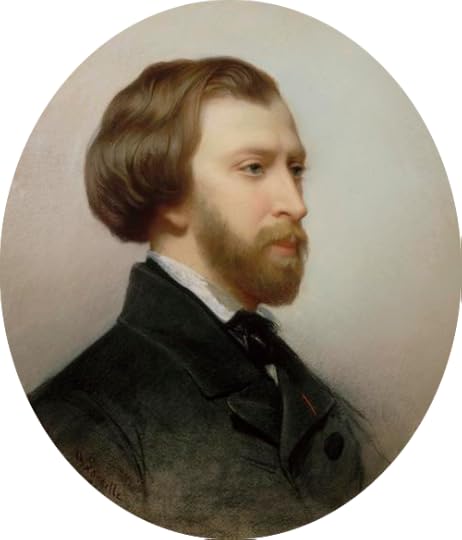
Alfred de Musset
1,649 books231 followersAlfred Louis Charles de Musset-Pathay (11 December 1810 – 2 May 1857) was a French dramatist, poet, and novelist. Along with his poetry, he is known for writing La Confession d'un enfant du siècle (The Confession of a Child of the Century, autobiographical) from 1836.
Musset was born on 11 December 1810 in Paris. His family was upper-class but poor and his father worked in various key government positions, but never gave his son any money. His mother was similarly accomplished, and her role as a society hostess, - for example her drawing-room parties, luncheons, and dinners, held in the Musset residence - left a lasting impression on young Alfred.
Early indications of Musset's boyhood talents were seen by his fondness for acting impromptu mini-plays based upon episodes from old romance stories he had read. Years later, elder brother Paul de Musset would preserve these, and many other details, for posterity, in a biography on his famous younger brother.
Alfred de Musset entered the collège Henri IV at the age of nine, where in 1827 he won the Latin essay prize in the Concours général. With the help of Paul Foucher, Victor Hugo's brother-in-law, he began to attend, at the age of 17, the Cénacle, the literary salon of Charles Nodier at the Bibliothèque de l'Arsenal. After attempts at careers in medicine (which he gave up owing to a distaste for dissections), law, drawing, English and piano, he became one of the first Romantic writers, with his first collection of poems, Contes d'Espagne et d'Italie (1829, Tales of Spain and Italy). By the time he reached the age of 20, his rising literary fame was already accompanied by a sulphurous reputation fed by his dandy side.
He was the librarian of the French Ministry of the Interior under the July Monarchy. During this time he also involved himself in polemics during the Rhine crisis of 1840, caused by the French prime minister Adolphe Thiers, who as Minister of the Interior had been Musset's superior. Thiers had demanded that France should own the left bank of the Rhine (described as France's "natural boundary"), as it had under Napoleon, despite the territory's German population. These demands were rejected by German songs and poems, including Nikolaus Becker's Rheinlied, which contained the verse: "Sie sollen ihn nicht haben, den freien, deutschen Rhein ..." (They shall not have it, the free, German Rhine). Musset answered to this with a poem of his own: "Nous l'avons eu, votre Rhin allemand" (We've had it, your German Rhine).
The tale of his celebrated love affair with George Sand, which lasted from 1833 to 1835, is told from his point of view in his autobiographical novel, La Confession d'un Enfant du Siècle (The Confession of a Child of the Century, made into a film, Children of the Century), and from her point of view in her Elle et lui. Musset's Nuits (1835–1837, Nights) trace his emotional upheaval of his love for George Sand, from early despair to final resignation. He is also believed to be the author of Gamiani, or Two Nights of Excess (1833), a lesbian erotic novel, also believed to be modeled on George Sand.
Tomb of Alfred de Musset in Père Lachaise Cemetery
Musset was dismissed from his post as librarian by the new minister Ledru-Rollin after the revolution of 1848. He was however appointed librarian of the Ministry of Public Instruction in 1853.
Musset received the Légion d'honneur on 24 April 1845, at the same time as Balzac, and was elected to the Académie française in 1852 (after two failures to do so in 1848 and 1850).
Alfred de Musset died in his sleep on 2 May 1857. The cause was heart failure, the combination of alcoholism and a longstanding aortic insufficiency. One symptom that had been noticed by his brother was a bobbing of the head as a result of the amplification of the pulse; this was later called de Musset's sign. He was buried in Père Lachaise Cemetery in Paris.
Musset was born on 11 December 1810 in Paris. His family was upper-class but poor and his father worked in various key government positions, but never gave his son any money. His mother was similarly accomplished, and her role as a society hostess, - for example her drawing-room parties, luncheons, and dinners, held in the Musset residence - left a lasting impression on young Alfred.
Early indications of Musset's boyhood talents were seen by his fondness for acting impromptu mini-plays based upon episodes from old romance stories he had read. Years later, elder brother Paul de Musset would preserve these, and many other details, for posterity, in a biography on his famous younger brother.
Alfred de Musset entered the collège Henri IV at the age of nine, where in 1827 he won the Latin essay prize in the Concours général. With the help of Paul Foucher, Victor Hugo's brother-in-law, he began to attend, at the age of 17, the Cénacle, the literary salon of Charles Nodier at the Bibliothèque de l'Arsenal. After attempts at careers in medicine (which he gave up owing to a distaste for dissections), law, drawing, English and piano, he became one of the first Romantic writers, with his first collection of poems, Contes d'Espagne et d'Italie (1829, Tales of Spain and Italy). By the time he reached the age of 20, his rising literary fame was already accompanied by a sulphurous reputation fed by his dandy side.
He was the librarian of the French Ministry of the Interior under the July Monarchy. During this time he also involved himself in polemics during the Rhine crisis of 1840, caused by the French prime minister Adolphe Thiers, who as Minister of the Interior had been Musset's superior. Thiers had demanded that France should own the left bank of the Rhine (described as France's "natural boundary"), as it had under Napoleon, despite the territory's German population. These demands were rejected by German songs and poems, including Nikolaus Becker's Rheinlied, which contained the verse: "Sie sollen ihn nicht haben, den freien, deutschen Rhein ..." (They shall not have it, the free, German Rhine). Musset answered to this with a poem of his own: "Nous l'avons eu, votre Rhin allemand" (We've had it, your German Rhine).
The tale of his celebrated love affair with George Sand, which lasted from 1833 to 1835, is told from his point of view in his autobiographical novel, La Confession d'un Enfant du Siècle (The Confession of a Child of the Century, made into a film, Children of the Century), and from her point of view in her Elle et lui. Musset's Nuits (1835–1837, Nights) trace his emotional upheaval of his love for George Sand, from early despair to final resignation. He is also believed to be the author of Gamiani, or Two Nights of Excess (1833), a lesbian erotic novel, also believed to be modeled on George Sand.
Tomb of Alfred de Musset in Père Lachaise Cemetery
Musset was dismissed from his post as librarian by the new minister Ledru-Rollin after the revolution of 1848. He was however appointed librarian of the Ministry of Public Instruction in 1853.
Musset received the Légion d'honneur on 24 April 1845, at the same time as Balzac, and was elected to the Académie française in 1852 (after two failures to do so in 1848 and 1850).
Alfred de Musset died in his sleep on 2 May 1857. The cause was heart failure, the combination of alcoholism and a longstanding aortic insufficiency. One symptom that had been noticed by his brother was a bobbing of the head as a result of the amplification of the pulse; this was later called de Musset's sign. He was buried in Père Lachaise Cemetery in Paris.
Ratings & Reviews
Friends & Following
Create a free account to discover what your friends think of this book!
Community Reviews
Displaying 1 - 13 of 13 reviews

June 18, 2018
Hem boyut, hem uzunluk hem içerik olarak minnacık bir kitap. Dul bir huysuz markiz ile ona aşık ezik bir kont var. Çok sade dille anlatılmış, ikisi bildiğiniz aşk ilişki mevzusunda battle rhyme yapıyorlar dkcldpğc güzeldi.
bu arada kitabın adı bir atasözüymüş, bayıldım. tam bir drama krizinde söylenip susulmalık söz. :)
bu arada kitabın adı bir atasözüymüş, bayıldım. tam bir drama krizinde söylenip susulmalık söz. :)

May 16, 2020
imagehost
Il faut qu’une porte soit ouverte ou fermée est une comédie en un acte et 2 personnages rédigée par Alfred de Musset publiée en 1854 dans la Revue des deux mondes. Cette pièce fait partie d’un genre théâtral appelé ’’ le proverbe’’ répandu au 19ème siècle, caractérisé par la rédaction d’un seul acte généralement et destiné principalement à la société mondaine.
La discussion se déroule dans une seule pièce, la marquise qui, à l’âge de 30 ans est censée recevoir des visiteurs, personne ne vient sauf le Comte. Un jeu de mots commence et la sincérité y trouve place. Une lecture rapide, un happy ending et la porte se ferme.

Read
December 28, 2024A brief dramatic scene. The marquise and the count flirt. They have nothing much to say but cannot stop running their mouths because evidently they want to touch each other.

July 25, 2025
The Marchioness :
I suppose you find me pretty, and it amuses you to let me know. Well then — and what of it? What does that prove? Is that a reason for me to love you?
I imagine that if someone pleases me, it won't be because I'm pretty.
What does he gain from all these compliments?
What a fine way to win someone’s heart — to plant yourself in front of a woman with a monocle, look her up and down like a doll in a shop window, and say ever so charmingly: Madam, I find you delightful!
Add to that a few insipid remarks, a turn around the ballroom, and a bouquet — and that, apparently, is what passes for courtship.
Fie! How can a man of intelligence take pleasure in such nonsense? It makes me angry just thinking about it.
The Marchioness :
Well, yes indeed. One must assume a woman has an utterly empty head and a wealth of foolishness to think she can be charmed with such ingredients.
Do you really believe it’s entertaining to spend one’s life in a flood of nonsense, with one’s ears filled from morning to night with silly talk?
Truly, it seems to me that if I were a man and I saw a pretty woman, I would say to myself: “There is a poor creature who must be utterly worn out by compliments.” I would spare her, I would pity her, and if I wished to please her, I would do her the honor of speaking about something other than her unfortunate face.
But no — always the same: “You’re beautiful,” and then, “You’re beautiful,” and again, beautiful... Good heavens! We know that already.
I suppose you find me pretty, and it amuses you to let me know. Well then — and what of it? What does that prove? Is that a reason for me to love you?
I imagine that if someone pleases me, it won't be because I'm pretty.
What does he gain from all these compliments?
What a fine way to win someone’s heart — to plant yourself in front of a woman with a monocle, look her up and down like a doll in a shop window, and say ever so charmingly: Madam, I find you delightful!
Add to that a few insipid remarks, a turn around the ballroom, and a bouquet — and that, apparently, is what passes for courtship.
Fie! How can a man of intelligence take pleasure in such nonsense? It makes me angry just thinking about it.
The Marchioness :
Well, yes indeed. One must assume a woman has an utterly empty head and a wealth of foolishness to think she can be charmed with such ingredients.
Do you really believe it’s entertaining to spend one’s life in a flood of nonsense, with one’s ears filled from morning to night with silly talk?
Truly, it seems to me that if I were a man and I saw a pretty woman, I would say to myself: “There is a poor creature who must be utterly worn out by compliments.” I would spare her, I would pity her, and if I wished to please her, I would do her the honor of speaking about something other than her unfortunate face.
But no — always the same: “You’re beautiful,” and then, “You’re beautiful,” and again, beautiful... Good heavens! We know that already.

April 23, 2018
Entre une déclaration d'amour qui prend son temps et une affaire de jalousie par défaut de communication qui se résout par l'entremise d'une bonne âme, ces deux pièces de Musset sont de jolies romances, un brin compliquées par les frasques verbales des protagonistes mais le verbe est haut, le propos est léger.
Ca se lit facilement et se savoure comme de belles histoires d'amour, entre une porte et une bourse rouge.
Ca se lit facilement et se savoure comme de belles histoires d'amour, entre une porte et une bourse rouge.

November 26, 2017
It is a nice love story.
Egy kedves szerelmi történet.
Egy kedves szerelmi történet.

May 2, 2020
Mal Passado 2018

February 9, 2026
Je mets 5 parce qu'on a fait un jeu d'évasion littéraire basé sur ce texte avec des élèves c'était trop fun super moment

November 13, 2020
Bir Kapı Ya Açık Durmalı Ya Da Kapalı |3/5|
Kitap hakkında yapabileceğim, çok isabetli olduğunu düşündüğüm bir yorum var. Kitap bir tiyatro oyunu esasında ve bunu da göz önüne alarak söyleyebilirim ki kitap, bir film ya da dizinin içerisindeki karakterlerin izlediği televizyon şovlarındaki espri amaçlı hazırlanmış olan tarihi romantizm dizilerine çok benziyor.
Evet şu film ya da dizinin içerisindeki televizyonun içinde olan film ya da diziler.
Kitap bir kadın ve bir erkeğin laflamasını temel alan ve tek mekanda geçen bir tiyatro eseri. Benim için kitabın en dikkat çeken yanı çeviride Oktay Rifat ve Orhan Veli Kanık’ın parmağı olmasıydı. Yayınevinin belirttiğine göre kitap yayına hazırlanırken çevirmenlerin kullandığı imlanın muhafaza edilmesine özen gösterilmiş. Bir kanıt görmemiş olsam da metnin içerisinde bunu hissettiğimi söyleyebilirim.
Dönemin her yerini sarmış ve onun gözünde artık bayatlamış olan romantizmden sıkılan bir kadın ile kadın karakterimize gönlünü kaptırmış ve kadının gözünde o bayık romantiklerden biri olan adamımızın atışmaları eserin temelini oluşturuyor. Dediğim gibi, yazıldığı dönem için normal ya da ilgi çekici bir eser olabilir ama günümüzde biraz klişe kalıyor. Yine de fena değildi. Sahnede izlemek istemezdim ama diyalogları okumak keyifliydi.
İsmi kadar ilgi çekici olmayıp ortalama kalan bir eser bence. Turuncu kitapların arasından, 29 Şubat ile ilgili olan kitaba kıyasla daha iyi ama Bir Balıkçının Kulübesi, bu eserden daha iyiydi bence mesela.
Güzel günler dileğiyle. Kendinize iyi bakın.
“Az görüşmenin yegâne çaresi bu. ‘Salı günü kabul ediyorum’ demek, adeta ‘diğer günler beni rahat bırakınız’ demek oluyor.”
Kitap hakkında yapabileceğim, çok isabetli olduğunu düşündüğüm bir yorum var. Kitap bir tiyatro oyunu esasında ve bunu da göz önüne alarak söyleyebilirim ki kitap, bir film ya da dizinin içerisindeki karakterlerin izlediği televizyon şovlarındaki espri amaçlı hazırlanmış olan tarihi romantizm dizilerine çok benziyor.
Evet şu film ya da dizinin içerisindeki televizyonun içinde olan film ya da diziler.
Kitap bir kadın ve bir erkeğin laflamasını temel alan ve tek mekanda geçen bir tiyatro eseri. Benim için kitabın en dikkat çeken yanı çeviride Oktay Rifat ve Orhan Veli Kanık’ın parmağı olmasıydı. Yayınevinin belirttiğine göre kitap yayına hazırlanırken çevirmenlerin kullandığı imlanın muhafaza edilmesine özen gösterilmiş. Bir kanıt görmemiş olsam da metnin içerisinde bunu hissettiğimi söyleyebilirim.
Dönemin her yerini sarmış ve onun gözünde artık bayatlamış olan romantizmden sıkılan bir kadın ile kadın karakterimize gönlünü kaptırmış ve kadının gözünde o bayık romantiklerden biri olan adamımızın atışmaları eserin temelini oluşturuyor. Dediğim gibi, yazıldığı dönem için normal ya da ilgi çekici bir eser olabilir ama günümüzde biraz klişe kalıyor. Yine de fena değildi. Sahnede izlemek istemezdim ama diyalogları okumak keyifliydi.
İsmi kadar ilgi çekici olmayıp ortalama kalan bir eser bence. Turuncu kitapların arasından, 29 Şubat ile ilgili olan kitaba kıyasla daha iyi ama Bir Balıkçının Kulübesi, bu eserden daha iyiydi bence mesela.
Güzel günler dileğiyle. Kendinize iyi bakın.
“Az görüşmenin yegâne çaresi bu. ‘Salı günü kabul ediyorum’ demek, adeta ‘diğer günler beni rahat bırakınız’ demek oluyor.”

October 3, 2020
Garip akımının bir hayranı olarak, Orhan Veli Kanık'ın ve Oktay Rifat'ın ortak çevirisini tecrübe etmek için aldığım bir kitap olmasına rağmen, aşk adına verilen öğretileri, ateş ile aşka ve diğer duygulara yapılan göndermeleri, kitabı bitirdiğimde beni tebessümle bıraktı.
This entire review has been hidden because of spoilers.

June 7, 2016
Un caprice: 5/5
Il faut qu'une porte soit ouverte ou fermée: 3/5
Il faut qu'une porte soit ouverte ou fermée: 3/5

October 12, 2020
Döneminin trendlerini de yansıtan, ama aşk meşk işleri üzerine çok da değişmeyen hallere de değinen eğlenceli bir okumalık ve seyirlik.

February 2, 2023
Markiz âdeta slayed
Benim turkce (eski turkce??) kelime bilgim yokmus, onu ogrendim
Benim turkce (eski turkce??) kelime bilgim yokmus, onu ogrendim
Displaying 1 - 13 of 13 reviews