Õnnetus muudab meeled teravaks ja mälu meelespidavaks. Munro parimad jutud ongi lastest, nende lõbudest, taltsutamatusest, kurjusest. Kõik Munro tegelased – olgu nad siis lapsed, loomad või täiskavanud – on kiired salvama, et ennetada salvatasaamist. Autori iroonia hellitatud ja enesekindla seltskonna suhtes näib olevat see ainuke rõõm, mis teda ängi eest hoiab ja aitab vastu pidada – kuni kaevikuni Beaumont-Hamelis.
British writer Hector Hugh Munro under pen name Saki published his witty and sometimes bitter short stories in collections, such as The Chronicles of Clovis (1911).
His sometimes macabre satirized Edwardian society and culture. People consider him a master and often compare him to William Sydney Porter and Dorothy Rothschild Parker. His tales feature delicately drawn characters and finely judged narratives. "The Open Window," perhaps his most famous, closes with the line, "Romance at short notice was her specialty," which thus entered the lexicon. Newspapers first and then several volumes published him as the custom of the time.
Read in The Weird anthology curated by the Vandermeers.
Another excellent short story wrote by the English short story master, Saki. This is a horror story sprinkled with the author's signature dark humour. A sickly child, who is raised strictly by his cousin (" the Woman"), creates a cult to worship his pet ferret. The ending is chilling and sinister. The calm way the child smears butter on his toast as things happen...Brrr
Sredni Vashtar went forth, His thoughts were red thoughts and his teeth were white. His enemies called for peace, but he brought them death. Sredni Vashtar the Beautiful.
It was Friday night, I happened to be in an upcountry location. Feeling tired from the exhaustive mundane day-to-day official sequence of events (which are ironically necessary evils for your existence), I wanted to read something short. And searching through the web of internet (after following the pleasant distraction of news about Nobel Prize winners) I chanced upon Sredni Vashtar by Saaki, the little beauty which immediately got hold of me. Here you enter the eerie and disturbing but convincing world of Conradin, sickly ten-year old boy who was pronounced to meet the eventual fate of his life by the doctor; however, the boy has his inventive imagination, wrapped in the cloud of solitude, at his disposal as a symbol of hope to not to be succumbed to this cruel world. Her strict guardian, Mrs. De Ropp, pounces upon any possability arises out of probabilistic thread of the universe to rips away Conradin from any sort of comfort fruits of his perceptive imagination might provide, as we see that an undiagnosed condition seems more of an excuse for coddling restrictions and drawn-out dullness than any actual illness and throw Conradin into the deep and dark well of nothingness built upon inherent meaninglessness of life.
A normal child would have certainly surrendered to the demands of dull and cheerless but brutish abode controlled by unsympathetic cousin, but Conradin is no usual child as he contrives pleasures for himself, gained an added relish from the likelihood that they would be displeasing to his guardian, and from the realm of his imagination she was locked out—an unclean thing, which should find no entrance. Conradin hated her with sincere antipathy, though the feeling is mutual among them, but he has been able to mask it perfectly under his tempting labyrinth of fancy. In a forgotten corner, however, almost hidden behind a dismal shrubbery, was a disused tool-shed of respectable proportions, and within its walls Conradin found a haven, something that took on the varying aspects of a playroom and a cathedral. He had peopled it with a legion of familiar phantoms, evoked partly from fragments of history and partly from his own brain, but it also boasted two inmates of flesh and blood. In one corner lived a ragged-plumaged Houdan hen, on which the boy lavished an affection that had scarcely another outlet. Further back in the gloom stood a large hutch, divided into two compartments, one of which was fronted with close iron bars. This was the abode of a large polecat-ferret, which a friendly butcher-boy had once smuggled, cage and all, into its present quarters, in exchange for a long-secreted hoard of small silver. The dreadfulness of the beast harbors trepidation in him however, the beast proves to be his most sought after possession, one which gradually defines his life.
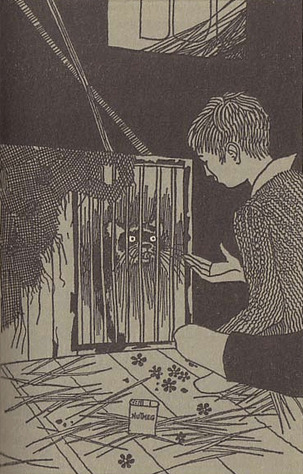
Conradin was dreadfully afraid of the lithe, sharp-fanged beast, but it was his most treasured possession. Its very presence in the tool-shed was a secret and fearful joy, to be kept scrupulously from the knowledge of the Woman, as he privately dubbed his cousin. And one day, out of Heaven knows what material, he spun the beast a wonderful name, and from that moment it grew into a god and a religion.
A seemingly simple tale of cat-mouse game (in which both opponents use their might to outsmart each other, only to realize eventually that they are in a deadly everlasting soup which would suck life out of both), in which Conradin and his cousin rear up their mutual aversion masked under the sheath of estranged association, to find solace in their mutually exclusive universes perhaps existing in the same space but in different dimensions, is in effect an astute study of faith and its impact over humanity. Our history (which gnaws at us from repository of time, wrenching our heart by throwing transcribes of human civilization at us and we look at those stricken with fear as if looking into a cruel mirror) is ornate with numerous instances wherein faith has been able to produce extreme righteous and evil deeds, but extremity of everything is bad, isn’t it. Recognizing that symbols or references we have carved out during the course of our existence essentially bestow psychological assurance that someone is there we may look up to (and Conradin too spun the beast a wonderful name, and from that moment it grew into a god and a religion which is contrasting to the religion of Mrs. De Ropp but following the fate of our belief systems it unfurls a sinister episode in the climax of the story) but if we move beyond the comfort of these symbols, we may come across the absurdity of life, however chilling it may be, in which we may realize our authentic existence which won’t holding upon any poles based upon psychedelic assumptions.
The Houdan hen was never drawn into the cult of Sredni Vashtar. Conradin had long ago settled that she was an Anabaptist. He did not pretend to have the remotest knowledge as to what an Anabaptist was, but he privately hoped that it was dashing and not very respectable. Mrs. de Ropp was the ground plan on which he based and detested all respectability.
Reading Saaki for the very first time, I find that his prose has a tinge of poetic beauty under the veneer of which actually lies profound absurdity conveyed through beautifully and carefully chosen (like the precision of a surgeon) adjectives which only enhances the effect of the narrative bequeathing the underlying irony. It is like a beautiful morning in which the tinge of red spreads across the landscape spreading pleasant panorama which soothes eyes and send pacifying ripples across the brain but at the heart of your consciousness you know that your star is burning and dying out every second, ironic beauty as we may call it. You may sense that the author has unparallel control of his prose as if he is guiding you through an unknown abyss of human consciousness holding a torch traversing through dark and menacing paths. And as one expects form the author in a short story to use a few words without blowing up the narrative- neither too revealing nor too disguised, one won’t be disappointed with Saaki- even a bit. It is like a literary pilgrimage wherein you worship the literature which oozes elixir of serenity and contentment for those who hold upon it. I highly recommend the short story to everyone as it sits shimmering through five ominous stars.
Picture a sickly ten-year old Edwardian boy, raised in a big house by a strict guardian. You might think of Colin in The Secret Garden (written and published shortly before WW1, as this was).
Image: Heydon Prowse as Colin Craven, 1993 (Source.)
But Conradin’s unspecified diagnosis seems more of an excuse for “coddling restrictions and drawn-out dullness” than the physical limitations imposed by Colin’s condition. And because Conradin is a child of Saki’s mind, he’s wily, and out to outsmart the elders, who are not, to his bright mind, his betters.
He finds small but significant ways to rebel against “the Woman” (actually his cousin). Their antipathy is mutual. She takes him to church each week, in what may be his only outings. He keeps secrets. He keeps things. He acquires a pet and, although “dreadfully afraid of it”, he worships it - literally. And then he prays to it to “do one thing for me”. That thing is not stated. It doesn’t need to be. Should he be careful of what he wishes for?
Saki’s brilliance here is a climax that happens in the shadows, but that shines a bright light on the true nature of Conradin.
“Conradin fished a toasting-fork out of the sideboard drawer and proceeded to toast himself a piece of bread. And during the toasting of it and the buttering of it with much butter and the slow enjoyment of eating it, Conradin listened…[and] made himself another piece of toast.”
Image: Spreading butter thickly, on toast. (Source.)
You will never picture someone cooly buttering hot toast in quite the same way again.
Other Quotes
• “Thwarting him ‘for his good’ was a duty which she did not find particularly irksome. Conradin hated her with a desperate sincerity which he was perfectly able to mask.”
• “His imagination… was rampant under the spur of loneliness.”
• “In the dull, cheerless garden, overlooked by so many windows that were ready to open with a message not to do this or that… The few fruit-trees that it contained were set jealously apart from his plucking.”
• “A disused tool-shed... a haven, something that took on the varying aspects of a playroom and a cathedral.”
More Saki
I'm gradually collating reviews of Saki short stories under The Best of Saki, HERE, as I read them in a rambling way, over several weeks and months.
You can find his stories, free, on Gutenberg. For example, HERE. Most are very short.
Shredni Vashtar is a disturbing morsel of a story by Saki (a.k.a. Hector Hugh Munro). Its eerie and perturbing quality is magnified as the protagonist is only a child and a sickly one.
Conradin is ten years old and not expected to live another five years. He has a guardian, Mrs. de Ropp, whom he deems ‘necessary and disagreeable and real.’ They both derive sadistic pleasure in hating each other, and the venom is veiled.
Conradin lives in his imagination as is sometimes true of children who are intensely lonely. He looks out on to a ‘dull, cheerless’ garden. His haven is a tool-shed, ‘something that took on the varying aspects of a playroom and a cathedral.’ His companions are a hen and a caged polecat-ferret; to the latter he gave the eponymous name of this story. I love how the gears start moving toward the sinister with this benign sounding line, ‘And one day, out of Heaven knows what material, he spun the beast a wonderful name, and from that moment it grew into a god and a religion.’ So what does an oppressed child do? Conradin makes a request of his hutch god but ‘The thing was not specified.’
The ending left me cold even as I watch Conradin toasting a slice of bread and buttering it generously. Read Shredni Vashtar. Five sinister stars. My thanks to Cecily for introducing me to Saki and this strange tale.
Long time ago I read the short story, at school, and we were taken to the cinema, lots of young teens, and watched the short film too. I remember at that young age really enjoying the film more than the words. I will probably read it again.
A particular scene in the film stuck with me. The scene where the young boy is told that he must not accept butter for his toast when they have a guest. It would considered rude and too luxurious.
And I wanted a ferret too...but my dad said no because they smell. I was bought a gold fish instead.
A ten-year-old boy struggles against the control of his cousin/guardian, whom he designates "the Woman." One might imagine here Saki's own boyhood, while under the care of stern and doting aunts.
The boy embraces wildness, in a shed in a hidden corner of the garden. He keeps a chicken and a ferret. He is friends with the chicken but worships the ferret. He names it Sredni Vashtar, and this story in turn is named after this polecat-ferret, red in tooth and claw.
The boy asks one thing from his spirit animal, but does not specify what that request might be. The animal will know.
My favourite line is at the beginning. It clarifies the nature of the life and death struggle between this stifled lad and Mrs De Ropp, his domineering guardian. The doctor has given his professional opinion that the boy will not live another five years. The doctor was silky and effete, and counted for little, but his opinion was endorsed by Mrs De Ropp, who counted for nearly everything.
Saki has a talent for creepy, charming tales; for sly biting wit, and beastly satire.
I can remember when I was 13 or 14 the Saki story the 'Lumber Room' was amongst the stories in our English reader and I was so overwhelmed by it that I went to the school library and took out a volume of Saki's stories - I have no idea which one - but that night in the dormitory (I was at a boarding school) I read the story 'Sredni Vashtar' and in particular the chant of young Conradian:
Sredni Vashtar went forth, His thoughts were red thoughts and his teeth were white, His enemies called for peace, but he brought them death Sredni Vashtar the beautiful.
And I can still remember the power of Conradian's chant and for the first time I understood how powerful words could be in the hand of master - that final phrase 'Srendi Vashtar the beautiful' just continued to echo and bring up images in my mind, that simple phrase said so much with so little. It was the beginning of a love affair with Saki who became my ideal of what wit and style could be in a writer. Fortunately I never attempted to imitate his style - though honestly if I could I would have - but having read the master at an utterly impressionable age I knew I couldn't.
More importantly I learnt about resistance to the world around me, not just as an adolescent, but throughout my life. Conradian found a way to save himself, though powerless, by creating his own world with its own god. That was lesson well learnt and far more important then any academic one.
“Sredni Vashtar” is tale about a sickly boy, bound to his large home, with no real outlets for his creativity and boredom. He has a hen and a caged polecat-ferret for pets. He is watched over by a kind of governess, for whom he does not care.
Your first hint that something has taken a turn for the weird and sinister is when the author describes the boy’s affection for the ferret turning into a religion. He names the animal “Sredni Vashtar”, a name that just comes to him, and prays that it will do him one favor that doesn’t need to be named.
I won’t give away the ending, but it is sinister as hell and you will never look at toast the same way again. This is an excellent example of early psychological horror and what would turn into the weird fiction tradition in the United States.
A disturbing tale of a sickly 10-year-old child, who is verbally abused almost daily by his guardian and in his rich imaginations he decides to invent a new god based on the caged polecat-ferret which was kept caged in the garden.
And then began his regular chants to Sredni Vashtar, his polecat god to take revenge against his tormentors, until one evening while he is slowly spreading butter on his toast, his vengeful dream comes true!
WOW. This short story was weird AF but I'm so here for it.
Sredni Vashtar is a story about a 10 year old boy who is supposedly sick and dying. He is under the guardianship of his older cousin, Mrs. De Ropp, who is a very strict and cold woman. The boy, Conradin, is kept from doing many things due to his state (although we are left to wonder if the poor boy is actually ill or not) and finds joy in only one thing: a ferret he dubs Sredni Vashtar. Conradin buys the ferret off of someone and hides it away in a locked hutch in a gardening shed. He visits the ferret every day and begins to worship it as a god. After awhile, Conradin's guardian notices he spends so much time in the shed and seeks out to sell off what she assumes is capturing Conradin's interest. However, she doesn't know about the ferret and sells off the hen in the shed instead. After Conradin continues to go to the shed, she steals the key to the locked hutch in an effort to take away the one thing Conradin holds dear.
I really liked the ending of this story and found it to be a perfect wtf just happened moment. I love that I was led to suspend my disbelief for it but in the best way possible. This is my first time reading something by Saki but I would like to read more of his work in the future if it's half as good as this was.
Sredni Vashtar went forth, His thoughts were red thoughts and his teeth were white. His enemies called for peace, but he brought them death. Sredni Vashtar the Beautiful.
That was my initial thought while starting this story. Saki is very very efficient with words, using the right amount to amaze and unsettle readers. Leaving open interpretations and Lovecraftian vibes in a nonchalant little boy's simulated reality. Oh, and that ironic last line.
I highly suspect Bradbury of borrowing "Cup of Tea" for his Veldt from here.
After reading some of the lesser known but ultimately contrived short tales of weird fiction during this time period, my first exposure to Saki through Sredni Vashtar was incredibly refreshing. The mix of the subtlety witty yet mysterious prose flowed well, and I felt that everything Saki wanted to express was successfully relayed to the reader in only a few short pages. This proves how impactful a story of less than 10 pages can be if outlined well enough. I look forward to reading more from Saki and the couple short film adaptations of this story that are out there.
This was another story recommended to me by my daughter. After reading a couple other gothic short stories, I was a little bored by ghosts and wanted a little something different. She recommended that I give Sredni Vashtar a read because it's about a killer ferret. The story did not disappoint. The ferret was cool. 4 stars.
Every few years, I have to re-read Saki's short stories. Utterly wicked, completely brilliant. This particular one is a favorite, in which a wicked aunt gets her just desserts.
Just completed my third reading. A masterpiece of a short story! “And while they debated the matter among themselves, Conradin made himself another piece of toast.”
A creepy tale that captures the frustration of adolescence in opposition to the arrogance of adulthood. When children covet secrets and adults do everything in their power to unearth them, convinced they must be 'up to no good'. Too often, I imagine, adults wished they'd never taken a peek down the rabbit hole...
I love Saki's short stories. He demonstrates irony, plot twists and a dark sense of humor. I also like that the stories are fully formed with fairly certain endings. Sometimes modern short stories feel to me like Ideas that went nowhere.