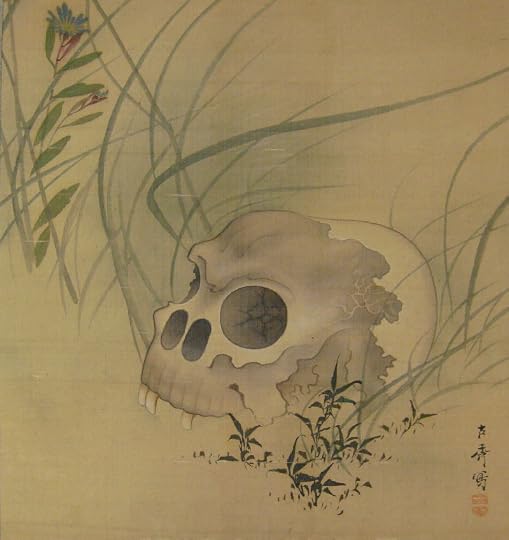
Some 120 haiku by such masters as Basho, Issa, and Buson—all written about animals—are combined with the woodblock prints and paintings of the great artists of classical Japan. The poems appear both in skillful English translation, as well as in the original Japanese.
Uneven translations, but the artwork is the reason to ‘read’ this. Dozens of beautiful reproductions in many styles of color and black and white images of animals. The b&w ink washes are just as stunning as the color woodblock prints.
Usually detestable, The crow, this morning, in the snow—
What a great find at a yard sale. The book is in perfect condition and its wood block prints are just beautiful. It is a book to protect.
I like how the author gives an introduction into writing Haiku and then a history on woodcutting. The poems are by various artists, many of whom I had ever heard of before, and the poems have woodcut photos behind them. The end of the book has a list of the artists and a short biography of each, as well as a list of the poets and their short biographies.
I have found that in order to write haiku you must first read many of the poems, and then you sit in nature and watch, or even walk into a photograph of nature, and then a poem arises within your mind and heart. I find that even when I read a poem, my own poem comes to me. This can happen even when watching TV. For example, I saw a documentary on the Mayflower, and when some settlers had arrived, they had caused disease among the Indians, which had killed them all off. The documentary said that villages up and down the coast had no one to bury the Indians, so their bones were all that were left. While I still know very little about haiku, I wrote a poem:
Passing by a village indian bones the earth replenishes
Hatta Koshu (one of the artists in the book.)
Here is one from a poet in this book:
Trampling on clouds, inhaling the mist, the skylark soars
~~Shiki
Then in the back of the book you will find this person's biography:
(1867-1901) Despite the brevity of his life, Shiki became the most influential haiku poet and theorist of the last century. He first studied Chinese literature and calligraphy, then after a hemorrhage of the lungs, turned to politics, philosophy, and aesthetics. Finally he took up haiku, advocating a return to the poetic ideals of Buson. Shiki's own poems show his keen observation of nature and display great sensitivity."
Two more poems:
His voice growing hoarse, the monkey's teeth are whitened by the moon over the peak ~~Kikaku
Wolves are keening in harmony-- this snowy evening
Is it really a surprise I enjoyed a book from the same set as Haiku People?
It equally stirred up a lot of the same emotions as well. The Haiku touch on the 'they were just like us' feeling even harder than the last one, but I think that's also because there was a side of mournfulness for all of the animals in the world I could never meet who were just as cute and smart and funny as the modern day. Except now we have short form videos that are more popular over short form poetry.
I'll admit there were a few chuckles and 'awe's to some of the work. I also showed some of the woodblock prints to my Grandma and she liked it a lot. Honestly I kinda wish there was a book in the series or a separate series on Japanese woodblock/painting with the pictures and maybe a brief blurb about them. I would buy 2, one to keep and one to cut out the pictures I like to frame.
But as for the book itself, I enjoyed the read and will possibly revisit it in the future whenever I need a kick in the butt to restart my Haiku journey.
There's a detailed intro about the history of haiku as well as the history of wood prints (the illustrations/art), and then the rest of the book is filled with charming animal poems and wonderful pictures. I read it aloud to my daughter (age 2) and she enjoyed it nearly as much as I.
One of my favorite poems:
The cuckoo with a single call has established summer
~Ryota
(Don't I long for a bit of summer, here in Wisconsin in February!)
I love haiku. I like to teach them and write them and read them. This sweet volume was given to me by my friend Yvonne as she prepared to move. It has wonderful Japanese woodblock art of animals beside the poems. The haiku are about animals and they are divided into swimmers, walkers,crawlers and fliers. So there are poems about warblers,snails and trout. I like this book. It is great for a quick shot of beauty in a busy day. I will keep it by my side!
This is a beautiful collection of traditional haiku written by Japenese masters and accompanied by woodblock prints. It gives a brief history of haiku and waka (5-7-5-7-7) in Japanese culture. Each poem is accompanied by the original in Japanese. At the back of the book there is a short biography of each poet and artist.
This is a beautiful book of haiku with some gorgeous prints. My only issue with it was that the translations were overly wordy and a bit clunky at times. Still, the pairing of haiku and art works well.
Another fine book in this series. A must for any haiku collection and perfect for lovers of animals and Japanese woodblock art. I especially like seeing the poems in both English and Japanese.