

What do you think?
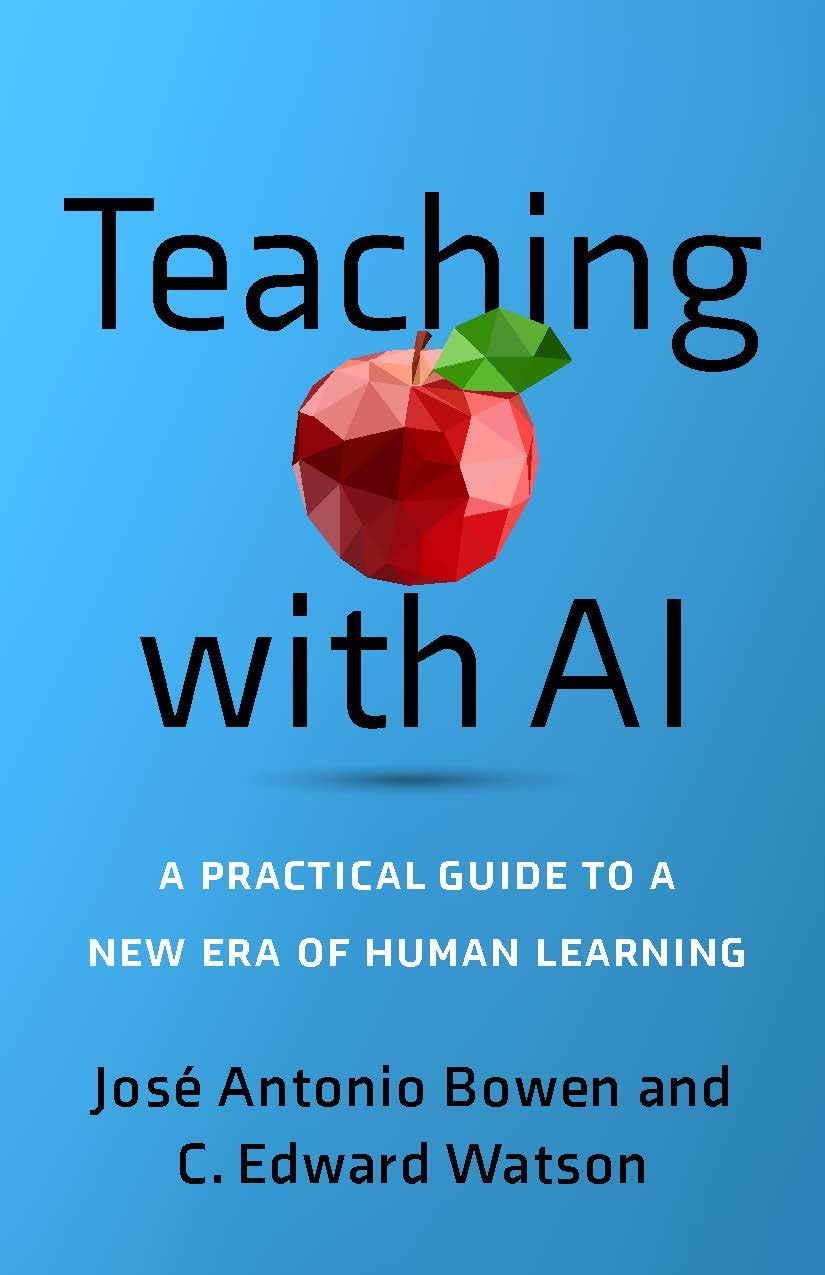
Teaching with AI: A Practical Guide to a New Era of Human Learning
How AI is revolutionizing the future of learning and how educators can adapt to this new era of human thinking. Artificial Intelligence (AI) is revolutionizing the way we learn, work, and think. Its integration into classrooms and workplaces is already underway, impacting and challenging ideas about creativity, authorship, and education. In this groundbreaking and practical guide, teachers will discover how to harness and manage AI as a powerful teaching tool. José Antonio Bowen and C. Edward Watson present emerging and powerful research on the seismic changes AI is already creating in schools and the workplace, providing invaluable insights into what AI can accomplish in the classroom and beyond. By learning how to use new AI tools and resources, educators will gain the confidence to navigate the challenges and seize the opportunities presented by AI. From interactive learning techniques to advanced assignment and assessment strategies, this comprehensive guide offers practical suggestions for integrating AI effectively into teaching and learning environments. Bowen and Watson tackle crucial questions related to academic integrity, cheating, and other emerging issues. In the age of AI, critical thinking skills, information literacy, and a liberal arts education are more important than ever. As AI continues to reshape the nature of work and human thinking, educators can equip students with the skills they need to thrive in a rapidly evolving world. This book serves as a compass, guiding educators through the uncharted territory of AI-powered education and the future of teaching and learning.
270 pages, Paperback
Published April 30, 2024
Ratings & Reviews
Friends & Following
Create a free account to discover what your friends think of this book!
Community Reviews
Displaying 1 - 30 of 140 reviews

August 27, 2025
Faculty summer reading. To no one's surprise, I found myself frustrated throughout. I can entertain some of the authors' points about, for example, emphasizing process over outcomes in assignments - that's an important conversation about pedagogy to have on its own. And for those who are already using AI in their teaching, I'm sure this book is helpful.
But to anyone who has strong ethical concerns about the proliferation of AI - not just about cheating and academic integrity, but about the environmental impact of AI technology and its anti-humanism - the authors are unconvincing. For all of the studies they cite and examples they share, they fail to grapple with counterarguments (which perhaps makes for C-level writing). They wave off ethical dilemmas as something that would make the book too long, but frankly the book is littered with suggestions for prompts and assignments that render the reading dull and lifeless. Such is the "practical" aspect, I suppose, but that assumes that we have all agreed to this practice, which I remain unconvinced in.
Another assumption the authors make is that the role of AI in increasing efficiency and productivity in a workplace is beneficial for that workplace. For high-level computing or automatable technological tasks, I can see the benefit. But education is an inherently inefficient process - we are slow to learn how to read, write, think, etc. After all, learning is a lifelong process, even after official schooling! In that sense, it seems impossible to me to speed up the learning process without losing something core to that process, which is finding a way through and make sense of complicated thoughts, emotions, and ideas - the internal struggle to understand something that is larger than oneself. If teachers or students are feeling pressed for time and want to cut corners, the solution is not to use AI - instead we should question what conditions make them feel that way and make the environment more conducive to the gradual, iterative process that is learning and teaching.
And, as I will continue to believe until I can be convinced by sounder arguments or life experience, to be human is to experience thinking, empathy, love, culture, art, nature in relation to the other humans around us. Teachers are engaged in a relational type of work. I fear that incorporating AI technology into the classroom risks undermining the unique connections we cultivate with students and colleagues. Rather than asking AI to help with drafting an email to a concerned parent, why not ask a trusted colleague? Rather than having AI create individualized assignments for students, why not spend time getting to know the students? Thinking is messy - as it should be, because humans are messy. And there is something beautiful in that mess - something that the sanitized, vague sounding writing of ChatGPT cannot - nor should not - reproduce.
But to anyone who has strong ethical concerns about the proliferation of AI - not just about cheating and academic integrity, but about the environmental impact of AI technology and its anti-humanism - the authors are unconvincing. For all of the studies they cite and examples they share, they fail to grapple with counterarguments (which perhaps makes for C-level writing). They wave off ethical dilemmas as something that would make the book too long, but frankly the book is littered with suggestions for prompts and assignments that render the reading dull and lifeless. Such is the "practical" aspect, I suppose, but that assumes that we have all agreed to this practice, which I remain unconvinced in.
Another assumption the authors make is that the role of AI in increasing efficiency and productivity in a workplace is beneficial for that workplace. For high-level computing or automatable technological tasks, I can see the benefit. But education is an inherently inefficient process - we are slow to learn how to read, write, think, etc. After all, learning is a lifelong process, even after official schooling! In that sense, it seems impossible to me to speed up the learning process without losing something core to that process, which is finding a way through and make sense of complicated thoughts, emotions, and ideas - the internal struggle to understand something that is larger than oneself. If teachers or students are feeling pressed for time and want to cut corners, the solution is not to use AI - instead we should question what conditions make them feel that way and make the environment more conducive to the gradual, iterative process that is learning and teaching.
And, as I will continue to believe until I can be convinced by sounder arguments or life experience, to be human is to experience thinking, empathy, love, culture, art, nature in relation to the other humans around us. Teachers are engaged in a relational type of work. I fear that incorporating AI technology into the classroom risks undermining the unique connections we cultivate with students and colleagues. Rather than asking AI to help with drafting an email to a concerned parent, why not ask a trusted colleague? Rather than having AI create individualized assignments for students, why not spend time getting to know the students? Thinking is messy - as it should be, because humans are messy. And there is something beautiful in that mess - something that the sanitized, vague sounding writing of ChatGPT cannot - nor should not - reproduce.

March 3, 2025
The central problem with AI is that it tends toward a generic lack of specificity, which I term "vague complexity." Thus any book written using primarily AI, such as this one, by definition cannot comment meaningfully on any topic. I know the "authors" of this book used AI not just because roughly half the book is simply lists of prompts, but because it concludes with "Key Themes" in exactly the same fashion as AI output. Other reviewers have pointed out bad misspellings and grammatical errors which would be embarrassing enough for a self-published book, let alone for a supposedly reputable publisher like Johns Hopkins University Press. In my case, I noticed at least three (3+) occasions when the audiobook reader said "IA" (Iowa) instead of "AI" (artificial intelligence). I have never heard anyone say "IA" aloud, and trying it myself, as a human, it feels awkward and difficult. This backs up my theory that the audiobook was not read aloud by a human, but rather by an AI that they gave a pseudonym to. I'm honestly not sure which is worse (a human reader who didn't catch these blatant errors, or Blackstone Audio using an AI), but either way the reader read very unclearly, and even attempting to speed it up to a meager 1.3x made basic pronunciation comprehension difficult.
To return to the start, that's the problem with AI: its quality degrades extremely quickly. The "danger" of AI recursion is to me the best thing that could happen to help undermine this non-technology, which fails on every single level. The biggest way that it fails is that it stupefies those who use it. In the case of this book, the "authors" (if you can even call them that) didn't explore even once the extremely debatable claim that AI "will" be used by everyone in the future, and furthermore that that's a good thing. The main problem with this assertion is that all AIs on the market today are imbued with a vaguely secular humanist neoliberal tech bro worldview. This is a large part of why they are so superficial, dated, and unreliable. For anyone who operates outside of that worldview, and for anyone who wants content not aligning with those assumptions, AI is worthless. Even telling it to roleplay doesn't help, because it's still trained off of such huge amounts of garbage data, and it tends toward the average of that landfill, which is roughly the consistency and odor of noxious sludge.
I genuinely don't know what the authors were thinking when they claimed "The second benefit was that this learning was not bound by human knowledge and bias." What do they think the LLM was trained on? The Platonically Ideal Thoughts of God? AI is biased and unethical, just like us. Furthermore, our bias and strangeness is precisely what makes human writing fun to read, and so removing that is precisely what makes AI writing so soulless. To me, there are no questions of how to best use AI; instead, the only valid questions concern the ethics of its use (and whether it should ever be used in the first place). For example, the "authors" wrote that you could ask AI to "Make this sound more empathetic and personal." Right there I had to freak out a bit, because if you ever get to the point in your life where you have to ask an AI how to be more empathetic, you probably need to seriously consider how you got to this point in your life. The only way to become a more empathetic human... is to be more human: consume and create art; make new friends; experience life in all its diversity; NOT reaching for the crutch of AI whenever you have the slightest dilemma.
Related to the shocking lack of humanity in that prompt, I also found shocking that the authors didn't understand that AI's popularity has absolutely no bearing on how ethical it is. The fact that it has been trained almost exclusively on illegally-sourced, copyrighted material should cause a class-action lawsuit so large that no corporation would ever touch the stuff again. Even though that hasn't happened and probably won't, AI is essentially worthless. An easy way to think about this is that AI use is analogous to steroid use. Though someone on steriods might still have an average physique, you can definitely tell in the extreme cases when it is being used. Therefore, it's at best something mediocre, and at worst it sticks out and causes red flags. This helps illuminate my initially paradoxical thoughts about its use in higher ed:
+ "AI is the new average of work" (totally agree)
- "With a little editing, a student could create a B paper with minimal effort" (totally disagree)
AI has not increased the quality of the average paper. It has lowered it. Superficial competency is always worse than unhinged human creativity. Operating with the assumption of inevitability is the central fallacy of this book. If you re-orient your rubrics to have AI as the new "F," then it forces students to use AI, rather than continuing to encourage them to avoid it, which is necessary lest we lose our souls. As I stated above, AI writing necessarily trends toward a mediocre average, so why build upon sand? Why not build upon the rock of human originality? Why settle for mediocre when you can rise above that? What sort of a hell do these authors live in, if they really are even the authors?
Despite how much I hate grading papers, the part near the end about AI for feedback feels exceptionally unethical. Because of the "authors'" fallacious starting assumption of AI's inevitability, they insanely think it’s fine. This is why thinking without AI is important, otherwise you’d never catch this and my many other complaints. Unless of course, this was entirely written by AI simply to comb negative reviews like mine, then to improve it via our responses. But even if that is the case, my valid points will get lost in a sea of irrelevancy, and the average will always win out. I can't wait for the eternal gray of the future, where there are no quality products, only average, half-functional products.
Snap out of your daydream Mark! You're writing a review! Returning to pedagogy, all I can see in the example assignments and prompts near the end is the many ways students will fall through the cracks who don't already have exceptional critical thinking skills. So many of these prompts totally skip any writing or critical thinking on the part of the student and basically just ask them to sit on a computer tinkering with AI all day, which to me is precisely the opposite of what students should be doing with their time. Rather than seeing how to get even more crutches in your writing and to make it even more average, we should look at how to avoid the crutches that all the lazy, stupid people will subject themselves to. People who write without AI are the future, not those who use it. Those who use it will be forgotten in the trash heap of the average, which curiously is shaped like a bell curve...
To return to the start, that's the problem with AI: its quality degrades extremely quickly. The "danger" of AI recursion is to me the best thing that could happen to help undermine this non-technology, which fails on every single level. The biggest way that it fails is that it stupefies those who use it. In the case of this book, the "authors" (if you can even call them that) didn't explore even once the extremely debatable claim that AI "will" be used by everyone in the future, and furthermore that that's a good thing. The main problem with this assertion is that all AIs on the market today are imbued with a vaguely secular humanist neoliberal tech bro worldview. This is a large part of why they are so superficial, dated, and unreliable. For anyone who operates outside of that worldview, and for anyone who wants content not aligning with those assumptions, AI is worthless. Even telling it to roleplay doesn't help, because it's still trained off of such huge amounts of garbage data, and it tends toward the average of that landfill, which is roughly the consistency and odor of noxious sludge.
I genuinely don't know what the authors were thinking when they claimed "The second benefit was that this learning was not bound by human knowledge and bias." What do they think the LLM was trained on? The Platonically Ideal Thoughts of God? AI is biased and unethical, just like us. Furthermore, our bias and strangeness is precisely what makes human writing fun to read, and so removing that is precisely what makes AI writing so soulless. To me, there are no questions of how to best use AI; instead, the only valid questions concern the ethics of its use (and whether it should ever be used in the first place). For example, the "authors" wrote that you could ask AI to "Make this sound more empathetic and personal." Right there I had to freak out a bit, because if you ever get to the point in your life where you have to ask an AI how to be more empathetic, you probably need to seriously consider how you got to this point in your life. The only way to become a more empathetic human... is to be more human: consume and create art; make new friends; experience life in all its diversity; NOT reaching for the crutch of AI whenever you have the slightest dilemma.
Related to the shocking lack of humanity in that prompt, I also found shocking that the authors didn't understand that AI's popularity has absolutely no bearing on how ethical it is. The fact that it has been trained almost exclusively on illegally-sourced, copyrighted material should cause a class-action lawsuit so large that no corporation would ever touch the stuff again. Even though that hasn't happened and probably won't, AI is essentially worthless. An easy way to think about this is that AI use is analogous to steroid use. Though someone on steriods might still have an average physique, you can definitely tell in the extreme cases when it is being used. Therefore, it's at best something mediocre, and at worst it sticks out and causes red flags. This helps illuminate my initially paradoxical thoughts about its use in higher ed:
+ "AI is the new average of work" (totally agree)
- "With a little editing, a student could create a B paper with minimal effort" (totally disagree)
AI has not increased the quality of the average paper. It has lowered it. Superficial competency is always worse than unhinged human creativity. Operating with the assumption of inevitability is the central fallacy of this book. If you re-orient your rubrics to have AI as the new "F," then it forces students to use AI, rather than continuing to encourage them to avoid it, which is necessary lest we lose our souls. As I stated above, AI writing necessarily trends toward a mediocre average, so why build upon sand? Why not build upon the rock of human originality? Why settle for mediocre when you can rise above that? What sort of a hell do these authors live in, if they really are even the authors?
Despite how much I hate grading papers, the part near the end about AI for feedback feels exceptionally unethical. Because of the "authors'" fallacious starting assumption of AI's inevitability, they insanely think it’s fine. This is why thinking without AI is important, otherwise you’d never catch this and my many other complaints. Unless of course, this was entirely written by AI simply to comb negative reviews like mine, then to improve it via our responses. But even if that is the case, my valid points will get lost in a sea of irrelevancy, and the average will always win out. I can't wait for the eternal gray of the future, where there are no quality products, only average, half-functional products.
Snap out of your daydream Mark! You're writing a review! Returning to pedagogy, all I can see in the example assignments and prompts near the end is the many ways students will fall through the cracks who don't already have exceptional critical thinking skills. So many of these prompts totally skip any writing or critical thinking on the part of the student and basically just ask them to sit on a computer tinkering with AI all day, which to me is precisely the opposite of what students should be doing with their time. Rather than seeing how to get even more crutches in your writing and to make it even more average, we should look at how to avoid the crutches that all the lazy, stupid people will subject themselves to. People who write without AI are the future, not those who use it. Those who use it will be forgotten in the trash heap of the average, which curiously is shaped like a bell curve...

June 1, 2025
The first chapters in this book annoyed me: lots of hype about the strengths of AI, lots of utopian dream casting about a future with generative AI ("previous AI helped curate your world but GPT AI will allow you to create your world"), and lots of references to dubious research—promotional advertisements, Forbes op-eds, Substack posts, YouTube lectures, Goldman Sachs reports, GitHub blogs, self-published syllabi, all cited in MLA format (often with that scholarly sounding "et al.") in a way that presented them on the page as authoritative, peer-reviewed sources—and in some cases disguised their special interests and unscientific credentials. The content sounded convincing until you double-checked the bibliography and realized that the data and statistics were culled from a radio program or a business school brochure. I balked at the salesmanship and window-dressing, the outlandish claims that AI will teach empathy and improve human communication, exalting AI as a classroom must on the flimsy basis of speculative think-pieces and amped-up marketing.
The book is much stronger when it eventually gets into the practical. I learned a lot about the so-called science of "prompt engineering" (I think this is a dressy name to describe the simple need for clear specifications when using AI interfaces like ChatGPT or Gemini). The authors offer a number of different strategies to generate better AI output:
* asking it to write in the particular style of an author or expert;
* using positive rather than negative language in the prompt (e.g. "use an informal tone" rather than "avoid formal language");
* giving more explicit instructions about how substantial and detailed the response should be (e.g. tell it to be thorough, ask for a complete response; if looking for a creative response, tell it to "transform" or "reimagine" the material provided);
* wrapping prompts in XML tags to get more specific and creative answers (for example, it may elicit a more elaborate response to write the prompt as "&<;thinking&/>;create an unusual hook for an opinion piece about the use of AI in higher education&<;thinking&/>;");
* including meta-instructions to get more accurate solutions with clearer process (e.g. "take a deep breath and work on this problem step-by-step" or "let's think carefully about the problem and solve it together").
All of these techniques can result not just in better answers but more explicit reasoning, depth and creative variety. I am skeptical of the idea of "prompt engineering" as some new specialist skill but they did show some unexpected ways (such as using XML tags) to modify and improve AI behavior.
Although the authors push heavily for the use of AI in education, I came to see them as much more even-keel and balanced than the initial chapters suggested. Their book is not just pedagogical trends and theory divorced from classroom realities; the authors shows real awareness of students' needs and challenges. They acknowledge the risks and trade-offs in using AI; they admit that students will often prefer to shirk the hard work of thinking and writing for themselves; they are attuned to the dangers of plagiarism and the futility of AI detectors; they suggest ideas for AI-resistant assignments but they also emphasize the need to discuss authorship, to explain the goals and benefits of the assignment, and to provide students with the curiosity and agency to do the work themselves; they are sensitive to the classroom pitfalls of introducing more digital apparatuses when human rapport and face-to-face interactions have been proven to be so essential in learning; they also note that students who over-rely on AI will often not be able to distinguish high-quality responses. They do not recommend that students "use AI as a tool" (a lazy mantra that I often hear); instead, they suggest that teachers use AI as the bar to define mediocrity—what AI can do should be a C and students should have to figure out the human-added value to obtain an A. "Rather than banning AI, let's just ban all C work," they argue.
And this gets to the real core of the book: numerous examples of prompts, activities, assignments, all involving AI—roleplaying with AI, using AI as a tutor, asking AI for feedback, or employing AI to present material in more engaging and personalized ways. The book presents different ways in which teachers might foster a more critical AI literacy in students: inviting students to fact-check and critique AI, "stress-testing" controversial claims by asking students to examine the claim and then get them to compare with AI output. Teachers could demonstrate how AI might fall for certain biases. While all of this may sound abstract in this summary form, what Bowen and Watson provide is a voluminous guide to AI lesson-planning: pages of varied sample prompts, often with select AI responses.
It's a useful resource but I still have many reservations about the research in the book. The opening chapters smacked too much of snake-oil charlatanism, and sometimes I felt the authors didn't do the kind of close reading of AI that they argued was so essential (the section in which they ask ChatGPT to write about Hamlet in the style of a Harvard professor was particularly bad—the AI response was repetitive, vague, and clumsy, everything a teacher would grade harshly). So all in all, useful but not authoritative.
The book is much stronger when it eventually gets into the practical. I learned a lot about the so-called science of "prompt engineering" (I think this is a dressy name to describe the simple need for clear specifications when using AI interfaces like ChatGPT or Gemini). The authors offer a number of different strategies to generate better AI output:
* asking it to write in the particular style of an author or expert;
* using positive rather than negative language in the prompt (e.g. "use an informal tone" rather than "avoid formal language");
* giving more explicit instructions about how substantial and detailed the response should be (e.g. tell it to be thorough, ask for a complete response; if looking for a creative response, tell it to "transform" or "reimagine" the material provided);
* wrapping prompts in XML tags to get more specific and creative answers (for example, it may elicit a more elaborate response to write the prompt as "&<;thinking&/>;create an unusual hook for an opinion piece about the use of AI in higher education&<;thinking&/>;");
* including meta-instructions to get more accurate solutions with clearer process (e.g. "take a deep breath and work on this problem step-by-step" or "let's think carefully about the problem and solve it together").
All of these techniques can result not just in better answers but more explicit reasoning, depth and creative variety. I am skeptical of the idea of "prompt engineering" as some new specialist skill but they did show some unexpected ways (such as using XML tags) to modify and improve AI behavior.
Although the authors push heavily for the use of AI in education, I came to see them as much more even-keel and balanced than the initial chapters suggested. Their book is not just pedagogical trends and theory divorced from classroom realities; the authors shows real awareness of students' needs and challenges. They acknowledge the risks and trade-offs in using AI; they admit that students will often prefer to shirk the hard work of thinking and writing for themselves; they are attuned to the dangers of plagiarism and the futility of AI detectors; they suggest ideas for AI-resistant assignments but they also emphasize the need to discuss authorship, to explain the goals and benefits of the assignment, and to provide students with the curiosity and agency to do the work themselves; they are sensitive to the classroom pitfalls of introducing more digital apparatuses when human rapport and face-to-face interactions have been proven to be so essential in learning; they also note that students who over-rely on AI will often not be able to distinguish high-quality responses. They do not recommend that students "use AI as a tool" (a lazy mantra that I often hear); instead, they suggest that teachers use AI as the bar to define mediocrity—what AI can do should be a C and students should have to figure out the human-added value to obtain an A. "Rather than banning AI, let's just ban all C work," they argue.
And this gets to the real core of the book: numerous examples of prompts, activities, assignments, all involving AI—roleplaying with AI, using AI as a tutor, asking AI for feedback, or employing AI to present material in more engaging and personalized ways. The book presents different ways in which teachers might foster a more critical AI literacy in students: inviting students to fact-check and critique AI, "stress-testing" controversial claims by asking students to examine the claim and then get them to compare with AI output. Teachers could demonstrate how AI might fall for certain biases. While all of this may sound abstract in this summary form, what Bowen and Watson provide is a voluminous guide to AI lesson-planning: pages of varied sample prompts, often with select AI responses.
It's a useful resource but I still have many reservations about the research in the book. The opening chapters smacked too much of snake-oil charlatanism, and sometimes I felt the authors didn't do the kind of close reading of AI that they argued was so essential (the section in which they ask ChatGPT to write about Hamlet in the style of a Harvard professor was particularly bad—the AI response was repetitive, vague, and clumsy, everything a teacher would grade harshly). So all in all, useful but not authoritative.

May 21, 2025
I teach history at the college level. I keep waiting for the book or the podcast or the video that will prove to me that the pedagogical losses I see everywhere and everyday on account of student use of AI will somehow be replaced by AI-enabled teaching techniques and assignments that will not only fully compensate for these losses, but will actually expand students' critical thinking and historical reasoning.
After reading this book, my wait remains.
It is not that I don't see how AI could possibly be useful to some things I do. For instance, I use AI for rapid translation of sources and to suggest alternative organizational patterns to pieces I've written. I could see some marginal ways I could allow students to use this in a class without feeling it was unethical. But do I think the fact that I could ask my college freshman to learn how to skillfully prompt ChatGPT to "write a 200-word process for removing a peanut butter sandwich from a toaster in the style of the King James Bible" (actual example from this book), makes up for the fact that I cannot assign take-home research papers to history majors without fear that they will wholesale AI them? No, I don't. No number of party tricks this technology can perform make up for the fact that it is killing something central to the humanities and what it means to be human, namely, the struggle of thinking something through that is wider than your own little self. Immersive, deeply researched, other-focused writing remains central to history, even if history CAN be done as a graphic novel (illustrated by AI) or a podcast (with AI voices) or a movie or whatnot. So what are we to do about writing? I noticed that all the writing assignments the authors provide as a means of bypassing AI are "you" centered - what choices "you'd" make, how the information you receive might effect "you," how "you" would talk with Socrates. I see why they propose this, but tt is so sad that we have now effectively hijacked any ways of wrestling with understanding the worlds that are not just about one's self.
Secondly, I also remain unconvinced that teaching AI literacy is a central part of my job. Not only do young people almost inevitably learn technologies faster than people my age - I don't remember any of my professors teaching me how to navigate the internet, and I would have scoffed at them had they tried! - but I did not receive a doctorate in machine learning. Now, I can teach them skills that could usefully be applied to AI, like how to verify information, or how to properly contextualize, or what makes for a strong historical argument. Students will learn this information in the course of study (that is if they don't use AI to bypass the heavy lifting of learning to do so). But should I be weighing in on whether they use Grok or Claude? No. I do not think so.
This leads me to the author's ultimate takeaway on mitigating unethical use of AI. Their suggestion is to just raise the bar on the level of work expected. If AI can produce C student work (let's not kid ourselves - for many of us, it's B or even A work), that work should be an F. That is just not practical. I cannot fail entire classes, and frankly most of my students struggle to think beyond the level that AI can think. If I flunked all students who cannot think beyond generalizations, I'd be meeting with the dean in no time.
At any rate, this book did not help me. I just felt frustrated and even sadder after reading.
After reading this book, my wait remains.
It is not that I don't see how AI could possibly be useful to some things I do. For instance, I use AI for rapid translation of sources and to suggest alternative organizational patterns to pieces I've written. I could see some marginal ways I could allow students to use this in a class without feeling it was unethical. But do I think the fact that I could ask my college freshman to learn how to skillfully prompt ChatGPT to "write a 200-word process for removing a peanut butter sandwich from a toaster in the style of the King James Bible" (actual example from this book), makes up for the fact that I cannot assign take-home research papers to history majors without fear that they will wholesale AI them? No, I don't. No number of party tricks this technology can perform make up for the fact that it is killing something central to the humanities and what it means to be human, namely, the struggle of thinking something through that is wider than your own little self. Immersive, deeply researched, other-focused writing remains central to history, even if history CAN be done as a graphic novel (illustrated by AI) or a podcast (with AI voices) or a movie or whatnot. So what are we to do about writing? I noticed that all the writing assignments the authors provide as a means of bypassing AI are "you" centered - what choices "you'd" make, how the information you receive might effect "you," how "you" would talk with Socrates. I see why they propose this, but tt is so sad that we have now effectively hijacked any ways of wrestling with understanding the worlds that are not just about one's self.
Secondly, I also remain unconvinced that teaching AI literacy is a central part of my job. Not only do young people almost inevitably learn technologies faster than people my age - I don't remember any of my professors teaching me how to navigate the internet, and I would have scoffed at them had they tried! - but I did not receive a doctorate in machine learning. Now, I can teach them skills that could usefully be applied to AI, like how to verify information, or how to properly contextualize, or what makes for a strong historical argument. Students will learn this information in the course of study (that is if they don't use AI to bypass the heavy lifting of learning to do so). But should I be weighing in on whether they use Grok or Claude? No. I do not think so.
This leads me to the author's ultimate takeaway on mitigating unethical use of AI. Their suggestion is to just raise the bar on the level of work expected. If AI can produce C student work (let's not kid ourselves - for many of us, it's B or even A work), that work should be an F. That is just not practical. I cannot fail entire classes, and frankly most of my students struggle to think beyond the level that AI can think. If I flunked all students who cannot think beyond generalizations, I'd be meeting with the dean in no time.
At any rate, this book did not help me. I just felt frustrated and even sadder after reading.

Read
July 31, 2024Faculty book club book! A lot of really great information on AI for anyone working in academia.

January 28, 2025
*4.5 rounded up
This was incredibly helpful as a tool to navigate my classroom AND my dissertation 🙏🏼
This version is for academia, but there is another in the series for K-12 Ed if anyone is looking!
This was incredibly helpful as a tool to navigate my classroom AND my dissertation 🙏🏼
This version is for academia, but there is another in the series for K-12 Ed if anyone is looking!

Read
August 7, 2025Read for work. Parts of this one made me mad. I wished for more nuance and more specifics.

November 10, 2025
Who was this written for? It seems like it was aimed at people who've never written an assignment for students and who don't have a subject or specific skills to teach. Have students tell the story of themselves using AI! What class is that for exactly? Scaffold assignments? Haven't we been doing that since the 20th century? The book pushes hard to get professors to adopt AI into the classroom, but through such mind numbing banal statements that it's nearly impossible to take them seriously.
To start, the authors make it immediately clear that they're not going to discuss the ethics of teaching with AI. They "are sure someone will write that book" (2). Yet, they qualify their suggestions with phrases such as "yes creepy, but ..." (90) and "even creepier" frequently enough that it's clear they are aware that they're making ethically sketchy recommendations. (92). They blithely say things like, it's "beyond the scope of this book to discuss ... how tragic it will be for individuals to lose their jobs to AI" (76), but claim in the next sentence that AI will level the playing field for disadvantaged students and employees. Then they also note that free AI is garbage compared to the paid versions and note the inequities that the difference will continue to perpetuate. So which is it?
The authors also say a whole lot of nothing Here's just one insightful gem: "However AI changes art, it will change creativity" (75). Such depth of thought. It's like the authors know that most of what they're suggesting is bunk or is fraught with issues that need to be considered before wildly and uncritically adopting them, but to sell the book to college administrators they had to lecture faculty on what the admin wants to hear. Get AI to teach intro courses! It will save so much money on underpaid TAs and ensure no one can afford grad school!
Finally, they only once, and very much in passing, allude to the vast amount of resources it takes to power AI. So, while we're all rushing to adopt a technology that uses cringe worthy amounts of water and electricity, this very technology is hastening the move towards a climate hostile to human life as we know it. It's important to stay aware of issues such as AI and education, but could we please get well thought out, consistent, and thought-provoking books on the topic?
To start, the authors make it immediately clear that they're not going to discuss the ethics of teaching with AI. They "are sure someone will write that book" (2). Yet, they qualify their suggestions with phrases such as "yes creepy, but ..." (90) and "even creepier" frequently enough that it's clear they are aware that they're making ethically sketchy recommendations. (92). They blithely say things like, it's "beyond the scope of this book to discuss ... how tragic it will be for individuals to lose their jobs to AI" (76), but claim in the next sentence that AI will level the playing field for disadvantaged students and employees. Then they also note that free AI is garbage compared to the paid versions and note the inequities that the difference will continue to perpetuate. So which is it?
The authors also say a whole lot of nothing Here's just one insightful gem: "However AI changes art, it will change creativity" (75). Such depth of thought. It's like the authors know that most of what they're suggesting is bunk or is fraught with issues that need to be considered before wildly and uncritically adopting them, but to sell the book to college administrators they had to lecture faculty on what the admin wants to hear. Get AI to teach intro courses! It will save so much money on underpaid TAs and ensure no one can afford grad school!
Finally, they only once, and very much in passing, allude to the vast amount of resources it takes to power AI. So, while we're all rushing to adopt a technology that uses cringe worthy amounts of water and electricity, this very technology is hastening the move towards a climate hostile to human life as we know it. It's important to stay aware of issues such as AI and education, but could we please get well thought out, consistent, and thought-provoking books on the topic?

May 23, 2025
Higher education is in desperate need of resources on this topic but, to borrow the parlance of exhausted Gen Z/Alpha students whose shamelessness re: cheating apparently knows no bounds, this book ain’t it chief. To be fair, there are some useful tips in here. Also, the idea of using AI to “assist” in thinking is nice in theory, but the line between “assist” and “do most of the thinking for you” is too squishy for most instructors to get their heads around, let alone our shortcut-starved students. And what is the AI hype all of in service of anyway? Stronger critical thinking skills? Better, more fulfilling work for the average person? No, according to this book. We need to allegedly succumb to our AI overlords because 1) it’s not going anywhere and 2) it will further enable continued growth, productivity, and profitability for the shareholders. I understand this is a pretty negative take on what these authors are trying to say, but I couldn’t help feeling this way throughout. Also, give me a break on the whole “what will we do with all of this extra leisure time we have once AI makes everything so much more efficient?!” canard. We know exactly what’s going to happen - middle managers will move the goalposts and we’ll all be expected to be even MORE productive, show MORE growth, and ultimately create MORE shareholder wealth. Isn’t technology fun?!??!
The authors are correct that instructors need to put a greater importance on process rather than simply outputs. But I fear that something deeply human and just good for its own sake is being lost when we relegate even part of our thinking to a machine that actually isn’t thinking, but rather is simply synthesizing (*cough* stealing *cough*) actual human writing and spitting out sophisticated predictive text. Why do we need to give in to all of this? Why shouldn’t instructors be the ones to hold the line against the outsourcing of our students’ thinking? And most importantly, why should students accept all of this for expediency’s sake at the expense of being truly educated?
The authors are correct that instructors need to put a greater importance on process rather than simply outputs. But I fear that something deeply human and just good for its own sake is being lost when we relegate even part of our thinking to a machine that actually isn’t thinking, but rather is simply synthesizing (*cough* stealing *cough*) actual human writing and spitting out sophisticated predictive text. Why do we need to give in to all of this? Why shouldn’t instructors be the ones to hold the line against the outsourcing of our students’ thinking? And most importantly, why should students accept all of this for expediency’s sake at the expense of being truly educated?

December 6, 2024
I read this as a part of a faculty read this semester. My biggest issue with this book is it takes very broad strokes, it is more of a primer about AI in general with some potential applications to the classroom. However, it does not address essential issues like ethical concerns with AI or practical usage of AI with actual students. For instance, other books I've seen have shown data from their own research (even if small samples) of implementation. Now for that first portion (re: ethical issues of AI), they do address that it should be its own book but why?! To me that took away from the credibility of their arguments and made me, as someone who is weary of AI, a bit more critical. I understand that no book is going to be fully comprehensive, especially with a newer tech as AI but I did feel it was missing key elements that I would look for as a professor.
April 12, 2025
Every teacher should read this book. I don’t agree with all of the ideas, but there is a great balance of pedagogical considerations and practical classroom applications.
Whether we like it or not, AI literacy will be a crucial demand of the workforce moving forward. The vast majority of our students are already experimenting with AI in our courses. We desperately need to catch up—not only in building AI-resistant assignments, but to also take advantage of this unique opportunity to raise academic standards and offer true differentiation to our students.
Whether we like it or not, AI literacy will be a crucial demand of the workforce moving forward. The vast majority of our students are already experimenting with AI in our courses. We desperately need to catch up—not only in building AI-resistant assignments, but to also take advantage of this unique opportunity to raise academic standards and offer true differentiation to our students.

January 23, 2026
Read this for work and thought it was very good, lots of practical takeaways while still giving a full and nuanced picture of all the factors at play with AI and education.

July 18, 2026
If you are an educator, no matter where you land on the topic of AI, you should, as Louis Epstein said in a review of the first edition in the Journal of Music History Pedagogy, “read this book.” Epstein also notes the authors’ “almost gleeful boosterism,” and indeed, there is no real doubt that they assume AI as a given. In the epilogue to the second edition, the authors generously allow: “Faculty are the ultimate decision-maker, arbiter of quality, and content expert within their own classroom” (319). But make no mistake, the book is unapologetically prescriptive: “You need to start playing and working with AI” (319); “Our curriculum and classroom discussions also need immediately to include AI topics around ethics, data privacy, civics, environmental and energy costs, labor, discrimination and bias” (321). On those latter fronts, if you are looking for advice on how to approach those topics, this is not the book for that (it will only tell you that you need to, not necessarily HOW to). Most of the book is focused on better prompt writing, because, as the authors claim: “All assignments are now AI assignments” (245). In his aforementioned review, Epstein notes that the “unspoken thesis” of the book is that student and faculty are now forced “to decide what really matters to us in our teaching and learning”. I don’t disagree, actually, but I have a feeling my human-generated SWOT analysis of AI and that of the authors would differ greatly.
Bowen and Watson offer: “The new goal of any assignment, especially a writing assignment, is to emphasize the important human contribution while recognizing the realities presented by AI” (250). I like the use of the word “realities” here, but the book is instead heavily focused on “opportunities”, with a strong belief that if we invest the time, students can integrate AI in meaningful ways. What isn’t clear (yet), is how this will really play out, given students’ various motivations for “efficiency.” There are good select studies on issues such as human agency in creative problem solving in AI collaboration, but the full-scale adoption of AI as our “thought partner” in higher ed has not yet come to pass in such a way that we have large-scale data on the impact. But we are probably getting there.
There are some seeming contradictions. Some of the examples and prompts offered by the authors mention how AI can be used to alter/experiment with “voice” in a piece of writing. I’ll be transparent and say that this, along with a new interpretation on the role of citation in writing, is one my biggest issues with AI. If I go full-on “the Borg are coming,” this is where I see a real abdication of human-ness. So, I found it odd to offer guidance on including “voice” in prompts for AI (p.59), but then in Chapter 8, on “Cheating and Detection”, the authors advocate starting a conversation with a student who you suspect might have used AI with “I don’t really hear your voice as much as I would like” (161). I happen to think that’s a GREAT way to start the conversation (and I have), but I also don’t encourage them to use AI with thorough prompts that include directions to “respond as if you were x” or write “like an engineer.” The conflation of “language” and “voice” I find problematic as well.
There is also a lack of acknowledgement of potential tokenism and essentialism in prompting AI in the ways the authors describe. For example, as a faculty member, the authors promote doing a practice conversation with AI wherein it is prompted to be “my student Jeff, who is a nineteen-year-old from Wisconsin majoring in biology and taking my course pass/fail” and then directed: “Please respond as if you were Jeff.” (133) While only a “practice conversation” and not a script, it posits poor Jeff as some sort of archetype of whatever identities we’ve given the AI. It isn’t to say that our experience of Jeff IRL is complete, but one hopes that we might have a better sense of Jeff as a student than an AI combing known character traits of nineteen-year-olds, biology majors, and folks from Wisconsin. More problematic (perhaps) is the counsel: “Perhaps you simply ask the AI to be an under-represented voice in the room (225).” On the same page, one might ask an AI to “reimagine” their work with the lead character as “an Asian American and identify what plot lines might need to be changed.” I note that it does say “might”, but the idea that we would ask AI to represent “an Asian American” doesn’t seem any better than asking an Asian American to speak for all Asian Americans.
My critique of the authors’ suggestions for citation goes far beyond the confines of their book. There seems to have been a large-scale shift in discussion about “checking citations” without highlighting the point of citation in the first place. I carefully say “seems” here, because this is a baseline perception, not a carefully researched thesis. But the authors tell me that I might, as a scholar writing an article, prompt an AI with “Who are the other major figures in this field, who might be reviewers of this article? What work of theirs should I cite?” (114). I understand the pragmatism there, but why not instead: “What work of theirs should I read?” I don’t think that’s a pedantic distinction.
In the chapter on “Reimagining Creativity”, the authors supply a cartoonish image created with Gemini-2.5 with a prompt that prescribed “style of a Renaissance woodcut with seventeenth-century London in the background” and features Genghis Khan on the left with his face merged into a strawberry, and Queen Victoria is on the right with her face hybridized with a cauliflower (Figure 4.1, 81). Both figures then have a thought bubble (as directed in the prompt) that asks “Will anyone care if we are AI generated?” The image is an answer to the question the authors pose: “What if AI makes the art itself?...Humans still need to think of the ideas, but does it matter whether AI was used to realize the actual image?” (80) Bowen and Watson don’t have the answer, but only offer “There are important personal, social, economic, and ethical issues that deserve a place for discussion in society and in our revised curricula.” (80). These discussions have long been part of artistic and creative production (think digital photography), so they aren’t wrong, but I’m growing tired of the “just because we can” advocacy when it comes to AI.
Ultimately, however, the book backs a lot of what is just good pedagogy. For example, there’s an excellent suggested exercise for a class on defining values, teamwork and accountability (180 – 181), something that mirrors the “Community Agreements” I facilitate for all my classes. Whether that discussion needs to be in service of using AI or not might be challenged, but it is good that it is offered in the book. Table 12.1, an “Assignment template combining motivation, task clarity, and success criteria” is another useful example both in and outside of AI contexts. And while I have not yet embraced intentional integration of AI into my own teaching/course content, I might get behind allowing specific prompts such as “Identify which ideas and arguments in this essay are common, flawed, repetitive, heteronormative, or culturally limited”(268). I see this as a bit different than the prompt I mentioned above that essentializes Asian Americans, but I’d have to run it on several examples for myself to see what a given AI calls “culturally limited.”
And that’s probably the biggest problem. One takeaway from the book is that converting core critical thinking skills into AI prompts is no simple task, and it isn’t until the Epilogue that Bowen and Watson seem to vaguely acknowledge the immense amounts of labor being placed on faculty: “Much of the AI-fueled pedagogical revision on college campuses has emerged as another unfunded mandate for faculty and their time.” (325) Even if I entertain sharing just the basic information of this book regarding how to prompt, I cannot imagine doing so at the sacrifice of things I find just as (or more) important for my particular course. And I certainly do not have the time to teach them “how to be expert prompters” AND music history. It isn’t to say that I can’t incorporate “relevant” examples and creative projects, but I certainly cannot afford the time to invest in the type of nuanced prompting the authors promote. So, who will? That remains to be seen.
So yes, Louis is right. Read this book. It features excellent and recent sources, and it will either strengthen your resolve, confirm your intentions, or move the needle to the middle, depending on your starting point.
Bowen and Watson offer: “The new goal of any assignment, especially a writing assignment, is to emphasize the important human contribution while recognizing the realities presented by AI” (250). I like the use of the word “realities” here, but the book is instead heavily focused on “opportunities”, with a strong belief that if we invest the time, students can integrate AI in meaningful ways. What isn’t clear (yet), is how this will really play out, given students’ various motivations for “efficiency.” There are good select studies on issues such as human agency in creative problem solving in AI collaboration, but the full-scale adoption of AI as our “thought partner” in higher ed has not yet come to pass in such a way that we have large-scale data on the impact. But we are probably getting there.
There are some seeming contradictions. Some of the examples and prompts offered by the authors mention how AI can be used to alter/experiment with “voice” in a piece of writing. I’ll be transparent and say that this, along with a new interpretation on the role of citation in writing, is one my biggest issues with AI. If I go full-on “the Borg are coming,” this is where I see a real abdication of human-ness. So, I found it odd to offer guidance on including “voice” in prompts for AI (p.59), but then in Chapter 8, on “Cheating and Detection”, the authors advocate starting a conversation with a student who you suspect might have used AI with “I don’t really hear your voice as much as I would like” (161). I happen to think that’s a GREAT way to start the conversation (and I have), but I also don’t encourage them to use AI with thorough prompts that include directions to “respond as if you were x” or write “like an engineer.” The conflation of “language” and “voice” I find problematic as well.
There is also a lack of acknowledgement of potential tokenism and essentialism in prompting AI in the ways the authors describe. For example, as a faculty member, the authors promote doing a practice conversation with AI wherein it is prompted to be “my student Jeff, who is a nineteen-year-old from Wisconsin majoring in biology and taking my course pass/fail” and then directed: “Please respond as if you were Jeff.” (133) While only a “practice conversation” and not a script, it posits poor Jeff as some sort of archetype of whatever identities we’ve given the AI. It isn’t to say that our experience of Jeff IRL is complete, but one hopes that we might have a better sense of Jeff as a student than an AI combing known character traits of nineteen-year-olds, biology majors, and folks from Wisconsin. More problematic (perhaps) is the counsel: “Perhaps you simply ask the AI to be an under-represented voice in the room (225).” On the same page, one might ask an AI to “reimagine” their work with the lead character as “an Asian American and identify what plot lines might need to be changed.” I note that it does say “might”, but the idea that we would ask AI to represent “an Asian American” doesn’t seem any better than asking an Asian American to speak for all Asian Americans.
My critique of the authors’ suggestions for citation goes far beyond the confines of their book. There seems to have been a large-scale shift in discussion about “checking citations” without highlighting the point of citation in the first place. I carefully say “seems” here, because this is a baseline perception, not a carefully researched thesis. But the authors tell me that I might, as a scholar writing an article, prompt an AI with “Who are the other major figures in this field, who might be reviewers of this article? What work of theirs should I cite?” (114). I understand the pragmatism there, but why not instead: “What work of theirs should I read?” I don’t think that’s a pedantic distinction.
In the chapter on “Reimagining Creativity”, the authors supply a cartoonish image created with Gemini-2.5 with a prompt that prescribed “style of a Renaissance woodcut with seventeenth-century London in the background” and features Genghis Khan on the left with his face merged into a strawberry, and Queen Victoria is on the right with her face hybridized with a cauliflower (Figure 4.1, 81). Both figures then have a thought bubble (as directed in the prompt) that asks “Will anyone care if we are AI generated?” The image is an answer to the question the authors pose: “What if AI makes the art itself?...Humans still need to think of the ideas, but does it matter whether AI was used to realize the actual image?” (80) Bowen and Watson don’t have the answer, but only offer “There are important personal, social, economic, and ethical issues that deserve a place for discussion in society and in our revised curricula.” (80). These discussions have long been part of artistic and creative production (think digital photography), so they aren’t wrong, but I’m growing tired of the “just because we can” advocacy when it comes to AI.
Ultimately, however, the book backs a lot of what is just good pedagogy. For example, there’s an excellent suggested exercise for a class on defining values, teamwork and accountability (180 – 181), something that mirrors the “Community Agreements” I facilitate for all my classes. Whether that discussion needs to be in service of using AI or not might be challenged, but it is good that it is offered in the book. Table 12.1, an “Assignment template combining motivation, task clarity, and success criteria” is another useful example both in and outside of AI contexts. And while I have not yet embraced intentional integration of AI into my own teaching/course content, I might get behind allowing specific prompts such as “Identify which ideas and arguments in this essay are common, flawed, repetitive, heteronormative, or culturally limited”(268). I see this as a bit different than the prompt I mentioned above that essentializes Asian Americans, but I’d have to run it on several examples for myself to see what a given AI calls “culturally limited.”
And that’s probably the biggest problem. One takeaway from the book is that converting core critical thinking skills into AI prompts is no simple task, and it isn’t until the Epilogue that Bowen and Watson seem to vaguely acknowledge the immense amounts of labor being placed on faculty: “Much of the AI-fueled pedagogical revision on college campuses has emerged as another unfunded mandate for faculty and their time.” (325) Even if I entertain sharing just the basic information of this book regarding how to prompt, I cannot imagine doing so at the sacrifice of things I find just as (or more) important for my particular course. And I certainly do not have the time to teach them “how to be expert prompters” AND music history. It isn’t to say that I can’t incorporate “relevant” examples and creative projects, but I certainly cannot afford the time to invest in the type of nuanced prompting the authors promote. So, who will? That remains to be seen.
So yes, Louis is right. Read this book. It features excellent and recent sources, and it will either strengthen your resolve, confirm your intentions, or move the needle to the middle, depending on your starting point.

June 6, 2025
A must-read for educators seeking to navigate the rapidly-changing complex landscape of the range of technologies lumped under the umbrella term “artificial intelligence”/AI. Watson & Bowen have written a guide that is both comprehensive and practical.
The book is divided into three main sections: "Thinking with AI," "Teaching with AI," and "Learning with AI." Each section explores the various ways AI could transform education, from enhancing critical thinking skills to redefining assessment strategies.
This book’s primary focus is empowering educators. Watson & Bowen provide strategies for integrating AI into teaching practices, enabling educators to not just be passive recipients of technology but active shapers of their teaching and curriculum. The authors address common, valid concerns such as academic integrity, cheating, and the balance between content and process, offering thoughtful solutions to these challenges
On the topic of maintaining educational integrity. Watson & Bowen explore how AI can be used to foster creativity, enhance student engagement, and support personalized learning, all while emphasizing the importance of ethical considerations and critical thinking.
"Teaching with AI" offers a visionary look at the future of education. The authors encourage educators to reflect on how AI can be utilized to benefit students and society. This forward-thinking approach is both inspiring and necessary as we prepare for a future where AI may play an increasing role in our lives.
The book is an invaluable resource for educators. Watson & Bowen have provided a roadmap for navigating AI-driven education with confidence and integrity.
A couple caveats—
—I imagine it is helpful for the reader to have at least used a generative AI model to write or create something at least once before diving into this book.
—I listened to the audiobook, and I found myself frustrated with the need to reference the accompanying PDF. In retrospect, I probably should have gotten the print or e-book version, and will probably still do so as a reference volume.
—Much of the content concerns text-generating LLMs and teachers who will continue to use written essays, papers, and other compositional assignments.
Basically, if you read this review and it sounds like it might be helpful for your fall semester planning, check it out. I’m glad I did.
The book is divided into three main sections: "Thinking with AI," "Teaching with AI," and "Learning with AI." Each section explores the various ways AI could transform education, from enhancing critical thinking skills to redefining assessment strategies.
This book’s primary focus is empowering educators. Watson & Bowen provide strategies for integrating AI into teaching practices, enabling educators to not just be passive recipients of technology but active shapers of their teaching and curriculum. The authors address common, valid concerns such as academic integrity, cheating, and the balance between content and process, offering thoughtful solutions to these challenges
On the topic of maintaining educational integrity. Watson & Bowen explore how AI can be used to foster creativity, enhance student engagement, and support personalized learning, all while emphasizing the importance of ethical considerations and critical thinking.
"Teaching with AI" offers a visionary look at the future of education. The authors encourage educators to reflect on how AI can be utilized to benefit students and society. This forward-thinking approach is both inspiring and necessary as we prepare for a future where AI may play an increasing role in our lives.
The book is an invaluable resource for educators. Watson & Bowen have provided a roadmap for navigating AI-driven education with confidence and integrity.
A couple caveats—
—I imagine it is helpful for the reader to have at least used a generative AI model to write or create something at least once before diving into this book.
—I listened to the audiobook, and I found myself frustrated with the need to reference the accompanying PDF. In retrospect, I probably should have gotten the print or e-book version, and will probably still do so as a reference volume.
—Much of the content concerns text-generating LLMs and teachers who will continue to use written essays, papers, and other compositional assignments.
Basically, if you read this review and it sounds like it might be helpful for your fall semester planning, check it out. I’m glad I did.

October 28, 2025
I want to preface my review that I still have a strong moral objection to using AI as it is contributing to climate change and environmental destruction. I personally rarely use AI (I’ve used it a few times out of desperation) unless I’m testing things out for a lesson plan that incorporates AI.
That being said, this book was eye opening for me. I learned so much about how to use AI better and more effectively. It made me think critically about how I can teach students ways to use AI in a high school classroom that doesn’t stop them from learning necessary skills. It has contributed to my already years-long, unfinished thought process about what that list of necessary skills even is. This book is helping me try to crystallize my thoughts on what kids need to learn to do on their own before then adding AI to the mix.
I do feel like the book raised a lot more questions than answers as it went. I still feel incredibly stuck, and many of their ideas and suggestions don’t translate to unmotivated high school students (who I find use AI no matter what you do).
That being said, this book was eye opening for me. I learned so much about how to use AI better and more effectively. It made me think critically about how I can teach students ways to use AI in a high school classroom that doesn’t stop them from learning necessary skills. It has contributed to my already years-long, unfinished thought process about what that list of necessary skills even is. This book is helping me try to crystallize my thoughts on what kids need to learn to do on their own before then adding AI to the mix.
I do feel like the book raised a lot more questions than answers as it went. I still feel incredibly stuck, and many of their ideas and suggestions don’t translate to unmotivated high school students (who I find use AI no matter what you do).

May 24, 2026
Yea I read this for my degree AND WHAT! You gonna fight me for being a nerd and adding it to my year long reads? A book is a book!
But frankly, it is actually really good! Like, as someone studying education, AI is our big fear, but could be a big ally. You just have to learn how to use it ethically (which mind you, is VERY difficult), and how to use it EFFECTIVELY (which is EVEN MORE difficult, believe it or not)
But this book helps any future professor to actually learn and practice uses of AI that are beneficial to our students, which should be our top priority as educators. We need to stop believing AI will disappear, even if it does, it won't happen as soon as we think. We need to look at it as our parents and grandparents saw the arrival of the internet, that was in its early stages and able to help students in absurd ways which we now would find to be very normal.
So instead of fearing it and how students use it, we need to face it to make pedagogy and education even more effective, with it or despite it.
But frankly, it is actually really good! Like, as someone studying education, AI is our big fear, but could be a big ally. You just have to learn how to use it ethically (which mind you, is VERY difficult), and how to use it EFFECTIVELY (which is EVEN MORE difficult, believe it or not)
But this book helps any future professor to actually learn and practice uses of AI that are beneficial to our students, which should be our top priority as educators. We need to stop believing AI will disappear, even if it does, it won't happen as soon as we think. We need to look at it as our parents and grandparents saw the arrival of the internet, that was in its early stages and able to help students in absurd ways which we now would find to be very normal.
So instead of fearing it and how students use it, we need to face it to make pedagogy and education even more effective, with it or despite it.

January 6, 2025
Much of this is amazing, thoughtful work about AI and how we integrate it into the classroom. Some of this is namby-pamby hand-wringing about AI and inequality. Not that there's anything wrong with thinking about the latter, but the way Bowen does it is the problem. He repeatedly talks about how the questions surrounding AI and inequality are a problem but he is not going to talk about. And then he keeps talking about it, again, never analyzing the problem, only flashing us with his concerns over the problem before moving on to another topic and then coming back to his hand-wringing. Still, overall this is a very useful resource with lots of great material…just could have used a stronger editorial hand.

December 1, 2024
A helpful book. My main takeaway: students are going to use GenAI; we need to show them what is unique and important about the human in the loop, building critical thinking and creative skills to enhance those attributes. Since GenAI can do C work, C work is the new F, and we need to recalibrate rubrics accordingly. The book was a bit of a slog: too many lists of different prompts to try.

April 30, 2025
Why kick against the pricks?
Creativity is independent of the tools used. The sooner students realize that, the more creative and innovative they will become.
As for the SPED kids? I’m not really sure AI will be a winning strategy, I wish it was, but if your parents are only focusing on the grade, you do anything you can to get that grade. Comprehension challenges are only going to lead to greater frustration.
Creativity is independent of the tools used. The sooner students realize that, the more creative and innovative they will become.
As for the SPED kids? I’m not really sure AI will be a winning strategy, I wish it was, but if your parents are only focusing on the grade, you do anything you can to get that grade. Comprehension challenges are only going to lead to greater frustration.
February 1, 2026
Les parties sont inegales. La premiere est passionnante et permet de reconsidérer les logiques derrieres les prompts avec l'ingenierie qui va avec. La deuxieme a des takes assez bateau meme si les chapitres sur la triche et les politiques pour encourager un usage raisonnable de l'IA etaient tres interessants. La derniere partie en revanche comporte beaucoup trop de redites, les takes sont intuitives et je n'ai pas eu l'impression d'en tirer grand chose étant donné que j'ai l'impression d'avoir vécu ces enjeux de Learning with AI.
En résumé : un livre qui reste interessant mais les arguments sont vraiment à la base et peuvent se montrer frustrant si on s'attend à des analyses approfondies mélangeant technique/psychologie et politiques éducatives.
En résumé : un livre qui reste interessant mais les arguments sont vraiment à la base et peuvent se montrer frustrant si on s'attend à des analyses approfondies mélangeant technique/psychologie et politiques éducatives.

October 27, 2024
Thought provoking. I have already begun using the tips to improve my workflow. I look forward to using what is presented in my classroom.

September 14, 2025
Ironic that I read a paper book on AI… but this is a good resource for anyone teaching or leading in education (k-12 or higher ed). It take a balanced approach to integrating AI literacy in the classroom and making teaching and learning even better. Note: this review was not written with the help of AI

November 20, 2025
This was a fantastic place for me to start learning and thinking about how to use AI in my courses. Highly recommended!

December 27, 2025
السرعة التي تصبح فيها الكتب التي تتحدث عن تطبيقات الذكاء الاصطناعي قديمة ، مرعبة

January 16, 2026
I found practical ideas that I can apply.

May 1, 2025
Minus a star for all of the typos and the number of times I made a note that said "is this a joke?" It has some specific ideas and strategies that I think faculty could benefit from, particularly how to shift instructional design and assessment from product towards process; but it glosses over some serious concepts such as, how do we teach writing fundamentals or critical reading skills when we students can cognitively offload them? They often made sweeping statements about serious concerns or pitfalls of AI that they almost immediately moved on from. I'd recommend this for people who want to educate themselves about what's out there and need ideas for updating their curriculum in the age of generative AI and Large Language Models.

January 9, 2025
Excellent practical guide for incorporating generative AI into the classroom

May 22, 2024
The authors are José Antonio Bowen and C. Edward Watson. Bowden. Bowen is the former president of Goucher College. Watson is the Associate Vice President for Curricular and Pedagogical Innovation at AAC&U. Their book is divided into three sections: Thinking with AI, Teaching with AI, and Learning with AI. I will review each section separately.
Thinking with AI
This section begins with an overview of AI technology and a brief history of generative AI. It then covers work, AI literacy, and creativity. Concerning work, the authors note that jobs involve various components. They suggest that for most jobs, it is likely that AI can perform at least some tasks more effectively than humans. They also cite studies showing that AI is most helpful to those with low performance or limited experience in a field. This is because AI often operates at an average proficiency level, and even average suggestions can be valuable for those with below-average proficiency.
The chapter on AI literacy includes guidance on drafting clear prompts, including lists of useful words associated with each prompt component: task, format, voice, and context. The authors offer tips on writing prompts, such as being consistent with terminology, saying explicitly what you want the AI to do, and framing instructions positively. For example, they advise against using synonyms because this may confuse the AI. They also suggest being direct in your instructions. For example, ask the AI to “rewrite” an assignment considering feedback rather than asking it to “apply” the feedback. Finally, they recommend telling the AI what to do rather than what not to do because AI responds better to positive framing.
The chapter on creativity focuses on how to work with AI as a collaborator or partner in solving problems. Problem-solving generally involves both divergent and convergent thinking. AI is good at idea generation, making it particularly useful for assisting with divergent thinking.
Teaching with AI
This section examines the impact of AI on faculty work, including research, teaching, and grading. It opens with an overview of generative AI applications like Consensus, Elicit, and ResearchRabbit. These tools facilitate research by assisting with tasks such as writing abstracts, summarizing papers, and outlining alternative article structures. The authors also suggest using AI to summarize teaching evaluations or refine emails to students.
Regarding classroom applications, the authors recommend using AI to brainstorm for discussion ideas, providing a curated list of prompts to facilitate this process. They also highlight the potential of using AI to create low-stakes multiple-choice quizzes to enhance student learning. The authors offer practical guidance on developing such assessments, such as instructing the AI on whether to include a "none of the above" option and having it generate feedback for incorrect responses. The "Designing New Assignments" section presents a collection of prompts for creating and refining assignments. I was amused by the authors’ suggestion to ask the AI, "How might students use AI on this assignment?” and “How might I make it harder to cheat using AI on this assignment?"
The chapter on academic integrity is particularly interesting because it includes survey data indicating a growing willingness among students to use AI even when prohibited. In the spring of 2023, 51% of students said they would use AI even if it were not allowed. By fall 2023, that number had risen to 75%. The authors propose several strategies for curbing cheating, such as employing traditional blue books for handwritten exams, administering in-class pop quizzes, and designing multi-step assignments prioritizing process over product.
The chapter on grading suggests that instructors must "reconsider and clarify how we discern quality, motivate higher standards, and grade in this new era of learning." The authors provocatively claim that all students should be expected to surpass the quality of AI-generated content:
"If AI can do it, then it is pointless to give it a C, both because students will be able to dupe us with AI, but more importantly because we will end up passing students (even the ones who actually wrote their essays) with skills that do not distinguish them from a typical AI result. . . . Rather than banning AI, let's just ban all C work."
Learning with AI
Despite its title, the final section of the book focuses on designing assessments and assignments that take advantage of the capabilities of AI. The first chapter explores the topic of feedback, offering a series of general prompts students can use to refine their work. The authors also provide more detailed examples that give the AI additional context and detailed instructions. They suggest providing students with a prompt like these more detailed examples to copy and paste into the chat to start a conversation.
The next chapter focuses on designing assignments that tap into students' intrinsic motivation. The authors suggest that students, like everyone else, are driven by three core desires: "I care," "I can," and "I matter." They argue that assignments should be crafted with these motivations in mind. This chapter also includes several examples of how to structure an assignment in which students prompt AI to complete a task, evaluate the AI-generated response, refine their prompt based on that evaluation, and then demonstrate how they can improve the AI's output.
Finally, the chapter on writing includes an interesting discussion as to whether AI will prove to be a complementary or competitive cognitive artifact. Drawing on David Krakauer's framework, the authors explain that complementary artifacts, such as the abacus, enhance human abilities in a way that persists even when the tool is no longer available. In contrast, competitive cognitive artifacts, like GPS or calculators, can diminish humans’ innate abilities in their absence. As the authors note, it remains to be seen which category AI will fall into when it comes to writing skills.
Conclusion
The authors compare the current state of AI to the early days of search engines, describing it as the "Altavista/Lycos/Ask-Jeeves/WebCrawler phase of AI," meaning that they anticipate significant advancements that are difficult to imagine now. Just as the Internet transformed our relationship with information, the authors envision AI changing our relationship with thinking, not by replacing human thought but through human-AI collaboration.
The Epilogue highlights key takeaways. I consider these three the most important:
"AI is a new baseline for average or adequate."
"AI is only going to get better and more ubiquitous: specialized AI tools are about to proliferate."
"All students will need AI literacy and will need to be able to use AI as a partner and collaborator."
The numerous sample prompts throughout the book are excellent starting points for generating customized prompts tailored to specific contexts. I intend to use them in this way. I highly recommend this book to anyone looking for ideas on incorporating AI into their teaching practice.
Thinking with AI
This section begins with an overview of AI technology and a brief history of generative AI. It then covers work, AI literacy, and creativity. Concerning work, the authors note that jobs involve various components. They suggest that for most jobs, it is likely that AI can perform at least some tasks more effectively than humans. They also cite studies showing that AI is most helpful to those with low performance or limited experience in a field. This is because AI often operates at an average proficiency level, and even average suggestions can be valuable for those with below-average proficiency.
The chapter on AI literacy includes guidance on drafting clear prompts, including lists of useful words associated with each prompt component: task, format, voice, and context. The authors offer tips on writing prompts, such as being consistent with terminology, saying explicitly what you want the AI to do, and framing instructions positively. For example, they advise against using synonyms because this may confuse the AI. They also suggest being direct in your instructions. For example, ask the AI to “rewrite” an assignment considering feedback rather than asking it to “apply” the feedback. Finally, they recommend telling the AI what to do rather than what not to do because AI responds better to positive framing.
The chapter on creativity focuses on how to work with AI as a collaborator or partner in solving problems. Problem-solving generally involves both divergent and convergent thinking. AI is good at idea generation, making it particularly useful for assisting with divergent thinking.
Teaching with AI
This section examines the impact of AI on faculty work, including research, teaching, and grading. It opens with an overview of generative AI applications like Consensus, Elicit, and ResearchRabbit. These tools facilitate research by assisting with tasks such as writing abstracts, summarizing papers, and outlining alternative article structures. The authors also suggest using AI to summarize teaching evaluations or refine emails to students.
Regarding classroom applications, the authors recommend using AI to brainstorm for discussion ideas, providing a curated list of prompts to facilitate this process. They also highlight the potential of using AI to create low-stakes multiple-choice quizzes to enhance student learning. The authors offer practical guidance on developing such assessments, such as instructing the AI on whether to include a "none of the above" option and having it generate feedback for incorrect responses. The "Designing New Assignments" section presents a collection of prompts for creating and refining assignments. I was amused by the authors’ suggestion to ask the AI, "How might students use AI on this assignment?” and “How might I make it harder to cheat using AI on this assignment?"
The chapter on academic integrity is particularly interesting because it includes survey data indicating a growing willingness among students to use AI even when prohibited. In the spring of 2023, 51% of students said they would use AI even if it were not allowed. By fall 2023, that number had risen to 75%. The authors propose several strategies for curbing cheating, such as employing traditional blue books for handwritten exams, administering in-class pop quizzes, and designing multi-step assignments prioritizing process over product.
The chapter on grading suggests that instructors must "reconsider and clarify how we discern quality, motivate higher standards, and grade in this new era of learning." The authors provocatively claim that all students should be expected to surpass the quality of AI-generated content:
"If AI can do it, then it is pointless to give it a C, both because students will be able to dupe us with AI, but more importantly because we will end up passing students (even the ones who actually wrote their essays) with skills that do not distinguish them from a typical AI result. . . . Rather than banning AI, let's just ban all C work."
Learning with AI
Despite its title, the final section of the book focuses on designing assessments and assignments that take advantage of the capabilities of AI. The first chapter explores the topic of feedback, offering a series of general prompts students can use to refine their work. The authors also provide more detailed examples that give the AI additional context and detailed instructions. They suggest providing students with a prompt like these more detailed examples to copy and paste into the chat to start a conversation.
The next chapter focuses on designing assignments that tap into students' intrinsic motivation. The authors suggest that students, like everyone else, are driven by three core desires: "I care," "I can," and "I matter." They argue that assignments should be crafted with these motivations in mind. This chapter also includes several examples of how to structure an assignment in which students prompt AI to complete a task, evaluate the AI-generated response, refine their prompt based on that evaluation, and then demonstrate how they can improve the AI's output.
Finally, the chapter on writing includes an interesting discussion as to whether AI will prove to be a complementary or competitive cognitive artifact. Drawing on David Krakauer's framework, the authors explain that complementary artifacts, such as the abacus, enhance human abilities in a way that persists even when the tool is no longer available. In contrast, competitive cognitive artifacts, like GPS or calculators, can diminish humans’ innate abilities in their absence. As the authors note, it remains to be seen which category AI will fall into when it comes to writing skills.
Conclusion
The authors compare the current state of AI to the early days of search engines, describing it as the "Altavista/Lycos/Ask-Jeeves/WebCrawler phase of AI," meaning that they anticipate significant advancements that are difficult to imagine now. Just as the Internet transformed our relationship with information, the authors envision AI changing our relationship with thinking, not by replacing human thought but through human-AI collaboration.
The Epilogue highlights key takeaways. I consider these three the most important:
"AI is a new baseline for average or adequate."
"AI is only going to get better and more ubiquitous: specialized AI tools are about to proliferate."
"All students will need AI literacy and will need to be able to use AI as a partner and collaborator."
The numerous sample prompts throughout the book are excellent starting points for generating customized prompts tailored to specific contexts. I intend to use them in this way. I highly recommend this book to anyone looking for ideas on incorporating AI into their teaching practice.

May 26, 2024
Bland. Some informative insights about the development of artificial intelligence. Uninspired examination of possible uses and known current uses of generative artificial intelligence. The book also strikes me as lacking reflection on significant topics. The authors admit from the outset that they will not weigh in on the topics of ethics, stating that deserves its own book. Great, maybe write that book first. Instead, I felt like I was reading another unexamined, resigned to the "inevitable future". Consequently, I did not learn much about A.I., A.I. situated into education, or heuristics for thinking about what to integrate. I am still waiting for a book to consider the FERPA implications of feeding student and instructor materials to third-party platforms without agreements or consent, but I have been waiting for that book since the 2000s when Turn It In was ascending as a plagiarism detection tool.

June 9, 2026
Written for university professors, but I still found it relevant. I've now read a handful of recent books on AI in education and this one felt the most current and useful.
I was looking for help shaping my school’s AI approach and AI literacy plan. Mission accomplished. Although the focus is on AI in university settings, I thought it was filled with ideas that can be applied to K-12 schools. It also helped me think through what skills and competencies will matter most for students and what we need to prioritize and nurture before introducing hands-on AI work.
Definitely recommend it to any educator or school leader, but be sure to look for the latest edition. Hopefully, they push out a new one every year so it keeps pace.
I was looking for help shaping my school’s AI approach and AI literacy plan. Mission accomplished. Although the focus is on AI in university settings, I thought it was filled with ideas that can be applied to K-12 schools. It also helped me think through what skills and competencies will matter most for students and what we need to prioritize and nurture before introducing hands-on AI work.
Definitely recommend it to any educator or school leader, but be sure to look for the latest edition. Hopefully, they push out a new one every year so it keeps pace.
Displaying 1 - 30 of 140 reviews