

What do you think?
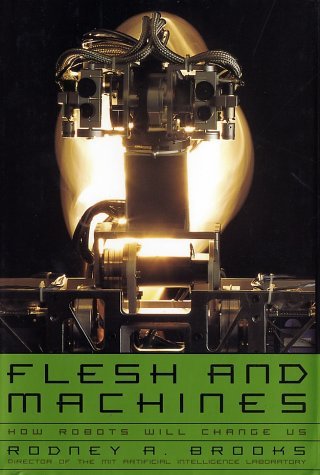
Flesh and Machines: How Robots Will Change Us
Flesh and Machines explores the startlingly reciprocal connection between humans and their technological brethren, and explains how this relationship is being redefined as humans develop increasingly complex machines. The impetus to build machines that exhibit lifelike behaviors stretches back centuries, but for the last fifteen years much of this work has been done in Rodney Brooks’s laboratory at MIT. His goal is not simply to build machines that are like humans but to alter our perception of the potential capabilities of robots. Our current attitude toward intelligent robots, he asserts, is simply a reflection of our own view of ourselves.
In Flesh and Machines , Brooks challenges that view by suggesting that human nature can be seen to possess the essential characteristics of a machine. Our instinctive rejection of that idea, he believes, is itself a conditioned we have programmed ourselves to believe in our “tribal specialness” as proof of our uniqueness.
Provocative, persuasive, compelling, and unprecedented, Flesh and Machines presents a vision of our future and our future selves.
In Flesh and Machines , Brooks challenges that view by suggesting that human nature can be seen to possess the essential characteristics of a machine. Our instinctive rejection of that idea, he believes, is itself a conditioned we have programmed ourselves to believe in our “tribal specialness” as proof of our uniqueness.
Provocative, persuasive, compelling, and unprecedented, Flesh and Machines presents a vision of our future and our future selves.
272 pages, Hardcover
First published January 1, 2002
About the author
Rodney A. Brooks
20 books31 followersFormer director of the Artificial Intelligence Lab at the Massachusetts Institute of Technology and co-founder of iRobot.
Ratings & Reviews
Friends & Following
Create a free account to discover what your friends think of this book!
Community Reviews
Displaying 1 - 18 of 18 reviews

July 7, 2007
This was a good book at first. It's very definitely a popular book, geared towards readers with little or no knowledge of robotics, programming, or AI. (Though even a moderate background in any of these subjects will probably enhance appreciation of the book.) The discussions of how to overcome various problems in robotics are interesting, as is his history of the discipline. (I had no idea that Hero of Alexandria had built pneumatic automata and a primitive steam engine.) However, the book falters in the last three chapters, as the author rebuts theorists he disagrees with, and tries to argue that humans and robots are both machines. (I will concede that humans are systems but feel that calling them machines stretches that word too much. This semantic quibble might be mitigated if the author had explicitly defined machine, but he didn't, that I noticed.)
This book was published in 2002, and there is no real awareness of energy and sustainability issues that I noticed.
This book was published in 2002, and there is no real awareness of energy and sustainability issues that I noticed.

October 29, 2024
Intriguing but dense. Shines in the first portion where it discusses societies' historical anxieties about robots, including how ideas of what that means have expanded over the years.

October 29, 2011
Just got this book. Cant wait to read it. I will be diving into it tonight.
Sean
Sean

September 18, 2021
Pretty dogshit. Would rather get shot in the face than hang out with this guy i think. I dont care about technology until i’m able to fly around in one of the big purple Covenant ships you get to fly in Halo. Does anyone want to hang out tonight
May 30, 2024
3.5 - dated but really interesting at times. The last few chapters can be thrown away. Author helped start iRobot and was a professor at MIT. He made some great predictions about the future of technology and some not so great ones. Interested to see what else he has written.

May 2, 2020
A pop-sci account of the advances in robotics into the new millennium. A bit dated these days, but still an enjoyable read for the philosophising about the nature of humanity.

September 24, 2012
Rodney Brooks is an icon in my field. He discusses his work in creating robots that don't perform heavy cognitive computations but rather have direct sensory to motor action loops. His motivation for this came from Walter Grey who built simple robots with complicated behavior resulting in multiple sensory simple systems interacting on motor systems in complex ways.
He believes the future of robotics in human society will be greatly beneficial. He neither subscribes to an utopic or dystopic future.
He believes the future of robotics in human society will be greatly beneficial. He neither subscribes to an utopic or dystopic future.

May 13, 2014
A little dated now (2002), but a good read. I especially like the B-52 analogy in the epilogue. The aircraft has not changed that much in outward (bodily) appearance, but internally it is nothing like the what flew 50 years ago (how many technologies survive for this long? I hate to say it but much of our technology is driven by military research. Eg: ARPA -> Internet.) Our human bodies are changing in the same ways, incorporating new technologies and adaptively retrofitting until we eventually merge with our technology.

February 6, 2012
Robots and technology are the future. The techie/regular people divide need not be so wide. Learn as much about what's happening in fields far from home as you can - and it's super interesting to read about what big brains are doing at MIT.

March 4, 2008
dont remember that much, must not have been good

July 21, 2008
A fun look at the world of AI through one of the greatest minds of out time.

April 8, 2011
Found recommendation for this book while reading Michio Kaku's "Physics of the Future". Began reading on 22 June 2011.

July 30, 2011
Easy to read, but can be long winded, got a bit more exciting towards the end. Otherwise an interesting read.

January 8, 2014
How can such a great scientist miss the social context of technology altogether?

February 16, 2016
Didn't finish. The book is mostly about the author's research through the years, it's only the last few chapters that are a bit more forward looking.

November 28, 2016
I enjoyed reading about Brooks' career as a roboticist, but felt the final futurist chapters to be unnecessary.

June 5, 2007
book about AI that looks more to evolutionary development than to computation.

Read
August 23, 2007nonfiction,philosophy,science,transhumanism,enhancement
Displaying 1 - 18 of 18 reviews