

What do you think?
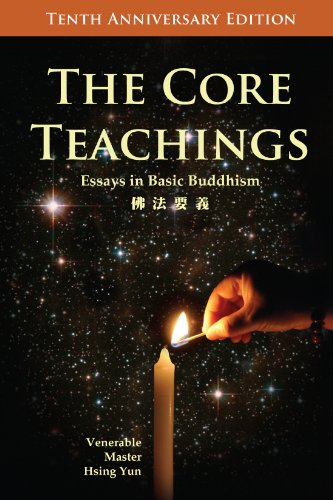
The Core Teachings: Essays in Basic Buddhism
Translated and edited by Fo Guang Shan International Translation Center.
- GenresBuddhism
190 pages, Paperback
First published October 1, 2012
About the author
Hsing Yun
141 books34 followersHsing Yun was a Chinese Buddhist monk, teacher, and philanthropist based in Taiwan. He was the founder of the Fo Guang Shan Buddhist monastic order as well as the layperson-based Buddha's Light International Association. Hsing Yun was considered a major proponent of Humanistic Buddhism and one of the most influential teachers of modern Taiwanese Buddhism. In Taiwan, he was popularly referred to as one of the "Four Heavenly Kings" of Taiwanese Buddhism, along with his contemporaries: Master Sheng Yen of Dharma Drum Mountain, Master Shih Cheng Yen of Tzu Chi and Master Wei Chueh of Chung Tai Shan.
Ratings & Reviews
Friends & Following
Create a free account to discover what your friends think of this book!
Community Reviews
Displaying 1 - 2 of 2 reviews

April 23, 2013
I purchased the paperback version of this book from the Los Angeles Times Book Festival 2013 held at the University of California (USC). This book is currently in its tenth edition and has a beautiful cover (not shown above at the time of this review). You can probably find it at Amazon.com or Barnes & Noble. I enjoyed this book. It is written in plain english, very easy to understand. Here's a sample from the book:
Positive Karma, Negative Karma, and Neutral Karma
Some acts produce positive karma, some produce negative karma, and some produce neutral karma. Positive karma is produced by acts that are intended to help other sentient beings. This includes protecting animals, giving to charity, speaking kind and encouraging words, and thinking compassionate thoughts. Negative karma is produced by acts that are intended to harm oneself or others. For example, killing, stealing, lying. . . . . . .
Positive Karma, Negative Karma, and Neutral Karma
Some acts produce positive karma, some produce negative karma, and some produce neutral karma. Positive karma is produced by acts that are intended to help other sentient beings. This includes protecting animals, giving to charity, speaking kind and encouraging words, and thinking compassionate thoughts. Negative karma is produced by acts that are intended to harm oneself or others. For example, killing, stealing, lying. . . . . . .

December 1, 2016
This feels like a textbook explanation of Buddhism, without a lot of passion or persuasiveness.
It's mostly pages and pages of numbered lists and paragraphs. It reads a bit like, "There are 12 kinds of delicious apples, and they are... There are 3 levels of deliciousness, as follows... Furthermore, there are 8 ways to properly eat an apple to maximize deliciousness... and finally, there are 4 benefits to eating delicious apples." And to take my silly analogy further, I'd say that after reading all that, the reader still hasn't learned what an apple tastes like.
Still, the first third of the book offers a lot of effective explanations of Buddhist teachings, helpful for newbies like me.
It's mostly pages and pages of numbered lists and paragraphs. It reads a bit like, "There are 12 kinds of delicious apples, and they are... There are 3 levels of deliciousness, as follows... Furthermore, there are 8 ways to properly eat an apple to maximize deliciousness... and finally, there are 4 benefits to eating delicious apples." And to take my silly analogy further, I'd say that after reading all that, the reader still hasn't learned what an apple tastes like.
Still, the first third of the book offers a lot of effective explanations of Buddhist teachings, helpful for newbies like me.
Displaying 1 - 2 of 2 reviews