Jump to ratings and reviews
Rate this book

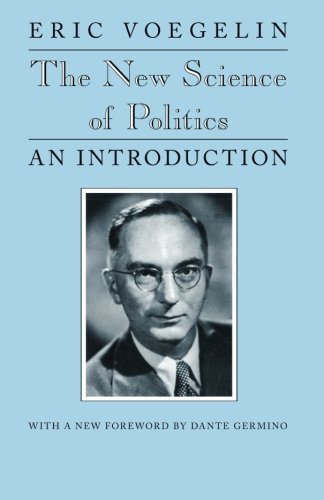
The New Science of Politics (Walgreen Foundation Lectures) unknown Edition by Voegelin, Eric

Rate this book
《新政治科学》是沃格林政治哲学的纲领性文献。本书首先从方法论上区分社会自我理解的符号与政治科学的理论概念,主张新政治科学的研究旨趣在于通过对社会上先前存在的符号予以批判性地阐明,探索关于人性和秩序的知识。本书基于对西方代议制民主的批判,提出三个类型的代表,即初级型的代表、存在意义上的代表和超越意义上的代表;进而指出,就社会将自身理解为超越真理的代表而言,人类历史上有三种类型的真理符号化,即宇宙论真理、人类学真理和救赎论真理。现代各色意识形态是真理的败坏形式,即所谓的灵知主义。本书着重阐述了灵知主义的内涵、在前现代的根源,以及灵知主义支配下的现代政治运动和意识形态。

《新政治科学》对西方政治观念的生成机制、传承历史及观念和现实的互动关系的探索,特别是对西方现代性的诠释和批判,对于我们重新认识西方,建设有中国特色的政治科学,具有重要的借鉴意义。

Paperback

First published January 1, 1952

81 people are currently reading
1239 people want to read

About the author

Eric Voegelin

88 books185 followers
German-born American political philosopher. He taught political theory and sociology at the University of Vienna after his habilitation there in 1928. While in Austria Voegelin established the beginnings of his long lasting friendship with F. A. Hayek. In 1933 he published two books criticizing Nazi racism, and was forced to flee from Austria following the Anschluss in 1938. After a brief stay in Switzerland, he arrived in the United States and taught at a series of universities before joining Louisiana State University's Department of Government in 1942. His advisers on his dissertation were Hans Kelsen and Othmar Spann.

Voegelin remained in Baton Rouge until 1958 when he accepted an offer by Munich's Ludwig-Maximilians-Universität to fill Max Weber's former chair in political science, which had been empty since Weber's death in 1920. In Munich he founded the Institut für Politische Wissenschaft. Voegelin returned to America in 1969 to join Stanford University's Hoover Institution on War, Revolution, and Peace as Henry Salvatori Fellow where he continued his work until his death on January 19, 1985. He was a member of the Philadelphia Society.

Ratings & Reviews

What do you think?
Rate this book

Friends & Following

Create a free account to discover what your friends think of this book!

Community Reviews

5 stars
148 (46%)
4 stars
96 (30%)
3 stars
59 (18%)
2 stars
7 (2%)
1 star
6 (1%)
Displaying 1 - 30 of 43 reviews
66 reviews15 followers
January 4, 2021
Don't immanentize the eschaton!
Profile Image for Justin Evans.
1,716 reviews1,124 followers
December 18, 2010
What does a book look like when it asks all the right questions, is concerned about all the right things, and is so completely and utterly conditioned by its historical moment and the author's intellectual and personal background that its answers to these questions and concerns is flat out bizarre? Like this book. Voegelin has a lot in common with Adorno: they both worry that the modern world tends to make people materialistic idiots; they both worry that high culture is being undermined; they both worry about the sort of materialistic idiots who thought Stalinism was a really great idea. They were both far too unwilling or unable to think outside the box of the post-war, Cold War world, and didn't seem to realize that a lot of their pessimism could be explained by the fact that they lived in one of the shittiest epochs of human history. They both something along the lines of "the truth isn't in history" (i.e., 'truth' can't necessarily be judged by what seems to be the case right now) and that "history is in the truth," that is, that 'truth' changes over time. They both have essentially dialectical views of culture, although they'd both deny that (e.g., Voegelin argues that the doubtfulness inherent in Christianity leads to the Gnostic search for certainty, which then undermines Christianity...)

The differences then: Adorno thinks that if you're going to do or think anything, you should probably do or think something that will make the world a better place, while admitting that you'll probably mess it up; Voegelin thinks that any effort to make the world a better place is doomed to failure, and it's better not to try. Voegelin thinks the major problem with the world is Gnosticism (that is, roughly, the tendency to treat history, subjects and God as if they were objects that we can know in the same way we know objects); Adorno thinks the major problem with the world is capitalism (that is, roughly, the tendency to treat everything as if it were a commodity and, therefore, an object). So that's a similarity and a difference.

From my perspective, both of those guys have a lot to tell us. This isn't the place to rag on Adorno, but there are some problems you should be aware of, if you plan on reading this book. First, Voegelin's argument is awfully incoherent in a number of spots, most importantly, his claims that Gnosticism ignores the 'structures of reality;' surely only a Gnostic would think there was such a thing as a knowable 'structure of reality'? Second, his insistence on the importance of political order, while perfectly understandable in the face of the second world war, can hardly be transhistorical: sometimes the breakdown of order is a good thing. Tied in to this, I'm pretty sure he's sometimes just trying to get a rise out of his reader, as, for instance, when he complains about the 'magical dream' foolishness of wanting world peace. Finally, and most obviously, his suggestion at the end of the book that the U.S., despite being founded by Gnostic Puritans, is a bastion of the 'Mediterranean' tradition, is either wishful thinking or a joke. Admit it man! Capitalism is a Gnosticism! More specifically: there is *no* force in the world which is neither 'Gnostic' nor revolutionary. Voegelin should have just bitten the bullet. If he's right, either it's all downhill from here, or there will have to be massive social change. Like Adorno, so for a consistent Voegelin: our choice is socialism or barbarism.
Profile Image for Todd.
420 reviews
April 25, 2016
What an amazing book--must read! Voegelin offers a clear, penetrating, insightful analysis of what is wrong with not only modern political science, but modern politics more generally and the decay and decline of the West. The list of 20th century writers with this level of understanding is a short one. The main criticism I have is Voegelin's gratuitous use of high-level vocabulary, particularly his use of Latin, Greek, French, etc., foreign words and phrases that have simple English equivalents. Given that his presentation is so remarkable in substance, he really does not need to try to impress anyone with his own level of intelligence and education, so his use of specialized and high-powered vocabulary probably makes his work less accessible to a broader audience, a genuine tragedy in light of the benefits reading this offers.

In short, Voegelin takes a sweeping look at Western culture and civilization to diagnose what led to its modern ongoing self-destruction, identifying not only what is wrong with it as such but in our understanding of it as well. He starts at the height of the pagan era, when the world was filled with gods and spirits and man was the plaything of the gods, not really much in control of his own destiny. This proceeds, in the late pagan era and especially in the early Christian era, to God becoming transcendent and the world becoming mundane, while man took control of his own soul, able to give to Caesar what belonged to Caesar, while retaining for God what was His own. However, even in early Christianity, there existed Gnostic heresies that taught that man could and ought to work to bring God's kingdom into the world here and now, that it was their mission to carry out God's work in a most immanent manner. While the Gnostics were relatively unimportant at first, their worldview took on more popularity in the Middle Ages, finally being fanned into flames by Joachim of Flora, who expected the arrival of the final "Third Age."

This Gnosticism, made relevant again by Joachim and his followers, enjoyed a steady growth in the disintegration of the Medieval world and the atomization of the Reformation. It led at first to nominally Christian groups, such as the Puritans, who were revolutionary in outlook and called for the seizure of temporal power and the absolute intolerance of non-adherents. This evolved, over time, into anti-Christian groups such as Positivists, French Jacobins, Marxists, Nationalist Socialists, etc.

Although Voegelin attacks the idea that a third and final period is around the corner and refutes those who wish to bring Heaven on Earth here and now, he ironically divides the West's self-understanding into three periods:

the contraction of political science to a description of existing institutions and the apology of their principles, that is, the degradation of political science to a handmaid of the powers that be, has been typical for stable situations, while its expansion to its full grandeur as the science of human existence in society and history, as well as of the principles of order in general, has been typical for the great epochs of revolutionary and critical nature. On the largest scale of Western history three such epochs occurred. The foundation of political science through Plato and Aristotle marked the Hellenic crisis; St. Augustine's Civitas Dei marked the crisis of Rome and Christianity; and Hegel's philosophy of law and history marked the first major earthquake of the Western crisis. (location 195-201)

One can plainly see those who dogmatize science or politicize it through not understanding its nature today; Voegelin traces the roots of this perversion: "the destruction of science which characterized the positivistic era in the second half of the nineteenth century." (location 224) He contrasts this, "Science is a search for truth concerning the nature of the various realms of being." (location 236) The difference stemming from: "The subordination of theoretical relevance to method perverts the meaning of science on principle." (location 260-261) He criticizes the accumulation of irrelevant facts, meaning he would likely roll in his grave today with the quick "fact-checking" of the Google age. As he further notes, "The content of a source may be reported correctly as far as it goes, and nevertheless the report may create an entirely false picture because essential parts are omitted." (location 317-318)

Voegelin zeroes in on the Positivist destruction of political science from within as the attempt to make it "objective" by exclusion of all value-judgments, which was not really possible. Voegelin praises Max Weber as coming closer than anyone at precisely this Positivist ideal, while opening the door to the futility of it by falling short. In the end, Weber grappled with the fact that "ideals justify neither the means nor the results of action, that action involves in guilt, and that the responsibility for political effects rests squarely on the man who makes himself a cause." (location 382-383)

Voegelin notes to the contrary that "The attack on metaphysics can be undertaken with a good conscience only from the safe distance of imperfect knowledge." (location 461-462) This led to Voegelin turning "progress" on its head:

The religious experiences of the Greek mystic philosophers and of Christianity would rank high because they allow the unfolding of metaphysics; the religious experiences of Comte and Marx would rank low because they prohibit the asking of metaphysical questions. Such considerations would radically upset the positivist conception of an evolution from an early religious or theological phase of mankind to rationalism and science. Not only would the evolution go from a higher to a lower degree of rationalism, at least for the modern period, but, in addition, this decline of reason would have to be understood as the consequence of religious retrogression. an interpretation of Western history that had grown over centuries would have to be revolutionized; and a revolution of this magnitude would meet the opposition of "progressives" who all of a sudden find themselves in the position of retrogressive irrationalists. (location 514-520)

Although Voegelin gave the lectures upon which this book was based decades ago, his critique of Western foreign policy could have come from this morning's paper: "Our own foreign policy was a factor in aggravating international disorder through its sincere but naïve endeavor of curing the evils of the world by spreading representative institutions in the elemental sense to areas where the existential conditions for their functioning were not given." (location 887-889) This being because "If a government is nothing but representative in the constitutional sense, a representative ruler in the existential sense will sooner or later make an end of it; and quite possibly the new existential ruler will not be too representative in the constitutional sense." (location 862-864) Hence the rise of populists from Gamal Abd al-Nassir to Donald Trump.

Voegelin explains the transfer from the transcendence of the early Christian period to the fall back into Gnosticism by noting, "The life of the soul in openness toward God, the waiting, the periods of aridity and dullness, guilt and despondency, contrition and repentance, forsakenness and hope against hope, the silent stirrings of love and grace, trembling on the verge of a certainty which if gained is loss--the very lightness of this fabric may prove too heavy a burden for men who lust for massively possessive experience." (location 1894) This is because "the substance of history is to be found on the level of experiences, not on the level of ideas." (location 1931)

While Gnoticism was itself a Christian variant, and continued to remain within the Christian context until the Enlightenment, the reason it moved from Christianity to virulent anti-Christian views was apparent:

The death of the spirit is the price of progress. Nietzsche revealed this mystery of the Western apocalypse when he announced that God was dead and that He had been murdered. This Gnostic murder is constantly committed by the men who sacrifice God to civilization. The more fervently all human energies are thrown into the great enterprise of salvation through world-immanent action, the farther the human beings who engage in this enterprise move away from the life of the spirit. And since the life of the spirit is the source of order in man and society, the very success of a Gnostic civilization is the cause of its decline. (location 2016-2020)

So is solved the riddle of Western decline being the result of Western "progress." And in a current warning today, "Totalitarianism, defined as the existential rule of Gnostic activists, is the end form of progressive civilization." (location 2023)

Voegelin focuses on the Puritan movement as non-Scriptural, despite its claim otherwise, but rather based on a worldly cause and call for intolerant, militant action in the here-and-now. The resulting chaos inspired Hobbes to turn to Leviathan for an answer: "Hobbes solved the conflict by deciding that there was no public truth except the law of peace and concord in a society; any opinion or doctrine conducive to discord was thereby proved untrue." (location 2317)

Voegelin's study of this extremism leads him to some disturbing questions that he leaves unanswered, but we may be seeing answered in our lifetimes with the rise of new extremist violence:

human nature does not change. The closure of the soul in modern gnosticism can repress the truth of the soul, as well as the experiences which manifest themselves in philosophy and Christianity, but it cannot remove the soul and its transcendence from the structure of reality. Hence the question imposes itself: How long can such a repression last? And what will happen when prolonged and severe repression will lead to an explosion? (location 2482-2483)

Voegelin recognized the modern Gnostic's disregard of reality that leads such societies to be no longer willing to fight for their own existence. The following segments deserve to be quoted at length owing to their direct bearing on modern Progressivism, Socialism, etc., and the policies such people seek that inevitably achieve the opposite of the intended effect (minimum wages, the "war on poverty," etc.):

In the Gnostic dream world, on the other hand, nonrecognition of reality is the first principle. As a consequence, types of action which in the real world would be considered as morally insane because of the real effects which they have will be considered moral in the dream world because they intended an entirely different effect. The gap between intended and real effect will be imputed not to the Gnostic immorality of ignoring the structure of reality but to the immorality of some other person or society that does not behave as it should behave according to the dream conception of cause and effect. The interpretation of moral insanity as morality, and of the virtues of sophia and prudential as immorality, is a confusion difficult to unravel. And the task is not facilitated by the readiness of the dreamers to stigmatize the attempt at critical clarification as an immoral enterprise. As a matter of fact, practically every great political thinker who recognized the structure of reality, from Machiavelli to the present, has been branded as an immoralist by Gnostic intellectuals--to say nothing of the parlor game, so much beloved among liberals, of panning Plato and Aristotle as Fascists. The theoretical difficulty, therefore, is aggravated by personal problems. And there can be no doubt that the continuous Gnostic barrage of vituperation against political science in the critical sense has seriously affected the quality of public debate on contemporary political issues. (location 2448-2559)

-and-

The critical exploration of cause of effect in history is prohibited; and consequently the rational coordination of means and ends in politics is impossible. Gnostic societies and their leaders will recognize dangers to their existence when they develop, but such dangers will not be met by appropriate actions in the world of reality. They will rather be met by magic operations in the dream world, such as disapproval, moral condemnation, declarations of intention, resolutions, appeals to the opinion of mankind, branding of enemies as aggressors, outlawing of war, propaganda for world peace and world government, etc. The intellectual and moral corruption which expresses itself in the aggregate of such magic operations may pervade a society with the weird, ghostly atmosphere of a lunatic asylum, as we experience it in our time in the Western crisis. (location 2560-2566)

Tremble not, Voegelin does not suggest that all is hopeless. First of all, "Western society is not all modern but that modernity is a growth within it, in opposition to the classic and Christian tradition." (location 2641-2642) He compared various Western revolutions and found "When the revolution occurred early, a less radical wave of gnosticisim was its carrier, and the resistance of the forces of tradition was, at the same time, more effective. When the revolution occurred at a later date, a more radical wave was its carrier, and the environment of tradition was already corroded more deeply by the general advance of modernity." (location 2812-2814) He noted the English and American revolutions were the earliest and the resulting societies were not only the least undermined by Gnostic counter-reality, but were the richest and most powerful societies, so as long as they did not capitulate or destroy themselves, they could remain bastions of healthy Western civilization.

As the reader can see from the above, this is an intense, challenging read, but well worth it. It is like crack cocaine for one's brain, the reader can feel his or her brain getting bigger and smarter while reading it. Seriously, Voegelin puts together events of history to give meaning and light to so much left in Orwellian doublespeak confusion today. I only wish Voegelin had given more treatment to Islam, variants of which have now supplanted Communism as the West's main external threat, though Progressivism remains the West's most grave internal threat and the only one capable of actually bringing the whole house down. I suspect Voegelin would see Gnosticism at work in the Ayatollah Khomeini line of working in this world to trigger the coming of the Mahdi and the reign of God on Earth. It would be interesting to see what he might have said about some of the other more violent or intolerant movements now stirring parts of the Islamic world. As for the Progressive threat, every word Voegelin spoke in this book remains 100% current. This book is a must-read!
Profile Image for Javier Muñoz.
190 reviews15 followers
May 10, 2025
Esta obra impresiona, y no precisamente por su longitud en nº de páginas. Eric Voegelin, filósofo político alemán que tuvo que huir a Estados Unidos debido al ascenso del Tercer Reich, demuestra en "La nueva ciencia de la política" un conocimiento enciclopédico. Se trata de 6 conferencias, recopiladas en este libro, que tienen como hilo conductor, en teoría, la representación política a través de un repaso histórico y de las ideas.
Pero me atrevería a decir que, realmente, el hilo conductor del libro es el orden social o político. Su tesis, muy resumida, es que el orden político tiene que estar abierto a la trascendencia. Y para explicar esto, Voegelin maneja con maestría elementos históricos, filosóficos, teológicos, literarios... Realmente apabullante.
Comienza con una fundamentación muy teórica de lo que es la representación en el orden político, y luego hace un recorrido parándose en el imperio romano y el ascenso del cristianismo, en la pugna de la teología de San Agustín frente a las ideas de Joaquín de Fiore, la consolidación del gnosticismo, su influencia en el puritanismo inglés, hasta llegar a la modernidad.
Ni qué decir tiene que el libro es muy denso en general, con unas partes más digeribles que otras. Pero es igual de interesante que denso, y ciertamente muy enriquecedor y luminoso.
Destacaría, como capítulo más redondo el 4º titulado "El gnosticismo, la naturaleza de la modernidad."
Pongo debajo link a una reseña mucho más completa e informada, que es de interés para quien quiera saber algo más.
https://www.aceprensa.com/resenas-lib...
En definitiva, merece mucho la pena dedicarle el esfuerzo necesario a este libro.
Profile Image for Tara.
242 reviews359 followers
February 10, 2017
You can read Eric Voegelin or not read Eric Voegelin. But, if you're not going to do the first, at least be sure not to worry too much about the opinions of those who have -not- read Eric Voegelin.

Because, Eric Voegelin.
Profile Image for Hobie.
27 reviews
March 25, 2025
Interesting views on philosophy and the gospel along with the role of a Christian within politics.
Profile Image for Mathew Madsen.
96 reviews
January 14, 2023
I read this for a course on Political Theology. It is dense and slow moving at times, but is full of new (at least new-to-me) ideas and provides an insightful perspective on Western politics, history, theology, and how they are connected. I had multiple "aha" moments in reading this. For example:
The attempt at constructing an eidos of history will lead into the fallacious immanentization of the Christian eschaton. The understanding of the attempt as fallacious, however, raises baffling questions with regard to the type of man who will indulge in it. (p.121)
Parsing this passage took several rereadings and a dictionary, but it is a good two sentence summary of Voegelin's thesis. In The New Science of Politics, he tells the story of modern history as progression through a series of Gnostic traditions: the Enlightenment, Puritanism, Nazism, Communism, etc. These groups advance confidently toward various visions of the future that eschew traditional Christian theology, yet they are influenced by and wholly reliant on Judeo-Christian ideas to provide them meaning.

The Gnostic tradition began soon after the advent of Christianity as a way to make knowable the unknowable divinity of the Judeo-Christian God. This divorce from Christian theology was a way to deal with the uncertainty required by faith. Voegelin explains (emphasis added):
Certainties, now, are in demand for the purpose of overcoming uncertainties with their accompaniment of anxiety; ...[by requiring faith,] uncertainty is the very essence of Christianity.

...The attempt at immanentizing the meaning of existence is fundamentally an attempt at bringing our knowledge of transcendence into a firmer grip than the cognitio fidei, the cognition of faith, will afford; and Gnostic experiences offer this firmer grip in so far as they are an expansion of the soul to the point where God is drawn into the existence of man.
So by Voegelin's account, history unfolds as the progressive secularization of Chrisitian theology, with each new Gnostic group evolving to further immanentize the spiritual in the quest of reducing uncertainty. He argues that the natural consequence at the end of this process will be some form of Gnostic totalitarianism:
A civilization can, indeed, advance and decline at the same time— but not forever. There is a limit toward which this ambiguous process moves; the limit is reached when an activist sect which represents the Gnostic truth organizes the civilization into an empire under its rule. Totalitarianism, defined as the existential rule of Gnostic activists, is the end form of progressive civilization.
The book also provides some possible explanations for how these Gnostic groups form, operate, and gain influence. Writing in the post-war era amidst the collapse of Europe, Voegelin's view of the world was certainly colored by the rise of totalitarian movements in Germany and Russia. Whether his account proves to be prophetic or not, the ideas in this book provide a helpful model for understanding our modern world.
Profile Image for John Smith.
67 reviews8 followers
September 10, 2018
No man is yet fit to evaluate fully Voegelin's thesis about Gnosticism, but brilliant and original he certainly was. A pleasure to read, albeit read slowly.
Profile Image for Henry.
864 reviews72 followers
March 10, 2019
A classic book on political theory. It has influenced my views for over half a century.
Profile Image for Aaron Crofut.
413 reviews54 followers
May 21, 2020
This is a tough book to read and a tough book to review. The big takeaway for myself was the notion that states and civilizations (as well as the folks who populate them) need more than a "what" to exist; they need a "why." My move away from libertarianism over the last few years has been driven by the need for a teleology, for a goal. Most civilizations have had an image of themselves as both representative of the great cosmic order and as a reflection of mankind itself; they are microcosmic and macroanthropic. That understanding of our meaning in the world matters quite a bit if we are going to reflect that in our state and society.

Societies focusing on the "how" questions of maintaining their life are generally stable and not overly interested in the "deeper" questions. The arrangement of institutions and who has the best technical skills to fill them are the questions to be asked. But if a society is in decay, if its "why" is being seriously questioned, people begin wondering about those deeper mysteries and whether their civilization doesn't need a serious overhaul to reflect the actual truth. There are always occasions when a nation will have this crisis, but in history Voegelin points out three civilizational shifts reorganizing our entire understanding of life: the rise of Greek philosophy, the rise of Christianity, and the rise of Modernism or Gnosticism.

The Christian mentality is largely explored through the thought of St. Augustine, which I greatly appreciated given the fact that St. A. is the one who brought me to this search in the first place. He does not call for a rule of priests, but for rulers who accepted the rule of God. This viewpoint has some particular strengths: it recognizes the imperfectability of mankind in this world (Original Sin) and offers a solution to this problem by the teleological goal of Heaven and Redemption with God. The weakness is faith, which by definition is not a certainty. In fact, the only certainty St. Augustine gives us is that Heaven is not going to be brought to Earth. For many people, this is just unacceptable., which is not the same thing as saying it is not true.

The balance of the book deals with the nature of Gnosticism, or our Modern understanding. "The Book" starts to become extremely important, whether it is the Bible, Das Kapital, Mein Kampf, what have you. But of course, the important part of a book is its interpretation. Gnosticism will have a few "elect" members authorized to speak the authoritative view and will ruthlessly shut down any other interpretation. They promise either Utopianism (a glorious future and no idea how to get there) or Progressivism (a foggy future but a radical and bloody plan to get there). Unable to change humans into perfect creatures, and thereby unable to create perfect societies, these groups spend an inordinate amount of time and energy on scapegoats.

This book is the source of the famous warning "don't immanentize the eschaton!" The actual quote is this: "The problem of an eidos in history, hence, arises only when Christian transcendental fulfilment becomes immanentized. Such an immanentist hypostasis of the eschaton, however, is a theoretical fallacy." This book is yet another reason I am beginning to see the Protestant Reformation or Revolution as an unmitigated disaster for human civilization. Voegelin's choice of the Puritans as an exemplar of Gnosticism appears weird on the face of it but is truly an apt demonstration of Gnosticism at work. These folks, supposed Bible readers, somehow got it into their head that if they could just set up their sect and their rulers into positions of power (and remove all the bad elements by whatever means), Christ's Kingdom could be established on Earth. With dozens of different sects all making that same claim, each exclusive of the other, and with such high stakes for this life, it should be no surprise to know they came to blows and nearly tore England to shreds.

And into this chaos walked Thomas Hobbes, the birth of liberalism. Peace will be established on condition that religion not be taken so seriously, that we have a secular sovereign.

So we have. Religion is not taken seriously whatsoever anymore, or at least not Christianity. But other, secular religions promising Paradise in this life have sprung up and savaged the 20th Century. Hobbes' solution of a society of just "what exists" cannot be; we need the why, we need meaning, especially since the "what exists" inevitably stops existing after 80 or so years. That perfection we all seek must happen now before we are blinkered out into an eternity of nothingness. If that is the foundation of your thought, don't be surprised when people will accept any evil and follow any lunatic pretending to have an answer no matter how pathetic in terms of truth.

St. Augustine sits on the side, unread by most, pointing out that he has found the Way, the Truth, and the Light, but it will not be of this world.
586 reviews89 followers
May 17, 2022
When I was a teenager, I sometimes carpooled to school with a boy from the next town over. His father, a minister and learned man with a deep rumbling voice, found out I was interested in politics and asked me questions about it. One was “…do you seek to… immanentize the eschaton?” I did not know what “immanentize” or “eschaton” meant, and the dad informed me it meant something like bringing about the end of time and the kingdom of Heaven on earth. I don’t know what I told him. Eventually, through reading about the history of conservatism, I found out that that “immanentize the eschaton” line, usually preceded by the words “don’t” or “don’t try to,” was a minor slogan of the American conservative movement popularized by William Buckley and adapted from the works of German refugee scholar Eric Voegelin. It was a cutesy way of getting across the point that efforts to bring about utopia lead to worse situations than before (and therefore, don’t inconvenience the wealthy and powerful). Apparently, there were bumper stickers with the slogan on it.

Voegelin may have inspired a bumper sticker slogan but he fell into obscurity after his death in 1985, especially compared to similar figures like his fellow emigre Leo Strauss. Voegelin has a fervent but small cult following, a little think tank somewhere where foundation money keeps a few pedants going, but nothing like what the Straussians had in terms of access to power, or to go a bit further afield in the movement, the Objectivists or even anarcho-capitalists ala Rothbard. He hasn’t become a meme, either, like assorted right-leaning thinkers like Julius Evola or Emil Cioran, unless the boomer, pre-Internet version of a meme — recalled slogans from yesteryear imparted on a captive (but willing enough!) audience of teenagers — counts.

This is too bad, because as far as I’m concerned, Voegelin had more on the ball than any of them, with the possible exception of Strauss- and unlike Strauss, Voegelin did not play. He laid his cards — his erudite, well-written (in a chunky, Teutonic way), deeply whack cards — on the table for all to see. It probably didn’t help his cult grow, compared to Strauss’s self-flattering mystery cult. But it made for an interesting read.

Voegelin was a totalitarianism theorist, but not like Arendt or any of the others I know. For one thing, he was stringent enough to attract gestapo attention even though he wasn’t a Jew or a leftist, which took some doing and promoted his move to the US. You can characterize Arendt and other totalitarianism thinkers by their philosophical reaches, their rummaging in the past for tools, metaphors, and explanatory schema (which all seems a little gratuitous to materialist me, but when done well makes for some toothsome reading). But I can’t think of any who reached as far back, with so rigorous a set of rummaging tactics, brushed up against and sometimes made good use of critical ideas we lose at our peril, and came back from this journey into the past with such a honkingly absurd but internally self-consistent set of schema as Voegelin does in “The New Science of Politics,” a set of lectures meant to be a prologue to the sprawling philosophical history of politics that he never finished.

It’s like this: forget power conflicts, or rather, forget their material dimensions, Voegelin tells us. All that does — Voegelin doesn’t say it but it’s what happens, in this and in idealist political thought more generally — is separate the wheat from the chaff, the rich powerful activist countries that matter and the rest who don’t (you gotta figure one of the reasons “traditionalists” — and Voegelin is related to big-T Traditionalism in some important ways — hate contemporary life is because a lot of rich countries can’t be bothered to play classical power politics anymore… though post-Ukraine invasion, who knows?). Politics is actually about representation. He doesn’t mean that as in “what should go along with taxation” or “brown faces in high places,” but an altogether more metaphysical representation, the instantiation of capital-T Truth, in some vaguely Platonist way, on earth. Representation, undertaken correctly, assures order, which in this sense basically means an alignment of the human and something like the divine. Voegelin doesn’t insist, explicitly, on a Catholic reading of the universe to agree with his system, but does see the Christian-classical synthesis of the high Middle Ages as the height of “philosophical anthropology,” the proper understanding of man in the cosmos.

“Order” is an interesting and fraught problem. I organize- I know getting people to do stuff, even stuff they want to do, in an efficient manner, takes coordination. But even a relatively type-A type like me gets that some kind of order generates itself without some mandate from the nous if there’s enough earthly motivation. Why isn’t that good enough, at least as a basis upon which to improve? Especially for self-proclaimed “conservatives”? (It clearly is for many!)

For conservative politicians, “order” generally means keeping the poor and whoever the local downtrodden ethnicities are around in a subordinate place. Simple! It becomes complicated when someone tries to make a transcendent order of that, which right-leaning intellectuals seemingly can’t stop themselves from attempting. I run into this with the fashy teens I try to get information out of after they ineptly troll some of my goodreads reviews. No matter how much they claim to venerate the pre-modern past, they always punt to evo-psych explanations: “traditional” oppressive order is good because we evolved with it, it’s old (it’s usually not that old but w/e) so that proves it’s stability, and with the era of accelerating disaster in which we live… it runs into the usual problems even taking as read the anachronism and factual errors involved. If it’s so natural and self-evidently good, why do you need oppressive structures to instantiate and maintain it? And you get the usual answer- because Those People are evil and want to destroy it, and we all know who Those People turn out to be.

Well, if Voegelin was an anti-semite, it doesn’t turn up here, though he’s notably uninterested in Jewish concepts of the relationship between divine mandate and worldly order, to which I understand Jewish thinkers have given a lot of sophisticated thought. Voegelin makes throwaway references to Jewish and Islamic ideas of representation to prove his concept is global and perennial, but the big show goes from Athens to Augustus to Augustine to Aquinas. They didn’t get it right right away. That’s one of the interesting things about Voegelin- his Truth is transcendent, but the ways people interact with it change according to circumstance, and he understands some of those changes as valid, necessary even. Let’s not make too much of it — they’re necessary to unfold god’s plan or something — but still. You got to something like an ideal representation of a divine order that is the most important fact of the universe, a critical element of which was that unknowability-but-demand-making combo that makes monotheism so spicy, in the Middle Ages, where Emperor represented political order and Pope represented spiritual order.

I didn’t agree with Voegelin by the point, maybe three fifths into the lectures, where he was making this point, but I was impressed with his erudition, his writing, and the sophisticated way he laid out the various elements of the system of order as he understood it. There were some farrago elements from the beginning, the nose-in-the-air way intellectuals of his kind, like his friend (and to my mind, substantial intellectual inferior) von Hayek, dismissed materialism based on straw-manning no one would accept for their own beliefs. More than — or along with being — a farrago, a dodge away from unacceptable ideas, it also got deeply derpy with Voegelin’s — and here, it’s good to GIS him, his beady eyes and big forehead behind his spectacles — insistence that all social science, including any history that partook of positivism, is wrong on its face because of its lack of “theory” i.e. value statements… but I’m used to that. And then came the turn. The turn wasn’t enough to ruin the experience of the book, not hardly. But it was enough to transform my enjoyment of it from intellectual appreciation to something like high camp.

It’s the gnostics, folks! It’s not the Jews, or whoever else, who brought the snake into the garden of the high Middle Ages, who play that role that all conservative world-building needs, but the ding-dang gnostics! Just when you thought it was safe, that pesky Joachim of Fiore has his vision and all of a sudden they’re immanentizing the eschaton all over the place! All modern political philosophy other than reactionary conservatism and, Voegelin grudgingly allows, some forms of very conservative classical liberalism, are just Gnosticism warmed over. Communism, socialism, most types of liberalism, fascism, nazism- all just Gnosticism, and all lead inevitably to totalitarianism, the erasure of all individuality and freedom in the great blaze of that immenatinized eschaton.

You can see it coming, if you read the text. For someone breezing over hundreds of years of history in a set of lectures for an American collegiate audience, Voegelin writes carefully, but not ploddingly, covering his bases, when he talks about ancient and medieval philosophy. But things get awful hurried and poorly-documented when he gets to his gnostic conspiracy theory. He can’t help it (well, maybe he could, if he threw his thesis overboard). There aren’t a lot of actual records of what the gnostics — and contemporary scholars often hate the word, because it implies a much more unitary movement than what record there is would suggest — actually believed or did. Most of what we “know” about Gnosticism comes from the records of the inquisitors who hounded them to destruction and burned their texts. Poor Voegelin- at the time he was writing in the early fifties, archaeologists were just piecing together the Nag Hammadi archive, the major source of stuff actually written by gnostics — about fifty texts in all — that we have. Voegelin wasn’t in the archaeology mafia, and translations wouldn’t appear until the sixties. Another way Strauss was lucky- he stuck to canon. Voegelin was more adventurous and it cost him.

But he did it to himself. Stuck-up German that he was, he should’ve known better than to just sort of slide a few half-apocryphal historical guesswork suggestion gnostic transmission from their utter destruction before the Late Antique period was out and into the 1200s, when Joachim of Fiore was doing his thing, let alone to Voltaire, Marx, and Hitler, into such a key place in his edifice. Amateur hour! The stupid thing is, he probably could have had his cake if he didn’t insist on eating it. He could’ve said the Enlightenment thinkers walked backwards into Gnosticism, reconstructing the creed (or Voegelin’s version of it) out of their interests, desires, and found intellectual parts. I’ve seen other right-wing theoreticians of history, lesser lights than Voegelin but perhaps more savvy, do stuff like that. The gnostics make great villains. You can argue that the Church instantiated their version of who the gnostics were, complete with weird rituals and underground dwellings, quite deep into the western idea of villainy, nestled comfortably next to stereotypes about Jews. John Whitbourn, who I’ve owned an email to for about eighteen months, made good use of gnostic villains in his anarcho-Jacobite fantasy stories. They’re a chestnut, and it’s easy enough to grow their ideas out of whatever soil you want to use for planting- intellectual pride, depression, decadence, neuroticism, whatever.

But no, that won’t do, not for Voegelin. Because ideas matter, dammit! And not in some positivist, pragmatic sense, some John Dewey feel-goodery where you pick what ideas “work!” They matter because they’re metaphysical concepts that we need to instantiate on earth to keep the darkness at bay, to make the world make sense. It’s touching, really, that Voegelin would want to extend this metaphysicality to his enemies, who he also regards as intellectually inferior (well, until you realize there’s really only one solution for dealing with them…). But it leads him to some excruciating readings of history and theory. I’m a lumper, rather than a splitter, in history- I like bigger categories than some people find legitimate. But everything from this Joachim guy to Keynes being a gnostic… when we barely know what they actually believed… and that it’s an actual intellectual lineage, a conscious project, like Catholic scholasticism! And he means it! That’s too much, man. He just gets himself deeper in the mire the further he goes until he sounds like Glenn Beck with a thesaurus.

It’s funny but it’s also sad, and gets crooked as you figure it would. Voegelin was giving these talks at the behest of some conservative foundation trying to bolster the Cold War on campuses. John Whitbourn, the anarcho-Jacobite Catholic fantasist, would probably agree with Voegelin’s condemnation of the Puritans as the first truly modern gnostic totalitarian movement. But Whitbourn had the balls to include all of Protestantism in the condemnation, Luther right next to Cotton Mather. If Puritanism was a rebellion against the divine settlement of Catholicism, it had a starting point: the Reformation, on which good Catholic traditionalist, but better Americanized Cold War conservative Voegelin, does not lay a glove, and doesn’t even mention. Shameful! If you’re going to go down this crazy road, go all the way! Similarly, at the very end, Voegelin cops out when granting that the American Revolution and even the English Civil War — where, mind you, the Puritans executed a sitting king! — were ok, for reasons too boring to get into but translate to “conservative cold warrior Americans sign my checks, and while they’re fine digging at Puritans — Mencken did that after all — they won’t tolerate smacking down the founding fathers or parliamentarian oligarchy.” Lame.

Well, campy conspiracy and lame-puts towards the end and all, I got a lot more enjoyment out of this than any right-wing material I’ve read recently. I don’t plan on chasing down any more Voegelin, and certainly not his little cadre of sad followers trying to pipe up with their imitation of the master’s erudition in the sea of bullshit on the right-wing internet. But this one was definitely well worth reading, in many of the veins in which my readings on the right work. *****
Profile Image for Anderson Paz.
Author 4 books19 followers
November 14, 2025
Excelente obra de Voegelin que analisa os princípios fundacionais e históricos de uma ciência política que integra ordem da alma, virtudes e estrutura social. Voegelin destaca os problemas de uma visão positivista de ciência social e a importância dos símbolos para a política e critica o gnosticismo das ideologias modernas. Não imanentize o escathon!


Nesse livro de 1952, Voegelin analisa os princípios fundacionais e históricos de uma ciência política que integra ordem da alma, virtudes e estrutura social. O positivismo destruiu a apreensão da ciência dos princípios da política, restringindo à causalidade de fatos e tornando os princípios de uma boa ordem social meros fatos históricos.

Capítulo I: A sociedade desenvolve símbolos de sua autocompreensão. A ciência política interpreta por símbolos. A representação é o símbolo de uma articulação de força social. Se a representação não alcançar o sentido existencial, mas meramente legal, outro poder ameaçará sua substituição. A representação precisa incorporar valores da existência para subsistir no tempo.

Capítulo II: Os símbolos da representação existencial revelam a verdade da sociedade. Essa verdade reflete a ordem ou desordem da alma da coletividade. Quando a alma se abre à transcendência, se descobre a verdade capaz de julgar a política.

Capítulo III: Em Roma, por séculos, se divinizou a ordem política. Com o cristianismo, houve uma desdivinização do poder político. A modernidade, porém, redivinizou a sociedade e política.

Capítulo IV: No fim do séc. XII, houve uma redivinização do poder temporal. Criou-se uma ideia de curso da história que justificava imanentizar a escatologia cristã. Uma gnose surgiu para puxar Deus para a existência humana. O resultado foi um empreendimento pela ação do homem que desordenou o espírito e a política.

Capítulo V: O gnosticismo puritano tentou imanentizar o escathon. Hobbes reagiu com uma teologia civil que imanentizou no poder político a paz e a concórdia.

Capítulo VI: O gnosticismo buscou destruir a verdade da alma e imanentizar o escathon. A política gnóstica é destrutiva porque viola a estrutura da realidade e, no extremo, viabiliza guerras totalitárias.
Profile Image for Laurens van der Tang.
39 reviews16 followers
January 19, 2018
The concept of gnosticism, as described in The New Science of Politics, has not much to do with the historical movement of gnosticism, is not precise enough as a scientific category and not broad enough to become popular. But once you understand Voegelin is not to be read as an acute historian, but as a political philosopher there is much to appreciate.
Voegelin's exegesis of Hobbes, for instance, is solid, much in the vein of Leo Strauss. But the connection between Puritanism and gnosticism is very hypothetical: he himself acknowledges it when he states that England and America have been resistant to gnostic influences. The irony being that England and America have also been most receptive of Puritan influence. He represents Hobbes as reacting against Puritan gnosticism, but also as espousing an immanentist view of the world, which in Voegelin's view is essentially gnostic. It is not clear why this dispute is relevant for a treatment of gnosticism. Hobbes could better have been treated as standalone gnostic.
The real merit of this book is identifying the common traits of liberalism and communism. Both are 'innerweltlich': in Voegelin's own words: "There is no problem in human society except the immanent satisfaction of the masses." The only difference between liberalism, communism and fascism is the means and radicality of acceleration.
It surprised me that Voegelin did not give examples of a truly non-immanent political philosophy. Other than vague allusions to 9th-century Europe, there does not appear to be a historical instance of it. I suppose that despised Puritanism might come close: a world in which society represents the truth of Christianity, but in which salvation is unreachable in this world, and ultimately independent of it. It can only be gained by participation in transcendent truth. Perhaps this could serve as the 'balance' Voegelin speaks of in the last sentences of the book.
Profile Image for Kyle.
30 reviews2 followers
November 13, 2022
A vitally important work of philosophy that reveals in an immensely illuminating fashion the foundations of our modern world and the central conflict of Western civilization.

This was one of the most intellectually rewarding books I have ever read. There are some sections, particularly from the second lecture onwards, where I would have to pause for reflection quite literally after every sentence, the wisdom and insights it provides are that intense.

My only critique is that Voegelin's ending note that the English/American model of democracy stands as the best bulwark against the Gnostic dream reads today as a bit naïve. It almost seems something tacked on by the author, perhaps as an appeasement to the American faction of the tense Cold War atmosphere in which this book was written. Today it is increasingly clear that it was not Marxism in the East, but scientism in the West that won out in the competing factions of Gnostic domination, and the American Empire more than ever stands as the great culminating force of Gnosticism's totalitarian vision of an immanent terrestrial paradise, not as the force that will fight against it. However we interpret this ending note, it at least requires further reflection in light of the circumstances of the 21st century.
Profile Image for Shulamith Farhi.
336 reviews82 followers
August 4, 2023
These lectures are a summary of EV's career, and the research is detailed and often compelling. EV's meta-narrative centers on Gnosticism, a category he uses rather freely to include Joachim of Flora, the Puritans, John Calvin, Marxism, Nazism and occasionally simply to include everyone he disagrees with. There are some infelicities, as might be expected when painting with a broad brush (most egregious perhaps is his reduction of Hegelianism to a cartoonish thesis-antithesis-synthesis model). Still, there is a lot of value in many of his readings of the tradition, which are on the whole careful and insightful. I confess that I am substantially more sympathetic to the Gnostics, but his critique is significant: we must be careful to avoid confusing our legitimate complaints against the world with a conspiratorial narrative about good guys vs bad guys. Agree or disagree with the narrative, it is a document of a genuine seeker, attempting to make room for a humane understanding of faith that remains relevant today.
1 review
February 1, 2021
A fascinating book about the drive of Gnostic political philosophies of the modern age to "immanentize the eschaton," i.e., to create a utopia on earth, no matter the cost. It's probably best understood as a document of the Cold War (it was written in 1952), but it certainly has new resonances with the environmentalist/socialist left in 2021 America, who appear to want to immanentize their own eschaton even if they have to steal an election and censor dissenting voices to do it.

One caveat: Voegelin's style is extraordinarily dense... it reads like a translation from German (which it is), but one which has gone through interim translations into Mandarin, Ancient Greek, Sanskrit, and Martian. Its subtitle may suggest that its suitable as an introduction for a college-level class... don't be fooled. Very rewarding, but hard sledding.
Profile Image for Bill Merkle.
28 reviews
May 17, 2020
This book is not adequately circulated. Voegelin was an anti-positivist and an anti-gnostic. What does that mean? He believed that policy based on empiric evidence alone was immoral and without moral sentiment could at best lead only to utilitarianism. He also believed that oligarchies will—without dissent of the people—seek to create a paradisiacal society based on their own pride and knowledge, believing that their status grants them the right to do so. His examples include communism, national socialism, and broadly speaking, authoritarianism. He also believes that generations are doomed to repeat past mistakes because the nature of man at some point requires experiential knowledge.
Profile Image for Gordon McCulloh.
140 reviews
March 16, 2024
As a reader outside the area of graduate political science and theology, I found Voegelin's work to be densely variegated with ideas and language that were inaccessible without background research. Once I read more into his personal categorizations, the lectures became much more valuable. "The New Science" is a twentieth century collection that could be applied with all the more emphasis today. Voegelin's final warning against the cultural spread of gnosticism (as he defines it) in the US and UK and the disorientation of the Western soul is harshly relevant.
Profile Image for Guille.
128 reviews14 followers
November 28, 2023
Brilliant book.

I do think it would have been even better if it had been written today (being a conservative in the US in the 1950s meant you had to talk about Communism a lot).

I also think his final analysis about the Germans being peak modernity and the US/UK being the last remnants of Mediterranean/Classical tradition is off. The Germans learned a lot of their racist biology from American progressives!
Profile Image for Xenophon.
181 reviews15 followers
July 23, 2020
Voegelin provides a concise and well-thought-out diagnosis on the problem of modernity. The chapters on Classical and early Christian thought are among the best available.

It was considered indispensable for a reason. I highly recommend reading alongside George Nash's treatment of Voegelin in "The Conservative Intellectual Movement Since 1945."
Profile Image for Mike Horne.
659 reviews19 followers
August 21, 2022
The fallacious immanezation of the Christian eschatolon is the gnostic problem of modernity. This is my third time to read the book. I am on the edge of understanding it. Once I do, I will give another star.
Profile Image for Nathan.
194 reviews53 followers
July 21, 2020
One of the best books I’ve ever read, hands down. This is an incredible piece of [political] philosophy.
Profile Image for Andrew.
96 reviews112 followers
January 17, 2022
Today, on MLK day, we remember Voegelin’s edict: don’t immanentize the eschaton!
Profile Image for Larry.
233 reviews26 followers
October 18, 2022
The political lesson here is Homer Simpson’s: you tried and failed miserably. The lesson is: never try
Displaying 1 - 30 of 43 reviews

Can't find what you're looking for?

Get help and learn more about the design.