

What do you think?
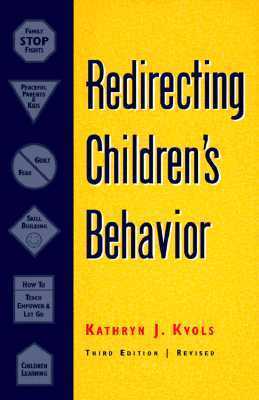
Redirecting Children's Behavior
Drawn from the author's years of experience counseling families and children, directing camps for children, and teaching personal and professional growth courses, this inspiring and motivating book challenges parents, teachers, grandparents, and coaches to create cooperative relationships with children. The book helps promote peace in families by offering skills to improve communication, help children get along, turn conflict into cooperation, use natural consequences, and increase parent understanding of children's perspectives.
178 pages, Paperback
First published November 1, 1997
Ratings & Reviews
Friends & Following
Create a free account to discover what your friends think of this book!
Community Reviews
Displaying 1 - 28 of 28 reviews

October 18, 2008
I really liked parts of this book: her questions about parental motivations for punishment p. 45, eight ways to teach values p. 55 - 56, her list of guidelines for parental behavior (though I strongly disagreed with her application) p. 121, logical consequences worksheet p. 137, and looking at the results of discipline p. 141-2. All of them are worth taking the time to look at.
However, she doesn't seem at all consistent with her own philosophy. For instance, even though she says she's against time-outs, she offers "self-quieting" as an alternative. Her distinction between a child to figuring out when they have self-quieted versus a time limit would be great except that she then gives examples of kids coming back from "self-quieting" and continuing to be put back in their quieting spot because they haven't calmed down. How about not isolating the child, breathing with them, acknowledging that they're upset and modeling self-quieting? Pretty much all of her examples about sleeping were disturbing in their treatment of the children. I kept reading and finding helpful resources and then being appalled and then finding another helpful section. Where our philosophies differed, the chasm was deep and wide. How about taking a 2 1/2 year old child out of the room 14 times for "inappropriate behavior" with guests at the table and celebrating success as the child sits quietly for one hour after the 14th withdrawal. Kvols should know that what is developmentally appropriate to expect from a toddler is no longer than 10-15 minutes sitting at a table for dinner.
I clearly have not reconciled how a book could simultaneously be so helpful and so disturbing.
Page numbers are from Third edition, 1998, in hardback.
However, she doesn't seem at all consistent with her own philosophy. For instance, even though she says she's against time-outs, she offers "self-quieting" as an alternative. Her distinction between a child to figuring out when they have self-quieted versus a time limit would be great except that she then gives examples of kids coming back from "self-quieting" and continuing to be put back in their quieting spot because they haven't calmed down. How about not isolating the child, breathing with them, acknowledging that they're upset and modeling self-quieting? Pretty much all of her examples about sleeping were disturbing in their treatment of the children. I kept reading and finding helpful resources and then being appalled and then finding another helpful section. Where our philosophies differed, the chasm was deep and wide. How about taking a 2 1/2 year old child out of the room 14 times for "inappropriate behavior" with guests at the table and celebrating success as the child sits quietly for one hour after the 14th withdrawal. Kvols should know that what is developmentally appropriate to expect from a toddler is no longer than 10-15 minutes sitting at a table for dinner.
I clearly have not reconciled how a book could simultaneously be so helpful and so disturbing.
Page numbers are from Third edition, 1998, in hardback.
October 28, 2018
I did not agree with every single piece of advice in the book but I found the general message and concrete recommendations to be useful for parenting and teaching.
The author starts with saying that in order to be a good parent, you need to take care of yourself, which includes leading a balanced life and figuring out what you want to happen. The second chapter is about encouraging your child, including by learning from, and learning how to repair mistakes. In the third chapter, the author describes three parenting styles and explains why the "democratic" style, although it may require more energy and time investment, is most desirable, insofar as it promotes self-responsibility. I don't think "democratic" is a good name for what she describes but I like the idea of developing mutual respect and open communication. This chapter also has a part on how to teach values, mainly by defining what your values are, and modeling the behavior you want to emulate. She also suggests to play a game with the family where everyone practice a certain value for a week. The fourth chapter is about communication in families and focuses on effective, guilt-free communication, family meetings, and conflict resolution. Chapter 5 deals with building responsibility, that is to say, teaching children how to make decisions, depending on their age, get what they want, make efforts, be altruistic. It insists on the fact that we have to expect our children to be capable and we can empower them by asking for their help and giving them responsibilities, not just "low dignity jobs". The chapter I found most useful is probably chapter 6, regarding "Why children misbehave". Basically the author considers that there are four reasons why children may misbehave: to get attention, because they want power, because they are hurt and seek revenge, or because they feel they can't meet external demands. For each reason, the author proposes a plan to redirect the behavior. Chapter 7 is about discipline that teaches self-control, meaning balancing kindness and firmness, and remembering that children do not need to suffer to learn. This implies "setting limits" that are fair and consistent, and using "consequences", either natural or logical, rather than "punishment". Chapter 8 specifies what actions can be taken to handle sibling conflicts. The last chapter summarizes the concepts presented in the book. An idea that the author mentions several times, although not explicitly in this chapter, and that I think is important to remember is that as a parent, you are trying to raise kids who will become well-rounded adults who are confident and self-reliant.
The author starts with saying that in order to be a good parent, you need to take care of yourself, which includes leading a balanced life and figuring out what you want to happen. The second chapter is about encouraging your child, including by learning from, and learning how to repair mistakes. In the third chapter, the author describes three parenting styles and explains why the "democratic" style, although it may require more energy and time investment, is most desirable, insofar as it promotes self-responsibility. I don't think "democratic" is a good name for what she describes but I like the idea of developing mutual respect and open communication. This chapter also has a part on how to teach values, mainly by defining what your values are, and modeling the behavior you want to emulate. She also suggests to play a game with the family where everyone practice a certain value for a week. The fourth chapter is about communication in families and focuses on effective, guilt-free communication, family meetings, and conflict resolution. Chapter 5 deals with building responsibility, that is to say, teaching children how to make decisions, depending on their age, get what they want, make efforts, be altruistic. It insists on the fact that we have to expect our children to be capable and we can empower them by asking for their help and giving them responsibilities, not just "low dignity jobs". The chapter I found most useful is probably chapter 6, regarding "Why children misbehave". Basically the author considers that there are four reasons why children may misbehave: to get attention, because they want power, because they are hurt and seek revenge, or because they feel they can't meet external demands. For each reason, the author proposes a plan to redirect the behavior. Chapter 7 is about discipline that teaches self-control, meaning balancing kindness and firmness, and remembering that children do not need to suffer to learn. This implies "setting limits" that are fair and consistent, and using "consequences", either natural or logical, rather than "punishment". Chapter 8 specifies what actions can be taken to handle sibling conflicts. The last chapter summarizes the concepts presented in the book. An idea that the author mentions several times, although not explicitly in this chapter, and that I think is important to remember is that as a parent, you are trying to raise kids who will become well-rounded adults who are confident and self-reliant.
February 12, 2022
I am not a parent yet, but I am a middle school teacher and I have been using a lot of these techniques in the classroom to create win-win situations for myself and my students. I love learning how to respond to behavior in my classroom versus react to it.

April 24, 2019
I've read a number of parenting books in my ten years so far raising children. This one may well be the very best I've found. It is logical, and practical to implement the concepts. I'm already seeing it make a difference I'm my family.
Currently Reading
September 4, 2021It's a very useful book for teachers and parents.
September 18, 2023
Excellent book for anyone who works with children! She presents practical solutions for everything.

December 18, 2016
Short and to the point. Excellent and practical advice.

October 13, 2016
Because of this book, I developed a wider perspective in terms of disciplining children.
November 5, 2014
The nice takeaway from this book is to be aware of, and in control of, your attitude and words. Be intentional in the way you speak to and deal with your children and that in itself can cause a big change. Beyond that, some of the examples were just a little too simplified for real life, and the viewpoints on things like depression and mental illness were glazed over to the point of being insulting. Depression was basically described as the habit of being sad and attention seeking, like people could just choose to quit it at any moment with the right attitude check.
November 19, 2011
This is the book that I most refer to and rely on when I have quesions about parenting. The techniques and philosophies behind Redirecting Children's Behavior are so healthy and honest that I wish I could just incorporate the whole thing into my head. Do they have cult that I could join? It is such a thoughtful and respectful approach for both the child and adult. It is a parenting approach that leaves room for honest emotion.

September 5, 2020
This is exactly what you would expect from a book like this. Easy to get through and a fast read (read in less than a week in conjunction with another book). Though some advice I did not agree with, overall it was a good book. It was recommended to me by an elementary school social worker, and she mentioned that she often recommends it to the parents of her students who are having some behavioral difficulties.

Read
November 21, 2007Nothing earth shattering.
Give kids choices.
Be consistent.
it's an easy read, I checked it out of Family Connections Library on Friday and am about done. Not reading every word.
I wasn't sure I'd like it, thought it might be too "something" for me, but it is refreshingly common-sense.
Give kids choices.
Be consistent.
it's an easy read, I checked it out of Family Connections Library on Friday and am about done. Not reading every word.
I wasn't sure I'd like it, thought it might be too "something" for me, but it is refreshingly common-sense.

December 2, 2008
This is an excellent reference for any parent. I found it helpful in guiding my son to have good decision making abilities. I hope to keep up the practice so he will turn out to be the independent and strong person I envision.

April 15, 2009
This book is phenomenal in dealing with people of all ages! It was recommended to me, when dealing with my husband....marriage is tough...and EVERYONE can use tips on how to communicate or "re-direct"!
July 30, 2009
I read this book along with a parenting class I took last spring - has some very interesting points about parents and helps you understand your child's motives. Definitely worth a read - with or without the class.

January 26, 2010
I think every parent should read this book. The best book about parenting so far I've read. If parent read this book and put it to use, the world would be a better place. Now let's see if I can change some of my habits ;-)

May 11, 2010
I don't do much reading at all when it comes to "parenting books" - but this one has given me tools again and again. I keep rereading portions here and there when various challenges come up with my curly-headed wonder.

October 20, 2012
This book was wonderful. I had the opportunity to meet and speak with Kathryn J Kvols recently in Southern Florida at the "It Takes A Village To Raise A Child" Parenting Conference. She is a lovely woman with a great energy about her. I knew her book would give the same feel.
December 28, 2007
This is not just for children. It is for insightful for self and other adults you relate to. A true gift in my life. I highly recommend the workshops which are offered all around the country.
September 11, 2008
I really like this parenting book. Need some inspiration lately.

May 21, 2009
this is a favorite. All good things, boiled down to one book and it's only a little over 100 pages. I've renewed it 3 times. I'm going to be forced to buy it!

July 5, 2011
Clear, concrete, sensible. From an "authoritative" parenting point of view. A how-to guide. Definitely recommend.
September 10, 2011
I had promised Caroline that I would read this bool.
December 11, 2011
I think I will be reading this book forever...over and over, bits and part everyday.
April 12, 2013
I loved this book. I must own it and will refer to it often. It epitomizes the parent I want to be.

to-read-more
April 4, 2014"...Best book on parenting I've read!" Jack Canfield

May 6, 2012
I went to the conference about this in the late 90's for work!
I
I

May 29, 2018
Basic positive parenting techniques, not much new, but I find a refresher is always helpful.
Displaying 1 - 28 of 28 reviews