Jump to ratings and reviews
Rate this book

Karma

Rate this book
It is 1984, and fifteen-year-old Maya is on her way to India with her father. She carries with her the ashes of her mother, who recently committed suicide, and arrives in Delhi on the eve of Prime Minister Indira Gandhi's assassination.

Maya is separated from her father and must rely upon the mysterious, kindhearted Sandeep to safely reunite them. As her love for Sandeep begins to blossom, Maya must face the truth about her painful adolescence...if she's ever to imagine her future.

534 pages, Paperback

First published March 1, 2011

36 people are currently reading
2245 people want to read

About the author

Cathy Ostlere

3 books65 followers
Cathy Ostlere’s second book, KARMA, a novel-in-verse, grew from her travels through India in 1984, the year Prime Minister Indira Gandhi was assassinated by her Sikh bodyguards. KARMA's story of two teenagers who fall in love while fighting to stay alive is a moving and turbulent narrative based on real historical events. Cathy's first book, LOST: A MEMOIR, began as a series of poems and essays. In 2010, Cathy co-wrote with Dennis Garnhum, a 90 minute one-woman play based on LOST and performed in the U.S. and Canada. Cathy's work has received many accolades including shortlists for National Magazine, Western Magazine, and CBC Literary awards.
Awards for KARMA:
-Alberta Literary Awards Winner – R. Ross Annett Children’s Award, 2012
-South Asia Book Award (SABA), Highly Commended Book, 2012
-Canadian Library Association Young Adult Book Award, Honour Book, 2012
-W.O. Mitchell Award City of Calgary, shortlist, 2012
-Ontario Library Association Best Bets List,Honourable Mention, 2012
-YALSA, Best Fiction for Young Adults, 2012
-Booklist, Editor’s Choice, Best Books for Young Adults, 2012
Awards for LOST: A MEMOIR (the book):
-2009 Edna Staebler Creative Non-fiction Award - shortlist
Awards for LOST: A MEMOIR, (the play):
-Nominated for Outstanding New Play, 2011 Betty Mitchell Awards, Calgary
-Top Ten Theatre Shows for 2011 — Indianapolis Star, Indianapolis
-Best 11 plays of 2011 — The Chronicle Herald, Halifax

Ratings & Reviews

What do you think?
Rate this book

Friends & Following

Create a free account to discover what your friends think of this book!

Community Reviews

5 stars
519 (31%)
4 stars
558 (34%)
3 stars
385 (23%)
2 stars
116 (7%)
1 star
54 (3%)
Displaying 1 - 30 of 258 reviews
54 reviews3 followers
June 18, 2012
I found Karma to be a relatively compelling read in which the author made some intriguing choices - particularly mirroring the conflict in India in 1984 with the main characters own heritage. On that basis, it was enlightening and worth the time it took to read it. The fact that that the author was present in India for a short visit at the time period in question adds some credibility to the historical aspects of the narrative, but I still found myself uncomfortable with the idea that it had been written by someone so far removed from that culture. The characters voice judgements of the Indian culture that struck me as the authors voice rather than authentic to the characters that she had created. I also had a hard time buying into the romance, although I think if I were a little younger and more starry eyed, it may have appealed to me more.
Profile Image for Marsha.
Author 33 books883 followers
July 14, 2021
Free verse is not sometime I gravitate toward, but this story is so real and so well written that I fell right into it. One of the best books I've ever read.
Profile Image for Jessica J.
12 reviews
August 13, 2017
Goodness, this book was quite fascinating! This book was a bit choppy in my opinion because the book was written as several poems which forms a story that you would have to picture in your mind alone. Overall I actually kinda liked it
Profile Image for Book Concierge.
3,075 reviews387 followers
October 31, 2017
Maya and her father are going from Canada to New Dehli to spread her mother’s ashes. They arrive, however, on the same day as Prime Minister Indira Gandhi is assassinated by two of her guards. Maya and her father are separated in the riots that ensue, and she must disguise herself and ultimately rely on Sandeep, a boy she’s just met, to keep her safe and see that she gets home.

This young adult novel is told entirely in verse, making for a very fast read. It includes some pretty serious matter, however: religious strife between Sikhs and Hindus, civil and political unrest in India, moral courage, religious differences, and the treatment of women. Central to the plot is the differences between generations and the ability of parent and child to truly see one another’s point of view, and to forgive their differences. Also, one’s own capacity to forgive oneself for past mistakes.

Maya is a strong female lead, despite the trauma she’s faced and her withdrawal into herself. Somehow, she comes across as resilient, resourceful and tenacious, even when paralyzed by fear or indecision. Sandeep is a steadfast and courageous friend; having suffered his own tragedy early in life, he’s determined to help Maya find her way. The differences in their religions and socio-economic status will not deter him.

I’m a little concerned by the ending. I’m not at all sure that Maya will be safe in the future, but I applaud Ostlere for *not* giving us a happy ending, tied up in a pretty bow.
Profile Image for Marcie.
709 reviews6 followers
April 5, 2011
Karma is defined as action, seen as bringing upon oneself inevitable results, good or bad, either in this life or in reincarnation. This is the main theme woven throughout this novel. The main part of this story takes place during the riots that broke out after Indria Gahndi is gunned down in 1984. Maya is the main character in this novel. She writes down the unfolding of these horrific events in her diary. The riots are between the Hindus and Sikh. The turmoil between these two religious groups results in bloodshed and senseless killings. The background controversy in this story is significant because it's also an internal conflict raging inside Maya. Her father is Hindu and her mother is Sikh. Her parents love each other but cannot escape their difference in beliefs. Maya feels torn between them. She doesn't quite fit in anywhere. Maya's character is very interesting. She starts out as an average teenage girl. Maya's world is thrown into turmoil and she must overcome heart wrenching obstacles to find her way. Her journey into India is one of self discovery and forgiveness. Maya has to choose her path or it will be chosen for her. When Maya looses her voice her story is told through the eyes of Sandeep. Sandeep watches over Maya as a favor to his sister. He is intrigued and enthralled by Maya. His sister thinks that Sandeep can be the one person who can lure Maya from her internal prison. In a way Sandeep and Maya's stories are similar. They are both trying to find out where they belong. I liked Sandeep's character a lot. He's is funny and charming. I really enjoyed reading about him.
Overall I thought this story was fantastic. Even though this book is over 500 pages it's very fast paced. It only took me a few days to read it. Cathy Ostlere did a great job with this novel. I experienced a lot of emotions while reading Kharma. It's funny how a few words can say so much sometimes. This novel is written in beautifully constructed verse. It is a must read.
Profile Image for Deanna Day.
Author 5 books115 followers
August 18, 2011
Verse novel, young adult, culture, historical fiction

I enjoy learning about countries and cultures through fiction. I am interested in finding out more about the author, Ostlere. Is she from Indian background and what kind of research did she complete to write this novel? Set in 1984 when India's prime minister is killed and religious genocides occur.

Maya, fifteen years old, is growing up in Canada where her parents immigrated to from India. Her father is Sikh and her mother is Hindu--completely different religious beliefs. Her mother longs to return to Canada but her father won't hear of it. Sadly her mother finally returns in an urn. When Maya and her father arrive in India (Maya's first visit) a cultural war has begun where thousands of Sikh people are murdered. Maya loses her father in the uprising and ends up at a refuge for widows. A woman doctor helps her by sending her to her family to heal where she meets a young man named Sandeep. The community believe Maya is a witch that will bring much harm to them. Thus begins a journey in the desert to find a new place for Maya.

Even though I thoroughly enjoyed this book and definitely recommend it I wonder about the verse. Sometimes I thought it was forced. The sentences seemed to be formatted into poetry but might have been better in a journal/diary format since that was what the characters were writing. I actually preferred when the story was in 2 voice poems and wish Ostlere had used more of this format.
Profile Image for Dana Al-Basha |  دانة الباشا.
2,348 reviews987 followers
June 7, 2017
I haven't read a novel told in verse for so long, this came as a pleasant surprise, not what I expected but I'm enjoying it so far. I imagine Dev Patel as Sandeep and Freida Pinto as Maya.

Māyā means illusion or more accurately a delusion. Though given two names as a daughter for two parents from different religions, she always favored the name her Hindu mother has given her "Maya". Her Sikh name given by her father is "Jiva" which means soul.

Maya is a Canadian, with an Indian family, a Hindu mother who commits suicide because she misses India and a father who plucks her from all that is a familiar and thrusts her into a 1984 war between Sikh and Hindus where she is orphaned and lost.

Sandeep is a desert boy, the moment he sees the silent sad Maya knows that she is his mirage.

The story is filled with love, hate, hope, despair, courage and weakness, grief and happiness. But the ending is bittersweet yet filled with hope.

Profile Image for Kevin Kuehn.
199 reviews4 followers
October 20, 2016
Historical fiction written as narrative poetry. Definitely a first for me, but wow. This book is compelling and rich. In both a historical and personal context, this book touches on so much of the beauty and heartbreak of India. The story of Maya (Jiva) and Sandeep is a love story. It's a drama. It's a comedy. It's a tragedy. It is clear that Cathy Ostlere has spent in India, and the way that she captures her experiences through her characters is very real. A strong recommendation for everybody (and especially if you have spent are or planning to spend any time in India).
Profile Image for Terri.
1,012 reviews39 followers
July 19, 2011
I have read some great multicultural pieces this summer that I can't wait to booktalk in the fall! "Karma," by Cathy Ostlere, is one such novel. The piece takes place in India from late October 1984 through late December 1984 with flashbacks to earlier in the main character's life. If you are familiar with your history, you know that on October 31, 1984, Prime Minister Indira Gandhi was assassinated in her garden by two of her Sykh bodyguards as revenge for the attack on the Sykh's holy "Golden Temple." This in turn led to riots where many (the numbers are disputed) Sykhs were brutally murdered by Hindus to avenge Gandhi's death. By December of that year, Sykhs and Hindu's were denying that anything had happened. As the main character says on page 397, "...we are a nation with a long history and short memories. We are a nation accustomed to pain."

In "Karma," just prior to Gandhi's assassination, fifteen year-old Maya/Jiva has just suffered the tragic loss of her Hindu mother, Matu. Maya, who is half Hindu and half Sikh, was born and raised in Elsinore, Canada. Her parents story is very much a "Romeo and Juliet" story, a recurring theme throughout the novel. Their marriage (of a Hindu to a Sykh) was not approved by either of their families. Thus, after having been born and raised in India, the two sought refuge in Canada where they did not fit in either. Matu's unhappiness grew over the years, and her desire to go home was discouraged by Bapu. With no job, no Indian community members with whom to find friendship, Matu was slowly driven mad. After her death, as "Karma" begins, Bapu and Maya bring Matu's ashes back to India, where Bapu seeks to deal with his guilt and to honor Matu - in ways Maya is not at first aware of. Soon after they arrive in New Dehli, Gandhi is murdered. Bapu, who is easily identifiable as a Sykh, must cut off his hair and give up his turban (which is like betraying his faith and denying everything about himself) in order to survive. When he goes out to find help and doesn't return, Maya is left to fend for herself. She too cuts off her hair and dresses as a boy. She flees to the train staiton, boards a train to an unknown destination, and witnesses brutality that forever changes her life and who she is. As a result of what she sees, she becomes mute and is taken in by the doctor, Parvrati, to whom she is brought after her collapse in a crowd. Parvati sends her to live with her Hindu family (Amma, Barindra, and the seventeen year old son they took in at age six, Sandeep). Parvati makes Sandeep promise to watch over Maya and to get her to talk and reveal her true identity and her story. Thus begins a great adventure, and eventually another "Romeo and Juliet" like relationship.

"Karma" is stunning in its writing. Presented as a 517 page novel-in-verse, it reads very quickly. The story is told in a first person journal format by first Maya and then Sandeep, whose voices are both distinct and memorable. Filled with vivid imagery, Ostlere is able to bring the sights, the smells, the colors, the emotions, and the sounds that surround Maya and Sandeep to life. It is in this way that the reader gets a real sense of the time and the place. For an American teen this is a beautiful introduction to India, and its history and cultures. Fabulous writing! Some reviews that I have read have mentioned that "Karma" could be an awards contender for the 2012 season. I would have to agree.

There is a wealth of thematic material here for thought, discussion, and writing. On page 390-91 Maya says, "Too dark to be Canadian. Too tall for a girl. Too pretty for a boy. I can speak three languages. English. Hindi. Punjabi. (And sometimes French.} But who am I? Always the foreigner. Hiding in her skin." Though Maya is literally a foreigner, most teens can identify with feeling like the foreigner, the odd one, the only one, etc. Another important theme found in "Karma" is that of forgiveness (page 489), "The dead. This is what they try to tell us. Everything can be forgiven. Everyone." On page 491. Maya talks of second chances: "Reincarnation. Another chance. Everyone deserves a second chance, don't you think?" In regards to racism, Bapu says on page 492: "Ignore them...Racism isn't always hatred. Sometimes it's just confusion and fear. It's their own hearts, they're not sure about. Not ours." Other significant themes include: shame, retribution, war, religious fanaticism, the will to live, suffering, suicide, ignorance, not fitting in, love, loss, grief, saying good-bye, hope, tradition, etc. Another interesting discussion would be on why the book is named "Karma."

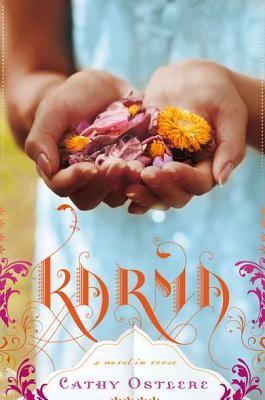
My only beef about the book is the cover. While it is really beautiful, the bright pink and yellow cover will make it a book primarily for girls - and there is so much here for any teen! Even if I got a teen boy to take a look at the book, through booktalking, it is doubtful that most boys would be willing to carry around this gigantic pink book! So sad...

Otherwise, this is a stunning debut young adult novel by Cathy Ostlere! Highly recommended!
Profile Image for Stacey Mclaren.
38 reviews
Read
February 19, 2013
This novel is written in poetic form. It took me about ten pages to get into the "voice" of the author but after that I fell in love with it. The story was amazing and has deep content to discuss with students in the 9-12 age range. This is also a Forest of Reading nominated novel for the 2013 collection.
Profile Image for Cathy.
Author 3 books65 followers
February 5, 2011
I am the author Cathy Ostlere. Writing the book has been an exciting journey. I can't wait to hear your thoughts!

For more information please visit cathy-ostlere.com or feel free to e-mail me author@cathy-ostlere.com.
Profile Image for Marilyn.
1,450 reviews30 followers
January 28, 2016
No understatement here to state that I loved this book. What a joy it was to read this very unique, interesting, heart-rending, and heart-warming story.
Profile Image for ✮Octjillery✮.
718 reviews10 followers
May 17, 2017
A bright pink cover kept catching my eye whenever I'd be in the library at work, and eventually I went over, picked it up, and discovered Karma.

Even as an English Ed major, I've never had a strong love for reading poetry for a variety of reasons (with some exceptions), so I've typically avoided books written in verse. I think I automatically assume that I'm going to have to decipher a bunch of figurative language and other stuff I don't really need to mess with in the same manner when reading a novel. But, I flipped through the book and it seemed to merely have the structure of poetry and not much beyond that, so I gave it a shot, and I'm so glad that I did.

The characters were beautiful, round, real; the emotions raw, believable, and touching. The settings were described simply, and yet they stood out in my head vividly.

I learned quite a bit about a culture I did not (and honestly still don't) know a lot about, and I was fascinated by these characters and their lives. It is a love story, but at the same time, it's so much more than that. It's a glimpse into normal lives disrupted by civil unrest and the clashing of cultures that aren't really all that different when you truly look at them.
Profile Image for Margo Tanenbaum.
823 reviews25 followers
June 24, 2011
I was immediately drawn into Cathy Ostlere's stunning debut novel, Karma, written in free verse and set in India during the turbulent period immediately after the assassination of Indira Gandhi in 1984. Her 15-year old heroine, Maya, a Canadian teenager who’s half-Hindu, and half-Sikh, is traveling with her grief-stricken father to India with the ashes of her mother and a new diary to record her thoughts. On the night they arrive, the prime minister is killed in her own garden by her Sikh guards, and In the turmoil and harrowing violence that erupt immediately after the assassination, Maya and her father are separated. With no time to think, Maya cuts off her hair and disguises herself as a boy, running to the train station to try to find her father. When he doesn’t arrive, she gets on a train anyway, not knowing exactly where she is headed in the chaos. On the train journey, she witnesses unimaginable horrors, and is so traumatized she is unable to speak.

Taken in by a kind doctor’s family, where no one knows who she is or where she comes from, Maya struggles to come back to life, with the help of Sandeep, an orphan boy who she’s just met. She has lost everything--but she will find love, open her heart, and recover her voice with Sandeep, who eventually takes her back to Dehli to try to find her father. While Maya is mute, Sandeep takes over the narration in the second half of the novel, giving the book two distinct voices. Toward the end of the novel, Maya resumes the narration.

This is a deeply romantic story of young love, passion, family, and trauma, where the evocative poetry serves to heighten the drama and suspense of the story. Because of the suspense of the story line, you will want to hurry along to find out what happens, but don’t forget to take the time to admire Ostlere’s elegant poetry, sometimes written in two columns. Asked often why the novel is written in free verse, she eloquently replies: “The best answer I have to this question is that Karma’s poetic form suits the emotional lives of Maya and Sandeep. Their feelings are intense, their insights into the world are sharp and critical, and their understanding of what it means to be human is fresh, ragged, not yet smoothed by maturity, not yet smoothed by conventional narrative. Poetry is the perfect medium for their age. The short sentence. The precise image. The outbursts of feeling. Maya and Sandeep invite the reader to look inside their diaries where they reveal an intimate world of secrets, confessions and longings, and where poetry is a fire.”

Although this book looks imposing at over 500 pages, it is actually a relatively quick read because of the free verse format, and like the books of YA authors Ellen Hopkins and Sonya Sones, would be a good recommendation for reluctant readers. With its exotic setting, it’s also a great fit with this year’s One World, Many Stories summer reading theme.

Ostlere’s website gives additional background on the genesis of this novel, which took root during her own travels in India in 1984, and the origin of the character of Maya, who is inspired by a young Indian girl she knew growing up in Canada, as well as some stunning photographs evoking the brilliant colors of India.
Profile Image for Stephanie.
152 reviews15 followers
April 22, 2012
This is one of the most beautifully written novels I’ve read since my undergrad. It’s in verse, with the narration and dialogue formatted in a unique and stylistic manner. If not executed correctly such a bold format would have taken away from the story, but Ostlere used it to enrich the text. In stark contrast to the last novel I read, Blood Red Road, the dialogue flowed naturally and it was always apparent who was speaking even without quotation marks.

This novel illustrates the difficulties of immigration from the perspective of a first generation Canadian. Maya is Indian to Canadians, and Canadian to Indians. She is always the outsider, and stands out in every culture she belongs to. Born to a Hindu mother and a Sikh father, Maya follows elements of both religions and cultures. Her mixed heritage puts her in grave danger when during her trip to India the Prime Minister is murdered, and the two cultures go to war on one another.

The book is marketed as a love story, and it does contain a compelling one, but that is not what got my attention. The very nature of humanity is explored as Maya deals with survivor’s guilt. It not only places blame on the rioters who burn men alive and rape young girls, but on those who stand by and do nothing to stop it. Maya is justifiably frozen by fear as the horrors take place, but she later thinks about how many lives could have been saved if the bystanders spoke up. The denial of everything that happened by the government and so many people in the city is chilling, and leaves a lasting impression.

The snowball effect of hate, as the men fight an eye for an eye reminds me of the beautiful take on a nursery rhyme that plays at the beginning of the film Free Zone. Click this link and read the subtitles. http://www.youtube.com/watch?v=FuBo5z...

This would be a fabulous choice for a book club, because it deals with so many great discussion topics:

-identity

-prejudice/acceptance

-depression/mental illness/suicide

-poverty/ class systems

-apathy/denial

-family

I think this novel has much wider appeal than it’s hot pink cover shows. I think the cover is beautiful with the swirly fonts, but there is plenty in this novel that would appeal to boys, and I don’t believe many would pick this up.
Profile Image for Priyanka Champaneri.
Author 1 book22 followers
July 7, 2021
It's a good thing that I didn't realize this was a "novel in verse" until I brought the book home from the library, because then I almost certainly would have passed it over, convinced that a book with a title like "Karma," a Bollywood-ish cover, and the additional supposed gimmick of being a giant poem was bound to be awful.

And it could have been....but it wasn't.

What saves this book is everything contained within the covers - the writing, the story, the characters, and the alternating POVs.

The writing: beautiful, with every word chosen with such deliberate care. Each page is a separate poem for the most part, yet they read like mini-chapters. As I was reading I wondered if the effect would have been the same if Ostlere had simply written it as a novel...and thank goodness she didn't, because this end result is truly exquisite.

The story: engaging on all levels, with conflict coming from many directions, the most urgent being the Hindu and Sikh riots which erupted after Indira Gandhi was assassinated. You don't need to know too much about this event - or about Indian religion or culture in general - because the author does such a wonderful job of outlining it all for you.

The characters and POV: The story revolves around Maya/Jiva, who becomes lost in the city during the riots and loses her voice after a traumatic experience; and Sandeep, the boy who becomes her caretaker and “voice” as Maya works through her trauma. The POV shifts between the two are necessary to keep the book from becoming too melancholy on Maya’s side and too irreverent on Sandeep’s, but the balance struck by both really flesh out the story and bring both humanity and humor in explaining a series of events that stained India’s history.

I found this book on NPR's list of Teen/YA picks, but I think pigeon-holing this gem as such would be an injustice. In fact, if I ever teach literature again, I would definitely add this to my students’ reading list. It’s impossible to finish this book and NOT want to talk about it.
Profile Image for Cait.
250 reviews16 followers
May 9, 2011
KARMA is a beautifully written book about self-discovery, and what it means to love.

Not my usual genre of YA book, I was blown away by KARMA – the writing, the story, description and characters all drew me in and kept me captive for the length of the book (and it’s not short!). Maya is an Indian-Canadian teenage girl. The story is written through verse, and is Maya’s diary. Through her, we learn about her family, culture, and life in a small prairie town. Despite the cultural differences, and some family problems, Maya is very much like any other Canadian teenager. It is only after she and her father travel to India to deliver her mother’s ashes to the final resting place that Maya’s life changes drastically, and her emotions, turmoil and uncertainty are reflected perfectly in the short poems that make up the story of KARMA.

An aspect I really liked is that for the middle section of the book, the reader is given the point of view of Sandeep, the boy that takes care of Maya while she is in India, lost without her father and mute from the horror she has seen after the assassination of the Indian Prime Minister. It is immediately apparent when the voice of the story changes, and I grew to like Sandeep very quickly – he’s blunt, observative, kind and fun. He looked after Maya to the best of his ability, and even runs away from home to help her find her father in New Delhi. Sandeep and Maya grow to have a deep connection, and the ending of the novel left me angry on their behalf, but hopeful that things would all work out in the long run.

The short poetry that makes up KARMA’s story is written beautifully, and really lets the reader into the details of Maya’s and Sandeep’s lives. Cathy Ostlere’s writing is very emotional and descriptive – something that I think helps the reader connect to Maya and Sandeep so well. For being a writing style and genre I don’t read very often, I loved KARMA to pieces.
Profile Image for Arthur Pengerbil.
192 reviews6 followers
February 23, 2012
Reading Level: Grades 7+

The year is 1984. Fifteen year old Maya packs a suitcase for a trip to India with her father. They are going to lay Maya's recently deceased Hindu mother to rest. Not long after they arrive, however, tumultuous religious differences between the Sikhs and Hindus explode into violence when prime minister Indira Gandhi is assassinated.

Maya and her father, a Sikh, are caught in the middle of the clash and separated when their hotel is attacked. Afraid for her safety because of her Hindu-Sikh parents and her sex, Maya quickly hacks off her long ponytail with a pair of scissors and runs, forgetting her mother's ashes in the hotel room.

The next hours are harrowing for Maya as the riots swell around her, Sikhs and Hindus fighting unrelentingly around her. When she finally emerges from the violence, rescued by a kind desert family but traumatized into muteness, it is only the 17-year old son, Sandeep, devoted to helping Maya find her father, that can save her again.

This historical fiction romance in diary-format free verse will have you turning pages back again and again to reread Maya and Sandeep's words and longing for more after the end. Karma is fraught with emotion, culture, violence, religion fear, but most importantly, family.


Other novels you might like:

Speak by Laurie Halse Anderson

Shine, Coconut Moon by Neesha Meminger

Keeping Corner by Kashmira Sheth

For older readers:

Sold by Patricia McCormick


For more book reviews from the HPPL Youth Department, click here.
Profile Image for Brooke Cheyenne.
115 reviews14 followers
February 20, 2013
Thought this book would be a quick read. Its quick if you can keep up with it and not lose interest. I lost interest multiple times and therefore it took me 2 weeks to read.

I had to read this book for white pine and at first found it to be very interesting. It follows a hindu/seik girl named Maya whose father brings her to india to say goodbye to her mother's ashes. During their stay, all hell breaks lose in India and Maya is separated from her dad and fostered by a family who is very strict and wary of her as she refuses to speak. A boy in the family falls in love with her and helps her find her dad.

As normal as this story line seems, I was confused about 80 % of the time. The book uses waaay too much hindu terminology and even though I got a 97 percent in world religions in grade 11, i was still lost. There were random names and story lines that kept popping out of the blue; leaving you confused if you chose to ever skim a page or two.

Note to readers: if you like skimming books... this is not the book for you. you will be so LOST!

I also did not like how the book is a diary through Maya's point of view.. all of a sudden changing to the diary entires of Sandeep - the boy who fals in love with Maya. It felt as if I was reading a diary entry from Katniss from The Hunger Games, only to have the story line suddenly turn into a narrative from a poor boy in district 12. It made no sense! and took me awhile to get used to it. As soon as I was used to it - the narrator flipped back to maya!

This book is interesting if you like indian culture. I dont find religions all that interesting and had real trouble continuing with this book.
Profile Image for AnQi.
143 reviews7 followers
March 14, 2011
REVIEW FOR KARMA BY CATHY OSTLERE

Cathy Ostlere brings to life a moving and rich post World War II novel about a girl named Jiva who must struggle to find her father in the religiously divided country of India. Throughout the book, elements of romance, historical fiction, and a coming-of-age story are all woven into this novel that tells its tale through angelic and detailed prose.

Jiva, who's name means 'life', has always been different, even in her home country of India, where her ancestors are derived from. For one thing, her mother is Hindu, and her father is Sikh-religions that continuously battle each other for supremacy in the Asian country. And even though Jiva is Indian, her family leads a life in Canada so as to avoid the religious turmoil in her parents' homes. When one day Jiva discovers her mother's body after commiting suicide, her father decides that they must go back to India to lay her mother's ashes to rest.

Jiva's journey thoughout this dramatic and intricate story leads to disaster, hope, and renewal. You will find yourself drawn into the magnificent world that is Jiva's, and urge yourself to read until you are finished and satisfied with Jiva's outcome. Though confusing with countless flashblacks and time lapses, Karma is a book that will weave you through a journey that moves and swells with emotion and philosophy.

Profile Image for Skedatt.
326 reviews
August 15, 2011
I picked this up as part of an NPR round-up also. Read the synopsis, then read a few reviews and decided to try it.

At first I was actually pretty impressed with the ability to tell a modern story in free verse. But then, I got bogged down by the plot.
This had way to much angst for me. It was like reading Sylvia Plath.

Or worse, like a gratuitously sad song meant to make you slit your wrists:

My mom committed suicide because she hated it in Canada,
my dad feels guilty,
he's going to marry me to some Sikh stranger so I can be raped in a marriage,
In India, of course, because of my mother.
Oh, I found this boy in the middle of these horrible riots,
I'm in lust with him,
he helps me find my dad,
who miraculously survived because he denied his faith by cutting his hair and shaving (but not really denying his faith, surely God will understand),
I am going to be separated from the guy that I am in lust with for an extended period of time....

Conclusion: Was this am epic book that crossed the YA barrier? Not so much. If it works for you, great. For me--Epic Fail.
This entire review has been hidden because of spoilers.
Profile Image for Connie.
588 reviews65 followers
September 2, 2013
It's a very interesting book. The emotions, characters, and plot are all very unique and interesting. This book is written in verse, something I'm unsure of. One POV, Maya, had some very interesting poems. The ones that were the most interesting were those that were call and effect across the page. However in Maya's POV their were a few chapters that were basically sentence that were awkwardly entered, and not so pretty. The other POV, Sandeep, had no flowery poetry. This was also written in verse, but I think this would have faired better if this was paragraphs, in turn letting Maya's POV being a little bit more flowery. The actual plot was interesting and very well told. This book taught me a lot about cultures in India. Also I feel that some people feel that because people are of a different skin colour etc, that they are different. This book shows that they're exactly the same as us. That they have the same hopes, desires. This book also shed light on historical events in India that I had no idea that they occurred. This book is an excellent read.
9 reviews
March 8, 2013
The book that I read was Karma, it is written by Cathy Ostlere. The main character in this book is Maya, a young girl who is struggling with personal loss and struggling with two different cultures, Maya later learns acceptance and love. If I was Maya in this book, I think that it would be difficult to understand how each culture is and how their way of life is but it would also be difficult to deal with the loss of somebody you love like Maya did in this book because she lost her father later on in the story. Struggling with different religions isn't easy for a young girl like Maya, but she later learns to accept who she is in life and goes by what her culture is required to do. In my opinion this book is a good book for others to read if they enjoy reading poetry like stories like Karma, I enjoyed reading this book and learning the story that young people had to say about their different points of the story.
Profile Image for Geeta.
22 reviews8 followers
September 24, 2011
I loved this novel. At first, I was a little wary for the "in verse" part wasn't quite a Geeta-book. However, after reading the first few pages I was hooked. This is a story about a massacre that took place nearly 30 years ago in India. After Indira Gandhi's death, there was turmoil in India and thousands died. In the midst of all this was a young Canadian-Indian, Maya, who can't find her father and becomes lost in this unknown land. Along comes Sandeep and they fall in love. What made this story so wonderful is because it was in verse. I loved Ostlere's writing style and that I could relate to some of Maya's feelings. This book stole my heart (and some of my tears), and I could not believe how much I enjoyed it despite taking a chance with it. This is a must-read for all who enjoy Indian culture. I hope you all do read it for it will make an impact.
Profile Image for Liz.
48 reviews
February 19, 2011
When a fifteen-year-old girl's mother dies, she and her father return to India. She only has two things with her. A diary and her mother's ashes. After the prime minister of India is shot down, India is thrown into chaos. Maya must find her way home through the turmoil of the country. This story is written in poetic style. They story is very gripping. You won't be able to put it down. Travel with Maya as she learns to trust and love again. She grows and learns the true meaning of life, love and home. Very thought provoking.
Cover: The cover is gorgeous. The vines running up and around the cover really make you want to pick it up and read it. The color scheme is also amazing. It really draws the eye.
Profile Image for M.B. Mulhall.
Author 6 books135 followers
July 30, 2011
A seriously amazing book on a topic I knew nothing about. Please don't shy away from it because it's free verse. The fragments, the clipped emotions and descriptions, somehow explain things better then a couple pages of flowing prose. It gives you that sense of urgency and fear that the characters are experiencing. The rush of emotions they are unused to. It doesn't hide behind anything.

I do feel the main character acts/speaks a little older than her age at times, she was raised differently than I and then goes through this horrid experience, so I can look past such a thing.

This deserves to be read and shared with others. Pick it up. You won't be disappointed.
Profile Image for Shweta.
35 reviews
July 28, 2013
This is the first novel i've read in verse. It tells of a riot, where the country was once again burned and the communal disharmony was in sync with people's fear.

Mostly, this is a story of a canadian immigrant girl who comes back to India and her bond with a boy name Sandeep.

The verses, are simple to understand, and yet they touch your every chord of your heart. The story grows on you on such a level, that you start even talking to yourself in verse.

Give this a read, for its a simple story told with better verse. It will leave a lasting impression on your mind for days to come after.
Profile Image for Katie.
97 reviews12 followers
April 11, 2011
I highly recommend this book. It was very interesting reading about India during this time of turmoil. It really makes you think about religious divides & how society works. You don't know til the very end what will happen. It is told from the perspective of a teenage girl. I think the author really hit the nail on the head in that she created a believable teenage with an adequate amount of parent -child angst without over doing it. This is absolutely a book an adult could read - it in no way is too 'teen.' There is a bit of romance & intrigue as well. Highly recommend.
8 reviews
March 20, 2013
Flipping through this book, I initially thought it was written like poetry. The author has chosen a non-traditional way of expressing conversation and thought. Once I had the flow of the writing style, I was able to enjoy the storyline. The story is set mainly in India beginning on the day Indira Ghandi was murdered. An interesting view of the struggles of being born of Indian parents in Canada and being Canadian born when visiting India.
Profile Image for Chiththarthan Nagarajan.
340 reviews9 followers
September 6, 2016
What you give, you'll get back!

I felt the sadness, lonely and pain in each page of a book. I kinda like a bravery, foolishness, silence of Maya(Jiva).

What this book taught me? Nothing.

Karma gave me the sweet pain only the readers can endure. I learned that we're allowed to give up if we're not going regret. Well! Karma is a bitch(pardon me for harsh word) in many ways, but she needed in everyone's life to keep us in line. A boundary of what we can do and what we should do.
Displaying 1 - 30 of 258 reviews

Join the discussion

Can't find what you're looking for?

Get help and learn more about the design.