

What do you think?
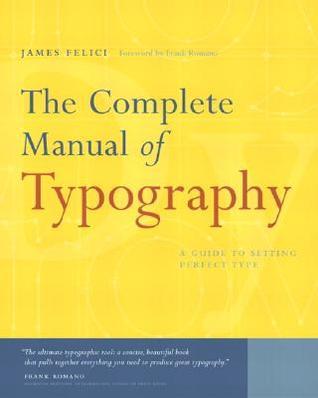
The Complete Manual of Typography: A Guide to Setting Perfect Type
Testimonials
"The ultimate typographic a concise, beautiful book that pulls together everything you need to produce great typography."
--Frank Romano, RIT School of Print Media "Clear and elegant...There's no better or more useful introduction to the whole craft of typography."
--Roger Black, Danilo Black, Inc. "All you've always wanted to know about type and typography but never dared to ask. Jim Felici brings together a vast amount of knowledge in this book. Must-have!"
--Erik Spiekermann, author, Stop Stealing Sheep (and Find Out How Type Works) This book is about how type should look and how to make it look that way; in other words, how to set type like a professional. It releases the craft knowledge that used to reside almost exclusively in the heads of people working in type shops. The shops are gone, the technologies have changed, but the goal remains the same. This book explains in very practical terms how to use today's computerized tools to achieve that secret of good well-set type. Beautifully designed and richly illustrated, The Complete Manual of Typography is an essential reference for anyone who works with type. Designers, print production professionals, and corporate communications managers can go straight to the index to find focused answers to specific questions, while educators and students can read it as a textbook from cover to cover. You'll
"The ultimate typographic a concise, beautiful book that pulls together everything you need to produce great typography."
--Frank Romano, RIT School of Print Media "Clear and elegant...There's no better or more useful introduction to the whole craft of typography."
--Roger Black, Danilo Black, Inc. "All you've always wanted to know about type and typography but never dared to ask. Jim Felici brings together a vast amount of knowledge in this book. Must-have!"
--Erik Spiekermann, author, Stop Stealing Sheep (and Find Out How Type Works) This book is about how type should look and how to make it look that way; in other words, how to set type like a professional. It releases the craft knowledge that used to reside almost exclusively in the heads of people working in type shops. The shops are gone, the technologies have changed, but the goal remains the same. This book explains in very practical terms how to use today's computerized tools to achieve that secret of good well-set type. Beautifully designed and richly illustrated, The Complete Manual of Typography is an essential reference for anyone who works with type. Designers, print production professionals, and corporate communications managers can go straight to the index to find focused answers to specific questions, while educators and students can read it as a textbook from cover to cover. You'll
400 pages, Paperback
First published October 6, 2002
Ratings & Reviews
Friends & Following
Create a free account to discover what your friends think of this book!
Community Reviews
Displaying 1 - 13 of 13 reviews

Read
September 19, 2009I couldn't put it down, which goes to show I am a huge nerd. Seriously, though, I learned a ton of interesting and useful information related to bookmaking. I think everyone who works in the publishing industry could benefit from reading through it.

September 11, 2018
Though I'd been given an old edition (2003), this was very helpful to learn general typographic guidelines! My InDesign documents will be better now than ever. I plan to check out the latest edition, since software and tech (especially screen resolution) have updated so much.

December 27, 2017
I go back to this again and again in my work.
January 18, 2018
Книга отличная, но не хватало визуальных примеров для тех, кто только знакомится с типографикой.

October 27, 2020
A good reference for typographical studying
June 22, 2012
The book on typography in our time. If you typeset books this is your ultimate tool. Felici goes into every detail right down to the spacing in between the letters. Filled with examples written in easy and entertaining manner. Let the master, James Felici, be your guide.

June 15, 2008
a pretty good read to learn the basics of typography so you don't make ugly things. And for the record... everyone needs to stop using comic sans. NOW.

January 10, 2011
haven't actually finished it. but it wows me everytime i open it.

Want to Read
January 17, 2011See this article from Slate: "Space Invaders: Why you should never, ever use two spaces after a period" (http://www.slate.com/id/2281146/pagen...).

March 22, 2013
This book serves its title perfectly: this is the complete guide. Everything is in there, with beautiful examples of all the nitty gritty typography conundrums.

August 10, 2014
A must have for self-publishers to understand typography.

Read
October 24, 2016A great read, engagingly written, with plenty of usable insights and typographical eye candy.

April 30, 2017
This excellent book covers:
Part ONE - Typography Basics
1) The State of the Art and How We Got Here
2) Units of Typographic Measurement
3) About Typefaces
4) About Fonts
5) The Basics of using Typefaces
6) Typesetting versus Typewriting
7) Setting Type on a personal Computer
8) What Makes Good Type Good (and Bad Type Bad)
Part TWO - How to Set Type
9) Measure, Point Size, and Leading
10) Controlling Hyphenation and Justification
11) Kerning and Tracking
12) Managing Indentation and Alignment
13) Special Characters and Special Situations
14) Document Structures and Typographic Conventions
15) Tables
16) Language-Specific Issues
17) Typesetting with Style Sheets
18) Output-Resolution Issues
For the end, let me just quote from the introduction of this book:
"Gutenberg was the last person to get away with the bad typography. Since type as such didn't exist before him, he was the last person to escape typographic criticism. All of you have no excuse: you will produce great typography because 550 years of experience and this great book are at your fingertips.
Part ONE - Typography Basics
1) The State of the Art and How We Got Here
2) Units of Typographic Measurement
3) About Typefaces
4) About Fonts
5) The Basics of using Typefaces
6) Typesetting versus Typewriting
7) Setting Type on a personal Computer
8) What Makes Good Type Good (and Bad Type Bad)
Part TWO - How to Set Type
9) Measure, Point Size, and Leading
10) Controlling Hyphenation and Justification
11) Kerning and Tracking
12) Managing Indentation and Alignment
13) Special Characters and Special Situations
14) Document Structures and Typographic Conventions
15) Tables
16) Language-Specific Issues
17) Typesetting with Style Sheets
18) Output-Resolution Issues
For the end, let me just quote from the introduction of this book:
"Gutenberg was the last person to get away with the bad typography. Since type as such didn't exist before him, he was the last person to escape typographic criticism. All of you have no excuse: you will produce great typography because 550 years of experience and this great book are at your fingertips.
Displaying 1 - 13 of 13 reviews