

What do you think?
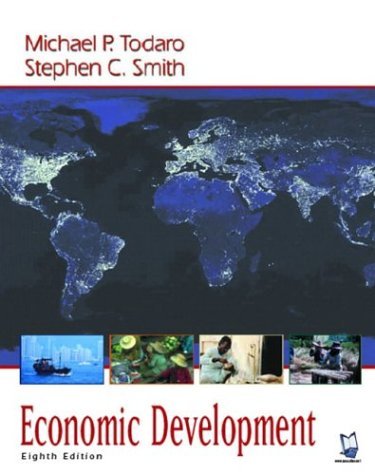
Economic Development
A complete, balanced introduction to the theory, issues, and latest research.
Economic Development–the leading textbook in this field–provides readers with a complete and balanced introduction to the requisite theory, driving policy issues, and latest research. Todaro and Smith take a policy-oriented approach, presenting economic theory in the context of critical policy debates and country-specific case studies so readers see how theory relates to the problems and prospects of developing countries.
The eleventh edition offers new sections on the global financial crisis and violent conflict.
Economic Development–the leading textbook in this field–provides readers with a complete and balanced introduction to the requisite theory, driving policy issues, and latest research. Todaro and Smith take a policy-oriented approach, presenting economic theory in the context of critical policy debates and country-specific case studies so readers see how theory relates to the problems and prospects of developing countries.
The eleventh edition offers new sections on the global financial crisis and violent conflict.
Hardcover
First published March 14, 1977
Ratings & Reviews
Friends & Following
Create a free account to discover what your friends think of this book!
Community Reviews
Displaying 1 - 30 of 43 reviews

March 5, 2008
this book made me cry as an undergrad. yes it did, and on multiple occasions. consequently, i decided i was an english major, and now i am an english phd student. so in other words, if i never obtain legitimate employment, it will be todaro and smith's fault.

December 5, 2016
The most unnecessarily verbose text on economics I have yet encountered, this book could easily have been reduced to one third or one fourth of its length. The author attempts to explain mathematical concepts without any mathematical terms and often ends up dragging on for several pages without coming to any semblance succinct conclusion.
Additionally, Todaro often fails to properly argue many of his points, instead "briefly summarizing" (if 7 pages could ever be considered brief) with lengthy, winded examples. One entire chapter seemed dedicated solely to tout his own slightly outdated and discredited theory he came up with 46 years ago; but then again, that chapter may have been my favorite because the theory was at least described well.
I learned very little other than no absolutes exist in developmental economics, and I am overall disappointed with this text.
Additionally, Todaro often fails to properly argue many of his points, instead "briefly summarizing" (if 7 pages could ever be considered brief) with lengthy, winded examples. One entire chapter seemed dedicated solely to tout his own slightly outdated and discredited theory he came up with 46 years ago; but then again, that chapter may have been my favorite because the theory was at least described well.
I learned very little other than no absolutes exist in developmental economics, and I am overall disappointed with this text.

September 28, 2020
I read this to prepare for a subject I was thinking of taking next semester on Development Economics. Even though it's quite long, and talks about a lot of different areas, I feel like I didn't really get much of anything out of it.
There's a bit on the recent history related to development, a bit on some economic models that relate to development, and discussion of different theories, but by and large, it's an overview of a field where people can't agree on fairly basic stuff, so, almost entirely, it's basically like:
- is democracy important for development? ¯\_(ツ)_/¯
- should the governments of developing countries be more or less involved in their economies? ¯\_(ツ)_/¯
- what's the best trade practice for a developing country? ¯\_(ツ)_/¯
and so on, and so on
So, like, while you will learn that basic health and education is probably a good idea, everything else is ¯\_(ツ)_/¯
In a way, if you want something which mentions everything, that's great! But it doesn't really facilitate understanding imo. If I could go back in time, I'd spend the 30+ hours I spent reading this book reading the work the textbook references- work by Banerjee, Duflo, Kremer, Acemoglu, and others- and get the best version of their arguments, not this -_-
There's a bit on the recent history related to development, a bit on some economic models that relate to development, and discussion of different theories, but by and large, it's an overview of a field where people can't agree on fairly basic stuff, so, almost entirely, it's basically like:
- is democracy important for development? ¯\_(ツ)_/¯
- should the governments of developing countries be more or less involved in their economies? ¯\_(ツ)_/¯
- what's the best trade practice for a developing country? ¯\_(ツ)_/¯
and so on, and so on
So, like, while you will learn that basic health and education is probably a good idea, everything else is ¯\_(ツ)_/¯
In a way, if you want something which mentions everything, that's great! But it doesn't really facilitate understanding imo. If I could go back in time, I'd spend the 30+ hours I spent reading this book reading the work the textbook references- work by Banerjee, Duflo, Kremer, Acemoglu, and others- and get the best version of their arguments, not this -_-

April 20, 2012
Rating this book is a dilemma for me. I actually liked it because it is really good at what it covers, but what it covers is seriously flawed. This is not a book about development. It is about misery and dealing with symptoms of backwardness and poverty, not its causes or the process of development. This shortcoming is most obvious in the complete lack of a discussion of industrialization - although very few countries can hope to develop without industrialization.
I'm not saying that we should close our eyes from the misery of the world. But a development economics textbook has to be about development and hope and this one is not.
Anyway, as I mentioned earlier, the book is really well-written. It is an almost encyclopaedic coverage of many issues related to backwardness and poverty. Theories, empirics and debates are well balanced.
Professors would do well to adopt Justin Lin's "New Structural Economics" instead, which is about economic development - in contrast to this book.
I'm not saying that we should close our eyes from the misery of the world. But a development economics textbook has to be about development and hope and this one is not.
Anyway, as I mentioned earlier, the book is really well-written. It is an almost encyclopaedic coverage of many issues related to backwardness and poverty. Theories, empirics and debates are well balanced.
Professors would do well to adopt Justin Lin's "New Structural Economics" instead, which is about economic development - in contrast to this book.
October 19, 2007
-Nature of aid
-nature of poverty and possible poverty policy options, plus case studies from other countries.
-Neocolony- theory of dependency
-nature of poverty and possible poverty policy options, plus case studies from other countries.
-Neocolony- theory of dependency

April 29, 2012
My all time companion, since undergrad. Excellent reference for students and academicians.

July 31, 2021
Классическая книга по проблематике "глобального Юга". Здесь есть все -- от моделирования миграции между городом и деревней типичной африканской страны до рассмотрения роли транснациональных корпораций Запада в мировой экономике. Тодаро явно не ангажирован: неоклассические подходы балансируются и нео-марксизмом (в т.ч. 'world-systems theory'), и изысканиями институциональной школы, а также complexity theory. Собственно, при прочтении данного 900-страничного опуса не будет лишним покопаться в международном праве и политической теории, ведь вся проблематика развивающегося мира проходит и по оси соревнования государственных сил в том числе.
Также, на мой взгляд, в глобальной гонке наций на первый план выходит (и не со вчерашнего дня) столкновение нарративов, некоторые из которых приобретают принципиально геополитическое значение. Тодаро об этом упоминает, может, мало и вскользь, но это и не его профиль. Это -- к политическим географам, литературным критикам и философам. Поэтому рассматривайте данную книгу лишь как один из многих столпов вашей компетенции в глобалистике.
Также, на мой взгляд, в глобальной гонке наций на первый план выходит (и не со вчерашнего дня) столкновение нарративов, некоторые из которых приобретают принципиально геополитическое значение. Тодаро об этом упоминает, может, мало и вскользь, но это и не его профиль. Это -- к политическим географам, литературным критикам и философам. Поэтому рассматривайте данную книгу лишь как один из многих столпов вашей компетенции в глобалистике.

February 12, 2019
The first piece of economics I remember actually understanding, probably because it got under my guard by being undeniably, obviously about matters of life and death, hope and justice, and what's around the corner, and how maths can help.
(Specifically Todaro's own model of urban migration.)
(Specifically Todaro's own model of urban migration.)

May 25, 2011
Refreshing if you're used to neoliberal texts. It is a bit sappy, but sweet and seems like it was written by a sane human, which cannot really be said of any other Econ textbook out there. Also, Todaro is a development Econ badass.
Read
March 26, 2011CAN TELL U AFTER READING

Read
April 13, 2013An incisive discussion on the prolems and solutions of the developing world
Read
September 30, 2014great book for all managers

November 11, 2022
the economics textbook you NEED!!!!!!!!!!!!!!!!!!!!!!

March 27, 2014
this is my class book,

Read
March 29, 2021Although this book is an important academic reference on the subject of economic development, the main problem of the book is not considering the differences in the causes of poverty and its repercussions, thus considering that all developing countries must follow one path to reach development.
the book can be considered a great encyclopedic coverage in theories of economic development, However, personal convictions are not taken from it regarding this aspect, so I do not think that it would be suitable for non-academic readers.
the book can be considered a great encyclopedic coverage in theories of economic development, However, personal convictions are not taken from it regarding this aspect, so I do not think that it would be suitable for non-academic readers.

November 5, 2017
This book took me One year! But it gives one a perspective of Development that is much required. It's not that it's sufficient but it's definitely necessary.

January 1, 2018
Best book in economic development I have read.

June 12, 2018
it addresses anything i need to understand economic development.
November 13, 2019
want to read
Currently Reading
December 13, 2019the book is one of the leading book for get information about economic fact who have learning economic situation, who want study about economy this guys must read this book for hence them knowledge
March 4, 2021
This book saved my life as an undergrad and allowed me to better apply economic development models and concepts in a modern context particularly to Africa- my area of interest. Highly recommended!
This entire review has been hidden because of spoilers.

Read
May 4, 2022Read for ECO 333K Development Economics, Spring 2022.

April 21, 2025
i read every single page so im marking it read. this made me want to bang my head against the wall but very informational.
June 4, 2026
Anything useful inside this book is buried under Todaro's ramblings, which are so unnecessary it renders the book almost unreadable.

December 26, 2009
Perhaps, readers from the developed world would find the text as sappy and melodramatic. I can't blame them. The text was originally entitled as Economic Development in the Third World, so expect a lot of heart wrenching stories!
Note to self: Main text for Development Economics course under Prof. Kiyoshi Taniguchi (currently an economist at the Asian Development Bank). Spring Term 2004, International Development Program, International University of Japan.
Note to self: Main text for Development Economics course under Prof. Kiyoshi Taniguchi (currently an economist at the Asian Development Bank). Spring Term 2004, International Development Program, International University of Japan.

March 18, 2013
I used the free e-book version of this text for one of my political science classes. I have to admit that I didn't read it all the way through. I just read the chapters assigned by the professor. It was fairly boring to be honest. If statistics and what-not is your thing, you will probably enjoy it a lot more than I did. I just couldn't get interested enough to read the entire thing on my own.

February 23, 2013
Todaro is an undisputed master on Economic Development. He has extensive experience in the field and genuine analyses are employed. His book on the subject is considered to be an authority and it is a real honor for me to have read such a good book.
December 26, 2009
Main text for Econ 191: Development Economics under Prof. Solita "Winnie" Monsod. First Semester 1997-98, UP School of Economics.

March 8, 2011
Introducción a una gran variedad de tópicos en la economía del desarrollo, MUY recomendable para los interesados en desarrollo, crecimiento y pobreza.

shelved
June 30, 2011...highlighting a policy-oriented approach to economic development studies, companion text for international development studies...
Displaying 1 - 30 of 43 reviews