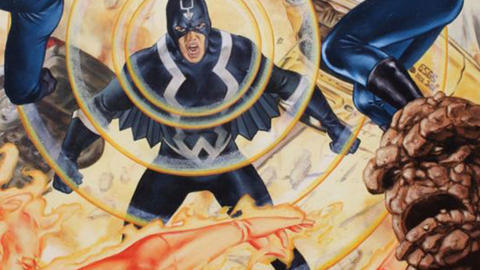
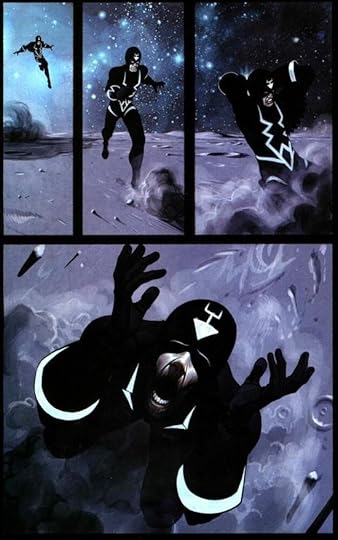
Mission: catch up on the last decade's worth of Inhumans. Reason: Inhumans are the new "mutants" of the MCU. Challenge: wade through some of the most tedious, second-rate, forgettable stories of the Marvel Universe that I've studiously avoided like a bad STD since getting back into Marvel comics. Round two: bridge between Jenkins Inhumans glacial primer and the War Of Kings event.
Here's an interesting lesson in fickle readers and creators: New Warriors kill 60 kids, leads to Civil War, echoes in Marvel for years. Gorgon leads an Inhumans terror cell that results in dozens of adult deaths, leads to War of Kings, no one talks of this ever again. What's the difference? Millar/Bendis/McNiven lead the former event; Hine/Abnett/Lanning lead the latter.
Can we hang the success on the talents of the creators? Did editorial have any influence over the staying power of such events? Are we readers to blame - did sales figures just kill an equivalent event? Or is "cosmic" just not as popular (and for reasons I could probably guess)?
I suspect there's well-documented speculation and hindsight, but either way it's fascinating that similar plots end up having vastly different impact.
Mr. Hine, could you straighten something out for me? Did Pietro steal *some* of the crystals and disturb the Terrigen chamber (as your last book said), or were they all stolen and the Terrigen chamber is bereft (as you say in this book)? It'd be awesome if you kept any of your key plot points straight. Hell, in the last book the mists could now affect human mutants (not kill them like was always true before), and a single exposure either gave them permanent powers (Pietro) or temporary (everyone else).
OTOH, the art makes some things much clearer than the writing (or the art from the last book): we see Maximus in all his insidious glory, we see actual emotion written on Black Bolt's face at a tragic betrayal, the crackle of schadenfreude all about Luna, even the cowardice of Jamie Madrox in his body language. Irving has an exaggerated style, and his faces often look like something out of a funhouse, but damned if he doesn't make this story come to life - finding the emotional tensions and turmoil that any run-up to war would bring.
Somehow the inevitability of the wars about to occur lend some extra weight to the dramatic tension for me, and I have no idea why. What is it about knowing the outcome that makes it so hard to watch heroes try to avoid it? Is it the nervousness that comes with waiting to find out how good intentions are thwarted? Do we feel terrified of the unknown quirk of fate that will cause the machinations to crumble?
Hine turns out to deliver a great premise to the War of Kings event, nearly intact. The Inhumans are broken and ready to fight, the humans and heroes are wrapped up in this mess, and we're headed to Earth. Hoo-rah?