Jump to ratings and reviews
Rate this book

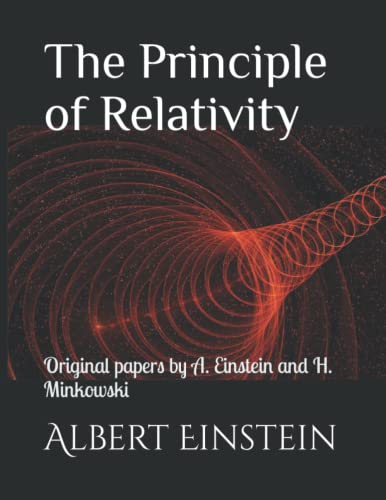
The Principle of Relativity: Original papers by A. Einstein and H. Minkowski

Rate this book
Meticulously edited for a better reading experience Created in Kindle Create Original papers by Albert Einstein and Hermann Minkowski related to The Principle of Relativity.

185 pages, Paperback

Published December 15, 2021

About the author

Albert Einstein

873 books9,644 followers
Special and general theories of relativity of German-born American theoretical physicist Albert Einstein revolutionized modern thought on the nature of space and time and formed a base for the exploitation of atomic energy; he won a Nobel Prize of 1921 for his explanation of the photoelectric effect.

His paper of 1905 formed the basis of electronics. His first paper, also published in 1905, changed the world.
He completed his Philosophiae Doctor at the University of Zurich before 1909.

Einstein, a pacifist during World War I, stayed a firm proponent of social justice and responsibility.

Einstein thought that Newtonion mechanics no longer enough reconciled the laws of classical mechanics with those of the electromagnetic field. This thought led to the development. He recognized, however, that he ably also extended the principle to gravitational fields and with his subsequent theory of gravitation in 1916 published a paper. He continued to deal with problems of statistical mechanics and quantum theory, which led to his explanations of particle theory and the motion of molecules. He also investigated the thermal properties of light, which laid the foundation of the photon.

Best known for his mass–energy equivalence formula E = mc2, dubbed "the world's most famous equation," he received "for his services to theoretical physics, and especially for his discovery of the law of the photoelectric effect". The latter was pivotal in establishing quantum theory.

He visited the United States when Adolf Hitler came to power in 1933 and went not back to Germany. On the eve of World War II, he endorsed a letter, alerting Franklin Delano Roosevelt, president, to the potential development of "extremely powerful bombs of a new type" and recommending that the United States begin similar research. This recommendation eventually led to the Manhattan project. Einstein supported defending the Allied forces but largely denounced the idea of using the newly discovered nuclear fission as a weapon. Later, with Bertrand Russell–Einstein manifesto highlighted the danger of nuclear weapons.

After the rise of the Nazi party, Einstein made Princeton his permanent home as a citizen of United States in 1940. He chaired the emergency committee of atomic scientists, which organized to alert the public to the dangers of warfare.

At a symposium, he advised:
"In their struggle for the ethical good, teachers of religion must have the stature to give up the doctrine of a personal God, that is, give up that source of fear and hope which in the past placed such vast power in the hands of priests. In their labors they will have to avail themselves of those forces which are capable of cultivating the Good, the True, and the Beautiful in humanity itself. This is, to be sure a more difficult but an incomparably more worthy task... "

("Science, Philosophy and Religion, A Symposium," published by the Conference on Science, Philosophy and Religion in their Relation to the Democratic Way of Life, Inc., New York, 1941).

In a letter to philosopher Eric Gutkind, dated 3 January 1954, Einstein stated:
"The word god is for me nothing more than the expression and product of human weaknesses, the Bible a collection of honorable, but still primitive legends which are nevertheless pretty childish. No interpretation no matter how subtle can (for me) change this."


(The Guardian, "Childish superstition: Einstein's letter makes view of religion relatively clear," by James Randerson, May 13, 2008)

Great intellectual achievements and originality made the word "Einstein" synonymous with genius.

The institute for advanced study in Princeton, New Jersey, affiliated Einstein until his death in 1955.

More: http://en.wikipedia.org/wiki/Albert_E...

http://www.nobelprize.org/nobe

Ratings & Reviews

What do you think?
Rate this book

Friends & Following

Create a free account to discover what your friends think of this book!

Community Reviews

5 stars
1 (100%)
4 stars
0 (0%)
3 stars
0 (0%)
2 stars
0 (0%)
1 star
0 (0%)
Displaying 1 of 1 review
10.6k reviews35 followers
September 29, 2024
THE BOOK CONTAINING THE FAMOUS 1905 PAPER WITH THE EQUATION, "E=mc2"

Other books that Einstein wrote or co-wrote that address relativity are 'The Meaning of Relativity,' 'Sidelights on Relativity,' 'Relativity: The Special and the General Theory,' and 'The Evolution of Physics.'

In his famous 1905 essay, "On the Electrodynamics of Moving Bodies," he notes, "The following reflexions are based on the principle of relativity and on the principle of the constancy of the velocity of light. These two principles we define as follows: 1. The laws by which the states of physical systems undergo change are not affected, whether these changes of state be referred to the one of the other of two systems of co-ordinates in uniform translatory motion." (Pg. 41)

He adds, "we cannot attach any ABSOLUTE signification to the concept of simultaneity, but that two events which, viewed from a system of co-ordinates, are simultaneous, can no longer be looked upon as simultaneous events when envisaged from a system which is in motion relatively to that system." (Pg. 42-43)

He observes, "From this ensues the following peculiar consequence. If at the points A and B of K there are stationary clocks which, viewed in the stationary system, are synchronous; and if the clock at A is moved with the velocity v along the line AB to B, then on its arrival at B the two clocks no long synchronize, but the clock moved from A to B lag behind the other which has remained at B... Thence we conclude that a balance-clock at the equator must go more slowly, by a very small amount, than a precisely similar clock situated at one of the poles under otherwise identical conditions." (Pg. 49-50)

The famed equation is followed by the statement, "Thus, when v = c, W becomes infinite. Velocities greater than that of light have---as in our previous results---no possibility of existence." (Pg. 63-64)

He defines the principle of [Special] Relativity: "The laws by which the states of physical systems alter are independent of the alternative, to which of two systems of co-ordinates, in uniform motion of parallel translation relatively to each other, these alterations of state are referred (principle of relativity)." (Pg. 69) He adds, "If a body gives off the energy L in the form of radiation, the mass diminishes... The fact that the energy withdrawn from the body becomes energy of radiation evidently makes no difference, so that we are led to the more general conclusion that: The mass of a body is a measure of its energy-content..." (Pg. 71)

In a 1916 paper, he explains, "the special theory of relativity does not depart from classical mechanics through the postulate of relativity, but through the postulate of the constancy of the velocity of light in [a vacuum], from which, in combination with the special principle of relativity, there follow, in the well-known way, the relativity of simultaneity, the Lorentzian transformation, and the related laws for the behaviour of moving bodies and clocks." (Pg. 111)

After observing that "Newtonian mechanics does not give a satisfactory answer to this question," he states, "The laws of physics must be of such a nature that they apply to systems of reference in any kind of motion. Along this road we arrive at an extension of the postulate or relativity." (Pg. 113) He adds, "in pursuing a general theory of relativity we shall be led to a theory of gravitation, since we are able to 'produce' a gravitational field merely by changing the system of co-ordinates. It will also be obvious that the principle of the constancy of the velocity of light in [vacuum] must be modified, since we easily recognize that the path of a ray of light with respect to K must in general be curvilinear, if with respect to K light is propagated in a straight line with a definite constant velocity." (Pg. 113-115)

He explains the cosmological implications of the theory: "The curvature of space is variable in time and place, according to the distribution of matter, but we may roughly approximate to it by means of a spherical space... whether, from the standpoint of present astronomical knowledge, it is tenable, will not here be discussed. In order to arrive at this consistent view, we admittedly had to introduce an extension of the field equations of gravitation which is not justified by our actual knowledge of gravitation. It is to be emphasized, however, that a positive curvature of space is given by our results, even if the supplementary term is not introduced." (Pg. 188)

For anyone seriously studying the development of modern physics, reading Einstein's actual original papers is indispensable.

Displaying 1 of 1 review

Can't find what you're looking for?

Get help and learn more about the design.