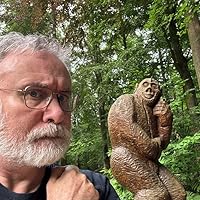
William Trevor, KBE grew up in various provincial towns and attended a number of schools, graduating from Trinity College, in Dublin, with a degree in history. He first exercised his artistry as a sculptor, working as a teacher in Northern Ireland and then emigrated to England in search of work when the school went bankrupt. He could have returned to Ireland once he became a successful writer, he said, "but by then I had become a wanderer, and one way and another, I just stayed in England ... I hated leaving Ireland. I was very bitter at the time. But, had it not happened, I think I might never have written at all."
In 1958 Trevor published his first novel, A Standard of Behaviour, to little critical success. Two years later, he abandoned sculpting completely, feeling his work had become too abstract, and found a job writing copy for a London advertising agency. 'This was absurd,' he said. 'They would give me four lines or so to write and four or five days to write it in. It was so boring. But they had given me this typewriter to work on, so I just started writing stories. I sometimes think all the people who were missing in my sculpture gushed out into the stories.' He published several short stories, then his second and third novels, which both won the Hawthornden Prize (established in 1919 by Alice Warrender and named after William Drummond of Hawthornden, the Hawthornden Prize is one of the UK's oldest literary awards). A number of other prizes followed, and Trevor began working full-time as a writer in 1965.
Since then, Trevor has published nearly 40 novels, short story collections, plays, and collections of nonfiction. He has won three Whitbread Awards, a PEN/Macmillan Silver Pen Award, and was shortlisted for the Booker Prize. In 1977 Trevor was appointed an honorary (he holds Irish, not British, citizenship) Commander of the Most Excellent Order of the British Empire (CBE) for his services to literature and in 2002 he was elevated to honorary Knight Commander of the Most Excellent Order of the British Empire (KBE). Since he began writing, William Trevor regularly spends half the year in Italy or Switzerland, often visiting Ireland in the other half. He lived in Devon, in South West England, on an old mill surrounded by 40 acres of land.
The Irish writer, William Trevor, described in the short story The Distant Past the life of two people - brother and sister. They were born and grew up in a family of Protestants when Ireland was under the United Kingdom rule.
Catholics in Ireland have fought for their autonomy from the rule of the British since the eighteenth century. Great Britain's rulers (Protestants) didn't welcome that movement. By 1949 the South of Ireland declared independence from British rule. Northern Ireland stayed as a part of the United Kingdom. The tension between Catholics and Protestants reached the highest level by 1960 when the Irish Republican Army (IRA) - an outlawed group of Catholics launched the terrorist attack on Northern Ireland.
The main characters of the story lived during that time in the South of Ireland. They remembered when British soldiers came to the town. All Catholic citizens were against British. There were rumors that their father had the relationship with Catholic woman in Dublin and he spent the major part of his fortune on her. When their father died in 1924, the children discovered that they did not inherit much.
The author used the parts of the family's name for presenting their belonging to Catholics or Protestants, he wrote:
"The Middletons of Carraveagh the family had once been known as, but now the brother and sister were just the Middletons, for Carraveagh didn't count any more, except to them."
The siblings grew up on the farm they inherited from their father. They worked hard on their farm, doing their best to survive. Their favorite pastime was to visit the city weekly and mingle with the locals drinking beer and tea. They were welcomed by society.
There was a time when the area became a very popular place for tourists, the prosperity of the city grew. People thought that the Middletons were a bit of an extravagant couple, but their attitude to them was quite positive. "The visitors who came to the town heard about the Middletons and were impressed. It was a pleasant wonder, more than one of them remarked, that old wounds could heal so completely, that the Middletons continued in their loyalty to the past and that, in spite of it, they were respected in the town."
Everything changed when the terrible news came from Northern Ireland. It was about the clash between the Irish Republican Army (IRA) and the British soldiers. Here is how the author described the change in the text:
“On Fridays, only sometimes at first, there was a silence when the Middletons appeared. ... It wasn’t something to laugh at any more, nor were certain words that the Middletons had gently spoken, nor were they themselves just an old, peculiar couple.”
The main idea of the story disclosed in the title: the origin of the people could be stronger than people expect. The last paragraph shows that they remained Carraveagh despite their ties Catholic society:
“...he said in a rushing way that they could no longer at their age hope to make a living out of the remains of Carraveagh. … Now and again, he thought, he would drive slowly into the town, to buy groceries and meat with the money they had saved, and to face the silence that would sourly thicken as their own two deaths came closer and death increased in another part of their island. She felt him thinking that and she knew that he was right. Because of the distant past they would die friendless. It was worse than being murdered in their beds.”
William Trevor grew up in Protestant family in a Catholic community. The story has a definite connotation with his experience. He drew an authentic picture of people’s attitude to some of them who have different beliefs even if they are close acquaintances. The distant past could appear in present and become a barrier which society is not able to overcome.
One of several compendia of Trevor's short stories, either from previous collections ('The Day We Got Drunk on Cake', 1967, and after) or from periodicals. Trevor curated this set, with a chosen theme of Irishness. In the introduction he explains his intention to avoid too much repetition and similarity, whilst still seeking to attain coherence.
Some of these stories were familiar to me from a later collection, as they will be to anyone who has read the original collections. It's hard to rate a hybridised reissue - so I haven't bothered - but I'd recommend it, especially to anyone who enjoys Trevor's darker or more macabre tales. It would make a good match with Ian McEwan's contemporary work of the late 1970s, especially 'The Concrete Garden' and perhaps his debut 'First Loves, Last Rites'.
http://nhw.livejournal.com/216482.html[return][return]Set of short stories by this Protestant writer from rural County Cork, mainly depressing tales about Protestants in rural County Cork (you should write about what you know, as Anne always says). Reminded me how glad I am to have moved away from Belfast. But easy reading.