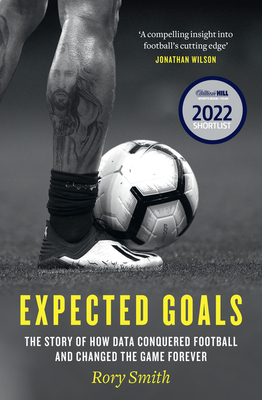
6 stars. Perhaps one of the best and most underrated books i have read on football. Implanted the 5.5 concept in my mind which i’ve passed onto the boys and its fundamentally changed their game. Here are the best Bits:
He called them his 'fantastic four. He knew that, if his team kept 16 clean sheets over the course of a 38-game season, it would not be relegated. He knew that if his team scored first. it would have a 70 per cent chance of winning a game. He knew that if his players covered more distance at a speed above 5.5 metres per second than their opponents, their chances of winning would go through the roof.
If you looked at that game, Brazil had more shots, more passes, more corners. But Germany won 7-1. It told you that those statistics were not telling the right story from the game.
Impect's approach is different. The company's foundational metric - the piece of information it is looking for from a game - is known by the slightly uncomfortable anglicism of packing. It is, at heart, a measure of how many opposition players are bypassed by any single action on the pitch.
football's in-built conservatism, its cherishing of the old ways, its reverence for tradition, the scepticism and suspicion it reserves for anything new-fangled or vaguely intellectual, or, the greatest sin of all, American.
Reep found that with every extra pass in a move, the chances of retaining the ball fell significantly. He discovered that football was a game not of possession but of turnovers, and that those turnovers were disproportionately valuable: long before Jürgen Klopp and Ralf Rangnick and even Marcelo Bielsa made it the bedrock of their playing philosophies, he could claim that the most sure-fire way of recording a shot on goal was to win the ball back in or near the opposition penalty area, and he had the data to prove it.
To understand the data, in his mind, was to understand the pattern. The same principle applied to football.
Marc Andreessen, the Silicon Valley investor and founder of Netscape - one of the dominant browsers of the early internet - has a dictum that, in his business,
"being early is the same as being wrong. The timing of technology is as vital to its success as the substance of it
football was a lucrative industry, but it was mired in inefficien-cies, held back by outdated thinking and tangled up in moribund traditions. Clubs did things because that is what they had always done, and even owners new to the game seemed to allow themselves to be shaped by that herd mentality. He wanted to do something completely different: cutting edge and untested and, to some extent, heretical.
Among the many and varied ways in Which football misinterpreted the lessons of Michael Lewis' book, and Beane's life's work, was the assumption that any club adopting a data-led approach would, inevitably, not spend significant sums of money. Why would they, when the analytics they had access to would give them the ability to sign hugely talented players for a fraction of the cost? 'Money-ball' was about exploiting inefficiencies in the market; paying premium fees was the very definition of an inefficiency.
He had long been interested in physical data: he knew, for example, that there was a correlation between how many high- intensity sprints a team made and how likely they were to win;
that the greatest challenge to the use of data in football was not - despite received wisdom running to the contrary - that the game was too fluid to be quantified, but that it was occupied by a group of traditionalists and conservatives who would see the empirical truths offered by the numbers as a threat to their power.
Since buying Brentford in 2012, and Midtjylland two years later, Benham has always been clear, though, that data is not the only tool at his teams' disposal. Ankersen, for a long time his trusted consigliere at both clubs, speaks frequently about what he calls football's 'end of history illusion, the idea that the game as we see it now. They broadcast around the world every three days in ultra high definition, is the highest and ultimate form of the game. We fall into it, he C believes, because when we review footage of old games - even this case, 'old' goes back no further than the 1990s - the players seem so much slower, so much less athletic, and the systems and formations feel so rudimentary. We look at how far we have come and we assume that there can be nowhere else to go. Ankersen, certainly, has little time for that idea. We think the players can't get thinner or fitter or run more or work harder, so this must be it' he said. 'But there are always edges? Midtjylland and Brentford see it as their task to find those edges. They might, as Ankersen said, be in terms of nutrition, or injury prevention anc recovery, or even in sleep, disciplines in which footballs interest t still young. They might be structural: it is telling, for example, that in 2016 Brentford took the unorthodox decision to scrap its academy
They realised that they lost possession from throw-ins with alarming regularity, so they hired a throw-in coach to help them improve both their technique and their strategy. "There is a lot that has been disre-garded, Ankersen said, whole areas of the game that nobody has ever really tried to improve. When we spoke, late in 2020, he even had his eye on kick-offs. Central to all of that, of course, has been data. Midtjylland - and Brentford - run on data; everything is checked and assessed and verified according to the data: the players they sign, the way they play, the decisions they make. Half-time team-talks are influenced by text messages sent to the coaching staff, detailing how the team is performing according to a prescribed series of performance indicators. In Denmark, they are now even trying to apply the same approach to one area that would seem immune to it: the psychology Of players. Midtjylland have partnered with a university to study whether there are any common characteristics among players who have succeeded at the club, to ask what sort of traits they should be searching for when recruiting.
There has, for example, been a notable demise in the popularity of the long-range shot. In the 2003/04 season, the Premier League's players took more than 5,000 shots from outside the penalty area. By 2020/21, that had collapsed to 3,333.
It seems likely that is testament to the increased awareness among teams - even those who are not quite so devoted to data as Brighton and Brentford and Liverpool - of metrics like Expected Goals; it is reasonable to assume that, five years or so since it first appeared on Match of the Day, most coaches have worked out that taking a shot from long distance is often less valuable than retaining possession and waiting for a better opportunity to present itself. But it is also possible that it has been driven by a desire to ape the style popularised by the dominant club teams of the era: Pep Guardiola's masterpieces at Barcelona, Bayern Munich and Manchester City. Their predilection to keep the ball circulating until the perfect chance arose was not - or at least not solely - because of an innate understanding of probability, but because of a deliberate philosophical choice made by their manager.
At RB Leipzig, Rangnick installed a custom-made clock at the training ground. During small-sided training games, it would be started, ticking loud enough for the players to hear. It gave them eight seconds to win the ball off their opponents, and ten seconds after that to have a shot on goal. If they failed, they had to give the ball back. The principle, for Rangnick, was simple. The greatest moment of danger for any team is in the moment when they switch from a defensive mode to an offensive one. His team, therefore, had the best chance of creating a goal-scoring opportunity if they won the ball back quickly after losing possession, and then wasted no time in moving it as close to goal as possible. He did not just believe that. He knew it, because that is what the data told him.
The clubs that parse the data best will, if the early years of the digital era have illustrated anything, make more good decisions or, at the very least, fewer bad ones. That will,
in the future, be the difference between success and failure.