Unpulped # 8: The World of Null-A by A. E. van Vogt
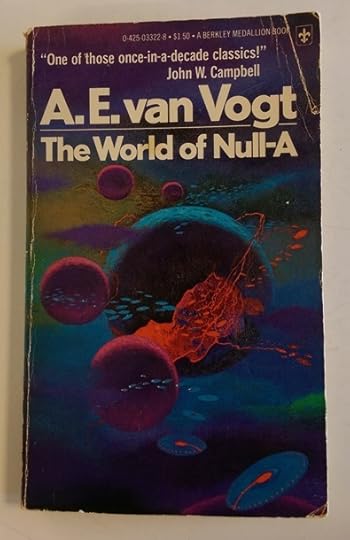
Who is Gosseyn?
So I recently finished reading A. E. van Vogt’s The World of Null-A, a story about a guy named Gosseyn who uses the ideas of General Semantics to thwart an invasion of our solar system. However, today I’m less interested in talking about the plot of the book than I am the author and his authorial practices.
Van Vogt is one of the first pulp science-fiction writers, having first published in 1939 and continuing to publish through the mid-eighties. Even though I took one of my Ph.D. exams on the history of science fiction, I’ve never read him—which means either that I was lax in my research or he just isn’t very well respected (SF critic Damon Knight would agree that he shouldn’t be respected) or he just isn’t a very good writer.
My interest in van Vogt stems from my love of Philip K. Dick, who cites van Vogt as one of his major influence. And part of that influence has to do with the way van Vogt wrote. Dick said of The World of Null-A that “All the parts of that book did not add up; all the ingredients did not make a coherency.” This lack of coherence was probably a result of van Vogt deciding to add a new concept every 800 words, which made his novels seem to spin out of control (in the same way that Dick’s books reveal layer upon layer of reality the deeper you get into them, your vision of the world you thought you were inhabiting constantly being radically adjusted).
If you haven’t figured out by now from what I’ve written above, this way of writing is fascinating to me. For myself, if I know where I’m headed in a story I’m writing, I get bored. And a secondary benefit to not boring myself is that I believe if I’m surprised by what I’ve written, then the reader’s likely to be surprised as well.
A. E. van Vogt is not a great writer. Critics lambast him for his inability to create believable characters or believable science or believable plots. However, his books are fascinating simply because of his (seeming) lack of control. The main character dies at the end of one chapter only to wake up resurrected in the next. This is a third of the way into the book, and there’s no mention before this point of this kind of death-cheat being possible. The other characters in the book (I might even say the book itself) is as confused about how such a thing could happen as the main character is.
I’d bet money van Vogt had no idea where the novel was going until he got there, chapter by chapter, new concept by new concept, because as I read the book I recognized the moves he was making. He was writing the way I write.
If you’ve signed on with me at Patreon to get a story a month, I’m assuming your down for this sort of chaos. (And if you haven’t, you can click on the link there to see whether or not such support is up your alley.)
It’s about time for a new concept.
Venus Fly Toasters.