Why Wildness Matters
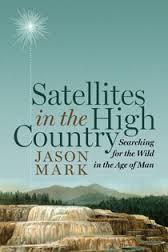 This past weekend the Wall Street Journal ran this review I wrote of Jason Mark’s “Satellites in the High Country.”
Wildness, that important but often vague word, is at the heart of
Jason Mark’s “Satellites in the High Country.” As is this question:
Have we been Googled and GPSed, Facebooked and fracked and generally over-computerized into such domesticated creatures—living in a minutely mapped world of diminished species, diminished biodiversity and diminished space—that experiencing wildness is no longer possible?
Good question, Mr. Mark. Ten years ago I followed the osprey migration
from Cape Cod to Cuba and marveled that, since I was carrying a
cellphone for the first time, I could be tracked just like the
radio-tagged birds I was chasing. As everyone knows, the changes in
the decade since have been head-spinning, but what continues to amaze
me, as a professor, is how technology and its uses change from year to
year, as if a whole new species of Homo sapiens were coming back to
school each fall.
One of the pleasures of “Satellites in the High Country” is that Mr.
Mark does not follow the usual nature writer’s path and just throw the
word “wild” out there, waving it like a flag, before carrying on with
his own happy tramps into the wilderness. His approach to decoding the
word is comprehensive, and he begins logically with etymology, laying
out all the definitions but focusing on “self-willed” and
“uncontrolled.”
“There’s simply something tougher about wild things,” he writes.
Wilderness and wildness are not synonymous, but Mr. Mark argues that
wilderness, especially big wilderness, is where wildness most often
happens. The reasons we need to continue to protect large swaths of
wilderness are many: because wilderness is where evolution occurs;
because it is where we can find an alternative to, and solace from,
our cluttered virtual lives; because it is simply moral to allow other
creatures their rights on this planet instead of carrying on like
anthropocentric bullies.
These arguments will sound familiar, but as Mr. Mark notes, the very
concept of wilderness has recently been under intellectual assault: We
are told by contemporary environmental thinkers that we have entered
the Anthropocene, the age of man. And since there really are no
pristine, untouched lands, we should move on and treat the Earth like
the human garden it is, embracing our role as gardeners and
benevolently guiding the fate of wild things.
Mr. Mark, who was the co-founder of San Francisco’s largest urban
farm, knows a thing or two about gardening, and he gives it its due.
He acknowledges that to be a gardener is a noble ambition. But he
argues that in the United States our wilderness areas, which
constitute less than 5% of our land, should be kept truly wild—that
is, “free from our intentions,” including the intentions of those
mostly benign control freaks known as conservation biologists.
This is a hard argument to make as many conservationists wrestle with
climate change, and most environmentalists prefer what Mr. Mark
rightly calls “the Pottery Barn mentality”—that is, “you broke it, you
fix it.” We need to right our environmental wrongs, the argument goes,
moving marmots north, for instance, as the their habitats warm. Mr.
Mark is hardly anti-marmot, but he makes a strong case that we need at
least some places that we keep our meddling hands off of.
You will notice that so far I have focused on the ideas in “Satellites
in the High Country,” and to my mind the ideas are the best part of
the book. I am slightly less thrilled with the more conventional,
journalistic presentation of these ideas, braided as they are into
trips to wild places like the Arctic National Wildlife Refuge, the
Black Hills, Yosemite and the Olympic Wilderness in the Pacific
Northwest. These trips are well-described and linked clearly to the
book’s intellectual lessons, but the book’s genre conventions leave it
feeling a bit, well, tame. “Satellites in the High Country” never
achieves the electric heights of Jack Turner’s “The Abstract Wild”
(1996), a work full of revolutionary verve that, in its thorny
intractability, was as self-willed and uncontrolled as its subject.
What Mr. Mark’s book does that earlier books did not is to
intelligently place the cry for wildness inside a time when the end of
nature and the rise of the virtual have been almost universally
declared. He never fails to acknowledge just what a predicament we are
in, both environmentally and intellectually. The planet is tamed and
all is known, we are told, so why not accept our fates, take our
numbers and do our best as we trudge through this unwild world?
Mr. Mark argues the opposite: that we have never needed the wild more
than we do now. “Big Data in the backcountry? No thanks. Wifi in the
woods? I think I’ll pass.” Someone could write these sentences
blithely, but he does not. He knows that it will be a nearly
impossible thing to respect the rights of other species and continue
to place lands beyond human hands, and that it will require what many
would consider the opposite of wildness: discipline. But if difficult,
it is also necessary and, Mr. Marks believes, both morally and
practically imperative. Because if we do not we will sever a lifeline
to the place we came from and to any lives beyond our own.