Sunday Mālama: Gandhi’s 7 Dangers To Human Virtue
I have seen this graphic on Pinterest and Tumblr several times:
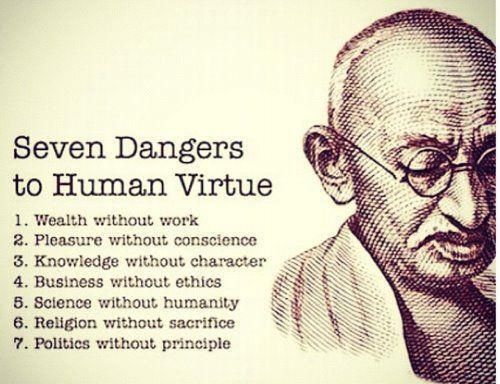
Dangers to virtue? I had to know more.
The Seven Social Sins, sometimes called the Seven Blunders of the World, is a list that Mohandas Karamchand Gandhi published in his weekly newspaper Young India on October 22, 1925. Later he gave this same list to his grandson, Arun Gandhi, written on a piece of paper on their final day together shortly before his assassination.
Another interesting tidbit on Wikipedia, is that Gandhi was editor, but not the author of the list:
Gandhi wrote that a correspondent who he called a “fair friend” had sent the list: “The… fair friend wants readers of Young India to know, if they do not already, the following seven social sins,” and the list was then provided, after which Gandhi wrote that “Naturally, the friend does not want the readers to know these things merely through the intellect but to know them through the heart so as to avoid them.” This was the entirety of Gandhi’s commentary on the list when he first published it.
Gandhi’s grandson Arun is said to have added an eighth social ill: Rights without responsibilities, which I would say is a good addition. We see things like this and think, “Interesting. Good list.” or “That’s cool.” or even, “He was right.” but to add to lists, to disagree with them, edit them or annotate them in some way is much more useful to us as learners and curators if we are to know things well — so good on Arun!
And good on others, as the decades of commentary have obviously shifted these Seven Social Sins to the Seven Blunders of the World, and in current popularity to Seven Dangers to Human Virtue, which is how it grabbed my attention. Context, constraints and connective windows… they make a big difference.
As does readiness. There’s been a delay in my own learning curation, for I pinned this a year ago with the note that, “It would be an interesting exercise to expand these thoughts with our Twelve Aloha Virtues.” Thus, post Christmastide 2014-15, here we are in a Sunday Mālama.
As is my habit, I tend to look at lists like this through 3 different lenses and filters, often mixing them together in pleasing combinations, and in contrary ones: Values, Virtues, and our 9 Key Concepts. Let’s start with a drill-down of everything above this, distilled.
Wealth without work.
Pleasure without conscience.
Knowledge without character.
Commerce without morality ~ “business without ethics” in the graphic.
Science without humanity.
Worship without sacrifice. ~ “religion without sacrifice” in the graphic.
Politics without principle.
Rights without responsibilities. ~ added by Arun Gandhi
1. Wealth without work.
At first take, wealth implies financial assets to most people. As the years have gone by, I’ve preferred to define wealth as well-being: A Sense of Place Delivers True Wealth.
That said, I absolutely agree that achieving wealth in a virtuous way, demands character-building work. There can be extraordinary strokes of luck in life (i.e. good fortune) like a slot machine pull for the megabucks jackpot, but well-being does not happen by accident (ask any lottery winner).
2. Pleasure without conscience.
I think of conscience as our moral compass: It’s the inner voice of our sense of right and wrong. As an inner voice, we achieve no wisdom in fooling ourselves and trying to gloss things over when it comes to ethical matters.
Simply said, it is indeed pleasurable to tell ourselves our truths, because we have asserted those truths with virtuous actions.
3. Knowledge without character.
Boy oh boy, this is a loaded one for me when weaving knowledge into ‘Ike loa, our value of learning, and our preoccupation with “know well.” When I bring it back to a study of virtue, I recall this distinction: Character and personality are not the same thing ~ character is who you are when nobody is looking.
4. Commerce without morality ~ business without ethics
Must say, I like both phrases, for they imply slight differences to me. Within commerce, I think of specific transactions between people (akin to buying and selling, but also in networking), whereas business is a much larger word, encompassing a plethora of complications within business strategy and modeling.
I also tend to think of morality in spirit-spilling (source and beginnings), whereas ethics is what results from deliberate choices made with our ethos… sometimes its good to just look up these words, define them well, and then sit with them, giving in to where they will take you…
ethos |ˈē θ äs|
noun
the characteristic spirit of a culture, era, or community as manifested in its beliefs and aspirations.
ORIGIN mid 19th cent.: from modern Latin, from Greek ēthos ‘nature, disposition,’ (plural) ‘customs.’
5. Science without humanity.
When I think of science and humanity together, I tend to think of our human biology, and how our very physical nature can affect our spirit. Quick link to explain: Scroll down to the subtitle, “Believe in your biology.”
6. Worship without sacrifice ~ religion without sacrifice
Again, I keep both phrases in musing about them here, mostly because I do think worship is a very good verb for religion, congruent to the way I think about it.
Since I largely discard religiousness in favor of spirituality, I take this as my direct route of reflection: What kind of sacrifices become necessary at times, so our Aloha Spirit can achieve its virtuous character? For after all, What is the Aloha Spirit? It’s you!
7. Politics without principle.
Politics, and especially partisan politics, frustrates me like crazy. Can’t speak to it internationally, but American politics and Hawai‘i’s politics on both the state and county levels, are so broken and in need of reinvention.
I vote religiously (guess I can use that word sometimes :) yet I know my Circle of Influence is so small in regard to politics, and that’s my frustration — how does a citizen enlarge their circle effectively, without being an insider and getting into the system via elected office?
8. Rights without responsibilities.
Kuleana shouts for our attention in this one, doesn’t it? Yep.
As in number 7. above, citizenship, civil engagement, and our assorted social contracts come to mind. The argument can be made there are less frustrations here, for the opportunities aren’t all systemic — there are more entry points for us, different ways we can get involved and engage should we choose to.
The villain is an attitude of entitlement, something completely contrary to the notion that virtue stems from our individual actions in earning our character.
The virtues you choose to practice are chosen by your “moral excellence” and by your courage. Character-building, and keeping our virtues free from danger, is not for the faint of heart.
Once he saw a youth blushing, and addressed him,
“Courage, my boy; that is the complexion of virtue.”
~ Laertius Diogenes

Postscript
Traditionally, Sunday Mālama has been when I will share my off-the-workplace-highway scenic route kind of posts. Not as a normal feature, but whenever they seem to be writing themselves.