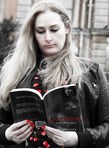
Interview with Margaret Skea
 Tell us about your publishing history…
I spent far too long hiding behind writing short stories. 3000 words was my comfort zone and while I’ve had some success with that form, having won and been placed in quite a number of competitions (for example: Neil Gunn, Winchester, Mslexia, Fish) and remain very proud of some of those stories, writing them was an excuse not to knuckle down and fulfill my primary ambition – to become a novelist. I deeply regret now not taking the advice I was given over 20 years ago by a literary editor, whom I had met as part of the prize for a short story competition for unpublished writers run by Woman and Home magazine, who told me to ‘Go home and write a novel.’ I went home and wrote more short stories…
Still, better late than never as the saying goes: my debut novel, Turn of the Tide, which was the Historical Fiction Winner in an Harper Collins / Alan Titchmarsh competition for unpublished novelists, was published by an Edinburgh publisher, Capercaillie Books, in 2012, and in May of this year – 2014 – I was awarded the Beryl Bainbridge Award for Best First Time Author. I am now almost finished the sequel, which hopefully will be out in the spring of 2015.
What do you love about being an author?
I now have a sense of fulfillment in that I feel I’m finally making proper use of the talent I’ve been blessed with, rather than just tinkering around the edges, and it’s enormously encouraging to find that readers enjoy what I write. I love the interaction with readers, both online and face-to-face, and it’s been a particular thrill (if slightly scary) to visit book groups when they are discussing my book. For practical reasons, those have all been in Scotland, but I’d love to travel far afield via Skype…
I’ve also found (a little to my surprise) that I enjoy running workshops for other writers and encouraging wannabee writers in schools – not to ‘Do as I did, but rather to do as I say and start now!’
As far as the writing is concerned, I love that I can get to 130,000 words, and that I can then be sufficiently ruthless to cut it back to c 100,000 (the publisher’s preferred length). I’ve discovered that pruning is always an improvement.
If you could have dinner with any literary character who would it be and what would you eat?
If I can only choose one it has to be Francis Crawford of Lymond (from Dorothy Dunnett’s Lymond Chronicles). But as to what to eat – I’d like him to choose for me – whatever he most enjoyed in all of his travels. I know that could take me right outside my comfort zone, but stepping outside of what you know and are comfortable with is, in part, what writing historical fiction should be.
If your book was to be made into a movie who would you cast as the leads? 
I think that Tom Ward (Silent Witness) would make a fantastic Munro, and Sean Connery a brilliant Glencairn with Ioan Gruffudd (Hornblower) as Patrick Montgomerie. I’ve never been able to come up with a preferred choice for Kate Munro – open to suggestions on that one.
If you had a time machine what era would you go back to and why?
This is one of those really tricky questions and my answer would probably change as often as British weather! At the moment I’m immersed in the late 16th century and loving it – though I’m not so sure about the lack of ‘facilities’ – the chilly experience of going to the outside toilet at the end of the yard at my grandparent’s house is one of my most vivid childhood memories. However as I survived that, I guess I would cope. The frost fairs and the fabulous clothes would definitely compensate.
What life advice do you wish you’d been given sooner?
I was given good life advice at a very young age, summarized in a verse in the New Testament – ‘Whatever you do, do it with all your might, as unto the Lord.’ As my faith, in terms of a personal relationship with Christ, is central to my life, so that verse remains the maxim by which I try (but don’t always manage) to live. And striving to be the best that you can be is, I think, great ‘life advice’ for everyone – of any faith, or none.
How do you go about researching your novels?
My aim is to be able to write about an historical period as naturally as if it was my own time and for me that means lots of research into every aspect of life in the period before I even begin to write. As far as the 16th c is concerned it’s not hard to get information on food, clothing, modes of transport, housing, money, etc. There are lots of ways to ‘eavesdrop’ on the past. One of the most important is of course contemporary sources such as letters, wills, parish records, books, pamphlets, household accounts, maps and so on. But there are other ways too that are equally important to me: including visiting locations whenever possible, and spending time in ‘living’ museums where I can, albeit to a limited extent, experience the conditions of my chosen period. I have found that the more literally I can do this, the better. For example two weeks ago I was able, for the first time, to manhandle a musket – and to get some sense of the process and physical strength required to load and fire it. I’m hoping very soon to be able to do the same with a black powder pistol, and first-hand experience of sword-fighting techniques is definitely on my ‘to do’ list! I believe good research is essential, my main problem is that it’s so endlessly fascinating that sometimes it’s hard to stop researching and start writing…
Where do you write best?
I wish I was one of those writers who can work anywhere, but I’m not. Recently, when I was struggling to write at home, a friend offered me the use of an empty cottage in the hills, part way up a dead-end road. I had a kettle, a microwave, a (small) circular garden table, a chair, fingerless gloves, a hot water bottle and a portable gas heater, so somewhat Spartan. On the plus side I had no phone, no internet and no-one other than my husband knew when or where I was (and as he can’t drive due to eyesight problems he couldn’t get there.)
It has been fabulous – the ‘block’ that I was experiencing evaporated and I found that every day as I drove to the cottage my brain went into ‘Munro’ mode, so that by the time I arrived and sat down I was ‘in the groove’. Of course there were times when I struggled, and if I’d been at home I’d have found lots of other ‘jobs’ that needed to be done, but because I couldn’t use ironing or cooking or cleaning as displacement activities and had no nearby friends to visit, I had no choice other than to keep writing. Sadly, as of this weekend the builders are moving in, so I need to de-camp, I’m just hoping that the good habits I’ve learnt in the last 2 months will continue back at home. It was certainly an eye-opener to me just how useful isolation and lack of distraction can be.
What was the last book you read and what are your thoughts on it?
This may seem a little odd, but it was actually an illustrated children’s book called Errol Come Home by Harvey Rooster. I needed 1) to have something very light and a complete change from what I was writing and 2) something simple that would help me get to grips with how my first ever e-reader worked.
I loved the illustrations and the story of a cat whose nose is put out of joint by the appearance of children in a house rings very true. However this book is written from the cat’s pov and for that reason I felt the author made a mistake in referring to the humans in the story as the ‘master’ and the ‘master’s’ family – most folk know that cats don’t have ‘masters’ – they have domestic servants! There are a couple of other minor slippages in the sense of words that didn’t seem appropriate for a cat – for example the swimming term ‘breast-stroke’, but still, it’s a charming story ideal for reading to young children.
If you didn’t write in your genre, which other would you prefer and why?
I’d love to try writing biographies of some of the characters I have ‘met’ during my research, particularly those who don’t currently have a voice – not kings and queens, but some of the ‘ordinary’ people for whom survival was a struggle but whose stories have something to say about the human spirit.
Where can fans find you online?
My novel is available on Amazon http://tiny.cc/ewzw8w (US) and http://tiny.cc/t8npow (UK) both as a paperback and as an ebook. I also have a website http://tiny.cc/ibopow including a complete short story, and a Facebook novel page https://www.facebook.com/TurnoftheTide.Novel
Filed under: Interviews with other authors Tagged: Kate Munro, unpublished writers