
Pop Quiz: Who first used the words “Wall of Separation” in talking about church and state?
Answer: Roger Williams, the dissident minister banished by the General Court of the Massachusetts Bay Colony on October 9, 1635. Williams was told to leave the colony within six weeks. If he returned, he risked execution. He eventually went on to found Rhode Island, with a written constitution guaranteeing freedom of religion, approved by Parliament in 1644.
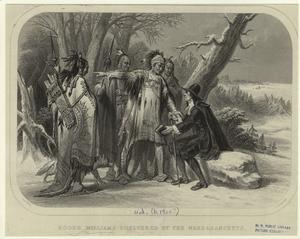
Williams died in Rhode Island in 1683. Learn more at the Roger Williams National Memorial (U.S. National Park Service).
As Williams biographer John M. Barry wrote:
Williams described the true church as a magnificent garden, unsullied and pure, resonant of Eden. The world he described as “the Wilderness,” a word with personal resonance for him. Then he used for the first time a phrase he would use again, a phrase that although not commonly attributed to him has echoed through American history. “[W]hen they have opened a gap in the hedge or wall of Separation between the Garden of the Church and the Wildernes of the world,” he warned, “God hathe ever broke down the wall it selfe, removed the Candlestick, &c. and made his Garden a Wildernesse.”
Read more: “God, Government and Roger Williams’ Big Idea” by John M. Barry in Smithsonian magazine
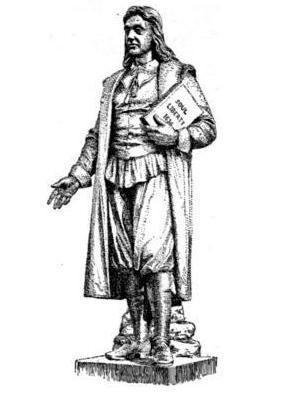
The phrase, “wall of separation between church and state” does not appear in the United States Constitution as many people think. But it was used in a famous letter written by Thomas Jefferson in 1802.
According to the Library of Congress:
This phrase has become well known because it is considered to explain (many would say, distort) the “religion clause” of the First Amendment to the Constitution: “Congress shall make no law respecting an establishment of religion …,” a clause whose meaning has been the subject of passionate dispute for the past 50 years.
Read more about Jefferson’s letter and the phrase: “A Wall of Separation” by James Hutson, a curator at the Library of Congress


