scinote:
What is it like to live and do science at a South-Pole...
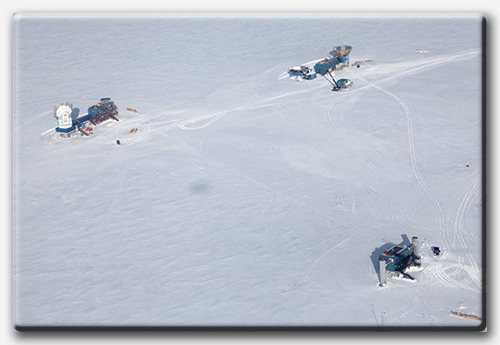
What is it like to live and do science at a South-Pole research station?
Can you imagine living in the frigid and utterly desolate environment of the South Pole for nearly 11 months? Well, we can’t either, but Jason Gallicchio, a postdoctoral researcher at the Amundsen-Scott South Pole Station, has done it.
Gallicchio, an associate fellow for the Kavli Insitute of Physics at the University of Chicago, is part of an astrophysics experiment at the South Pole Telescope. He knows all about the challenges of building and maintaining such a complex scientific instrument in one of the most unforgiving places on the planet. Gallacchio was primarily responsible for the telescope’s data acquisition and software systems, and he also occasionally assisted with some maintenance work.
You might ask why anyone would even put a telescope in such a hostile environment in the first place. It’s not an accident, I promise! Actually, placing the telescope at the South Pole minimizes the interference from the Earth’s atmosphere. One of the primary objectives of the South Pole Telescope is to precisely measure temperature variations in the cosmic microwave background, and getting such precise measurements requires the telescope to be put in a high, dry, and atmospherically stable site.
The South Pole Telescope is 10 meters across and weighs 280 tons. Researchers use this telescope to study cosmic microwave background radiation (or CMB, as it’s often affectionately called), hoping to uncover hints about the early days of our universe.
As Erik M. Leitch of the University of Chicago explains, CMB is a sort of faint glow of light that fills the universe, falling on Earth from every direction with nearly uniform intensity. It is the residual heat of creation—the afterglow of the Big Bang—streaming through space in these last 14 billion years, like the heat from a sun-warmed rock, re-radiated at night.
Click here to read more about life at the Amundsen-Scott South Pole Station.
You can learn even more about the topics discussed in this summary at the links below:
Amundsen-Scott South Pole Station
A brief introduction to the Electromagnetic spectrum
Cosmic microwave background
A day in the life of South Pole Telescope
Big Science With The South Pole Telescope
Submitted by Srikar D, Discoverer.
Edited by Jessica F.