
So I Finally Saw "The Amazing Spider-Man 2"
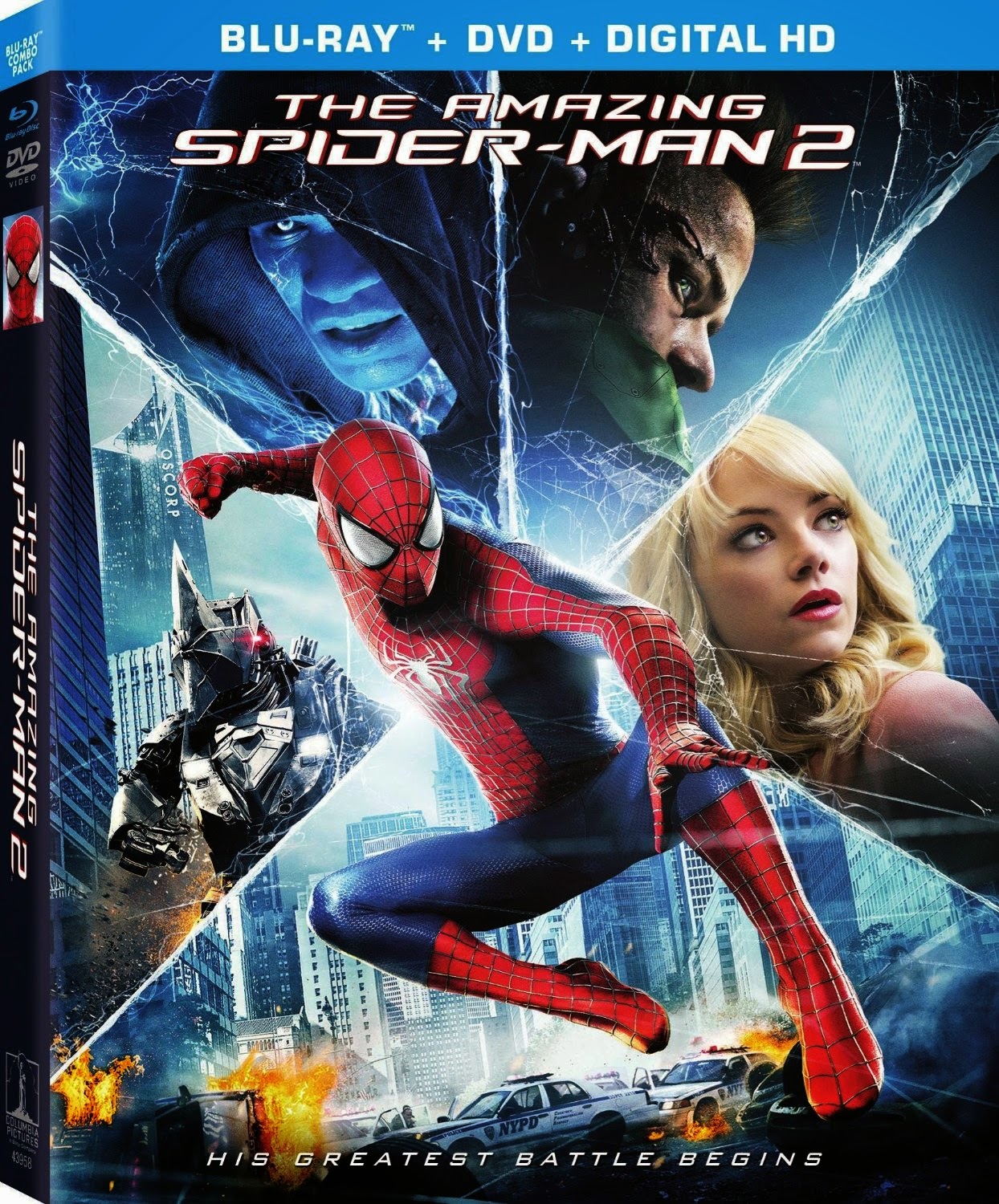
I never made it to see this in theaters, but instead chose blockbusters with higher ratings from critics. It's too bad. While I was repeatedly disappointed by those movies, this one actually exceeded my expectations. I guess that goes to show I should stop paying attention to the critics.
I agree it has it's problems, but I still had a hard time finding things not to like about this movie. A second viewing might reveal more, but for now I can number them with the fingers on one hand - mainly just a few silly plot points. Narrative and tone took a lot of hits from critics, but I found the movie very well balanced. Sure, there are several plot threads to follow, but haven't we come to expect that from this genre? Isn't it one thing we like about this genre? What's more, they develop alongside each other, so that no character arc or subplot feels too sudden or convenient. We know where it's going and just get to sit back and enjoy the ride.
Or dread it, knowing the tragic fate beforehand.
Like the first time around, Andrew Garfield and Emma Stone have perfect chemistry and are so much more fun to watch than Tobey Maguire and Kirsten Dunst. Many seem to agree on that point, but maintain that Spider-Man 2 is the superior movie (and has long been considered one of the best superhero movies ever, only finally dethroned by The Dark Knight and The Avengers). It's the only entry in that original trilogy that I can stand, and that's owing entirely to Alfred Molina's Doc Ock. I'll admit that The Amazing Spider-Man 2's villains aren't quite as fun, but the "create your own villain" trope is consistent with the first movie (not to mention superhero movies in general). Jamie Foxx's Electro, despite being very reminiscent of the Riddler in Batman Forever, works just fine. Electro was never my favorite villain, but this version at least has an underlying motive (attention starved) that makes him more responsible for his "from nobody to nightmare" development than Spider-Man. However, he also provides one of those few moments of irritation: How is he able to turn both his physical body and the leather suit he's wearing into pure electricity and back again? Is that a nod to Hydro-Man and Sandman, who can both simulate clothing?
Conversely, Dane DeHaan's Harry Osborn/Green Goblin really impressed me. Like Electro, his path through the movie is very linear and transparent, but I found myself appreciating that. This movie does a good job showing characters' relationships in single scenes, like Peter and Aunt May (I loved that she resented his obsession with his parents), Peter and Harry, and Harry and his dad. His daddy issues are more straight-up contempt than love/hate and end with the early death of Norman, replaced by self-preservation. Therein is another quibble, or maybe just misunderstanding on my part: If his genetic disease is beginning and progressing the way Norman's did, why does it start to affect him so quickly? The movie mentions several times that OsCorp was forced to terminate their human/animal hybrid projects because of Connors/the Lizard, so maybe the implication is that Harry's disease will progress faster than Norman's did owing to the lack of treatment. In any case, the way Harry represents a consolidation of the OsCorp/Peter's parents mysteries makes me like the first film more.
A theory I developed to explain the movie's critical failure is that the ending is too upsetting. On the subject of tropes, we're dealing with "women in fridges" here, who, despite being stiffed (horrible pun), are missed only by other characters and not the audience. Rachel's death in The Dark Knight is surprising, dramatic, and important to the plot, but I doubt if anyone really missed the actual character (played by two separate actresses in the franchise). Gwen Stacy's death, on the other hand, is a deeper felt loss. While even more dramatic, it is less important to the plot and even less surprising, obediently adhering to the comics - notwithstanding an initial fake-out (Spider-Man saves her successfully once, then fails the second time). There's therefore a lot of tense foreshadowing leading up to it, and even those who knew it was coming probably hoped the writers would subvert it the way they did with Mary Jane in Spider-Man.
In other words, she didn't have to die to move the story forward, like the creation of Two-Face in TDK. But we see (and hear!) her die, with no getting around the fact, confirming the movie's status as a tragedy. I imagine that was bittersweet for Spidey fans, and I personally wish there were some way to resurrect her as Spider-Woman, given Gwen will fill that role in the upcoming alternate Spider-Verse. Still, I feel the denouement, bookended with the beginning, is the perfect conclusion to the theme of letting go and moving on. Given Captain Stacy's death in the first film, I think it's a fair argument that killing Gwen this soon after, or at all, was too much...though again, the return of Spider-Man in the end, in spite of all this loss and guilt that keeps piling on, makes for an inspiring finish. And so I'd argue that she's not a fridged character at all, except in the most basic sense (a love interest who dies). It's her life and not her death that motivates Peter to keep going in the end, and that's after two movies full of strong, voluntary assertions of her independence and capability.
I've made a lot of comparisons with Batman movies, but I haven't mentioned the only one that occurred to me while actually watching this, which was The Dark Knight Rises. Basically, I kept thinking how The Amazing Spider-Man 2 pulled off certain ideas that the other didn't, making it, in my mind, the superior film. I'll demonstrate:
IdeaTDKRTASM2Large theatrical message on a bridgeBatman's flaming Bat-signal, I guess meant to scare the bad guys and encourage the good, makes no sense at all. How in the world did he rig it?Spider-Man spells out "I Love You" in webbing for Gwen. This serves a stronger, simpler purpose and is entirely plausible. Also, it recalls Venom's taunting of Spider-Man (over Gwen Stacy, no less) in the same way in The Spectacular Spider-Man animated series.Secret identityBat-fans like to think Gordon knows Bruce Wayne is Batman, given he's a great detective and all, and just doesn't say anything. Here, Gordon has to ask him outright, and is truly surprised. Blake does figure it out, but his explanation how makes no sense.It's implied throughout that Aunt May suspects Peter is Spider-Man and allows him his privacy. Bonus: Gwen has known since early in the first movie.Smart heroBatman - a ninja, by the way, who usually beats his enemies with strategy - loses to Bane in a straight-up fight. When he returns to Gotham for a rematch, his new plan is to...face Bane in a straight-up fight. His success this time seems almost lucky, as if the shot to Bane's mask is coincidental.When Electro fries Spider-Man's web shooter, Peter spends a lot of time trying to figure out how to prevent that happening again, and finally reaches a solution with Gwen's help.Anyone can be me!Batman calls this "the point," and although he complained in the previous movie that literal Batman copies wasn't what he meant by inspiring people, he secretly leads Blake toward becoming Batman (sans training or personal guidance). Overall it's a muddled, inconsistent message.The Spider-Kid in the ending, while literally dressed as Spider-Man, is a simpler, more successful rhetorical point in that he can't literally do what Spider-Man does, but stands up to evil anyway.Homage to the larger universeThis final installment left me unsatisfied for not taking the opportunity to give subtle nods to other Bat-villains left unexplored, like Penguin, Riddler, etc. For example, why not make the guard pushing people out onto the ice a bald guy named Victor?Rhino's brief role at beginning and end is exactly what I mean. Perfect! The entire Sinister Six is set up for future installments, and the mere implication would make this movie a satisfying conclusion to the series (even though it's not).
Obviously these superhero movies, especially when too loyal to classic (outdated?) stories, tend to hit a lot of the same notes. That's the Hero's Journey for you. But that's just a formula, and while The Amazing Spider-Man 2 follows that formula, it does an admirable job making it work for its characters and universe, rather than the other way around. That some people have trouble seeing past that formula is maybe the sadder ending here.


No comments have been added yet.
Andrew Bud Adams's Blog

- Andrew Bud Adams's profile
- 4 followers
Andrew Bud Adams isn't a Goodreads Author
(yet),
but they
do have a blog,
so here are some recent posts imported from
their feed.

