Janie Taylor Debuts in Millepied's "Why Am I Not Where You Are" Etc.
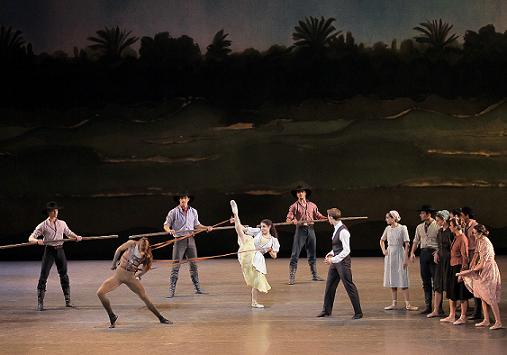
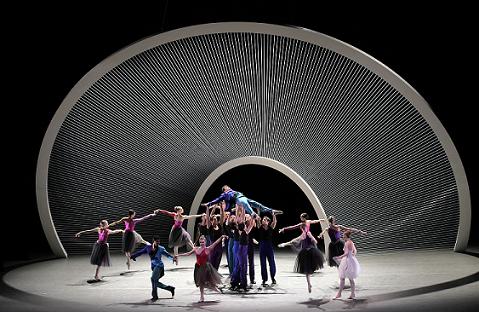 I've been remiss in my New York City Ballet posts! Last week I saw two programs: one featuring three dances to three different violin concertos – Peter Martins's Barber Violin Concerto, Robbins' Opus 19 / The Dreamer, and Balanchine's Stravinsky Violin Concerto. And the other program was another in the "See the Music" series but was also dedicated to Santiago Calatrava, who designed sets for all three of the ballets performed – Benjamin Millepied's Why Am I Not Where You Are (pictured above, photo by Paul Kolnik), Christopher Wheeldon's Estancia (pictured below, photo also by Kolnik), and Mauro Bigonzetti's Luce Nascosta, all of which premiered last season and which I wrote about here, here, and here.
 Calatrava was in the theater, and after encouragement by Peter Martins, he rose and took a bow.
Then, as with the first "See the Music" program, before the performance began, the orchestra pit rose and conductor Faycal Karoui gave a humorous little explanation of various parts of the Thierry Escaich score from Millepied's Why, the first ballet performed.
These explanations are really interesting to me, I have to say. I only took one classical music class in college and now wish I'd taken more. Karoui talked about how there were four main parts to the score: a waltz, a tango, a disco, and a final climactic part, and he talked about the differences in tempo between them, and between them and a typical waltz, tango, etc.. He also talked about how the ballet has a central male character (danced very well by Sean Suozzi – in top picture, being carried by the group of men), and how you can hear that central character's theme – or voice – throughout each section of the music. But the voice changes with each section: at first, he's shy and mysterious (and his voice in the first section is portrayed by a violin solo), then as the orchestra grows sharper and stronger in the second, tango, section, so did the character, etc.
When we got to the "disco" section (it sounded nothing like disco to me but just slightly more mechanical and percussive than the preceding sections), Karoui really began rocking out as he led the orchestra. It was like he was actually dancing in a disco, and I nearly cracked up. I'm not sure if that's what he normally does down in that pit – if he regularly starts to embody the music literally like that, or if he was just being a goof for the audience. He didn't seem to be hamming it up at that point, though – oddly – so who knows. Anyway, he is very entertaining and I find his musical explanations very educational as well. What more can you ask than to be both entertained and educated, right?
Anyway, Janie Taylor debuted in the Millepied. She was supposed to have debuted when the ballet did last season but she was out with injury and so Kathryn Morgan had filled in. Character-wise I thought she played it the same as Morgan. Except with Morgan it seemed to have a West Side Story feel to it; with Janie it was darker and more La Valse-like. Both were tragic, but in a different way; Kathryn's character seemed more innocent. Anyway, this was my second time seeing the ballet and it grew on me. It's very dramatic, not a dull moment in the whole thing, and you're really on the edge of your seat, both because of the intensity of the music – maintained throughout each section – and the dramatic story of the poor innocent guy who's drawn into another world by his enchantment by this ethereal creature, only to get trapped and ultimately destroyed, along with her.
To me, Sara Mearns and Amar Ramasar, with their bravura roles, largely stole the show – I think I remember thinking the same last time. She with those crazy fast chaine turns all around stage that almost make you sickly dizzy, and he with his virtuosic leap sequence – they are kind of the sinister characters, seducing Suozzi but also the audience.
Then came Estancia, and it was my first time seeing Ana Sophia Scheller and Adrian Danchig-Waring (pictured above) in the leads. I'm not a huge fan of this ballet – well, I like the ensemble sections, particularly the dancing and taming of the "horses" – but I nearly fall asleep during the middle, romance part, where city boy wins country girl over. I think it's just the choreography in that middle section (that I found relatively bland) that slows it down – along with the music – but I liked Scheller and Danchig-Waring just as much as the first pair of leads – Tiler Peck and Tyler Angle. In fact, they seemed to fit the roles a bit more. Scheller reminded me of the main character of Agnes de Mille's Rodeo and there was something more sweetly, playfully tomboyish about her look than Peck's. And Danchig-Waring perfectly suited the city boy trying to woo her. He acted his part very well. And his movement is always very sharp. Andrew Veyette and Georgina Pazcoquin as the horses who are eventually tamed, were fabulously entertaining.
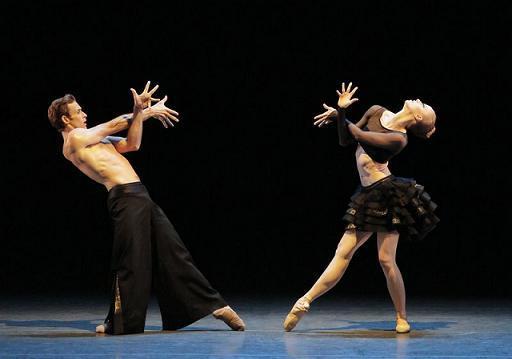 And lastly was Bigonzetti's Luce Nascosta (picture at left by Kolnik), which I've seen now three times and which I like but think is too long. I missed seeing Craig Hall in the middle section that seems to be softer and looser than the other sections, where the movement is more marked by those extreme shapes with the flexed hands, splayed fingers, and angular balances and slides on pointe. Hall seems to have the ability to move in a more undulating, kind of serpentine way than most of the others and it seems to me to suit that middle section well.
In the previous program, I loved Megan Fairchild again as the "modern" dancer in Barber Violin Concerto, and, as always, Gonzalo Garcia as "the dreamer" in Robbins' Opus 19!