
The Lady, the Unicorn, and Grendel: High Summer Read-a-Thon Wrap Up #HSReadathon
I really enjoyed participating in the High Summer Read-a-thon! Despite a busy week with work demands, I finished one book and made good progress in two others. I looked forward to the focused reading time when I was able to grab it!
I finished The Lady and the Unicorn by Tracy Chevalier, our July selection for TuesBookTalk Read-a-longs. My Goodreads review is here. Chevalier is best known for The Girl with the Pearl Earring, which offers a narrative to accompany the creation of Vermeer’s famous painting. Once again, in The Lady and the Unicorn, she teaches well the process of art-making–tapestry weaving, in this case–and engagingly imagines the lives of the people who commissioned and executed this ambitious project just at the turn of the 16th Century. The real series of six tapestries is currently housed in a dedicated room at the Musée national du Moyen Âge, formerly the Musée de Cluny. Its website gives a glimpse of some of them, but the whole set can be viewed online, something I did while reading the novel and especially after I finished it.

I’m past the halfway mark in my reading of John Gardner’s Grendel–enough to catch the tone of its surly, surreal power. It feels as archaic as the world of the Beowulf poem–probably more so, since it is told from the viewpoint of the primeval, man-crunching monster. But very much as in Mary Shelley’s Frankenstein, the monster’s sad, frustrated musings become a satire on the human world he can never really enter. In Grendel’s case, it is especially a commentary on heroic poetry and the morality of masking violence in literary grandeur–the ways such art can distort our very memory of events.

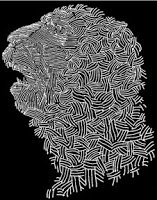
As I read, I was also struck by Emil Antonucci’s cryptic interior illustrations of the hairy Grendel’s face, which headed each chapter. In profile (below), his features were discernible, but when he was shown facing forward, the features were hidden and then gradually emerged like a visual illusion.
I became quite absorbed in Elizabeth Gilbert’s impressive novel The Signature of All Things. I decided to concentrate on it rather than splitting my time between it and Donna Tartt’s The Goldfinch, which I had just begun. I ended up reading about one third of Gilbert’s botanical family-saga, and so much has already happened! I will return to say more about this one when I’ve finished it.

Here is a summary of my reading for the week:
1. The Lion and the Unicorn by Tracy Chevalier (finished).
2. Grendel by John Gardner (halfway done).
3. The Signature of All Things by Elizabeth Gardner (one third done).
4. Beowulf, trans. by J. R. R. Tolkien, intro. By Christopher Tolkien (read introduction and a good start on Tolkien’s magnificent prose).
5. The Goldfinch by Donna Tartt (just a taste so far, but good).
6. Last Bus to Woodstock by Colin Dexter (didn’t get to this one, except for the Prologue).
Big thanks to Michelle, who is indeed The True Book Addict, for organizing and hosting the event at Seasons of Reading! I’ll be back next season!
Related post:
Beowulf, Grendel, and The Goldfinch: High Summer Read-a-thon #HighSummerRAT


 newest »
 Thank you, Jane! You put it well. There is always an inherent moral stance in the choices an artist must make. The moral assumptions about heroism may have changed since Beowulf, but even the Homeric epics allowed for the futility of it all.
Are you planning to read The Invention of Wings? You recently read a different book about the Grimkes, right?
Hope your summer continues well and happily. :)



> a commentary on heroic poetry and the morality of masking violence in literary grandeur–the ways such art can distort our very memory of events.
I think this is a very real and common danger. Literature, even realistic lit, cannot but transform what it depicts.
The illustration is pretty cool, actually.
Sounds like a great Read-a-thon!