
The Making of a Spy
[image error] It took years of research to create Jack, the secret agent man, in my literary thriller Patriarch Run. Four years and too many books to mention here (the book covers illustrated in this post represent a fraction of the research). The original concept of the character was Billy Waugh, a legendary special forces operator and Vietnam veteran. About the only thing that stuck with the final character from Waugh’s life was Vietnam, that and Waugh’s relationship to Cambodian Colonel Um Savuth. Although Waugh did become somewhat of spook in later life, working for the CIA, I decided early that Jack wasn’t going to be tied to that agency.
After Waugh, I studied Richard Marcinko. I started to think of ways to build the Rogue Warrior into Jack’s Character. Except that Jack’s a bad ass, I can’t say much of Marcinko stuck. I kept exploring the idea of Jack being an operator in Delta Force, the Navy SEALs or the Green Berets, but in the end, I decided against all that. I decided that Jack was going to be a spook among spooks. He wasn’t going to belong to a known agency because his agency would be too black to be known.
The research into America’s special forces community provided a detailed history of America’s wars since Vietnam, including the secret wars: the wars in which Jack plays a roll. Although Jack is good at what he does, he is critical of his country’s blunders, especially the political missteps of the intelligence community. As he puts it, “creating tomorrow’s crisis with today’s intervention.”
 I spent a lot of time researching the Iranian Revolution, trying to decide what Jack’s role would be in the lead up to Operation Eagle Claw, the disastrous rescue mission that killed eight service men and left two American aircraft in the Iranian desert in 1980. In the end, I decided that Jack would be the voice of reason inside Iran. I had learned a lot about Howard Hart, the CIA station chief during the Iranian Revolution, and I decided to let Jack voice some of Hart’s concerns, concerns that fell upon deaf ears in Washington.
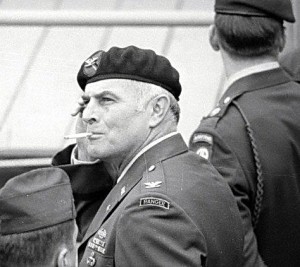 The research into Delta force and Operation Eagle Claw brought my attention to Colonel Charles Alvin “Charlie” Beckwith, who is credited for the creation of Delta Force. The Colonel, Jack’s boss in Patriarch Run, began as Beckwith then evolved into a character based loosely on the historical man.
After his mission in Iran, Jack finds himself entangled with the  Nicaraguan Contras. He deftly negotiates a recruitment meeting with Ed Wilson, a historical figure who operated as a front man for the CIA.
Jack foresees the conflict between America and Al-Qaeda during the Soviet war in Afghanistan. And he predicts the collapse of the Soviet Union, positioning himself in East Germany as the wall comes down.
By the 1990s Jack has had enough. He steps out of his secret life and pursues a relationship with Rachel. Billy is born. The family disappears into the Colorado mountains. But the Colonel finds them. Jack is called back into service right before the Battle of Mogadishu.
 By the turn of the millenium, Jack is aware of the cyber threat to national security, a topic I wrote about in a previous post. Jack finally uses this knowledge in 2010 to save, by quite controversial means, the human race.
 Excerpt from Patriarch Run
Iran, 1979
“Can you make it to the meeting?”
“Yes.”
“Do you need anything from me?”
“Yes, but it’s not related.” Jack had been mulling it over: the students, what he saw on the street. It was alarming.
“What is it?”
“This whole thing is about to go. You’ve got to tell State to get their people out of Tehran.” It wasn’t just Iran, it was the whole region. Jack had been to the Hindu Kush, and he didn’t like what he saw in the mountains of Afghanistan and Pakistan either.
“It’ll be OK.”
“For who? The Ayatollah Khomeini? These kids, I’ve seen the fervor in their eyes.”
“Jihad.”
“Yes. And Washington doesn’t have a clue as to what the hell that is.”
There was only one play in the American foreign policy playbook. Find a strong man to oppose the communists. Stand him up. And close your eyes to the consequences. That strategy was unraveling in Tehran.
“I got word from the CIA’s Iran branch chief. He assured me that the situation would only get explosive if the Shah was let into the United States.”
“And that comforts you? Which assumption are you making: that Kissinger is not that stupid or that he doesn’t have that type of influence with the president?”
“Point taken.”
“Can you name one prediction the CIA has gotten right in the last thirty years? Their only claim to fame was the installation of the Shah, himself, which, I don’t have to remind you, was the antecedent to the goat-fuck we’re in now.”
“They got Howard Hart in there as station chief, don’t they? He’s a good man.”
“Yes, he is. He told me headquarters buried his report.”
“What else did he tell you?”
“That Tehran is going to explode. That a group of the ayatollah’s thugs almost executed him in January. He shot his way out of a second attack early this morning.”
The incompetence in Washington was staggering. American intelligence could launch satellites. It could use them to count tanks on the ground, but for all its apparatus, for all its money, it could not collect any meaningful information about its enemies.
The curtain had already been dropped in Iran. Jack was looking ahead to the stage of Afghanistan, where he saw a fresh set of performers acting out the same play.
Because America did not understand its enemy’s intentions, because it did not understand the vanity and the avarice of the Politburo, the script was certain to play itself out around the world. It was simple. The solution was so simple. But nobody in Washington wanted to grasp the fact that the Soviet system of government was beyond corrupt: the Kremlin was determined to defeat itself.
“I’ll pass the word to Vance, but don’t hold your breath.”
“At least, we’ll know we tried.”
“Once you finish your business,” the Colonel ordered, “get out.”
***
Jack was on foot in the Nazi Abad district of Tehran. He had two hours. The meeting he said he would attend was located across town in the affluent Elahieh district. Peng Chuanzeng, a Chinese nuclear physicist, would be linking up with an agent working for the Libyan intelligence service in a restaurant on Fereshteh Street at noon. Jack’s business was to guarantee that there would be no exchange of nuclear secrets.
What made the operation unique was that the Chinese were feeding him the intelligence. No government on Earth was willing to help Muammar Gaddafi build a nuclear weapon. He had tried them all.
Moreover, Peng Chuanzeng was a scourge to the Chinese Academy of Sciences. Not only did he peddle in unauthorized nuclear secrets: he sidelined in human traffic. Since the revolution, the market in Iran paid a premium for young boys. Jack was presented with photographs of the rogue physicist in Dhaka, where he spent the weekend. Accompanying Chuanzeng on the flight to Tehran was a a nine-year-old, Bangladeshi boy.
The restaurant on Fereshteh Street was about fourteen miles to the north. To make the meeting on time Jack needed transportation, something that could also get him to the boat waiting in the Persian Gulf, six hundred miles away.
Jack was confident that a solution would present itself.
***
The way north was blocked by a crowd in the street. Although the assembly was listening intently, Jack, at the back of the crowd, could neither see nor hear the orator. He stepped into the throng.
What he saw in the eyes of the men around him was the same thing he saw in the eyes of the mujahideen fighting the communists in the mountains. Left to itself, the religious contagion wasn’t dangerous. But if provoked…
That is what frightened him.
Not only was Washington oblivious to the threat, its national security bias was bent toward provocation. Compared to the conviction of these college students, other security concerns were myopic. They were misguided.
Jack checked the time. He had a half hour. He was sorry he couldn’t stay.
A man on a motorcycle was looking for a way through the crowd. He gave up and began to turn the bike around…until he became interested in what was happening and cut the engine.
“How much will you take for the motorcycle?”
“Excuse me?”
“How much will you take?”
“I don’t know what it’s worth. Besides it’s not for sale.”
Jack pulled a roll of US currency from his jacket.
“What’s this?”
“Hold out your hand.”
The man wrinkled his nose.
“Like this,” Jack took the man’s wrist, pulled it between them and started stacking hundred dollar bills in his palm.
The Iranian’s mouth opened. He muttered something unintelligible.
Jack kept counting bills into his hand.
The man looked around to see if anybody was watching.
Jack counted out eleven hundred dollars.
“OK, that’s enough.”
Jack studied him for several seconds, assessing his astuteness, “Tell them it was stolen.”
***
Jack started the bike before the target got out of the taxi. From where the taxi was parked, the target would have about thirty yards of sidewalk to cover before he could reach the door to the restaurant.
Jack approached from behind. He rode up onto the sidewalk. To avoid being hit, a man pressed himself against the facade of a building. Another leapt into the street.
When he heard the shouts from the frightened pedestrians behind him, the target spun around.
Jack swung the bike sideways and skidded to a stop.
“Who are you?” Peng Chuanzeng asked in Persian.
Jack looked him in the eye and did not answer.
“Who are you?” This time he asked in English.
Jack thumbed off the safety as he drew the M1911A1 pistol from a shoulder holster. It was the same pistol he modified and fought with nine years earlier in Vietnam.
Chuanzeng saw the .45 caliber muzzle and turned his head. It’s what they all did. There had only been two targets who did not flinch at their own execution. One of them was a woman.
His voice cracked, “Please.”
“You don’t strike me,” Jack was unhurried in his delivery, “as a man who, when given the opportunity, has shown mercy.”
Chuanzeng’s eyes were squeezed tight. Despite all his mathematical training, his profound understanding of momentum, the physicist lifted both hands and pressed them together in order to shield his head, as if a few inches of flesh and bone could deter the speeding mass of the bullet.
Jack wasn’t thinking about nuclear secrets. He wasn’t thinking about safeguarding democracy. He was thinking about a nine-year old boy.
The voice was high pitched and barely audible, “Please don’t.” The urine spread down the physicist’s slacks, over his shoes and onto the pavement.
Jack had time to see the hole bored through the palms before the target crumpled to the pavement.
***
When Jack turned to the sound of screeching tires and saw the muzzle flashes, he was able to locate the revolver extended from the vehicle’s open window, but not the shooter, nor the vehicle that transported the threat.
Jack’s visual world narrowed even further until it was composed of only two items–both of which he saw in high definition. The first was the front sight of his own weapon: he could see the horizontal serrations milled into the blued steel. The other item he was aware of was the muzzle of the revolver. It couldn’t have been more than a .38, but the black muzzle seemed huge and occupied his entire visual field.
A gun fight had a way of distorting reality. Time didn’t unfold in its regular procession. Moreover, the physical world often became other than what it, moments ago, was.
Jack could not hear the reports, neither his weapon nor his enemy’s. But he could hear the screaming of the civilians around him. He could hear his ejected brass tinkling against the windshield of the parked car on the street. The front sight of his weapon kept returning to his enemy’s muzzle, and he kept resetting then pulling the trigger.
Jack ejected the empty magazine, pushed a new magazine home and released the slide without consciously thinking about the action of his hands.
Then he finally saw the sedan, and the Libyan driving it, just as it crashed head-on into the oncoming truck.




![[image error]](http://www.benjamindancer.com/Blog/wp-content/uploads/2014/06/File-Charles_Beckwith.jpg)