Good Friday
This is the text of the talk I gave in church on Easter Sunday, 2014. Well, most of it - I ad-libbed quite a lot. I'm posting it here following several requests for it. (And apologies to Hazel for the picture!)
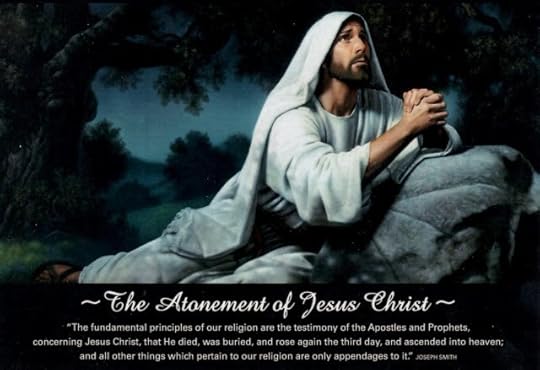
Elder Richard G. Scott said "There is an imperative need for each of us to strengthen our understanding of the significance of the Atonement of Jesus Christ so that it will become an unshakable foundation upon which to build our lives." Accordingly, I’ve been looking at what the scriptures, the prophets and other church leaders have to say about what the atonement means.
The Atonement was wrought on Good Friday. I always used to think that it was odd that it was called Good Friday, since what happened that day was far from good. After all, in the course of just a little over a day Jesus was betrayed by his close friend Judas, denied by his best friend Peter, tried in a mockery of justice, savagely whipped and beaten, taunted and ridiculed, and finally executed in the most degrading and painful way possible. What could possibly be good about that? Jesus was the only perfect man who ever lived, the great exemplar, teacher and healer, loving and understanding. I love him, and it hurts me to even think about what happened to him. How could it possibly be called good?
Some sources (well, Wikipedia) tell me that good used to be synonymous with holy. (Shouldn't it be still?) But I don't think that's the only reason we refer to Good Friday. As I speak, I'd like you to bear in mind that the word gospel means good news. Is that something else we call good that isn't really?
Stephen E. Robinson talks in his wonderful book, Believing Christ, about how his wife came to understand the atonement. “Janet had a particularly exciting year that year. Besides being Relief Society President, she graduated from college for the second time, passed the CPA exam and took a job with a local firm, and she gave birth to our fourth child. One day the lights just went out. It was as though Janet had died to spiritual things; she had burned out. She became very passive in her attitude towards the church.
"Finally after almost two weeks I made her mad with my nagging and she said, 'All right. Do you want to know what’s wrong? I’ll tell you what’s wrong. I can’t do it anymore. My load is just too heavy. I can’t get up at 5.30 and bake bread, and sew clothes, and help the kids with their homework, and make their lunches, and do the housework, and do my Relief Society stuff, and have scripture study, and do my genealogy, and get our year’s supply organised, and do to my stake meetings, and write to the missionaries…' She just started naming, one after the other, all the things she couldn’t do, or couldn’t do perfectly—all the individual bricks that had been laid on her back in the name of perfection until they had crushed the light out of her.
"She said, 'I’ve finally admitted to myself that I’m never going to be perfect, I can’t make it to the celestial kingdom, so why should I break my back trying?'"
Do you sympathise with Sister Robinson? I know I do. A great deal is expected of us in this church. There is always somewhere we should be and something we should be doing, or someone we should be helping, or a calling we should be magnifying. And even discounting all the things we’re supposed to do, there are all the things we’re supposed to be. Loving, generous, happy, sober, healthy, chaste, worthy; standards far higher than those most of the rest of the world aspires to. It’s a wonder more of us don’t burn out. It’s especially a wonder that more converts don’t give up shortly after baptism, overwhelmed at all that is suddenly required of them.
But Brother Robinson goes on to say, “Finally it occurred to me what the problem was. Janet did not completely understand the core of the gospel—the atonement of Christ. She knew the demands, but not the good news. After all the meetings and lessons, after all the talks and testimonies and family home evenings, somehow the heart of the gospel had escaped her. She knew and believed everything except the most important part. You see, Janet was trying to save herself. She was trying to do it all with Jesus Christ as merely an advisor."
Jesus is not just an advisor, our exemplar, our friend, our brother or our Lord. He is our saviour. (In this church we refer to him as “The Saviour” a lot – more than we use his name, I think. In fact, during my anti-Mormon days, one of the criticisms I heard levelled at the church was that someone could go to a whole three-hour meeting block and not once hear the name of Jesus Christ. From my standpoint today I would like to ask first where that person was during the six opening and closing prayers and two sacrament prayers offered in his name, and second, how often that person heard “the saviour” referred to reverently and lovingly.)
Brother Robinson noted that “Janet was trying to save herself.” But we cannot save ourselves. We can never keep all of the commandments, do all the things we are supposed to do, be all the things that we are supposed to be. It just isn’t possible, however hard we try. If the gospel means that we have to do all these things, live up to all these standards and expectations, in order to get into the celestial kingdom, then it's not good news at all. In fact, it's pretty rubbish news, because no one can do it. And Good Friday was actually Fairly Pointless and Rubbish Friday because Jesus died for absolutely no reason at all.
We can’t refer to Jesus as “the saviour” if we don’t understand that he has saved us. If we are trying to save ourselves though our works, then we make a mockery of what he did on that Good Friday, and we deny the atonement.
Let’s look at a couple of scriptures. In Matthew 5:28 Jesus tells us to “Be ye therefore perfect, even as your Father which is in heaven is perfect.” That’s a tall order, and I think most of us take it seriously and are doing our best to live up to it, despite the burden. We have covenanted to follow Christ and keep his commandments to show our love for him, and we are obligated to do our very best. But as Sister Janet Robinson recognised, perfection really isn’t an attainable goal.
Or is it? There is a way be can be perfect, and the answer is in Moroni 10:32. It says, “Come unto Christ, and be perfected in him.” Through Christ, we can be made perfect. He can and does make up that difference between all we are supposed to be, and what we really are. In 2 Nephi 25:23 we read that “we know that it is by grace that we are saved, after all we can do.” In other words, after all that we can do, or maybe despite our best efforts to do good and live righteously, it is by grace that we are saved. Jesus Christ makes us perfect. He makes up the difference, and he makes all the difference. And that's the good news.
But what if we haven’t done our best? What if we haven’t even tried? Or what if we have made particularly grievous errors and committed sins which we can hardly bear even to think about, knowing how much we have hurt our father in heaven and shamed ourselves?
I read an interesting scripture the other day. It’s in Matthew 27, starting at verse 3. It reads, “Then Judas, which had betrayed him, when he saw that he was condemned, repented himself, and brought again the thirty pieces of silver to the chief priests and elders, saying ‘I have sinned.’” He had been paid thirty pieces of silver for betraying his Lord, and realising the enormity of what he had done, he tried to return it, to distance himself from his heinous crime. In the Joseph Smith translation we read what the chief priests and elders responded. They told Judas, “thy sins be upon thee.”
In other words, the repentant Judas could not put the matter right simply by recognising his guilt and returning the money. He had still committed the most terrible sin, and he couldn't turn back time and un-betray Jesus. We know what his terrible remorse drove him to do.
Some have questioned whether Judas truly repented. Maybe, just recognising that “he was condemned” – that others were angry with him, that his friends had turned on him – he was trying to save face. I don’t think so. I think his actions, his words, his despair, are the signs of someone who was truly repentant.
Although I hope none of us have sinned to the extent that Judas did, I think there are many of us here who know what it is to be truly repentant and recognise how Judas felt. However much we try to do good, to put right things we have done wrong, to make up for shortcomings in one area by working extra hard in another, we can’t do it. Our sins remain upon us.
The good news is that our sins, big and small, need not be upon us. The atonement of Jesus Christ means that we can be made perfect in him. Not just those of us who, like Sister Robinson, are doing our best but just can't quite manage it all, but those of us who haven't even got out of the starting gate when it comes to being righteous. Many of us repent regularly of small transgressions – forgetting someone’s birthday, eating too much chocolate – but those of us who have had real cause to use the power of the atonement for serious sins understand more than most, I think, what a wonderful thing it is. The knowledge that you’ve been forgiven, made clean, made perfect again, is something that brings overwhelming gratitude and joy.
In the most recent General Conference, Elder L. Tom Perry quoted Harry Emerson Fosdick who wrote: “Some Christians carry their religion on their backs. It is a packet of beliefs and practices which they must bear. At times it grows heavy and they would willingly lay it down.”
I think that’s how Sister Robinson felt, how I have felt when I have once again got out of bed at 6 a.m. to spend the next hour and a half preparing for and then teaching Seminary. I’m sure sometime we all feel the responsibilities placed up on us are heavy.
Fosdick continued, “Real Christians do not carry their religion, their religion carries them. It is not weight; it is wings.”
When we understand the atonement, when we are forgiven and filled with the joy of being saved by Jesus Christ, it lifts us. When we understand that we do not have to save ourselves, we only have to give our best, however paltry and pathetic our best may be, it frees us to experience the fullness of joy promised us.
And that’s why what happened on Good Friday was good.
I testify that Jesus Christ lives, that he is my saviour and yours, and that he can and will lift you to perfection.
Yn enw Iesu Grist, Amen.

Elder Richard G. Scott said "There is an imperative need for each of us to strengthen our understanding of the significance of the Atonement of Jesus Christ so that it will become an unshakable foundation upon which to build our lives." Accordingly, I’ve been looking at what the scriptures, the prophets and other church leaders have to say about what the atonement means.
The Atonement was wrought on Good Friday. I always used to think that it was odd that it was called Good Friday, since what happened that day was far from good. After all, in the course of just a little over a day Jesus was betrayed by his close friend Judas, denied by his best friend Peter, tried in a mockery of justice, savagely whipped and beaten, taunted and ridiculed, and finally executed in the most degrading and painful way possible. What could possibly be good about that? Jesus was the only perfect man who ever lived, the great exemplar, teacher and healer, loving and understanding. I love him, and it hurts me to even think about what happened to him. How could it possibly be called good?
Some sources (well, Wikipedia) tell me that good used to be synonymous with holy. (Shouldn't it be still?) But I don't think that's the only reason we refer to Good Friday. As I speak, I'd like you to bear in mind that the word gospel means good news. Is that something else we call good that isn't really?
Stephen E. Robinson talks in his wonderful book, Believing Christ, about how his wife came to understand the atonement. “Janet had a particularly exciting year that year. Besides being Relief Society President, she graduated from college for the second time, passed the CPA exam and took a job with a local firm, and she gave birth to our fourth child. One day the lights just went out. It was as though Janet had died to spiritual things; she had burned out. She became very passive in her attitude towards the church.
"Finally after almost two weeks I made her mad with my nagging and she said, 'All right. Do you want to know what’s wrong? I’ll tell you what’s wrong. I can’t do it anymore. My load is just too heavy. I can’t get up at 5.30 and bake bread, and sew clothes, and help the kids with their homework, and make their lunches, and do the housework, and do my Relief Society stuff, and have scripture study, and do my genealogy, and get our year’s supply organised, and do to my stake meetings, and write to the missionaries…' She just started naming, one after the other, all the things she couldn’t do, or couldn’t do perfectly—all the individual bricks that had been laid on her back in the name of perfection until they had crushed the light out of her.
"She said, 'I’ve finally admitted to myself that I’m never going to be perfect, I can’t make it to the celestial kingdom, so why should I break my back trying?'"
Do you sympathise with Sister Robinson? I know I do. A great deal is expected of us in this church. There is always somewhere we should be and something we should be doing, or someone we should be helping, or a calling we should be magnifying. And even discounting all the things we’re supposed to do, there are all the things we’re supposed to be. Loving, generous, happy, sober, healthy, chaste, worthy; standards far higher than those most of the rest of the world aspires to. It’s a wonder more of us don’t burn out. It’s especially a wonder that more converts don’t give up shortly after baptism, overwhelmed at all that is suddenly required of them.
But Brother Robinson goes on to say, “Finally it occurred to me what the problem was. Janet did not completely understand the core of the gospel—the atonement of Christ. She knew the demands, but not the good news. After all the meetings and lessons, after all the talks and testimonies and family home evenings, somehow the heart of the gospel had escaped her. She knew and believed everything except the most important part. You see, Janet was trying to save herself. She was trying to do it all with Jesus Christ as merely an advisor."
Jesus is not just an advisor, our exemplar, our friend, our brother or our Lord. He is our saviour. (In this church we refer to him as “The Saviour” a lot – more than we use his name, I think. In fact, during my anti-Mormon days, one of the criticisms I heard levelled at the church was that someone could go to a whole three-hour meeting block and not once hear the name of Jesus Christ. From my standpoint today I would like to ask first where that person was during the six opening and closing prayers and two sacrament prayers offered in his name, and second, how often that person heard “the saviour” referred to reverently and lovingly.)
Brother Robinson noted that “Janet was trying to save herself.” But we cannot save ourselves. We can never keep all of the commandments, do all the things we are supposed to do, be all the things that we are supposed to be. It just isn’t possible, however hard we try. If the gospel means that we have to do all these things, live up to all these standards and expectations, in order to get into the celestial kingdom, then it's not good news at all. In fact, it's pretty rubbish news, because no one can do it. And Good Friday was actually Fairly Pointless and Rubbish Friday because Jesus died for absolutely no reason at all.
We can’t refer to Jesus as “the saviour” if we don’t understand that he has saved us. If we are trying to save ourselves though our works, then we make a mockery of what he did on that Good Friday, and we deny the atonement.
Let’s look at a couple of scriptures. In Matthew 5:28 Jesus tells us to “Be ye therefore perfect, even as your Father which is in heaven is perfect.” That’s a tall order, and I think most of us take it seriously and are doing our best to live up to it, despite the burden. We have covenanted to follow Christ and keep his commandments to show our love for him, and we are obligated to do our very best. But as Sister Janet Robinson recognised, perfection really isn’t an attainable goal.
Or is it? There is a way be can be perfect, and the answer is in Moroni 10:32. It says, “Come unto Christ, and be perfected in him.” Through Christ, we can be made perfect. He can and does make up that difference between all we are supposed to be, and what we really are. In 2 Nephi 25:23 we read that “we know that it is by grace that we are saved, after all we can do.” In other words, after all that we can do, or maybe despite our best efforts to do good and live righteously, it is by grace that we are saved. Jesus Christ makes us perfect. He makes up the difference, and he makes all the difference. And that's the good news.
But what if we haven’t done our best? What if we haven’t even tried? Or what if we have made particularly grievous errors and committed sins which we can hardly bear even to think about, knowing how much we have hurt our father in heaven and shamed ourselves?
I read an interesting scripture the other day. It’s in Matthew 27, starting at verse 3. It reads, “Then Judas,
 which had betrayed him, when he saw that he was condemned, repented himself, and brought again the thirty pieces of silver to the chief priests and elders, saying ‘I have sinned.’” He had been paid thirty pieces of silver for betraying his Lord, and realising the enormity of what he had done, he tried to return it, to distance himself from his heinous crime. In the Joseph Smith translation we read what the chief priests and elders responded. They told Judas, “thy sins be upon thee.”
 In other words, the repentant Judas could not put the matter right simply by recognising his guilt and returning the money. He had still committed the most terrible sin, and he couldn't turn back time and un-betray Jesus. We know what his terrible remorse drove him to do.
Some have questioned whether Judas truly repented. Maybe, just recognising that “he was condemned” – that others were angry with him, that his friends had turned on him – he was trying to save face. I don’t think so. I think his actions, his words, his despair, are the signs of someone who was truly repentant.
Although I hope none of us have sinned to the extent that Judas did, I think there are many of us here who know what it is to be truly repentant and recognise how Judas felt. However much we try to do good, to put right things we have done wrong, to make up for shortcomings in one area by working extra hard in another, we can’t do it. Our sins remain upon us.
The good news is that our sins, big and small, need not be upon us. The atonement of Jesus Christ means that we can be made perfect in him. Not just those of us who, like Sister Robinson, are doing our best but just can't quite manage it all, but those of us who haven't even got out of the starting gate when it comes to being righteous. Many of us repent regularly of small transgressions – forgetting someone’s birthday, eating too much chocolate – but those of us who have had real cause to use the power of the atonement for serious sins understand more than most, I think, what a wonderful thing it is. The knowledge that you’ve been forgiven, made clean, made perfect again, is something that brings overwhelming gratitude and joy.

In the most recent General Conference, Elder L. Tom Perry quoted Harry Emerson Fosdick who wrote: “Some Christians carry their religion on their backs. It is a packet of beliefs and practices which they must bear. At times it grows heavy and they would willingly lay it down.”
I think that’s how Sister Robinson felt, how I have felt when I have once again got out of bed at 6 a.m. to spend the next hour and a half preparing for and then teaching Seminary. I’m sure sometime we all feel the responsibilities placed up on us are heavy.
Fosdick continued, “Real Christians do not carry their religion, their religion carries them. It is not weight; it is wings.”
When we understand the atonement, when we are forgiven and filled with the joy of being saved by Jesus Christ, it lifts us. When we understand that we do not have to save ourselves, we only have to give our best, however paltry and pathetic our best may be, it frees us to experience the fullness of joy promised us.
And that’s why what happened on Good Friday was good.
I testify that Jesus Christ lives, that he is my saviour and yours, and that he can and will lift you to perfection.
Yn enw Iesu Grist, Amen.


No comments have been added yet.