Myth of the Week 010
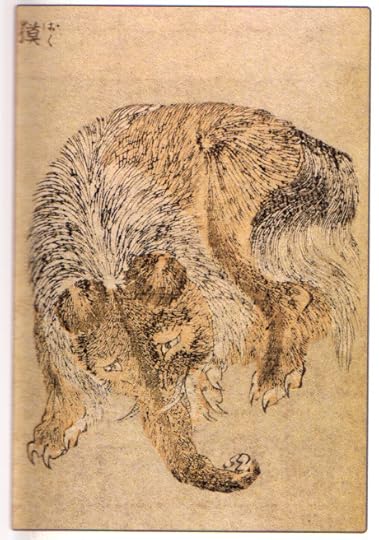
A baku as depicted by Japanese artist Katsushika Hokusai (1760-1849).
Baku are spirits who devour dreams and nightmares. They have a long history in Japanese folklore and art.
The Japanese term baku has two current meanings, referring both to the traditional dream-devouring creature and to the zoological tapir. In recent years, there have been changes in how the baku is popularly depicted.
The traditional Japanese nightmare-devouring baku actually originates from Chinese folklore, and was familiar in Japan as early as the Muromachi period (14th-15th century). An early 17th-century Japanese manuscript, the Sankai Ibutsu (山海異物), describes the baku as a shy, Chinese version of a chimera, with an elephant’s trunk, rhinoceros eyes, an oxtail, and tiger paws, all of which protected the creature against pestilence and evil.
Eating nightmares was not originally included among its list of abilities. However, in a 1791 Japanese wood-block illustration, a specifically dream-destroying baku was depicted with an elephant’s head, tusks, and trunk, with horns and tiger’s claws. The elephant’s head, trunk, and tusks are characteristic of baku portrayed in classical era Japanese wood-block prints and in shrine and temple carvings.