CHARACTER DESCRIPTIONS--FROM DAVID MAMET
Hi folks,
As some of you know, I’ve gotten into the habit of providing a literary quote of the day in Facebook. I have personal experience from my own writing life that “proves” the quote I provided today, at least for me. First, let me provide that quote:
Quote of the day: (On describing characters.)
“Bruno Bettelheim, in The Uses of Enchantment, writes that the fairy tale (and, similarly, the Drama) has the capacity to calm, to incite, to assuage, finally, to affect, because we listen to it nonjudgmentally—we identify subconsciously (non critically) with the protagonist.
“We are allowed to do this, he tells us, because the protagonist and, indeed, the situations are uncharacterized aside from their most essential elements.
When we are told, for example, that a Handsome Prince went into a wood, we realize that we are that Handsome Prince. As soon as the prince is characterized, ‘A Handsome Blond Prince with a twinkle in his eye, and just the hint of a mustache on his upper lip…’ and if we lack that color hair, twinkle, and so on, we say, ‘What an interesting prince. Of course, he is unlike anyone I know…’ and we begin to listen to the story as a criticrather than as a participant.”
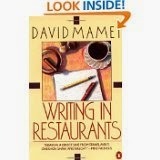
David Mamet from his book Writing in Restaurants
Years ago, in my days of cutting hair, I talked to most of my clients about my work. That was a big mistake—I later discovered that when I talked about the work, especially the current work—that I’d expended the energy of actually writing it that night when I went home and faced my computer.
But, in those days I still hadn’t learned that lesson. What was profitable from those conversations was that I learned something from my readers. Most had read my work, particularly Monday’s Meal, my first collection of short stories. We’d talk about them and I’d answer the usual questions—how did you come up with that idea? did that happen in real life? how come there are a lot of characters who have their hands or fingers cut off?
And then, one day, I noticed in our conversations, very often the person would describe one of the characters in the stories. That’s odd, I remember thinking. I couldn’t ever remember providing character descriptions. It wasn’t because of something someone had told me not to do—I’d experienced little or no writing instruction of advice in those days and wrote purely from an instinctual stance. I went back to see if I had, inadvertently, provided descriptions. I hadn’t.
So then, I began asking the person I was chatting with if he or she could describe the character in the story we were talking about. Sure, they said, almost to a person, and proceeded to deliver a very detailed, sometimes exhaustivedescription of the person. And, I began to notice that in these very complex descriptions always there would be a characteristic that belonged to the person telling me the description.
“And where,” I said, “did you get this description from?” “Why, it was in the story,” they’d say. “No, it wasn’t,” I said. I’d open a copy, turn to the story, and ask them to point out where their description came from. They’d skim through it, a puzzled look on their faces, and finally, say, “Well, I was sure I read it.” And then, we’d laugh and go on to other topics.
I think the best way to learn to write well is to read lots and lots and lots. Something I’ve done all of my life. One of the things I’d always thought boring in a novel was when the author described their characters. Especially when they overloaded the details of those descriptions. I knew that my brain switched off at those passages and I’d almost always skip those parts and go ahead. And, usually those kinds of stories were fairly boring to me. At the time, I couldn’t articulate why that was so, I just knew it was.
And, like Harry Crews (who said it first and these days it’s inaccurately attributed to Elmore Leonard, who included it in his book on writing and had taken it from Crews) I was always acutely aware of those parts I tended to skip when reading and did my utmost to not provide those parts in my own writing.
And, then, a few years ago, I happened upon David Mamet’s book, Writing in Restaurants, and when I read the quoted passage above, had one of those Eureka! Moments.
I didn’t change anything. I didn’t pay closer attention to avoiding character descriptions—that was already finely-honed in me to not do so, but it is always great when you encounter a bona fide writing “authority” that confirms what you’ve been doing is spot on the money. Kind of validates what you’re doing.
How about you? How do you feel about character descriptions? Are you like me or are you the opposite? Are you one who really enjoys the author laying out exactly what the protagonist looks like? If you are, can you say honestly, if upon encountering such a description you begin reading as a critic or remain identifying subconsciously with the protagonist? Or, does it even matter to your own personal experience?
I’d really like to know!
Blue skies,Les
And, if you haven't read Mamet's book, I highly, highly recommend it to all writers--it's an amazing book.


No comments have been added yet.