
The Ultimate Back Workout: The Best Back Exercises for a Thick, Wide Back
Although many guys focus on building the “beach muscles” (every day is Chest Day), I think a big, thick, wide back is awesome.
It doesn’t come easily though. It takes a lot of proper training to really make it stand out.
In this article, I’m going to share with you my favorite back exercises and how I like to program my back workouts. If you follow my advice, and eat properly, your back will grow in both size and strength.
So, let’s first look at the anatomy of the back so we can better understand what we’re trying to achieve with our training.
The Back Muscles We Want to Focus on Building
The four muscles that make up the bulk of the back, and that need to be well developed, are the trapezius, rhomboids, latissimus dorsi, and erector spinae. Here’s how they look:
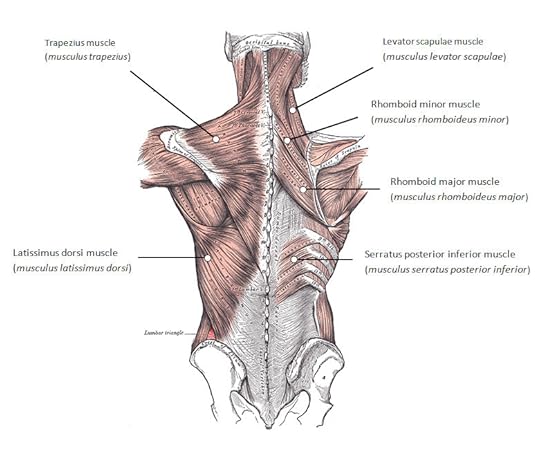
(The erector spinae aren’t shown on the above chart, but they are the lower back muscles that occupy the gray area at the bottom.)
There are a few smaller bundles of muscle that matter as well, such as the teres major and minor, and the infraspinatus. You can see them here:
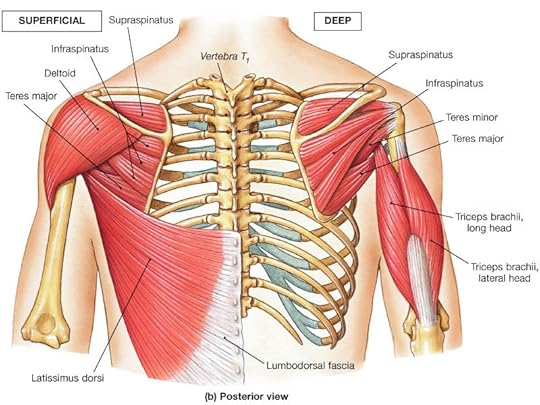
Now, here’s the goal in terms of overall back development:
Large, but not overdeveloped, traps that establish the upper back
Wide lats that extend low down the torso, creating that pleasing V-taper
Bulky rhomboids that create “valleys” when flexed
Clear development and separation in the teres muscles and infraspinatus
A thick, “Christmas tree” structure in the lower back
My back is a work in progress, but here’s what I’ve been able to achieve so far:

Unfortunately I don’t have any older “before” shots of my back (every day was Chest Day), but my back has come come very far in the last few years. The breakthrough occurred when I changed my workouts to what I’m going to share with you in this article.
So, let’s start with some basic principles of back training, and then we’ll get to the best back exercises and a sample back workout.
Back Training 101
Here are the two most common back training mistakes that I see:
Focusing on the wrong exercises (usually boiling down to focusing too much on the lats)
Focusing too much on high-rep training
The result is a weak-looking back that has a V-taper but nothing else–nothing to show for in the middle, and small erector spinae. Here’s a good example of this type of back:

Crappy looking, but I bet he can do a lot of standing lat pushdowns.
A proper back workout trains the lats, but blasts the other major muscles. And fortunately the best back exercises do both–they build depth, thickness, and width.
There’s another very important point that needs to be made regarding back training:
Like all major muscle groups in the body, the back responds best to heavy, compound weightlifting. (Click here to tweet this!)
You need to pack on quite a bit of size to develop a great back, and when you want to maximize muscle growth, you need to focus on lifting heavy free weights.
What do I mean by this, exactly?
Your workouts should be comprised mainly of sets performed in the 4 – 6 or 5 – 7 rep range (80 – 85% of your one-rep max). You’re not going to build a big, strong back by drop- and super-setting the pulldown machine.
Training volume and frequency is also important.
Like “ideal” rep ranges, optimal training frequency is a hotly debated subject. The bottom line is it boils down to workout intensity and volume.
The lighter the weights and fewer the sets, the more often you can train the muscle group. And, as a corollary, the heavier the weights and greater the sets, the less often you can train the muscle group.
I’ve tried many different splits and frequency schemes, and what I’ve found works best is in line with an extensive review on the subject conducted by researchers at Goteborg University:
When training with the proper intensity (focusing on lifting heavy weights), optimal frequency seems to be about 60 reps performed every 5 – 7 days. (Click here to tweet this!)
This not only applies to the back but to every other major muscle group as well. If you’re an advanced weightlifter (3+ years of proper training under your belt), you can probably push this up to the 70 – 80 rep range, but any more than that and you will be risking overtraining.
So, we have our marching orders for building a big, strong back:
Focus on heavy, compound weightlifting.
Perform about 60 reps every 5 – 7 days.
Let’s now move on to the best back exercises for rapid muscle growth and strength gains.
The Best Back Exercises for Muscle Growth
My list of the best back exercises is short and sweet. Here it is:
1. Deadlift
The deadlift is the core of any great back program. My back sucked in both strength and size until I started really working on my deadlift, and I’ve never looked back.
Many people are afraid of the deadlift because they think it’s inherently bad for your lower back or dangerous. This is incorrect. When performed with good form, the deadlift is actually a fantastic way to build lower back strength and prevent injury.
That said, if you have sustained a lower back injury or have a disease affecting the area, you will not want to perform deadlifts. Proper rehab can include deadlifting, but it’s done with light weights and lower workout volumes.
Here’s what proper form on a deadlift looks like:
Two Useful Variations of the Deadlift: The Sumo Deadlift and Hex Bar Deadlift
The sumo deadlift uses a wide stance (1.5-2 times the width of your shoulders) to shorten the range of motion and shearing force on the lower back. It also can feel more comfortable in the hips than a conventional deadlift, depending on your biomechanics (if you walk with your toes pointed out, the sumo may be better for you).
Here’s a good explanation of the Sumo Deadlift:
The downside of the sumo deadlift is the reduced range of motion, which results in less work done, which means less muscle development. Nevertheless, give this variation a try if you lack the flexibility to do a conventional deadlift, if it just feels very uncomfortable (certain people’s bodies are better suited to the sumo deadlift), or if it’s causing low-back pain.
The hex bar—or trap bar—deadlift is a great way to learn to deadlift, because it doesn’t require as much hip and ankle mobility to get to the bar, and it puts less shearing stress on the spine. It also allows you to lift more weight than the conventional deadlift, which may make it a more effective exercise for developing overall lower body power.
Here’s how the Hex Bar Deadlift looks:
One last thing of note is that the conventional deadlift is more effective in strengthening the erector spinae muscles and hip muscles, because the hex-bar deadlift is more like a squat due to the increased load it places on the quadriceps.
2. Barbell Row
The barbell row is a staple in my back workouts because it works everything from the erector spinae to the traps.
In terms of form, I prefer something closer to a Pendlay Row than a Yates Row. Here’s the Pendlay Row:
And here’s the Yates Row:
I prefer keeping my torso close to parallel to the ground because it allows you to work the rhomboids through a fuller range of motion than the more upright, Yates position.
And in case you’re worried about your lower back, the reality is if you’re keeping your form in, and deadlifting every week, you’ll never be rowing enough weight to cause an issue.
3. Dumbbell Row
Like the Barbell Row, the Dumbbell Row is an exercise I do regularly. It allows you to really overload your upper back, and your lats in particular. The form is very simple:
4. T-Bar Row
The T-Bar Row is another great row variation, and like the Barbell Row, it not only strengthens the erector spinae, it’s particularly useful for targeting the middle of the back. Here’s how it works:
5. Chin-Up and Wide-Grip Pullup
While many people swear by chin-ups alone, I think they should be used as a stepping stone to doing proper, wide-grip pullups, which are incredibly good for building upper back thickness.
Here’s a chin-up:
And here’s a wide-grip pullup:
Something to pay attention to is the fact that the bottom of his chin rises just above the bars. This is a full range of motion. Don’t stop halfway.
As you get stronger, you will eventually be able to add weight to your pullups using a dip belt.
6. Lat Pulldown (Wide- and Close-Grip)
The lat pulldown is simply a machine variant of the pullup, and it’s worth including in your back workouts. I like both the wide- and close-grip variants.
Here’s a video that shows proper form on both:
As you can see, the close-grip variation is performed with the V-bar attachment.
7. Seated Cable Row (Wide- and Close-Grip)
Last but not least is the Seated Cable Row, which is yet another row variant that focuses on building the upper portion of your back. Here’s how you do it:
In the video, Ronnie is doing a close-grip row using the V-bar attachment. The wide-grip variant is performed with the same type of bar as the lat pulldown, and with the same grip setup (overhand grip, hands about shoulder-width apart).
Remember–Progression is the Key to Muscle Growth
That’s it on the exercises.
The key, however, isn’t just doing the above exercises. It’s progressing on them. That is, increasing the amount of weight you can push over time.
If you don’t get stronger, you won’t get bigger. But if you do work on building your strength on these 7 exercises, and you eat enough food to grow, your back will get bigger and stronger.
The Ultimate Back Workout
While I go over everything you need to program your own workouts in Bigger Leaner Stronger (and provide you with an entire year’s worth of workouts that can, when combined with proper nutrition, help you put on 20 – 25 pounds of muscle in your first year of weightlifting), I want to leave you with a back workout that will prove the effectiveness of what I’ve discussed in this article.
What I want you to do over the next 8 weeks is perform the following back workout once every 5 – 7 days:
Deadlift: Warm up and 3 sets of 4 – 6 reps
Barbell Row: 3 sets of 4 – 6 reps
Chin-Ups or Wide-Grip Pullups: 3 sets of 4 – 6 reps (add weight if possible)
Optional (if you feel like you have some juice left): One-Arm Dumbbell Rows 3 sets of 4 – 6 reps
That’s it–just 9 – 12 heavy sets for your entire workout.
If you’re an advanced lifter, or you feel you have more in you at the end of the workout, you can do the final 3 sets, but don’t do more than that or you will likely wind up overtrained at some point.
Once you hit the top of your rep range for one set, you move up in weight. For instance, if you get on the incline bench and push out 6 reps on your first set, you add 5 pounds to each side of the bar for your next set and work with that weight until you can press it for 6 reps, and so forth.
I guarantee you that if you combine that back workout with a proper nutrition plan, you will be very happy with how your back responds.
This type of training is the core of my Bigger Leaner Stronger program, and I’ve had hundreds and hundreds of guys email me, ecstatic that they were finally breaking through 1+ year plateaus with ease, gaining strength and size every week.
What do you think of my choices for back exercises? What are your favorite back workouts? Let me know in the comments below!
How to get lean and build serious muscle and strength, faster than you ever thought possible…
Depending on how you eat, train, and rest, building muscle and losing fat can be incredibly easy or incredibly hard. Unfortunately, most people make many different mistakes that leave them stuck in a rut.
And that’s why I wrote Bigger Leaner Stronger for men, and Thinner Leaner Stronger for women: they lay out EVERYTHING you need to know about diet and training to build muscle and lose fat effectively…
Buy now
AmazonAmazon UKAmazon AUAmazon CAAudible AudiobookBNiBooksiBooks AudiobookKobo
Buy now
AmazonAmazon UKAmazon AUAmazon CAAudible AudiobookBNiBooksiBooks AudiobookKobo


