
Battle Tactics: Key Differences Between Duel and Battle
Regard your soldiers as your children, and they will follow you into the deepest valleys; look on them as your own beloved sons, and they will stand by you even unto death. – Sun Tzu
Most of the action in first two books of my Domains of the Chosen series, Bloodlust a Gladiator’s Tale and Bloodlust: Will to Power, took place in many arenas in the empire. The largest number of Gladiators to take the field on any single side during a match was ten, in an epic battle in book one. While the monster fights often involved hordes of creatures facing the Gladiators, few of them were really a close match to the supernaturally powerful and magically gifted Gladiators one on one. The action covered in the books thus far is small unit tactics and dueling, mostly; very different stuff from the massive conflicts in less structured epic fantasy.
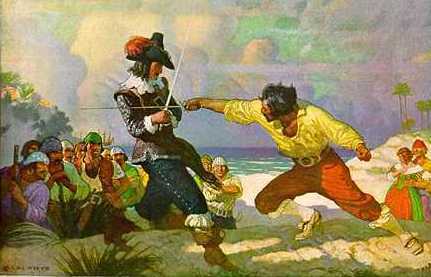
In a duel, dodge and parry are better defences.
As I begin to delve into the third book in the Domains of the Chosen series, Warbound: the Shieldmaiden’s March (working title) I am leaning more towards larger battles. I still need action pieces to spice up my writing and drive certain plot elements, but after writing around seventy-five arena matches I want to try my hand at describing High Fantasy warfare in the Domains (although I do have a few short stories in the arena, and the Great Games will still figure into the books). I suppose the juxtaposition here is that the dueling in the arena is how the Domains deal with the Gifted and internal enemies, while battle is how the expansionist, imperialistic people of the Domains often deal with outside threats. The personal struggles of the arena are very different in character than the large scale conflicts of a battle.
Here are some of the differences:
Armour: Armour is a hot topic in Fantasy, partly because female armour depictions on cover art are often highly sexualized, which dovetails into discussions about sexism and prudishness. Fantasy armour also looks cool these days, be it a plate clad knight or leather and cloak clad assassin.
Duel: In a Duel much of the advantage offered by armour is mitigated by the fact that mobility and endurance can be leveraged as defences. Moving in heavy armour requires more energy and a lightly armoured foe can dodge and stay out of the way in personal combat in a much more reliable fashion than in battle. By most accounts a duelist with a rapier was the doom of a warrior clad in plate in one on one combat, assuming equal skill.
Battle: Armour and shields become vastly more important in formation based warfare. You can’t dodge a volley of arrows, and in the press of melee it is much harder for a combatant to protect themselves from every blow. Many attacks come from unseen vectors and often it can be difficult even to parry when shoulder to shoulder with others. Add to this the idea that advanced formations allow an armoured combatant a chance to rest, In addition to weight the needs of equipping thousands of combatants makes armour less likely to be customized.
Tactics: The ability to anticipate and react to an opponent and awareness of the environment remain important in both duel and battle, however how that information is used is very different.
Duel: In a duel individual skill is king. The duelist fights in small groups where the outcome can be decided by a single well-placed sword stroke. Because of this duels are fought at a faster pace, but do not require much organization.
Battle: Battle requires coordination on a massive scale. Units have to coordinate with their team-mates and other elements in the army. One person reacting properly to an attack is very different than one thousand reacting to the same attack. Everything is more complex at that scale and even simple manoeuvres like turning abruptly require drill to function smoothly. Just imagine a phalanx of pike standing shoulder to shoulder, having to turn suddenly and brace to face a cavalry charge.
Magic: Being able to incinerate someone from the inside out is really impressive. It wins duels. In a battle putting that much effort into killing one person is rarely worth the effort. A priceless magic sword is less of an asset against ten thousand men than a unit of mercenary archers.
Duel: In Bloodlust any spell which increases the prowess of the Gladiator or does damage is a tremendous asset. Any personal advantage, no matter how expensive, is important in the duel. Magic weapons, armour, and so on are important.
Battle: Single target damage spells are less useful in battle, reserved for high value targets like commanders. Spells that effect the weather become incredibly useful: a fog can conceal a unit of archers, heavy rain can create mud which hinders an enemy cavalry charge. Mass damage spells and counterspells remain obviously useful, but must be used with precision to avoid damage to friendly forces. Even a simple communication spell can become incredibly important, giving a strategist better control over the battle as it unfolds.
Monsters (and Warbound): A unit of rabid beastmen might make for good shock troops, but their lack of discipline could backfire much more easily on the battlefield than in the arena.
Duel: Monsters make for interesting foes. Their savagery and viciousness does not need to be controlled in the arena or in combat with a heroic knight.
Battle: Using monsters or supernatural assets like the warbound in battle is an interesting prospect. A giant might make for an exceptional linebreaker (creating gaps in enemy formations) but could be vulnerable to massed projectile or cannon-fire. Monstrous steeds would offer advantages over their mundane counterparts. On the downside monsters might be difficult to control, and dangerous to friendly troops. Would you really like to fight alongside a pack of firespitting drakes that think you look tasty?
These are just some preliminary thoughts. In the end, examining the differences between Warbound (The Gifted who fight with the Legions) and Gladiators will be interesting. Also in book three we will get to see one of the Chosen on the battlefield. The key differences between battle and a duel are based on the risks that must be managed and the tactics that must be used, In a formation based battle, you cannot rely on mobility as a defence and teamwork is often far more important than individual skill at arms. A duel is less complex, but proceeds much faster. Soldiers and Gladiators are both warriors, but the way they fight is as different as the arena is from the the battlefield.
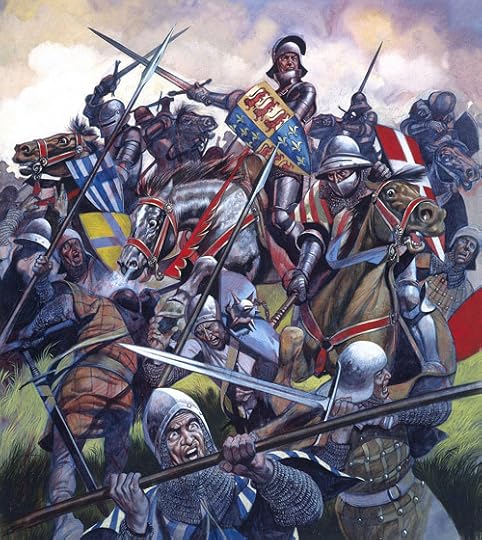
Yeah. Better wear something protective, just to be sure.


