
Samskar, Chicken Embryos, and Places of Practice

Zing-Yang Kuo
Zing-Yang Kuo was a physiological psychologist who was interested in investigating behaviors that were thought to be instinctual, or innate (his early research on this topic was in the 1920s). He studied chicken embryos, because it was believed the distinctive pecking behavior chicks show immediately upon hatching was an instinctual, innate behavior.
Zing-Yang Kuo believed that labeling a behavior as “innate” or “natural” or “instinctual” didn’t help anyone understand the behavior. He watched chicken embryos develop by coating eggs with warm vaseline, rendering the shells translucent. And here’s the thing: He discovered that as the chicks develop inside the tightly packed egg, their head rests directly over their heart, and as soon as the heart begins to beat, the thumping heart causes the chick’s head to move in exactly the same pecking motion. The chicks are practicing this pecking behavior many hundreds, probably thousands of times, before they hatch. The finding blurs the line between natural talent and practice in a very interesting way.
Zing-Yang Kuo’s research highlights the fact that context matters. Where you practice is important, and early on, you have no control over that whatsoever. Some are lucky to be born into a rich musical environment.
Indian vocalist Prasad Upasani is the creator of the fantastic iTabla Pro app (video demo), one of my essential practice technologies. When Prasad spoke with me about his own music practice, he introduced me to a term: samskar. Prasad said this word translated means “unconscious influence.” One of Prasad’s earliest memories is waking to hear his father’s early-morning singing practice. He would wander in, sit on his dad’s lap, and they would sing some of his favorite songs. This early exposure to music and music practice certainly had an impact on his developing sensibilities. Rex Martin, a tuba virtuoso who I mention frequently because his knowledge of music and practice are incredibly deep, had two older brothers who played the tuba, so he was exposed to those vibrations from conception onward. Did this have an impact on his neural wiring? I don’t know, but I suspect it might have.
Readers of this blog know that I don’t much believe in “natural” talent. To me, labeling a skill as a “talent”–in the sense that it’s a natural ability–blinds us to the reality behind that skill, much like the idea of “instinctual behavior” blinds us to the developmental realities that support any ability. Something to think about.
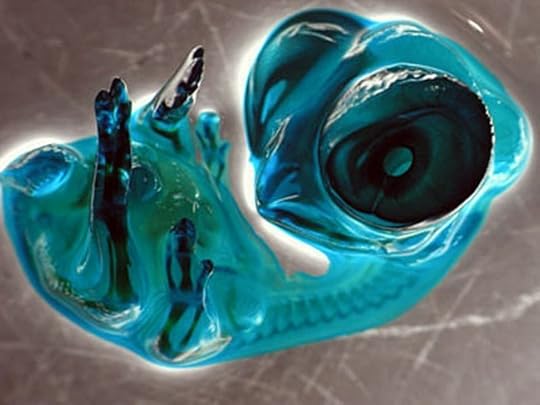
Electron microscopy of a chicken embryo, taken at Lisbon University, Portugal
Related articles
Crazy Photo of a Chicken Embryo Under Stereoscopic Microscope (americanlivewire.com)
Shark Embryos Devour Each Other in the Womb: Sibling Rivalry at its Finest (scienceworldreport.com)
Innate Compassion. How Come We All Don’t Have It? (sweetsimplesmiles.wordpress.com)


