Dialogue, Education Can End Violence, says Dalai Lama
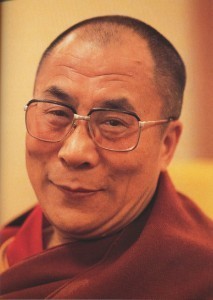 A couple of weeks ago I got to see His Holiness the Dalai Lama speak at a local college.
He wore his traditional maroon and gold robes, along with a bright purple visor from the college to shield his eyes from the harsh stage lighting. He was funny, mostly because he laughs at himself. He was humble, smart — quoted neuro-scientists and ecologists — and referred to relevant studies. For a time he even had a tutor in quantum physics, though he claimed he didn’t learn much.
He radiates warmth and kindness. I’ve heard people say that he changes the energy in the room with his presence, and he does. He is infused with positive energy and you can feel it even when you are sitting 20 rows up. When you consider what he puts into his life – the practice of mediation, the act of compassion and tolerance; when you realize how long he has studied these habits and rituals – since he was around two years old — you understand that he exudes love and compassion and tolerance because that’s what he is. It’s not an attitude. It’s what it within him, so of course that is what comes out. Even when minor mishaps showed up – he was interrupted, he fell off topic, even got tired – compassion, tolerance and humor is all that came out. Not impatience. Not frustration.
His Holiness is not a big presence in any physical way. He is small, thin, a bit frail seeming when he walks. He speaks low and quiet like we’re having a conversation. He is not a chest-thumper. But there he was this little man amid thousands of people, and when he spoke there was silence. Quiet reverence. Awe. Everyone was riveted and respectful. He was firm and clear and loving. And, he was heard.
Education and Dialogue Key to Ending Violence
The Dalai Lama said that he believes the tide of violence and hostility is shifting in the world and has been since the Vietnam War. He is hopeful and optimistic (interesting since he’s witnessed so much violence firsthand and was driven from his country at age 24 when China invaded) that there will be world peace. He said that if we commit to “modern, secular ethics” not ethics based on religious roles or personal status, but education and dialogue, that we could end world violence and make this the Century of Peace.
He was consistent with the Buddhist teaching of oneness. He reiterated that we are all sentient beings connected and reliant on each other for survival. We are not separate or different no matter where we live or what we know. He said if we commit to educating ourselves from preschool on, about the practice of affection, compassion, and dialogue, tolerance and forgiveness, that violence would end globally, except for a “few hundred mischievous people.” He said there will always be those troublemakers (my word) but out of seven billion people he could live with a couple hundred of the others.
“If we nurture the basic human needs through education [we will] develop a generation who has a more compassionate strive, said His Holiness. He called for a practice of “secular ethics,” a lifestyle built around acting out of concern for one another. A lifestyle centered on looking out for the well-being of others.
He advocated personal responsibility and education instead of prayer. He said that strength of emotion and mind rather than strength of body and artillery will help end the violence.
“A peaceful world comes from inner peace,” said His Holiness the Dalai Lama. “It is an individual initiative.”
I, like everyone else I know who has heard him speak, was touched by his energy, joy, and optimism. I left feeling hopeful and I think that’s part of his charisma. He reminds us who we are at our core: good, loving, creative people. He reminds us who we can be if we act from this place.
Sometimes we stray from it, of course. We start thinking that we are on our own. We take things personally, fight for what we need – even if it means leaving others without. We get a little judgy, and self-righteous, angry and intolerant. We become impatient. But that isn’t ever who we are. Not really. We have the same qualities the Dalai Lama radiates: compassion, love, joy. We simply need to practice those things so that they become essential in our lives once again. We need to fill up on those things, so that is all that comes out.
To develop then, the kind of secular education His Holiness talked about, we must go to that goodness within. We must enter into dialogue before we enter into war– to develop the habits and practices that will center us in compassion and gratitude and tolerance.
Inspired by the Dalai Lama, I begin my practices again with renewed commitment and vigor. On Wednesday, I’ll offer up three of my favorites so that you can begin your practice again too. Just remember, you are already a compassionate and spiritual being, all you have to do in reconnect to that inner source, rather than something external.
Image supplied by Kechara